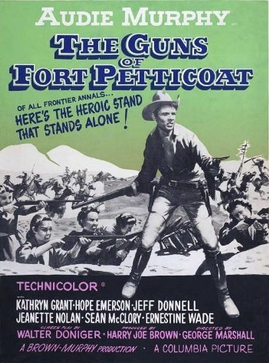
The Guns of Fort Petticoat (1957, directed by George Marshall)


During the waning days of the Civil War, Lt. Frank Hewitt (Audie Murphy) is a man without a country.  A Texan, he joined the Union Army even as his home state was voting to secede from the United States.  In the Army, Hewitt is viewed with distrust by his autocratic superior, Col. John Chivington (Ainslie Pryor).  When Hewitt learns that Chivington has ordered a surprise attack on an unarmed local Indian tribe in order to drive them into Texas where they will attack the nearest settlement for revenge, Hewitt deserts the Army to warn the people left in his hometown.

When Hewitt arrives, he discovers that all of the men in town have left to join the Confederate Army.  Only their wives, mothers, and sisters remain.  Though Hewitt is, at first, accused of being a traitor, he sticks around and trains the women on how to fight not only the incoming Comanches but also any outlaws who ride into town looking to take advantage of the situation.

The Guns of Fort Petticoat is an interesting B-western that holds up well today.  Even though the film ends with a Comanche attack, it’s made clear that the attack would not have happened if not for the actions Col. Chivington.  Chivington, who doesn’t care that the victims of his actions would not be Confederate soldiers but instead just helpless woman and children, is the film’s true villain, even if he only appears in the first and final scenes.  Audie Murphy, who was America’s most decorated World War II veteran, not only starred in but produced the movie.  Murphy was a stiff actor but he looked believable in uniform and obviously knew how to convincingly shoot a rifle and that’s all this role really demands of him.  Kathryn Grant plays the woman who goes from distrusting Hewitt to falling in love with him and she and Murphy work well together.  The final battle between the women and the Comanches is exciting and well-shot by veteran western director George Marshall.  The movie’s final scene may not be totally believable but it’s still very satisfying.

Fans of the western genre and Audie Murphy will find much to enjoy about The Guns of Fort Petticoat.

30 Days of Noir #14: Shoot to Kill (dir by William Berke)


The 1947 film, Shoot to Kill (also known as Police Reporter), opens with both a bang and a crash.

The police are chasing a car down one dark and lonely road.  When that car crashes, the police are shocked to discover who was inside of it.  Two men and one woman, all well-dressed.  The men are both dead but the woman is merely unconscious.  The police identify one of the men as being the notorious gangster, Dixie Logan (Robert Kent).  It makes sense that Logan would be fleeing the police but what about his two passengers, newly elected District Attorney Lawrence Dale (Edmund MacDonald) and Dale’s wife, Marian (Luana Walters)?

The police may not be able to get any answers but fortunately, there’s a reporter around!  Mitch Mitchell (Russell Wade) is a crime reporter and, seeing as how he knew both Lawrence and Marian, he seems like the perfect person to get some answers.  (In fact, it was Mitch who first suggested that Lawrence should hire Marian as his administrative assistant, therefore setting in motion the whirlwind romance that would end with them married.)  Mitch goes to see Marian in her hospital room and he asks her what happened.

It’s flashback time!  Yes, this is one of those films where almost the entire film is a flashback.  That, in itself, is not surprising.  Some of the best film noirs of all time were just extended flashbacks.  (D.O.A, Double Indemnity, and Sunset Boulevard, to name just a few examples.)  What sets Shoot to Kill apart is the fact that, occasionally, we even get characters having a second flashback while already in someone else’s flashback.  We’re through the the film noir looking glass here, people.

Lawrence Dale, we’re told, was elected district attorney because he managed to secure the conviction of notorious gangster Dixie Logan, despite Logan’s insistence that he was no longer involved in the rackets.  However, what we soon discover is that not only was Logan actually innocent but Dale specifically prosecuted him as a favor to some of Dale’s rival gangsters.  That’s right, Lawrence Dale was on the take!  It also turns out that Marian has some secrets of her own.  When she first showed up at Dale’s office, she was doing more than just looking for a job.  As for her marriage to Dale …. well, I really can’t tell you what the twist is here because it would spoil the entire film.

Shoot To Kill may clock in at just 64 minutes but it manages to pack a lot of twists and turns into just an hour.  In fact, I’d argue that it probably tries to do a little bit too much.  At times, the film is a bit difficult to follow and a few inconsistent performances don’t help matters.  For instance, Russell Wade is likable as the crime reporter but he still doesn’t exactly have a dynamic screen presence.  Much better cast are Luana Walters and Edmund MacDonald, who both do a good job as, respectively, a femme fatale and a sap.  At the very least, history nerds like me will be amused by the fact that Edmund MacDonald was obviously made up to resemble Thomas E. Dewey, the former Manhattan District Attorney who twice lost the U.S. presidency.

The best thing about Shoot To Kill is the look of the movie.  Filmed in grainy black-and-white and full of dark shadows, crooked camera angles, and men in fedoras lighting cigarettes in alleys, Shoot to Kill looks the way that a film noir is supposed to look.

Regardless of whether it was the filmmaker’s original intention, Shoot To Kill plays out like a low-budget, black-and-white fever dream.  It’s definitely a flawed film but, for lovers of film noir, still worth a look.

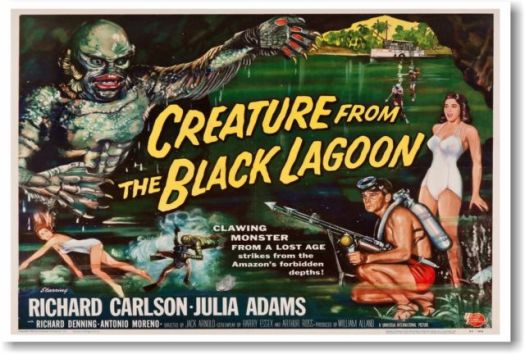
Halloween Havoc!: THE CREATURE FROM THE BLACK LAGOON (Universal-International 1954)


gary loggins's avatarcracked rear viewer

By the early 1950’s, the type of Gothic horrors Universal was famous for had become passe. It was The Atomic Age, and science fiction ruled the roost, with invaders from outer space and giant bugs unleashed by radiation were the new norm. But the studio now called Universal-International had one more ace up its collective sleeve: THE CREATURE FROM THE BLACK LAGOON, last of the iconic Universal Monsters!

Scientist Dr. Maia, exploring “the upper reaches of the Amazon” with his native guides, discovers a fossilized hand that may be the evolutionary “missing link”. Taking his finding to the Institudo de Biologia Martima, he teams with ichthyologist David Reed, David’s pretty assistant/fiancé Kay Lawrence, institute chief Dr. Mark Williams, and fellow scientist Dr. Thompson to form an expedition. They charter the steamer The Rita, skippered by Captain Lucas, and head down the river into the Black Lagoon. Maia’s Indian guides…

View original post 574 more words

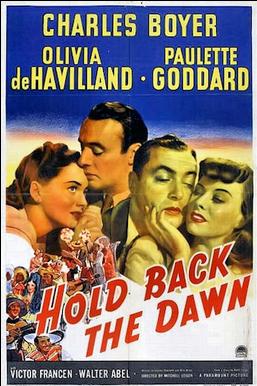
Lisa Reviews An Oscar Nominee: Hold Back the Dawn (dir by Mitchell Leisen)


(With the Oscars scheduled to be awarded on March 4th, I have decided to review at least one Oscar-nominated film a day.  These films could be nominees or they could be winners.  They could be from this year’s Oscars or they could be a previous year’s nominee!  We’ll see how things play out.  Today, I take a look at the 1941 best picture nominee, Hold Back the Dawn!)

Hold Back The Dawn is a historically important film for many reasons.

First off, this was the last film to be written by Billy Wilder before he launched his own legendary directorial career and, with its mix of sharp comedy and tearful melodrama, Hold Back The Dawn definitely feels like a Wilder film.  Wilder, himself, claimed that he was never happy with the way his script was adapted.  For instance, Wilder wrote a scene in which Charles Boyer, playing a Romanian who is stranded in a Mexican border town, was meant to deliver a monologue to a cockroach.  Boyer felt that the scene was ridiculous and the film’s director, Mitchell Leisen, never filmed it.  Wilder was so incensed that he declared that he would never again allow any of his scripts to be filmed by anyone other than himself.

Hold Back The Dawn also played a part in one of the most legendary feuds in Hollywood history, though there are some who claim that it was more the product of an overzealous pr agent’s imagination than anything else.  For her role as the shy school teacher with whom Boyer falls in love, Olivia de Havilland was nominated for Best Actress and was considered to be one of the front-runners for the reward.  (If nothing else, it was felt that giving her the Oscar would make up for not giving it to her when she was nominated for Gone With The Wind.)  However, that same year, Joan Fontaine was nominated for her role in Hitchock’s Suspicion and many felt that, after losing the previous year for her performance in Rebecca, Fontaine was owed an Oscar as well.  An Oscar night, Joan Fontaine beat Olivia de Havilland.  What complicated matters it that, beyond issues of professional jealousy, de Havilland and Fontaine were sisters.  For years, there were stories that de Havilland had never gotten over losing her Oscar to Fontaine and that, as a result, the two sisters had little to do with each other.  (The truth, as is always the case with siblings, appears to have been a lot more complicated.  de Havilland herself said it was less about the Oscars and more about just not having much in common with her sister.)

Beyond all that, however, Hold Back The Dawn is a charming dramedy that holds up remarkably well.  Boyer is Georges Iscoveu, a Romanian gigolo who has spent eight years living in a Mexican hotel, waiting to be allowed to enter the U.S.  Olivia de Havilland is Emmy Brown, an unmarried teacher who has nearly given up on ever finding love.  At first, Georges just wants to trick Emmy into marrying him so that he can legally enter the United States.  However, he soon finds himself truly falling in love with her.  Unfortunately, his partner-in-crime — Anita (Paulette Goddard) — is also in love with Georges and is not at all prepared to lose him to Emmy.  I know it all sounds very melodramatic but Wilder frames his story with a meeting between Georges and a Hollywood producer, a move the assures us that Hold Back The Dawn is content to be pure entertainment and we really should just sit back, not get too caught up on the specifics of the plot, and enjoy ourselves.  Charles Boyer is all befuddled charm as Georges while de Havilland is both poignantly likable as Emmy.  For me, as good as they are, the best performance came from Paulette Goddard, who is sharp-tongued and wonderfully cynical as Anita.  All three performers are helped by a wonderful script.  Even if Boyer never does talk to a cockroach, Wilder’s dialogue is still sharp and witty.  This is a film that is as much fun to listen to as it is to look at.

Hold Back The Dawn was nominated for best picture but lost to How Green Was My Valley.

This tribute Olivia de Havilland in Hold Back The Dawn was put together by Monique Classique for Olivia’s 100th birthday.

Horror on the Lens: Jesse James Meets Frankenstein’s Daughter (dir by William Beaudine)


This 1966 western/horror hybrid is just about as stupid as you think it is but it’s also a lot of fun if you’re in the right mood.  Notorious outlaw Jesse James (John Lupton) attempts to hold up a stagecoach but, in the process, his hulking partner Hank (Cal Bolder) is serious wounded.  Some helpful peasants direct Jesse and Hank to the mysterious German doctor who happens to live in a nearby dark and scary house.  That doctor is Maria Frankenstein (Narda Onyx) and she’s been conducting experiments to bring dead Mexicans back to life.  Imagine her joy when the nearly dead Hank shows up at her laboratory.  Anyway, Maria performs a brain transplant on Hank and once Hank comes back to life, she informs him that his new name is “Igor.”  Yes, she does.  That plot description pretty much tells you everything you need to know about the movie but I vaguely enjoyed vaguely paying attention to it.  Maria’s German accent is hilariously overdone, the Frankenstein laboratory is full of pointless electrical things, and a character dies halfway through the film just to later show up again with no explanation.  It’s that type of movie.

And it’s also the type of movie that you can watch below!

Enjoy!

http://www.youtube.com/watch?v=BF1leghsszg

Horror On The Lens: Revenge of the Creature (dir by Jack Arnold)


For today’s horror on the lens, we present to you 1956’s Revenge of the Creature!

Revenge of the Creature was the first sequel to The Creature From The Black Lagoon.  It turns out that the Gil-Man didn’t actually die at the end of the last film.  Instead, he’s alive, he’s been captured, and he’s now being displayed in an aquarium.

Now, I’m going to be honest: Revenge of the Creature is not as a good as The Creature From The Black Lagoon.  But it’s still kind of fun in a silly 1950s monster movie sort of way.  And, if you keep your eyes open, you might spot a very young Clint Eastwood, playing a lab technician and sporting a truly impressive head of hair.

Enjoy!


The Daily Drive-In: The Creature From The Black Lagoon (dir. by Jack Arnold)


As anyone who knows me can tell you, Lisa Marie doesn’t do water.

Seriously, I have a very intense fear of drowning and, while I might enjoy laying out by the pool during the summer, you’re never going to catch me actually going anywhere near the deep end.  I’m the epitome of the girl who loves the beach but hates the ocean.  As a result, I have a hard time with movies the feature swimmers thrashing about in the water or ancient monsters coming up to the surface in search of swimsuit-clad victims.

For lack of a better term, these films freak me out.

Sometimes, however, it’s fun to be freaked out.  Perhaps that’s why I so love the 1954 monster classic, The Creature From The Black Lagoon.

Like all good B-movies from the 1950s, The Creature From The Black Lagoon starts off with a lot of stock footage and a stuffy narrator telling us about how the Earth was created and how mankind originally evolved from a creature that crawled out of the sea.  The narrator manages to cover all the bases by including a few Biblical quotes with his explanation of how evolution works.

From the beginning of mankind, we fast forward to the 1950s.  A fossilized claw has been discovered in the Amazon and a group of scientists think that it could be evidence of the missing link in human evolution.  Mark (Richard Denning), who is kind of a jerk, funds an expedition to the Amazon to search for more evidence.  Accompanying Mark is hunky young scientist David (Richard Carlson) and David’s girlfriend, Kay (Julie Adams).  Traveling on a boat captained by the rather gruff Lucas (Nestor Paiva), they go to the camp where the fossil was originally discovered.  However, once they arrive, they discover that everyone in the camp has been killed.  Lucas suggests that the camp was attacked by a jaguar.

Lucas, needless to say, is totally incorrect.  The film isn’t called The Jaguar From The Black Lagoon.  It’s called The Creature From The Black Lagoon and the creature, also known as the Gill-Man (played by Ben Chapman when on land and by Ricou Browning whenever he’s underwater), is none too happy about these strangers invading his home.  Soon, the Gill-Man is stalking the expedition as they move up and down the Amazon River.

The Creature From The Black Lagoon is probably best known for the dream-like sequence in which Kay, wearing a white bathing suit that is simply to die for, swims in the Amazon River without realizing that the Creature is following just a few feet below her.  This scene (which does little to help with my aquaphobia) is one of the most iconic in the history of monster cinema.  Expertly framed by director Jack Arnold, this scene is distinguished by the graceful movement of both Julie Adams and Ricou Browning.  It’s as close as a monster movie has ever gotten to duplicating ballet.

Ultimately, like all good monster films, the Creature from the Black Lagoon is on the side of the monster.  The members of the expedition are, for the most part, interchangeable and, when the Gill-Man attacks, he’s acting more out of self-defense than out of hostility.  The expedition, after all, has invaded his home.  Like many 50s B-movies, the theme for The Creature From The Black Lagoon is not that people should be careful while investigating mysteries but that most mysteries are best left unsolved.

When you combine one of the genre’s most iconic monsters with Jack Arnold’s atmospheric direction, the end result is one of the best B-movies ever made.