Film Review: Greta (dir by Neil Jordan)


I always worry a little bit about Chloe Grace Moretz.

Seriously, it seems as if every film in which she appears features her either losing her entire family or getting stalked by some psycho or both.  It’s rare that she ever gets to play someone who is happy with their life.  Even when she was cast against type as a spoiled, vacuous brat in Clouds of Sils Maria, she still came across as being the saddest spoiled, vacuous brat imaginable.  Obviously, Mortez has the dramatic talent necessary to play these type of roles and, out of all the young actresses working today, she seems the most likely to still have an interesting career 30 years from now.  Still, it’s hard not to wish that she could just do a nice, romantic comedy at some point in the future, if just to give her a break from constantly being menaced on screen.

This year’s Chloe Moretz Gets Stalked film was Greta.  In this one, Moretz plays Frances McMullen, a waitress living in New York City.  Frances lives in a nice loft, has a fantastic roommate and best friend named Erica (Maika Monroe), and a strained relationship with her wealthy father (Colm Feore). As is typical of any character played by Chloe Moretz, Frances is still struggling to come to terms with the recent death of her mother.

After Frances finds an expensive handbag on the subway, she returns it to its owner, a piano teacher named Greta Hibeg (Isabelle Huppert).  Greta claims to be French and says that she’s been lonely ever since her daughter left home to study music in France.  Frances needs a substitute mother.  Greta needs a substitute daughter.

Can you tell where this is going?

If you said, “Together, they solve crimes!,” — well, you’re wrong but you’re still my hero.  Instead, what all this leads to is Greta becoming rather obsessed with Frances.  When Frances discovers that Greta has a whole closet full of handbags and that she’s not even French, Frances decides to end their friendship.  However, Greta will not take no for an answer.  Soon, Greta is following both Frances and Erica all around New York City.  Greta even goes to Frances’s place of employment and makes a scene that leads to Frances losing her job.  (Considering the amazingly ugly waitress uniform that Frances was required to wear, I’d say that Greta was doing her a favor.)  Eventually, it all leads to a kidnapping, a drugging, and an unexpected visual gag involving the Eiffel Tower.

About 30 minutes into Greta, there’s a scene in which Isabelle Huppert spits a piece of chewing gum into Chloe Moretz’s hair and it was at that moment that I knew that I was going to absolutely love this film.  I mean, there have been a lot of films made about people being stalked but it takes a certain amount of demented genius to have one of the world’s most acclaimed actresses actually spit a piece of gum into someone’s hair.  Brilliantly, the film follows this up with a scene of Frances and Erica trying to press assault charges against Greta, all because of the gum incident.  The cop is so cynical and unimpressed by their story that you just know that Frances is probably like the hundredth person to get attacked by chewing gum in just that day.

My point here is that there’s absolutely nothing subtle about Greta and we’re all the better for it.  As directed by Neil Jordan, Greta is a thoroughly excessive and deliberately campy little film and definitely not one to be taken too seriously.  Everything, from the lush cinematography to Greta’s sudden rages, is wonderfully over-the-top.  While Moretz wisely underplays her role (because, after all, someone has to keep things at least vaguely grounded in reality), Maika Monroe and especially Isabelle Huppert dive head first into the film’s melodramatic atmosphere.  Huppert, especially, deserves a lot of credit for her ferocious performance as Greta.  Whether she’s cheerfully celebrating a murder by doing an impromptu dance or suddenly screaming in Hungarian, Huppert is never less than entertaining while, at the same time, remaining credible as a very threatening individual.  One of the great joys of Greta is watching this masterful French actress play a Hungarian who is obsessed with Paris.  (It’s also probably not a coincidence that Greta is obsessed with someone named Frances.)

There’s an interesting subtext to the Greta and Frances relationship, one that goes beyond a girl who needs a mother and a woman who needs a daughter.  In many of the scenes where Greta stalks Frances, Huppert plays her as if she’s a spurned lover, crying out, “I love you!” and demanding that Frances return her phone calls.  As for Frances, she’s portrayed as being an almost absurdly repressed single girl who spends all of her personal time with two very different women, the accepting and fun-loving Erica and the predatory and destructive Greta.  (When Erica tells Frances that a guy who is interested in her is throwing a party, Frances says that she already has plans with Greta.)  Watching Greta, it occurred to me that the film was really about Frances coming to terms with her own sexuality, with Greta representing her fears and Erica representing the peace of accepting who you are.  The film may be about Greta stalking Frances but it’s also about Frances struggling to decide whether to give in to her fears or to accept her own identity.

Then again, it’s also totally possible that there’s no intentional subtext at all to this film.  It might just be an entertaining film about Isabelle Huppert stalking Chloe Moretz.  And that’s fine, too!  Either way, it’s a fun movie.

4 Shots From 4 Irish Films: In The Name of the Father, The Butcher Boy, Six Shooter, Calvary


Happy St. Patrick’s Day!

4 Shots From 4 Films

In The Name of the Father (1993, dir by Jim Sheridan)

The Butcher Boy (1997, dir by Neil Jordan)

Six Shooter (2004, dir by Martin McDonagh)

Calvary (2014, dir by John Michael McDonagh)

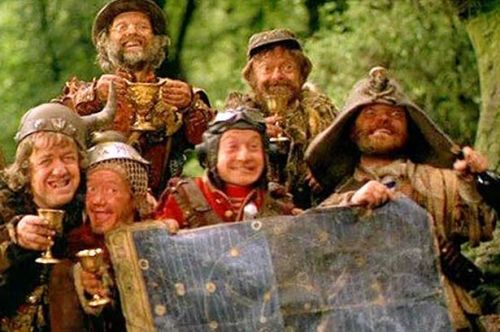
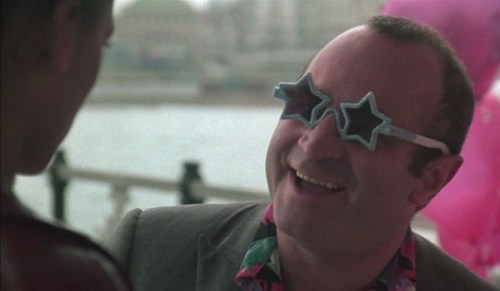
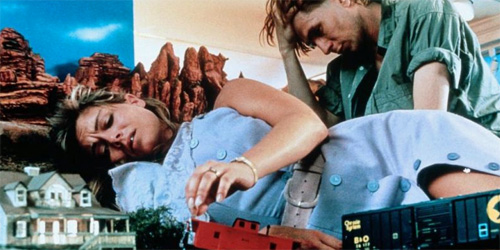
4 Shots From 4 Films: Monty Python’s Life of Brian, Time Bandits, Mona Lisa, Track 29


4 Shots From 4 Films is just what it says it is, 4 shots from 4 of our favorite films. As opposed to the reviews and recaps that we usually post, 4 Shots From 4 Films is all about letting the visuals do the talking.

In 1978, George Harrison co-founded HandMade Films to finance Monty Python’s The Life of Brian.  The company continued to produce films through the 80s and helped to reinvigorate the British film industry.  All of the shots below come from HandMade films and credit George Harrison as executive producer.

4 Shots From 4 Films

Monty Python's The Life of Brian (1979, directed by Terry Jones)

Monty Python’s Life of Brian (1979, directed by Terry Jones)

Time Bandits (1981, directed by Terry Gilliam)

Time Bandits (1981, directed by Terry Gilliam)

Mona Lisa (1986, directed by Neil Jordan)

Mona Lisa (1986, directed by Neil Jordan)

Track 29 (1988, directed by Nicolas Roeg)

Track 29 (1988, directed by Nicolas Roeg)

Embracing the Melodrama Part II #108: The Brave One (dir by Neil Jordan)


Brave_one_2007For our next entry in Embracing the Melodrama Part II, we take a look at Jodie Foster in the 2007 film The Brave One.  And…

Well, how to put this delicately?

I hate hate hate hate HATE this movie, with every last fiber of my being.  I hated it the first time that I saw it and I hated it when I recently rewatched it and right now, I’m hating the fact that I even decided to review this damn film because it means that I’m going to have to think about it.  I’m going to try to get this review over with quickly because, with each minute that I think about this film, I doubt my commitment to cinema.  That’s how much I hate this movie.  If I’m not careful, I’m going to end up joining a nunnery before I finish this review…

So, in The Brave One, Jodie Foster plays Erica Bain.  Erica lives in New York and hosts one of those pretentious late night radio shows that are always popular in movies like this but which, in real life, nobody in their right mind would waste a second listening to.  Erica spends her time musing about life in the big city and hoping that we can all just love one another and expressing a lot of other thoughts that sound like they’ve been stolen from an automated twitter account.

Erica also has a boyfriend.  His name is David and he’s played by Naveen Andrews.  That means that he looks good and he has a sexy accent and when he first shows up, you hope that he’ll stick around for a while because otherwise, you’re going to have to listen to move of Erica’s radio monologues.  But nope — one night, while walking through Central Park, David and Erica are attacked.  David is killed.  Erica is raped.  And their dog is taken by the gang!

(And the film doesn’t seem to know which it thinks is worse…)

When Erica gets out of the hospital, she is, at first, terrified to leave her apartment.  Or, at least, she’s terrified to leave her apartment for about five minutes.  But then she does find the courage to go outside and, of course, the first thing she does is buy a gun.  At first, she’s buying the gun for her own state of mind but, almost immediately after purchasing her firearms, she happens to stumble across a convenience store robbery.

Bang!  Bang!  Erica’s a vigilante now!

But, of course, she’s not really sure if that’s what she wants to be.  Even though she eventually ends up sitting on a subway and waiting for a guy to approach her so she can shoot him, Erica is still never really that comfortable with the idea of seeking vengeance.  And this is why I hated The Brave One.  The film is so damned wishy washy about Erica’s motivations.  Instead of allowing Erica to get any sort of satisfaction or emotional fulfillment out of her actions, The Brave One has her constantly doubting whether or not violence is the answer.  And don’t get me wrong, I’m not saying that violence is the answer.  But if you’re going to make a film about a female vigilante who is out looking for vengeance, why don’t you at least allow her to get some sort of empowerment out of her actions?  That doesn’t mean that the film itself can’t be ambiguous about what she’s doing.  But by having Erica constantly questioning her actions, it makes her into a weak character and it lets the men who raped her and the ones who subsequently threaten to do the same off the hook.  It allows them to be seen as victims, as opposed to products of a society where men are raised to believe that women will never fight back.

There’s a far superior New York-set film that has almost the same plot as The Brave One.  The title of that film was Ms. 45.  It was made for a hundred times less money than The Brave One and, at the same time, it was and remains a hundred times better.  (I previously wrote about Ms. 45 and The Brave One in my essay, Too Sordid To Ever Be Corrupted.)

The difference between the two films can be summed up by the film’s tag lines.  The Brave One was advertised with, “How many wrongs to make it right?”  Ms. 45 was advertised with: “She was abused and violated … IT WILL NEVER HAPPEN AGAIN!”   Ms. 45 features a vigilante who never doubts her actions and, as a result, she becomes a symbol not of violence but of empowerment.  Meanwhile, Jodie Foster is so constantly wracked with guilt and doubt that the film almost seems to be criticizing her for not staying in her apartment and trusting the police (represented by Terrence Howard and Nicky Katt) to do their job.

Oh!  And, of course, at the end of the film, Erica gets her dog back.  Because nobody ever permanently loses their dog in a big budget studio film…

And really, that’s why The Brave One is such a failure.  It takes a subject that was tailor-made for the grindhouse and attempts to give it the slick and self-important studio approach.  And part of that approach is that no one can be offended.  This is a film that both wants to celebrate and condemn at the same time.

And that’s why I say, “Give me Ms. 45!”

At least that movie knows what it wants to say…