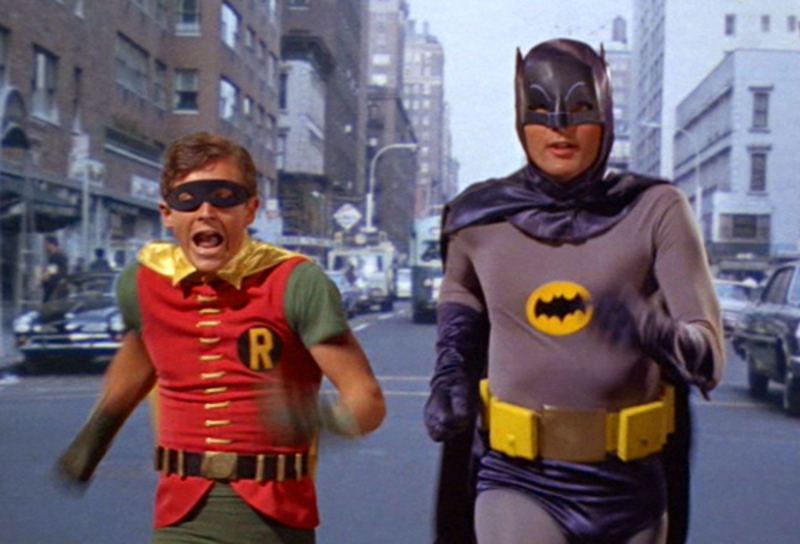
Batman: The Movie (1966, directed by Leslie H. Martinson)


One day, while defending Gotham City, Batman (Adam West) and Robin (Burt Ward) learn that there is a plot to abduct Commodore Schmidlap from his yacht. Quick! To the batcopter! Flying over the ocean, they locate the yacht but it turns out that the whole kidnapping plot was a ruse for a shark to attack Batman!

“Holy sardine!” Robin exclaims!

With the help of porpoise who bravely sacrifices its life to protect the Caped Crusader, Batman manages to escape. Back at police headquarters, Batman, Robin, Commissioner Gordon (Neil Hamilton), and Chief O’Hara (Stafford Repp) wonder which member of Batman’s rogue’s gallery of villainy could have been responsible for the ruse.

Batman says that it was pretty “fishy” what happened and that could possibly mean The Penguin (Burgess Meredith) was involved!

Robin points out that it happened “at sea” and C stands for Catwoman (Lee Meriweather)!

Batman then says that the shark was “pulling my leg” and that might mean it was working for The Joker (Cesar Romero)!

Chief O’Hara says that it all adds up to “a sinister riddle,” which can only mean one thing: The Riddler (Frank Gorshin)!

“The four of them,” Batman says, “working together…”

“Holy nightmare!” Robin exclaims!

As you can probably guess, the tone of 1966’s Batman: The Movie is far different from the tone of more recent Batman films. That’s because Batman: The Movie was based on the light-hearted 60s TV show that made Batman a household name even while transforming the character from being a shadowy vigilante to being a comedic straight arrow, a proud square who regularly lectured the citizens of Gotham about respecting the forces of law and order.

Batman: The Movie was released after the conclusion of the first season of the Batman televisions series and it featured nearly the entire cast of the show. (Lee Meriweather replaced Julie Newman in the role of the purring Catwoman.) The movie feels like an extended episode of the show, still using the same famous music and featuring scenes of Batman and Robin running in place with a street scene projected behind them. The attitude is one of affectionate parody, as opposed to the more cynical campiness of Joel Schumacher’s infamous films from the 90s. Adam West expertly deadpans his way through the main role while the underrated Burt Ward energetically plays the naïve and easily amazed Robin. Of the villains, Lee Meriweather is a sexier Catwoman than Anne Hathaway and there’s never been a better Riddler than Frank Gorshin. (Of the many actors who played Batman’s villains on the TV series, Gorshin was always the only one who seemed to understand that he was supposed to be playing someone dangerous.) At 104 minutes, Batman: The Movie runs out of steam before it ends but there’s still much here to entertain fans of the television show.

Of course, when I was growing up in the 90s, there was no easier way to lose credibility with most diehard Batman films than to admit to liking anything about the television series. The Batman TV series was widely blamed for people thinking that comic books were only meant for kids. Tim Burton was a hero for treating Batman seriously. Joel Schumacher was hated for taking the opposite approach. Batman and Robin was criticized for being too much like the TV show, right down to George Clooney doing a poor man’s Adam West impersonation in the main role. Despite the acclaim that greeted Batman: The Animated Series, It wasn’t until Christopher Nolan took control of the character that the cinematic Batman truly returned to his grim roots.

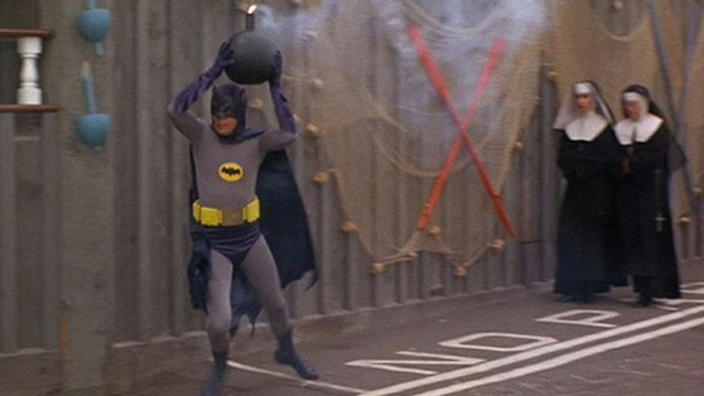
Since the conclusion of Nolan’s Dark Knight trilogy, there have been several versions of Batman. Ben Affleck took over the role for two films. Young Bruce Wayne and his doomed parents briefly appeared in Joker. Robert Pattinson is set to take over the role in The Batman. Now that everyone knows Batman as a grim avenger and countless actors have bragged about how they prepared for their roles in the Batverse by reading either The Killing Joke or The Dark Knight Returns, it’s easier to appreciate the more light-hearted approach of something like Batman: The Movie. After two decades of grim and serious Batmans being used as a metaphor for everything from PTSD to the surveillance state, the sight of a paunchy Adam West trying to find a place to safely dispose of a ridiculously oversized bomb can be a relief.
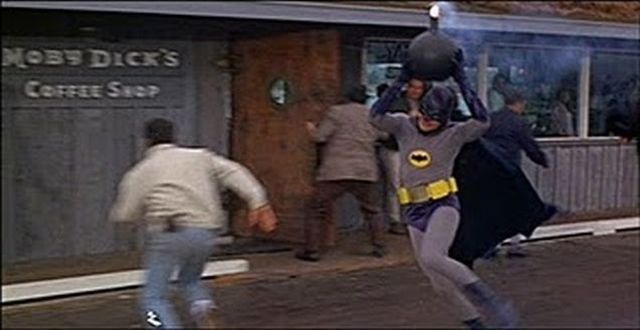
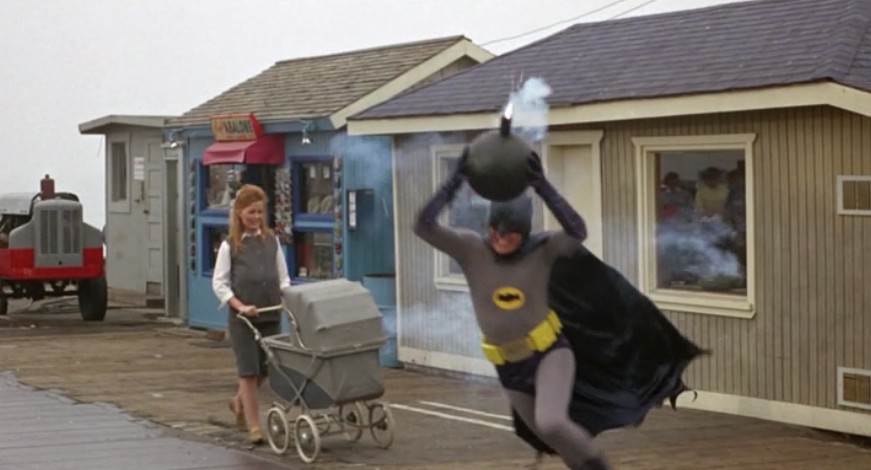
“Sometimes,” Batman says, “you just can’t get rid of a bomb!”

Tell me about it, Batman.
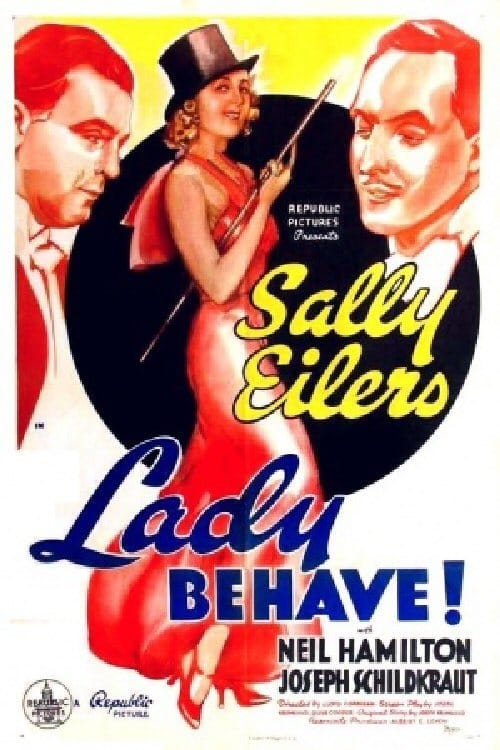
Mardi Gras Film Review: Lady Behave! (dir by Lloyd Corrigan)


The 1938 film, Lady Behave!, begins with a woman named Clarice (Patricia Farr) getting ready to go out and celebrate Mardi Gras.  Even though Clarice invites her older sister, Paula (Sally Eilers), to come with her, Paula refuses.  Paula has work to do at home.  It’s pretty obvious that this is the way that it’s always been between the two sisters.  Clarice has fun while Paula stays home and waits for her to return.

Fortunately, Clarice does return in the morning.  As she tells Paula, she had a great time during Mardi Gras.  In fact, she had such a great time that she ended up getting married!  She married a wealthy northerner named Stephen Cormack (Neil Hamilton).  The only problem is that Clarice is already married!  She’s totally forgotten that she only recently became the wife of a dissolute playboy named Michael Andrews (Joseph Schildkraut).  By getting married a second time, Clarice has committed bigamy!  She could go to prison for 10 years!

Whatever is Paula to do?

Well, what if she arranges for Clarice to leave the country?

What if she tries to bribe Michael into accepting an annulment?

What if Paula goes up to New York and pretends to be Clarice (because, after all, Stephen was pretty drunk when he married her)?

What is she does all three!?

Of course, when Paula goes up to New York, she discovers that Stephen is out of the country.  She moves into his mansion, where she discovers that his two children — Patricia (Marcia Mae Jones) and Hank (George Ernest) — are convinced that she’s just a gold digger who only wants to steal their father’s money (and, it should be noted, also their inheritance).  When Michael shows up at Stephen’s mansion, he explains to Paula that he needs $10,000 for a horse and he’ll only agree to an annulment if he gets the money.  However, when he meets Patricia and Hank, he tells them that if they pay him $30,000, he’ll help to break up the marriage between Stephen and Paula (who, of course, everyone but Michael thinks is actually Clarice).

Eventually, Stephen shows up and he assumes that Paula actually is Clarice.  Paula and Stephen quickly fall in love and it turns out that Stephen is very serious about his new marriage.  He even wants to take Paula on a honeymoon.  Of course, he thinks Paula is Clarice and Paula is freaking out because they’re not actually married but she wishes that they were.  But, if they did actually get married, Stephen would be guilty of bigamy and then he’d have to leave the country like Clarice and….

Yes, this is one of those somewhat busy screwball comedies where almost every action is motivated by a misunderstanding and where all of the dialogue is extremely snappy.  To be honest, it’s all a bit too hyper.  Though the film originally had a running time of 70 minutes, most of the existing prints are only 57 minutes long.  This film has a lot of plot for only 57 minutes and it’s often difficult to keep track of what’s happening from one scene to the next.  That wouldn’t be a problem if this film starred someone like William Powell and Carole Lombard (or, for that matter, Cary Grant and Myrna Loy) but instead, this film features Sally Eilers and Neil Hamilton, who are likable performers but not quite likable enough to carry the film over it’s rough edges.

On the plus side, Joseph Schildkraut has some very funny scenes as the flamboyant Michael.  And Marcia Mae Jones and George Ernest both do a great work as Stephen’s paranoid children.  They consistently made me laugh.  Otherwise, Lady Behave! is a bit too frantic for its own good.

Horror Film Review: The Devil’s Hand (dir by William J. Hole, Jr.)


Rick Turner (Robert Alda) has a problem.

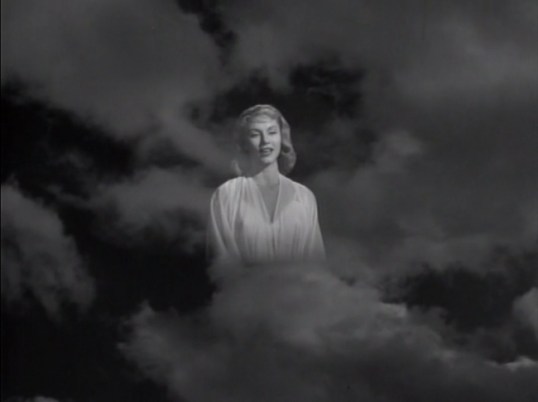
Because he’s continually haunted by strange dreams, Rick hasn’t been getting much sleep.  As he explains to his incredibly understanding girlfriend, Donna (Ariadna Welter), the dreams involve a vision of a beautiful woman named Bianca (Linda Christian), who appears to be standing in the clouds while wearing a sheer negligee and calling out to him.

Donna insists that it’s probably nothing but Rick says that, after his last dream, he felt himself being drawn to a doll shop in downtown Los Angeles.  When Rick and Donna go down to the shop, they discover a doll of Bianca sitting in the window.  The owner of the shop, Frank (Neil Hamilton), insists that Rick came in earlier and specifically requested that Frank design the doll so that he could send it as a gift to another woman.  You would think that would upset Donna but she’s more interested in the fact that she’s found a doll that looks exactly like her.

Well, you can probably guess what happens.  Eventually, the doll that looks like Donna ends up pinned to the wall of the shop and Donna ends up in the hospital with a mysterious illness.  Rick manages to track down the real-life Bianca, who greets him in her apartment while wearing the same negligee from Rick’s dreams.  Bianca explains to Rick that she’s been reaching out to him because she wants him to join a cult that worships “Gamba, the Great Devil Dog.”

It turns out that the cult meets in the back of Frank’s doll shop.  Rick attends a meeting with Bianca and discovers that the cult is made up of exclusively of beautiful young women and bland, middle-aged men.  He even gets to witness a near-human sacrifice involving a wheel that’s studded with knives.  As Bianca explains it, Gamba sometimes turns the knives into rubber and then sometimes, he doesn’t.  Gamba’s unpredictable like that.

Bianca explains that Rick can have everything he wants if he just gives his soul over to the Devil Dog.  But what about Donna, who is still in the hospital?

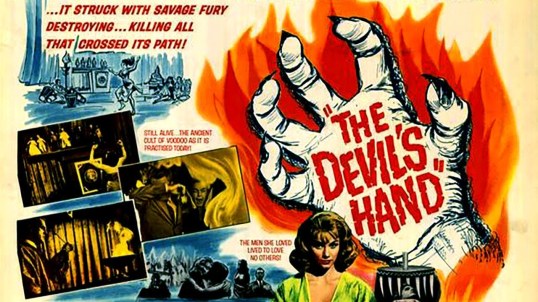
The Devil’s Hand is a low-budget but occasionally effective horror film from 1962.  (Apparently, it was originally filmed in 1959 but it wasn’t released until 3 years later.  Linda Christian later said that she never actually got paid for appearing in this film, as the production company apparently ran out of money during filming.)  Oddly enough, the film opens with extremely cheerful surf music, which leads you to suspect that you’re about to see some sort of weird beach comedy.  Instead, The Devil’s Hand turns out to be a film about a cult operating in the shadows of Los Angeles.

The cult is probably the most interesting thing about the film.  Though the film doesn’t specifically call attention to this fact, it’s hard not to notice that most of the male cult members appear to be either accountants or middle-management types, the type who wear cheap suits and too much cologne.  It’s impossible not to be amused by the idea of a bunch of middle class nobodies gathering in the back of a doll shop so that they can worship the Great Devil Dog.  Neil Hamilton and Linda Christian are both perfectly cast as the leaders of the cult.  Hamilton is properly menacing while Christian seems to be having fun tempting Rick into the darkness.

Unfortunately, Rick’s not a very likable protagonist.  Even though his girlfriend is in the hospital, Rick doesn’t have any problem with going to the horse track and playing the stock market with Bianca.  In short, Rick comes across as being a bit of a jerk and you can’t help but feel that Donna might be better off without him.

Anyway, The Devil’s Hand is an entertaining occult film, one that’s definitely not meant to be taken too seriously.  It’s only 71 minutes long so it really plays more like an extended episode of an old anthology show than anything else.  (It just needs a narrator.)  The story moves quickly and you’ll never forget those accountants in the back of the doll shop.

Going Ape!: TARZAN, THE APE MAN (MGM 1932)


gary loggins's avatarcracked rear viewer


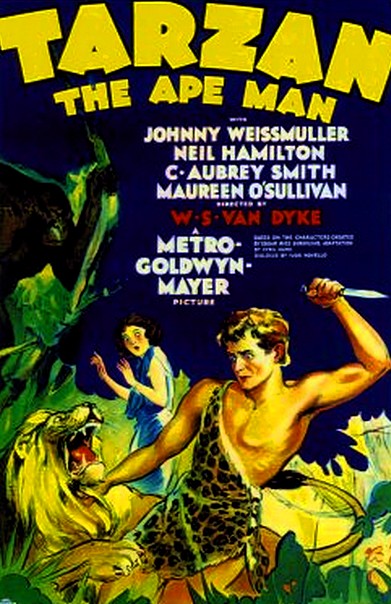
Edgar Rice Burroughs’ Lord of the Jungle first hit the screen way back in 1918 with Elmo Lincoln as Tarzan. Many actors since then have donned the loin cloth, but for me the definitive movie Tarzan remains Johnny Weissmuller , who swung from his first Hollywood vine in MGM’s TARZAN, THE APE MAN, and played  the part for 16 years in 12 films.

Elderly John Parker and his young partner Harry Holt are in deepest Africa searching for the legendary “elephant’s graveyard”, which contains a fortune in ivory, but is considered sacred ground by the native tribes. Parker’s daughter Jane shows up, a spirited girl who’s no ball of fluff, but can hold her own. When Jane insists on accompanying the men on their journey, Parker scoffs, but Harry signs off because of course he’s immediately smitten with her.The jungle trek is fraught with perils, like a dangerous river crossing…

View original post 623 more words