The year is 2016. A global depression has crippled the world’s economy. While the middle class struggles to exist from day to day, the poor are getting poorer and the rich are getting richer. Across the world, countries are nationalizing their industries, instituting price controls, and passing burdensome regulations. Though the government officials and the academics claim that all of this is being done “in the name of the people”, it’s hard not to notice that the people are the one who are suffering as a result. It’s also hard not to notice that most of the regulations seem to result in the bureaucrats getting not only more powerful but also wealthier. Throughout the world, people who have started businesses or who have otherwise stood up to the government are vanishing without a trace. In the shadows people ask, “Who is John Galt?”
Because gasoline now costs $37.00 a gallon, railroads have made a big comeback. But the government, which claims to know what’s best and to be infallible, has done a terrible job maintaining the nation’s railways. Dagny Taggart (Taylor Schilling), the vice president of Taggart Transcontinental Railways, is determined to rebuild the aging tracks with Rearden Metal, a new type of metal that is somehow both stronger and lighter than steel. The inventor of the new metal is Hank Rearden (Grant Bowler). And while that may sound like a good plan that will preserve the the nation’s supply chain, the government is angry that Rearden will not hand Rearden Metal over to them. When Dagny’s weaselly brother, James (Matthew Marsden), announces that Taggart Railways will continue to use an inferior metal, Dagny goes into business for herself. Despite the attempts of the government to stop them with bad publicity and excessive regulation, Dagny and Hank construct the John Galt Line. Unfortunately, the success of the John Galt Line does not matter to Wesley Mouch (Michael Lerner, giving the film’s best performance), the former corporate lobbyist-turned-economics czar. Mouch only sees the success of others as being a threat to his own power.
Meanwhile, people like oil tycoon Ellis Wyatt (Graham Beckel, giving the film’s second-best performance) continue to ask, “Who is John Galt?”
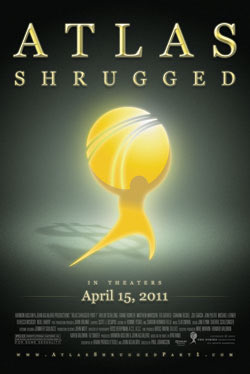
The first part of a trilogy of films based on the Ayn Rand novel of the same name, Atlas Shrugged Part One was released in 2011. At that time, it received overwhelmingly negative reviews. That, in itself, wasn’t really a shock. There was no way that a Libertarian-themed film released at the height of the “good government” era was going to get positive reviews. To some, it was a bigger shock that the film itself didn’t do particularly well at the box office but, again, it should have been expected. I think Libertarians always tend to overestimate the amount of people who have 1) read Ayn Rand and 2) liked what they read.
Myself, I thought the film suffered due to its low-budget and the bland performances of Taylor Schilling and Grant Bowler in the lead roles. At the same time, I felt that the film accomplished what it set out to do, in that it entertained the anti-government folks while annoying the MSNBC crowd. (That said, I doubt anyone from the latter group voluntarily watched the film.) With everything that has happened over the past seven years, it can be easy to forget just how idealized the government was in 2011. In 2011, we were continually told that the solution to every problem could be found in a government agency populated by wonky bureaucrats. It was like being trapped in a never-ending Aaron Sorkin fanfic. Whatever flaws Atlas Shrugged Part One had, there was something enjoyably subversive about the film’s suggestion that the government was staffed by fools and aspiring authoritarians. The film may have been heavy-handed when it came to portraying the greed and the stupidity of its villains but one could argue that it was no more heavy-handed than the typical Hollywood film. It’s just, in this case, the villains of Atlas Shrugged Part One were the people who would have been the heroes of any other film.
Of course, when viewed today, Atlas Shrugged lands a bit differently. Now that we’ve lived through the COVID era, the film’s portrayal of arrogant bureaucrats and politicians barking out orders and claiming that anyone who questions them is an enemy of the people no longer feels quite as over-the-top. As well, it’s no longer easy to laugh off the idea of corporations working hand-in-hand with the government or the supply chain being disrupted. The film itself still comes across as being a bit silly with its attempts to recreate the world of the rich and powerful on a very limited budget but it’s definitely more relatable today than it was in 2011. Much of what originally felt subversive about this film now feels a bit prophetic. If the film were released today, it would probably appeal to a mix of anti-government activist and transcontinental rail enthusiasts. The critic wouldn’t be any nicer but it would definitely do better at the box office.

 Through the Shattered Lens