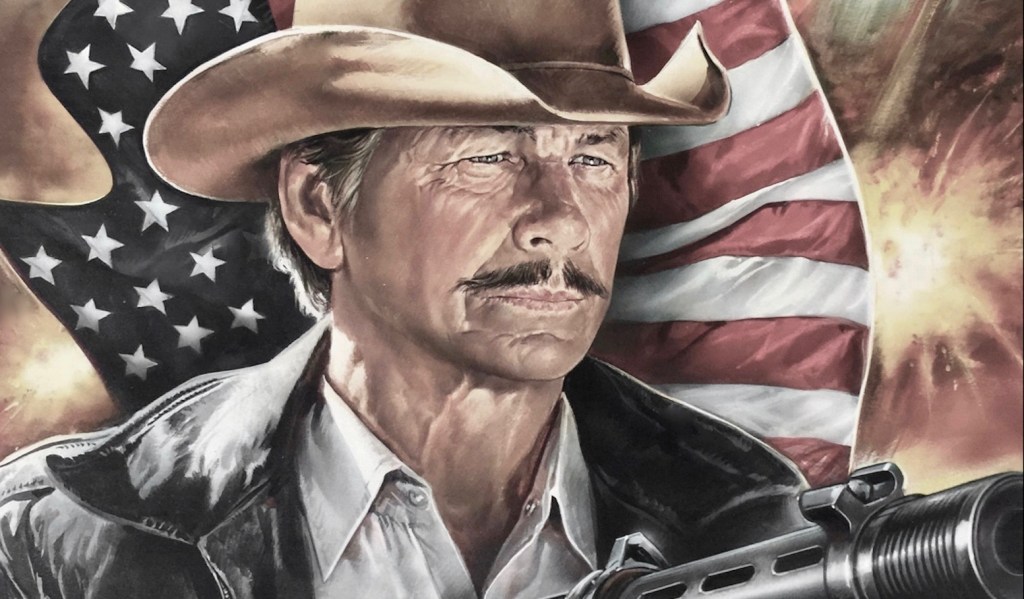
After a couple of decades of toiling away in TV and supporting roles, Charles Bronson became a huge international film star in 1968 when he starred in the films FAREWELL, FRIEND (with Alain Delon), and Sergio Leone’s ONCE UPON A TIME IN THE WEST (with Henry Fonda). For the next 5 years, Bronson would star in successful international co-productions, before hitting it big in the United States with the influential 1974 blockbuster, DEATH WISH. From 1974 to 1977, Bronson had his pick of any role that he wanted. This was probably the most interesting time in his career as he truly tried to expand his range with films like the depression-era HARD TIMES (1975), the romantic comedy FROM NOON TILL THREE (1976), the Raymond Chandler-esque ST. IVES (1976), and the surreal western THE WHITE BUFFALO (1977). But after 1977’s TELEFON and a series of underwhelming box office returns in the states, Bronson’s star was on the wane. He wouldn’t have his next #1 box office hit until he joined forces with the infamous Cannon studios in 1982 for the sequel to his biggest hit and DEATH WISH II. Cannon Studios would provide Bronson with a guaranteed paycheck and a non-stop presence on cable TV and at the video store for the remainder of the decade. I call the films that Bronson made between 1977 and 1982 the in-betweens. They don’t really fit into his European phase (1968-1973), his post-DEATH WISH phase (1974-1977) or his Cannon phase (1982-1989). To be completely honest, it seemed his career was somewhat in limbo at this point, and the movies he made during these years are some of his least well-known.
One of the movies that Charles Bronson made during the in-between years was 1980’s BORDERLINE. In this film, he plays Jeb Maynard, a border patrolman and expert tracker who will stop at nothing to find the human smuggler responsible for killing his friend and fellow patrolman Scooter, played by Wilford Brimley. I like this lower-key Bronson film. Director Jerrold Freedman has made a more realistic film than a lot of the movies in Bronson’s filmography. Outside of the murder that gets the story going, and the final showdown with the lead smuggler (a young Ed Harris), most of the film is made up of good old-fashioned field work and investigation. Bronson even based much of his performance on the technical advice of legendary border patrolman Albert Taylor. Now that doesn’t mean there aren’t some solid, action-packed scenes during the movie. My favorites include a scene where an undercover Maynard goes into Mexico with the mother of a young Mexican boy who was accidentally killed at the same time as Maynard’s friend Scooter. Maynard poses as a family member of the woman in hopes of being smuggled across the border so he can see how the illegal immigrants are being brought in. When thieves intercept the group, all hell breaks loose, and Maynard and the woman must fight their way out. Another badass moment occurs when Bronson beats needed information out of one of the smugglers in a nasty bathroom. This last scene is especially enjoyable for us Bronson fans.
There are so many good actors in this film. Outside of Bronson, Brimley, and Ed Harris, the cast is filled out by other veterans like Bruno Kirby, Bert Remsen, Michael Lerner, John Ashton, and Charles Cyphers. On a side note, Ed Harris gets the “introducing” credit here, even though he had appeared in several TV shows, as well as the movie COMA with Michael Douglas. This was his first major role in a feature film though. I also want to throw out special mention to Karmin Murcelo. She’s not a household name, but she’s excellent as the mother of the young boy who gets killed with Wilford Brimley’s character, who then helps Bronson in his quest to find the killer. Her career extended over 3 decades, and it’s easy to see why based on this performance.
BORDERLINE may not be an explosive action film like some of Bronson’s other work, but it’s an effective drama with a good performance from the star. I think he embodies the character perfectly. It’s also just as relevant in 2025 as it was in 1980, and I give the film a solid recommendation.
 Through the Shattered Lens