Review: Rats: Night of Terror (dir. by Bruno Mattei)


Can one scene make an otherwise thoroughly useless movie worth seeing?

That’s the question that I’m pondering right now as I attempt to write this review of 1984‘s Rats: Night of Terror.

Rats: Night of Terror opens in the 23rd century.  As the result of a nuclear war, Earth has been transformed into a barbaric wasteland.  While the majority of humankind has retreated underground, small bands of scavengers occasionally get dressed up like a New Order tribute band before coming to the surface and driving around on their motorcycles. The movie follows one group of survivors as they scavenge for food, come across a deserted ghost town, and eventually end up getting attacked by hundreds of rats.

For the most part, that’s the movie.  None of the characters are all that memorable and the so-called rats appear to be bored.  For the most part, the film wouldn’t even be worth reviewing except for the Scene.  After 90 minutes of languid mayhem, Rats: Night of Terror comes up with one scene that manages to be odd, brilliant, and numbingly stupid all at the same time.  The Scene simply has to be seen to be believed.

Director Bruno Mattei often said that Rats: Night of Terror was his personal favorite out of the countless number of exploitation films that he directed.  While it’s generally agreed that Mattei was responsible for making some of the worst films in history, I’ve always had a sneaky admiration for him.  It’s hard not to love someone who defies the odds while pursuing his dream.  Mattei’s dream was to make movies and he never let a thing like budget or talent to stand in his way.  While Mattei is best known for taking over the direction of Zombi 3 after Lucio Fulci walked off the set, he was a prolific director who dabbled in every genre.  Rats: Night of Terror is his contribution to the post-apocalyptic genre.

For a brief period in the 1980s, Italian exploitation filmmakers moved away from cannibals, gialli, and zombies and instead concentrated on making movies about post-apocalyptic bikers.  For the most part, I’ve never been a huge fan of these Italian versions of The Road.  There’s an overwhelming blandness to them.  If the underlying goal of Italian exploitation cinema was to make movies that could pass for American studio productions, then the postapocalyptic genre is the closest the Italians came to accomplishing that goal.  As opposed to the zombie films or the gialli, the only thing that was obviously Italian about the majority of these films was George Eastman.

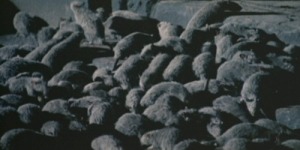
Rats: Night of Terror, strangely enough, does not feature George Eastman.  What it does feature is a lot of gerbils.  We’re continually told, throughout the movie, that these gerbils are actually rats but no, they’re gerbils and they’re pretty obviously not only gerbils but cute gerbils too!
 I’m sure I’m not the only person out there who has a strong phobia of rats.  I can still remember when I was 12 years old and visiting my grandad’s farm in Arkansas.  I was exploring an old barn with my older sister, Erin.  The barn, which already smelled like death, was also full of hay and, within a few minutes of stepping inside, I stared to have trouble breathing.  I stepped outside, used my inhaler, and leaned up against the barn’s wall.  As I caught my breath, I heard a very distinct squeaking coming from inside the wall.  I jumped away from the wall, spun around, and realized that I had been resting my head against a small hole.  Staring contemptuously at me from inside that hole was a really ticked-off looking rat.  No matter how many times I washed my hair that day (and, believe me, I washed and rewashed it a lot), I could not stop imagining the feeling of germ-ridden rodents running across the back of my head.

Ever since that day, whenever I’ve seen a rat in a movie (or, God forbid, real life), I’ve remembered that feeling and it still makes me shudder.  It’s a reminder that, in the end, we’re all going to end being devoured by the same scavengers.

On the other hand, whenever I see a gerbil, I’m reminded of that episode of South Park where Mr. Garrison, attempting to get fired, makes Mr. Slave his new teaching assistant.

And whenever I see Rats: Night of Terror, I’m reminded of the Pandemic episodes of South Park because the gerbils in this film appear to be about as naturally aggressive as a bunch of guinea pigs dressed up like pirates.

Pirates!

 Yes, Rats: Night of Terror has a lot going against it.  The characters are boring, the rats are gerbils, and the director is Bruno Mattei.  It would be easy to dismiss this film if not for the Scene.  Oh, how I wish I could tell you something about the Scene without giving the whole thing away.  I wish there was some way I could safely expand on just how weird and silly and oddly wonderful the Scene is.

Tell you what.  My e-mail address is LisaMarieBowman@live.com.  Or you can talk to me on twitter where I’m @LisaMarieBowman.  If you’ve seen this movie or if you see the movie after reading this review, contact me and tell me what you thought when you saw the Scene.  Seriously, it’s something that has to be discussed.

If you haven’t seen the film, I’ll give you a clue about the Scene.  It happens at the end of the movie.  It makes absolutely no sense and it is so extremely odd that it actually makes you wonder if maybe the entire film was meant to be somehow satiric.  What’s especially odd is that most viewers usually guess what the Scene is going to be halfway through the film before then thinking, “No, no way.  There’s no way that’s going to happen.”

So, to a return to the original question, can one scene make an entire film worth seeing?

In the case of Rats: Night of Terror, the answer is yes.

Review: A Blade In The Dark (dir. by Lamberto Bava)


If you’re lucky, you remember your first time.  I know I do.  I was 17 years old and I was trying very hard to convince myself that I was an adult.  It had been less than a year since I was first diagnosed as being bipolar and I was still struggling to understand what that truly meant about me.  My days were spent wondering if I was crazy or if I was just misunderstood.  In the end, I just desperately wanted to be loved.  As for the event itself, I remember being more than a little anxious and, once things really got going, pleasantly surprised.  However, the main thing I remember is thinking to myself, “Wow, that’s a lot of blood.”

Yes, everyone should remember the experience of seeing their first giallo as clearly as I do.

Over the years, I’ve read a lot of different definitions of what a giallo is and none of them have really managed to capture what makes this genre of film so strangely compelling.  The simplest and quickest definition is that a giallo is an Italian thriller.  Typically (though not always), the film features a protagonist who witnesses and then proceeds to investigate a series of increasingly gory murders.  Often times, solving the murders means uncovering some dark and sordid sin of the past and, just as often, the film’s “hero” turns out to be as damaged a soul as the killer.  However, the plot is rarely the important in a giallo film.  What’s important is how the director chooses to tell the story.  When I watch the classic giallo films of the 60s and 70s, I get a sense of a small group of directors who were all competing to say who could come up with the most startling camera angle, who could pull off the bloodiest death scene, and who could pull off the most audacious tracking shot.  Giallo is a uniquely Italian genre of film, an unapologetic opera of mayhem and murder.  For the most part, the films seems to have a polarizing effect on viewers.  You either get them or you don’t.  (From my own personal experience, I think it helps if you come from a Catholic background but, again, that’s just my opinion.)

My first giallo was Lamberto Bava’s 1983 shocker, A Blade in the Dark.

The protagonist of A Blade in the Dark is Bruno, a popular young composer who has been hired to score a horror movie.  The film’s director has arranged for Bruno to stay in an isolated villa while he works.  Every night, Bruno sits in front of his piano and searches for the perfect note.  Occasionally, his actress girlfriend calls him from the other side of Italy and demands to know if he’s cheating on her.  He’s not despite the fact that he has two attractive neighbors who tend to come by at the most inconvenient of times and who make cryptic comments about the woman who lived at the villa before him.  Bruno would probably be even more frustrated if he knew that, on most night, he’s being watched by someone outside hiding outside the villa.  One night, Bruno listens to the movie’s soundtrack and hears a menacing voice whispering on the recording.  Meanwhile, the mysterious watcher begins to brutally murder anyone who has any contact with Bruno.

(Despite all these distractions, Bruno continues to vainly try to create the perfect score.  Much like Kubrick’s Shining, A Blade in the Dark is as much about the horrors of the artistic process as it is about anything else.)

As it typical of most giallo films, the plot of A Blade in the Dark makes less and less sense the more that you think about it.  However, this is a part of the genre’s charm.  One doesn’t watch a giallo for the story.  One watches to see how the story is told and that is where A Blade in the Dark triumphs.  Wisely, director Lamberto Bava keeps things simple.  Working with a small cast and one main set, Bava fills every scene with a palpable sense of dread and uneasiness.  As Bruno finds himself growing more and more paranoid, so does the audience.  Watching the movie, you feel that anyone on the screen could die at any moment and, for the most part, that turns out to be the case.

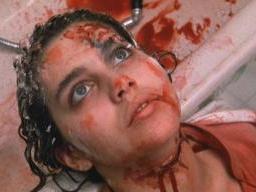
A Blade in the Dark is probably best known for the brutality of its violence.  Even after repeat viewings, the murders are still, at times, difficult to watch. In the most infamous of them, one of Bruno’s neighbors is killed while washing her hair over a sink.  The violence here is so sudden and so much blood is spilled (and spurted) that its easy to miss just how well-directed and effectively shocking this scene really is.  In this current age of generic cinematic mayhem, the violence of A Blade In The Dark still packs a powerful punch.

(The scene is so effective that, for quite some time after seeing it, I actually got uneasy whenever I found myself standing in front of a sink.  A Blade in the Dark does for the bathroom sink what Psycho did for showers.)

Bruno is played by Andrea Occhipinti, an actor whose non-threatening, Jonas Brotheresque handsome earnestness was used to great effect by Lucio Fulci in the earlier New York Ripper.  Since I’ve only seen the dubbed version, it’s difficult to judge his performance here.  He’s never quite believable as a great composer though you could easily imagine him writing whatever syrupy ballad that James Cameron chooses to play at the end of his next blockbuster.  However, Occhipinti does have a likable enough presence that you don’t want to see him killed and that’s all that the film really requires anyway.

A far more interesting presence in the cast is that of Michele Soavi.  Soavi plays Bruno’s landlord and, even with limited screen time and even with his dialogue dubbed into English, Soavi is such a charismatic presence that he dominates every scene that he’s in.  Before being cast, Soavi was already serving as Bava’s assistant director on Blade in the Dark and, of course, he later went on to have a significant directorial career of his own.  Soavi is perhaps best known for directing one of the greatest films of the 1990s, Dellamorte Dellamore.

While Soavi would go on to great acclaim, the same cannot be said of this movie’s director.  Among fans of Italian horror, it’s become somewhat fashionable to be dismissive of Lamberto Bava.  It’s often pointed out that the majority of his filmography is actually made up of cheap knock-offs that he made for Italian television (and, admittedly, A Blade in the Dark started life as a proposed miniseries).  Most of the credit for Bava’s most succesful film — Demons — is usually given to producer Dario Argento.  Perhaps the most common complaint made about Lamberto Bava is that he isn’t his father, Mario Bava.  With films like Blood and Black Lace, Lisa and the Devil, Black Sabbath, and Bay of Blood, Mario Bava developed a deserved reputation for being the father of Italian horror and Lamberto is often accused of simply trading in on his father’s reputation.

It’s true that Lamberto Bava is no Mario Bava but then again, who is?  Blade in the Dark was Lamberto’s second film (as a director) and its a tightly constructed, quickly paced thriller.  Bava makes good use of the vila and creates a truly claustrophobic atmosphere that keeps the viewer on edge throughout the entire film.  Even when viewed nearly three decades after they were filmed, the film’s murders are still shocking in both their violence and their intensity.  There’s a passion and attention-to-detail in Bava’s direction here that, sadly, is definitely lacking in his later films.  If most of Bava’s film seem to be the work of a disinterested craftsman, A Blade in the Dark is the  work of an artist.

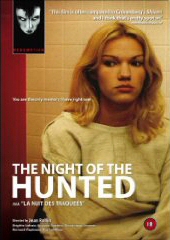
Review: Night of The Hunted (dir. by Jean Rollin)


When, at that age of 22, I first saw Jean Rollin’s Night of the Hunted, I cried as much as the first time I saw Titanic at the age of 12.  In both cases, the tears were inspired by a “doomed” love story.  The main difference between the two films is that I don’t cry over Titanic anymore.  But Night of Hunted still brings me to tears every time I see it.

The film opens with the image of a terrified young woman (Brigitte Lahaie) running through a dark forest until she eventually reaches a highway.  She’s picked up by a young man (Vincent Gardere) who, being a guy, proceeds to take her back to his apartment in Paris.  She confesses that she can’t remember who she is, why she was running, or even being picked up by the young man in the first place.  Saying that she needs some sort of memory to fill the emptiness, she proceeds to make love to Gardere.  Gardere, being a guy, doesn’t object.

However, he does make the mistake of later leaving Lahaie alone in the apartment afterwards.  As soon as Gardere leaves, Lahaie forgets ever meeting him and why she’s even in the apartment in the first place.  Even as she tries to figure out what’s going on, the apartment is visited by a doctor who tells Lahaie that she is his patient and that she needs to go with him to a “clinic” where he can treat her.  No longer remembering her encounter with Gardere, Lahaie agrees.

Needless to say, the “clinic” turns out to be what Lahie was so desperately trying to escape just a few hours before.  We learn that Lahie is merely one of several hundred people who, months earlier, were exposed to a biological warfare experiment gone wrong.  Now, as a result, her brain is slowly dying one cell at a time.  The clinic is actually a government-run prison where she and her fellow victims have been sent to be forgotten about and to eventually die.  Lahie finds herself surrounded by men and women who, as they slowly lose everything that made them unique, revert back to their most primal instincts.  While Gardere tries to find her, Lahie struggles to survive just one final night in both the clinic and in the prison of her own fading mind.

Director Jean Rollin is best known for his sexually-themed vampire films but the Night of the Hunted is not as huge a departure for him as it may first seem.  One of Rollin’s reoccurring themes is the importance of our memories, no matter how idealized they may sometimes be and this theme is present in every frame of Night of the Hunted.

The lead role is played by Rollin’s frequent muse and collaborator, Brigitte Lahaie.  Because the majority of Lahaie’s career has been spent making adult films, she’s never gotten the due she deserves as an actress.  Playing a difficult role here, Lahaie is the movie’s greatest strength.  She brings a real sincerity and empathy to her role and its impossible to imagine this movie working without her.  If nothing else, this movie is a wonderful display of Lahaie’s often underrated talent. 

Rollin made the film for very little money and used a cast made up almost entirely of nonprofessionals and French adult film veterans.  So, yes the film does sometimes have a grainy look and the editing is definitely jagged.  When the characters shoot at each other, it is obvious that they’re firing toy cap guns.  To me, however, this works in the film’s favor.  The raw quality of the film perfectly mirrors that constant fear and confusion that Lahaie and her fellow prisoners live in.  No, the film is not technically perfect but a flawed masterpiece is preferable to uninspired technical perfection any day.

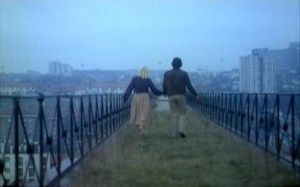
Despite working with a miniscule budget, Rollin captures some haunting images in this film.  Never has Paris looked as desolate as in this movie.  One of Rollin’s trademarks has always been his own fascination with architecture and, as a result, the cold skyscraper where Lahaie is held prisoner almost becomes a character itself.  I’ve always considered Jean Rollin to be horror cinema’s equivalent to Jean-Luc Godard and, with its images of a sterile city run by passionless autocrats, Night of the Hunted brings to mind Godard’s Alphaville.

 The film’s most haunting image comes at the end and it is this image that brings tears to my eyes every time.  Whatever flaws the film may have, Night of the Hunted has one of the best final shots in the history of cinema.  Even if everything preceeding it had been worthless, this movie would be worth sitting through just for the stark beauty of the final shot.  Night of the Hunted ends on a note that manages to be darkly sad and inspiringly romantic at the same time.  It’s an ending that makes Night of the Hunted one of the most romantic films of all time.

Night of the Hunted was released in 1980 and, like the majority of Rollin’s films, was never released in the States.  Redemption, however, has released it on DVD (which is how I first saw it in 2008.)   While the transfer is undeniably rough, that actually gives the movie a documentary-like quality that works in its favor.  The film is in French with English subtitles.   As is so often the case with subtitles, a lot of the film’s nuance is sacrificed in translation.  Fortunately, the combination of Rollin’s visual sense and Lahaie’s lead performance more than makes up for it.