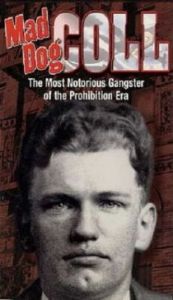
 New York. The prohibition era. The Coll Brothers, Vincent (Christopher Bradley) and Peter (Jeff Griggs), are sick of working for the Irish gangster, O’Malley (William Anthony La Valle). They want to hang out at the Cotton Club with big time gangsters like Lucky Luciano (Matt Servitto), Legs Diamond (Will Kempe), and Dutch Schultz (Bruce Nozick). Vincent has fallen in love with Lotte (Rachel York), a singer at the club but the club’s owner, Owney Madden (Jack Conley), makes it clear that Lotte is too good for a low-rent thug. After killing O’Malley, Vincent and Peter go to work for Dutch Schultz but soon, they grew tired of the low wages that Schultz pays them. The Colls decide to strike out on their own, leading to all out war with New York’s organized crime establishment.
Vincent Coll was a real-life gangster who actually did go to war with Dutch Schultz and Lucky Luciano. After a five-year old boy was fatally caught in the crossfire of a gun battle between Coll and his rivals, Vincent was nicknamed “Mad Dog” by the New York press. Mad Dog Coll presents a highly fictionalized account of Coll’s life, suggesting that the kid was actually shot by one of Coll’s rivals and presenting Coll as an idealistic rebel who refused to be controlled by Luciano’s organized crime commission. Luciano, Vincent and Peter agree, has sold out and no longer remembers where he came from.
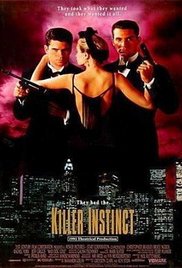 Mad Dog Coll was one of two gangster movies that Menaham Golan produced, back-to-back, in Russia. In fact, Mad Dog Coll may be the first American film in which Russia stood in for America instead of the other way around. Though this film was produced after Golan broke up with his longtime producing partner, Yoram Globus, Mad Dog Coll still has a definite Cannon feel to it. It is low-budget, fast-paced, unapologetically pulpy, and entertaining as Hell. For a Golan production, the performances are surprisingly good. Bruce Nozick steals the entire movie as crazy Dutch Schultz. None of it is subtle but it is enjoyable in the way that only a Greydon Clark-directed, Menahem Golan-produced gangster film can be. 1920s New York is recreated on Russian soundstages. The threadbare production design and cardboard cityscape brings a Jon Pertwee/Tom Baker-era Dr. Who feel to the movie. All that is missing is The Master brewing up moonshine and the Daleks exterminating the Chicago Outfit.
In the U.S., Mad Dog Coll was retitled Killer Instinct, probably to cash in on the recent success of Basic Instinct. The entire cast was featured in the sequel, the Menahem Golan-directed Hit the Dutchman.
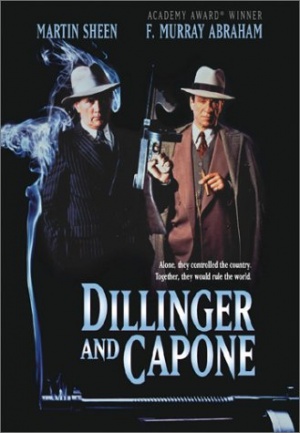 1934. Chicago. The FBI guns down a man outside of a movie theater and announces that they have finally killed John Dillinger. What the FBI doesn’t realize it that they didn’t get Dillinger. Instead they killed Dillinger’s look-alike brother. The real John Dillinger (played by Martin Sheen) has escaped. Over the next five years, under an assumed name, Dillinger goes straight, gets married, starts a farm, and lives an upstanding life. Only a few people know his secret and, unfortunately, one of them is Al Capone (F. Murray Abraham). Only recently released from prison and being driven mad by syphilis, Capone demands that Dillinger come out of retirement and pull one last job. Capone has millions of dollars stashed away in a hotel vault and he wants Dillinger to steal it for him. Just to make sure that Dillinger comes through for him, Capone is holding Dillinger’s family hostage.
 Chicago. 1915. Up-and-coming gangster Al Capone (Eric Roberts) berates his younger brother, Jimmy (Adrian Pasdar), for not being aggressive enough in a street fight. Not wanting to follow his brothers into a life of organized crime, Jimmy runs away from home and eventually finds himself in Harmony, Nebraska. Claiming to be a World War I vet named Richard Hart, Jimmy impresses everyone with both his marksmanship and his incorruptible nature. Soon, the new Richard Hart has been named town marshal. While Al Capone is taking over the Chicago rackets, Richard is keeping the town safe with his Native American deputy, Joseph Littlecloud (Jimmie F. Skaggs), and starting a family with the local school teacher, Kathleen (Ally Sheedy). When illegal liquor from Chicago starts to show up on a nearby Indian reservation, Richard Hart comes into conflict with the Chicago Outfit and his secret is finally revealed.
 Scott Wolf plays Clyde, a nerdy high school student who has a go-nowhere job at a burger place. Maureen Flannigan, best known for starring in Out Of This World, is Bonnie, who likes to steal stuff and have fun. Unfortunately, Bonnie’s father (played by Tom Bower) is not an avuncular alien who sounds like Burt Reynolds. Instead, he’s the extremely strict and controlling police commissioner of their hometown. Clyde like Bonnie but Bonnie wants nothing to do with him. It’s not until Clyde spies Bonnie shoplifting in a record store that he realizes that larceny is the key to her heat. When Clyde steals a van and Bonnie steals her father’s guns, the two of them head for Mexico, robbing banks, shooting guns, making love (which, judging from the comments I have found online, is the main reason the film found an audience once it started showing up on HBO) and becoming media celebrities along the way.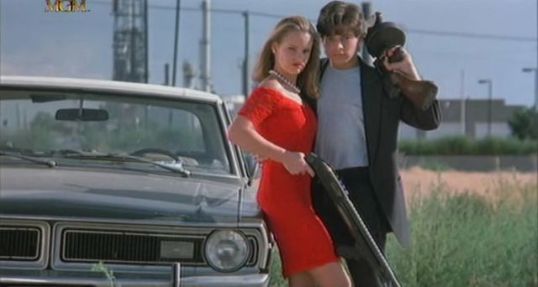
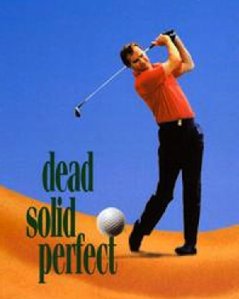 Based on a novel by veteran sports writer Dan Jenkins, Dead Solid Perfect takes an episodic look at a year on the PGA tour. Kenny Lee (Randy Quaid) is a good but aging golfer who wants to finally have his time in the spotlight. His sponsor (Jack Warden) is an eccentric old racist. His girlfriend (Corinne Bohrer, who has a lengthy scene where she walks naked down hotel hallway while carrying an ice bucket) isn’t looking for a commitment while his wife (Kathryn Harrold) is getting sick of his emotional immaturity. Kenny Lee just wants to hit the perfect shot.
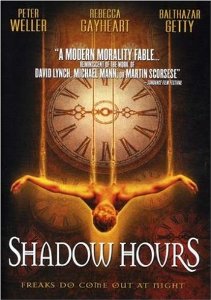 Straight from the direct-to-video graveyard comes this journey through the seedy underbelly of Los Angeles. Michael Holloway (Balthazar Getty) used to drink every hour and snort cocaine every night. That was the past. Now, he is clean and sober. Michael is married to Chloe (Rebecca Gayheart) and they have a baby on the way. In desperate need of money to support his family, Michael gets a job working the night shift at a 24-hour gas station. Most of his customers are the scum of the Earth until, one night, Stuart Chappell (Peter Weller) steps into the station. Stuart claims to be a writer and he hires Michael to accompany him on an exploration of the dark side of L.A. They start with strip bars and then eventually move on to fight clubs and BDSM parlors. Everywhere they go, Stuart is recognized but everyone knows him by a different name. Soon, Michael is not only drinking and doing drugs again but he is also the prime suspect in a murder.
 Long before the rise of trash TV, reality television, Jerry Springer, Maury Povich, Fox News, and MSNBC, there was The Morton Downey, Jr. Show. Airing at the end of the 1980s, The Morton Downey, Jr. Show featured its host railing against liberals, vegetarians, communists, feminists, libertarians, animal rights activists, teenagers, and pot smokers. Though the show only lasted for two seasons and ended after a bizarre incident in which Downey faked being the victim of a hate crime, The Morton Downey, Jr. served as a forerunner to the rise of our current toxic political culture.
 In Zero Tolerance, Robert Patrick plays Jeff Douglas, an FBI agent who is sent down to Mexico to pick up a recently captured drug dealer. Ray Manta (Titus Welliver) is the head of the White Hand drug cartel and he is not happy about having been arrested. When Ray tells Jeff that his entire family is being held hostage and will be killed unless Ray is allowed to escape, Jeff demands that Ray give him his word that no harm will come to his wife and children. Ray gives his “word of honor,” not realizing that his associates have already killed Jeff’s family. Jeff is now out for revenge and he is not going to let the FBI, with its rules and procedures, stand in his way. Jeff is not only out to get Ray. He is also going to track down and kill every member of the White Hand, which includes everyone from Mick Fleetwood (yes, that Mick Fleetwood) to Jeffrey Anderson-Gunter (playing almost exactly the same role that he played in Marked for Death and Only The Strong) to Ator the Invincible himself, Miles O’Keeffe.
 When game designer Milton Parker (Vincent Price) dies, all of his greedy relatives and his servants gather for the reading of his will. Parker’s lawyer, Benstein (Robert Morley), explains that Parker is leaving behind a $200 million dollar estate to whoever can win an elaborate scavenger hunt. Dividing into five teams, the beneficiaries head out to track down as many items as they can by five o’clock that evening. Among the items that they have to find: a toilet, a cash register, an ostrich, a microscope, and an obese person. Hardy har har.
 Through the Shattered Lens