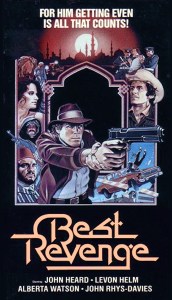
A Movie A Day #195: Best Revenge (1984, directed by John Trent)


Damn … John Heard died.

I know that almost everyone knows John Heard as either the father from Home Alone or as the detective on The Sopranos or maybe even the executive in Big.  Over the course of his long career, John Heard played a lot of neglectful fathers, greedy businessmen, and corrupt politicians.  Heard was good in all of those roles but he was capable of so much more.  Though he did not get many chances to do so, he could play heroes just as well as villains.

One of his best performances is also one of his least seen.  In Best Revenge, he plays Charlie.  Charlie is a laid back drug dealer, someone who would probably hate and be hated by most of the authority figures that Heard was best known for playing.  Charlie is the ultimate mellow dude, without a care in the world.  All he wants to do is play his harmonica and spend time with his girlfriend (Alberta Watson).  However, an old friend (Stephen McHattie) wants Charlie to help smuggle 500 keys of hash from Tangiers to America.  Charlie wants nothing to do with it but then he finds out that the Mafia will kill his friend unless the drugs make it across the ocean.  Charlie and his friend Bo (Levon Helm of The Band) fly over to Morocco but are betrayed.  Charlie ends up in a prison cell, from which he has to escape so that he can rescue Bo, smuggle the drugs, and get revenge on those who betrayed him.

Because of the prison aspect and the fact that Charlie wears a fedora, Best Revenge was sold as being a combination of Midnight Express and Raiders of the Lost Ark but actually it is a character study disguised as an action film.  Despite the title, Best Revenge is more interested in the real-life logistics and hassles of being an international drug dealer than in any sort of revenge.  Though it is a role far different from the ones he may be best known for, John Heard was perfectly cast as a small-time drug dealer who suddenly finds himself in over his head.  Heard gives such a good  and sympathetic performance that this film, along with his work in Cutter’s Way and Chilly Scenes of Winter, shows what a mistake was made when Heard became typecast as the bad guy.

Best Revenge was filmed in 1980 but not released until four years later.  Along with appreciating Heard’s performance, keep an eye out for Michael Ironside in an early, blink-and-you’ll-miss-it role.

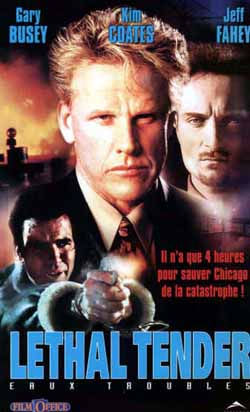
A Movie A Day #194: Lethal Tender (1996, directed by John Bradshaw)


Detective David Chase (Jeff Fahey) should not be mistaken for the creator of The Sopranos.  Instead, he is an eccentric and tough Chicago policeman, the type of cop who appears to have seen Mel Gibson in Lethal Weapon one too many times.  His superiors send Detective Chase and his partner to keep an eye on a strike occurring outside of a water purification plant.  Chase, however, is less interested in the strike and more interested in hitting on Melissa (Carrie-Ann Moss), who works at the plant.
Before you can say Die Hard All Over Again, a band of terrorists led by Montessi (Kim Coates) seizes control of the plant.  Montessi threatens to poison all of Chicago’s drinking water but, what the authorities don’t realize, is that the attack is really just a distraction, designed to keep everyone from noticing Mr. Turner (Gary Busey) and his men running off with a bunch of stolen government bonds.  Since Bruce Willis, Steven Seagal, and even Jean-Claude Van Damme were busy, it is up to Jeff Fahey to save the water, the money, and the day!

A Die Hard rip-off starring Gary Busey, Kim Coates, and Jeff Fahey does not actually have to be any good.  All the movie has to do is let those three actors do their thing and it will be watchable.  That is certainly the case with Lethal Tender, which is entertaining even if it is, ultimately, just another predictable Die Hard ripoff.  Jeff Fahey does okay as the hero but Lethal Tender belongs to the villains.  This was made in the days when Gary Busey playing crazy was still enjoyable instead of just sad.  Realizing that he was going to have to compete with Busey’s legendary ability to overact, Coates chews every piece of scenery that he can get his hands on.  Launching a major terrorist strike to cover up a simple robbery might seem like overkill but watching Busey and Coates compete to see who can steal the most scenes is so much fun that it really doesn’t matter that Chicago’s drinking water might get poisoned as a result of their shenanigans.

For fans of Busey and Coates, Lethal Tender is required viewing.  For everyone else, it’s the most successful attempt ever made to transport the plot of Die Hard to a water filtration plant.

A Movie A Day #193: The O.J. Simpson Story (1995, directed by Alan Smithee)


Long before O.J.: Made In America

Before The People vs. O.J. Simpson

Before American Tragedy

Before today’s live, televised parole hearing…

There was The O.J. Simpson Story.

In 1994, shortly after O.J. Simpson was charged with the murders of Nicole Brown Simpson and Ron Goldman, Fox rushed The O.J. Simpson Story into production.  It was one of many “true life” stories that showed up as television movies during the 90s.  There was a movie about Woody Allen and Mia Farrow’s divorce.  There was a movie about David Koresh and the Branch Davidians, which actually aired while the siege in Waco was still ongoing.  There were three movies about Amy Fisher.  So, of course, O.J. would get a movie.

Though the movie was produced in 1994, it was not allowed to air in 1995 so that it would not prejudice any of the jurors in the case.  (After all, they might have done something crazy like ignore all of the DNA evidence and let O.J. go free.)  I think the legal authorities may have been giving The O.J. Simpson Story too much credit.  There were many bad made-for-TV movies made in the 90s but The O.J. Simpson Story may very well be the worst.  The only thing it could prejudice some against is television.

Opening with the discovery of the murders in Brentwood, The O.J. Simpson Story mixes scenes of O.J. (played by Bobby Hosea, who shows not a hint of O.J.s famous charisma) talking to the police and his lawyer, Bob Shapiro (Bruce Weitz, slightly more credible than John Travolta was in The People vs. O.J. Simpson) with flashbacks to O.J.’s youth, first marriage, and his relationship with Nicole (blandly played by Jessica Tuck, who, beyond the color of her hair, looked nothing like Nicole).  The film also devotes some time to O.J.’s friendship with A.C. Cowlings, who, as a young man, is played by Terrence Howard.

Several of the famous incidents of the case are wanly recreated.  The famous bronco chase is there, of course.  O.J. is shown beating Nicole in the infamous 1989 incident, which the movie suggests was triggered by Nicole telling O.J. that he would never win an Oscar for appearing in The Naked Gun.  But, since the movie was rushed into production before the trial even began, it is remarkable how much is left out.  There’s no Mark Furhman finding the black glove.  There’s no Kate Kaelin, Faye Resnick, Johnnie Cochran, or even Marcia Clark.  Because the movie was made before the trial had even begun, it does not even take a stand on whether or not O.J.’s guilty.  Narratively, it is an incomplete movie and evidence of why movies that claim to tell true stories should not be rushed into production before the story itself has been completed.

As for the film’s dialogue, when O.J. first meets Nicole, he asks her, “Any problem with going out with a brother?”

“Yeah,” Nicole says with a smile, “I’m in the Ku Klux Klan.”

Not surprisingly, The O.J. Simpson Story was directed by Alan Smithee, which was the pseudonym used by directors who felt that their movie has been so butchered by outside interference that they should not even be credited with the final result.  The O.J. Simpson Story is one of the worst Smithee films that I have ever seen.  Compared to The O.J. Simpson Story, Smithee’s work on Let’s Get Harry was Oscar-worthy.

As for the real life O.J. Simpson, earlier today, he was granted parole from the Nevada Parole Board.  He will be released from prison on October 1st.  He has said that he hope to be allowed to move to Florida after being released.  The real-life O.J. Simpson story continues.

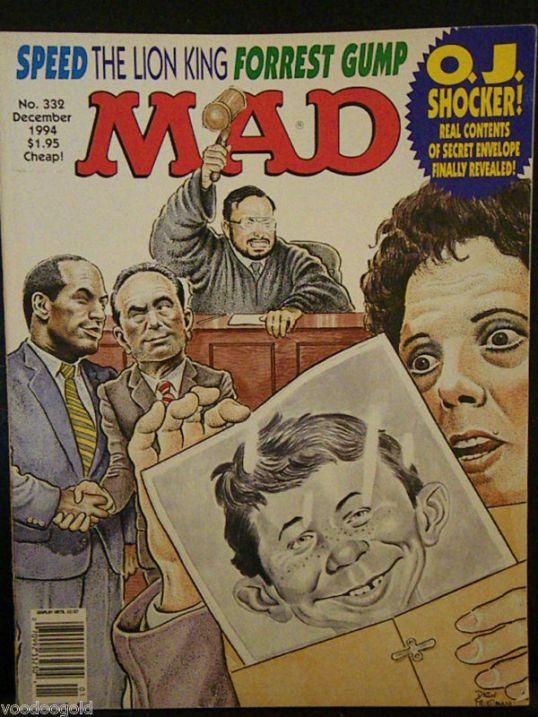
When it comes to the long saga of O.J. Simpson, it seems appropriate to give the last word to MAD Magazine:

A Movie A Day #191: Blue City (1986, directed by Michelle Manning)


Billy Turner (Judd Nelson) has always been the bad boy but now he just wants to return to his Florida hometown and reconnect with his estranged father.  As soon as he rolls into town, Billy gets into a bar brawl and is arrested.  The chief of police (Paul Winfield) informs Billy that his father has been murdered and that his stepmother has since married the local gangster, Perry Kerch (Scott Wilson).  Everyone knows that Perry murdered Billy’s father but no one can prove it.  He is told to get out-of-town but Billy’s not going out like that.  Instead, he gets together with his childhood friends, gimpy legged Joey (David Caruso) and Annie (Ally Sheedy), and seeks his revenge.

No, it’s not a picture of Judd Nelson hanging out with the a member of the Heaven’s Gate cult.  It’s the DVD cover for Blue City.

An infamous flop, Blue City was meant to show that the members of the infamous Brat Pack could play serious, adult roles.  Unfortunately, Blue City was released right at a time when everyone was starting to get sick of the Brat Pack.  (Even John Hughes had moved on, casting Matthew Broderick as Ferris Bueller, instead of Anthony Michael Hall.)  After countless magazine covers and the monster success of The Breakfast Club and St. Elmo’s Fire, a backlash was brewing and Blue City walked (or, in Joey’s case, limped) straight into it.

It also did not help the film’s prospects that it matched up the least interesting Brat Packer, Judd Nelson, with the member of the Brat Pack most likely to take herself too seriously, Ally Sheedy.  Playing roles that would have been played by Alan Ladd an Veronica Lake in the 40s, both Nelson and Sheedy are miscast and, strangely considering this was their third film together, have no chemistry.  Nelson, in particular, gives one of the most annoying performances in film history.  He never stops smirking, even when there is no reason for Billy Turner to be smirking.  With his wide-eyed stare and his attempts to speak like a tough guy, Nelson comes across like John Bender auditioning for West Side Story.  The scene where he manages to floor Tiny Lister with one punch is simply beyond belief.

When Judd Nelson can beat you up, there is only one thing left to do:

Thanks, Duke.

On a more positive note, David Caruso, long before he could usher in the Who by simply putting on his sunglasses, is better cast as Joey but there is nothing surprising about what eventually happens to him.  The best performance is from Scott Wilson, showing why he used to always play villains before reinventing himself as Herschel on The Walking Dead.  Wilson was so good that I realized, halfway through Blue City, that I actually would not have minded if he succeeded in killing Billy.

The most disappointing thing about Blue City is that it is a Florida noir from the 80s that somehow does not feature even a cameo appearance by Burt Reynolds.  Couldn’t Judd have taken just a few seconds during the filming of Shattered: If Your Kid’s On Drugs to convince Burt to drop by Blue City?

They could have used the help.

A Move A Day #190: The Contender (1944, directed by Sam Newfield)


Gary Farrell (Buster Crabbe) is a widowed truck driver who wants his son to have a better life than his old man.  Good luck pulling that off on a salary of $45 a week.  Gary enters a boxing tournament, just hoping to win enough money to pay for his son to go to military school.  But, under the tutelage of veteran trainer Pop Turner (Milton Kibbee), Gary becomes a real contender.  He also becomes a first class heel, turning his back on his old, honest lifestyle and getting involved with fast-living socialite, Rita London (Julie Gibson).  Can Gary’s friends and newspaper reporter Linda Martin (Arline Judge) get Gary to see the error of his ways?
The Contender, which is in the public domain and can be viewed at the Internet archive, is a typical poverty row production, with all the expected boxing clichés.  Gary’s initial rise is just as predictable as his downfall and eventual redemption.  For fans of Buster Crabbe, though, it is a chance to see Crabbe playing someone other than Tarzan, Flash Gordon, or Buck Rogers.  (Crabbe was the only actor to play all three of these roles over the course of his long career.  He also appeared as Billy the Kid in several westerns.)  Though he was a swimmer and not a boxer, Crabbe’s natural athleticism made him a good pick for the role of Gary.  Julie Gibson is sexy and fun as the bad girl and be sure to keep an eye out for Glenn Strange, who plays Gary’s best friend.  Just as Crabbe was forever typecast as Flash Gordon, Strange will always be remembered for replacing Boris Karloff in the role of Frankenstein’s Monster.

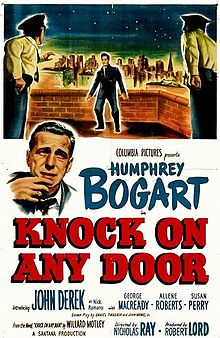
A Movie A Day #189: Knock On Any Door (1949, directed by Nicholas Ray)


Knock On Any Door opens with the murder of a policeman in New York City. Nick Romano (John Derek) is arrested for the crime. Nick is a troubled young man who has grown up in the slums and is fond of saying that his goal is to “Live fast, die young, and leave a good-looking corpse.” Now on trial for his very life, Nick reaches out to lawyer Andrew Morton (Humphrey Bogart), who once unsuccessfully defended Nick’s father in a similar criminal trial. At first, Morton wants nothing to do with Nick but he changes his mind, partially out of guilt over Nick’s father and partially because Morton himself came from the same slums that produced Nick. Even as the district attorney (George Macready) goes for blood, Morton argues that Nick isn’t a menace but instead a victim of a society that left him with little choice but to become a criminal.
Knock Any Door is heavy-handed but, for fans of Humphrey Bogart and Nicholas Ray, this is an essential film. Bogart produced this film himself and the subject matter was very important to him.  Bogart, the classic tough guy with a heart of gold, gives one of his best performances, delivering his closing statement with such conviction that it is impossible not to be moved.  Though Ray’s direction is often heavy-handed and the courtroom scenes are sometimes too stagey, Knock On Any Door sees him exploring the same themes that he would later explore in Rebel Without a Cause and with the empathy that made that later film a classic.

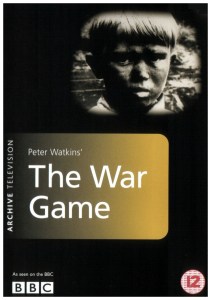
A Movie A Day #188: The War Game (1965, directed by Peter Watkins)


“Do you know what Strontium-90 is and what it does?”
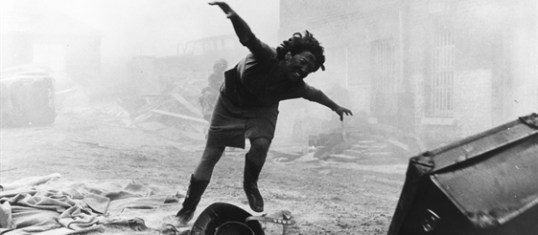
That question is asked as part of a man-on-the-street interview in The War Game.  Despite a pledge by the Home Office to educate the British public on the possible effects of atomic war and nuclear fallout, the man being asked has no idea what Strontium-90 is.  For that matter, I have no idea what Strontium-19 is.  The War Game makes a good case that the only way anyone will ever understand that true horror of atomic conflict is to live through it but, by the point that we have no choice but to know what Strontium-90 is and what it does, it will be too late.

Clocking in at a brisk 50 minutes, The War Game is set up like documentary, though the majority of the film is staged.  (That did not stop The War Game from winning an Oscar for best documentary feature.)  Made at the height of the Cold War, The War Game suggested that not only was Britain not prepared for a possible nuclear attack but that the attack itself would be so devastating that was literally no way that it ever could be prepared.  Opening with interviews with typical Britons expressing both their ignorance about the longterm effects of an atomic war, The War Game proceeds to visualize what would actually happen if the UK ever did find itself attacked. When the bomb falls, most people are nowhere near a shelter.  (“Within this car,” the narrator says, “a family is buring alive.”)  Even for those who get to safety, it turns out that there is no shelter strong enough to protect its inhabitants from both physical and psychological damage.  The film ends with chilling scenes of London bobbies executing looters and British children saying that they never want to grow up.

The War Game was originally made for the BBC, which deemed the program to be to “upsetting,” refused to air it, and subsequently tried to bury it.  This attempt at censorship had the opposite effect, earning The War Game a theatrical release and exposing it to an even larger audience than would have seen it originally.  However, it would be another 20 years before the BBC allowed The War Game to air on television.  Though, especially for media-savvy viewers, the staged nature of this “documentary” is sometimes too obvious, The War Game is still a powerful and bleakly disturbing vision of an all-too possible future.

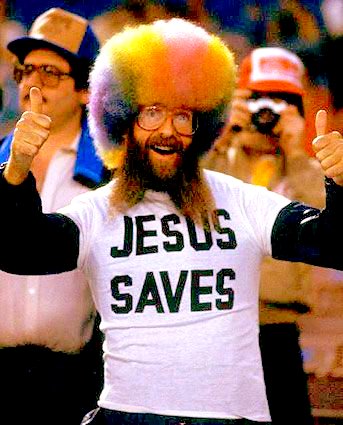
A Movie A Day #187: The Rainbow Man/John 3:16 (1997, directed by Sam Green)


Who was Rollen Stewart?

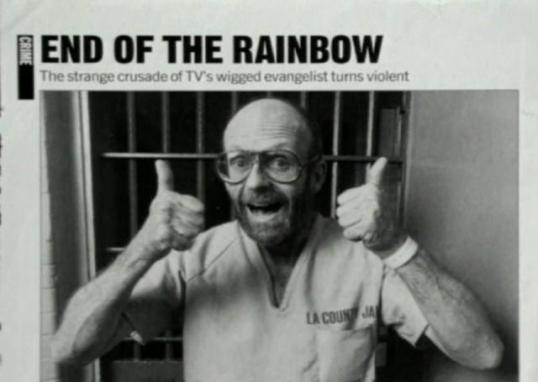
Briefly, he was a celebrity.  In the 1970s, he was inspired to start appearing at every sporting event that he could, wearing a leisure suit and a rainbow afro wig.  As the Rainbow Man, Rollen became a familiar face on television, even getting to appear in a beer commercial.  What no one knew was that, before he became the Rainbow Man, Rollen was the child of an abusive alcoholic and that he never emotionally recovered from the murder of his sister.

Rollen Stewart was also an aficionado of marijuana, which perhaps led to the next stage in his odd career.  While possibly high, Stewart became a born again Christian and he traded in his disco lifestyle for a hand-made signs and t-shirts reading John 3:16.  When his new religious persona proved to be far less popular than his Rainbow Man persona, Rollen decided that it was a sign that the end of not just his celebrity but also world itself was near.  He started to leave stink bombs in various churches and Christian bookstores.  (Because, according to him, “God thinks this stinks!”)  In 1992, Rollen entered a motel room, lit a joint, covered the windows with religious placards, and then took a hotel maid hostage.  He is currently serving a life sentence.

The Rainbow Man/John 3:16 is a documentary about the strange life and times of Rollen Stewart.  Along with plenty of footage at Rollen at the height of his fame, the documentary also includes footage of a visibly unstable Rollen in prison.  The documentary is 20 years old so I don’t know if Rollen still believes the world is about to end.  He comes up for parole later this year.

The documentary is only 48 minutes long.  I wish it had been longer because Rollen’s life was an interesting one.  His greatest tragedy is that this attention-seeker became famous before the advent of reality TV.  Today, he could have revived his career by appearing on Dancing With The Stars or I’m A Celebrity, Get Me Out Of Here.  Instead, he is just another inmate at California’s Mule Creek Prison.

A Movie A Day #186: Joysticks (1983, directed by Greydon Clark)


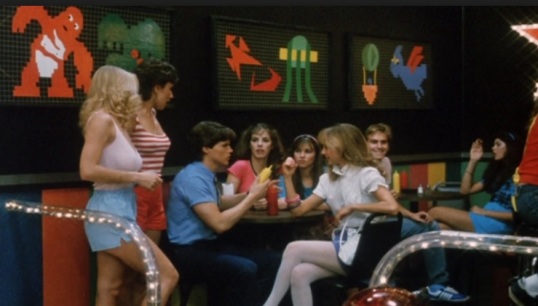
It’s Porky’s in an arcade!

Every gamer knows how accurate this is.

Jeff Bailey (Scott McGinnis) is the manager of the hottest (and only) arcade in town.  His grandfather owns the place and Jeff is everyone’s friend but he does not play any of the games.  When he was younger, he was caught getting it on with his girlfriend in an arcade.  She was sent out of town and Jeff was left so traumatized that he swore he would never touch another joystick.  However, he may have to go back on his pledge because the local evil businessman (Joe Don Baker) is determined to take over the arcade and he has recruited King Vidiot (Jon Gries) to help him do it.  In between Jeff getting laid and King Vidiot scheming, there are all the usual teen sex comedy hijinks.  Just like in real life, the arcade is perpetually full of hot, single girls wearing bikinis.  A hot dog gets stuck between a pair of breasts.   Pacman is played by a topless video game groupie.  Inevitably it all leads to a training montage and a showdown between Jeff and King Vidiot, with whoever gets the highest score at Super Pacman winning control of the arcade.

King Vidiot was the height of 80s fashion.

Joysticks is as dumb as it sounds but it is also a lot of fun, especially if you want to see what life was like before everyone had internet access and their own home gaming console.  The movie is full of classic games, from Pac-Man to Satan’s Hollow.  The best thing about the arcade is that the final video game duel is played with giant, floor-mounted joysticks.  I’m not sure they would work well in real life but they look extremely cool.

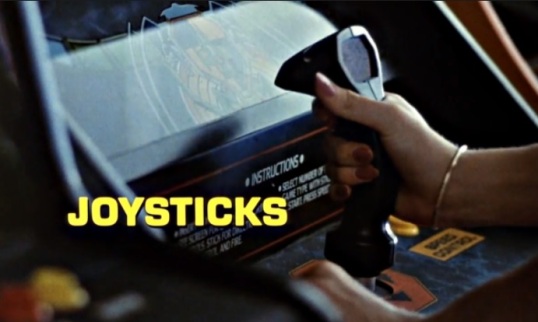
Check out those joysticks!

For those wondering, at no point does Joe Don Baker play Pacman during Joysticks.  If he had, the end result would have been a classic for all time.

Grab that joystick, Joe Don. You know you want to.

Joysticks?  I wonder if that title was supposed to have a double meaning.

Arcade Life, 1983

A Movie A Day #185: Emperor of the North Pole (1973, directed by Robert Aldrich)


Emperor of the North Pole is the story of depression-era hobos and one man who is determined to kill them.

The year is 1933 and Shack (Ernest Borgnine) is one of the toughest conductors around.  At a time when destitute and desperate men are riding the rails in search of work and food, Shack has declared that no one will ride his train for free.  When Shack is first introduced, the sadistic conductor is seen shoving a hobo off of his train and onto the tracks.  Shack smiles with satisfaction when the man is chopped in half under the train’s wheels.

A-No.1 (Lee Marvin) is a legend, the unofficial king of the hobos.  A grizzled veteran, A-No. 1 has been riding the rails for most of his life.  (The title comes from the hobo saying that great hobos, like A-No. 1, are like the Emperor of the North Pole, the ruler of a vast wasteland).  A-No. 1 is determined to do what no hobo has ever done, successfully hitch a ride on Shack’s train.  He even tags a water tower, announcing to everyone that he intends to take Shack’s train all the way to Portland.

If A-No. 1 did not have enough to worry about with Shack determined to get him, he is also being tailed by Cigaret (Keith Carradine), a young and cocky hobo who is determined to become as big a legend as A-No. 1.  Cigaret and A. No. 1 may work together but they never trust each other.

Like many of Robert Aldrich’s later films, Emperor of the North Pole is too long and the rambling narrative often promises more than it can deliver.  Like almost all movies that were released at the time, Emperor of North Pole attempts to turn its story into a contemporary allegory, with Shack standing in for the establishment, A-No. 1 representing the liberal anti-establishment, and, most problematically, Cigaret serving as a symbol for the callow counter culture, eager to take credit for A-No. 1’s accomplishments but not willing to put in any hard work himself.

As an allegory, Emperor of the North Pole is too heavy-handed but, as a gritty adventure film, it works wonderfully.  Lee Marvin is perfectly cast as the wise, no-nonsense A-No. 1.  This was the sixth film in which Marvin and Borgnine co-starred and the two old pros both go at each other with gusto.  Carradine does the best he can with an underwritten part but this is Borgnine and Marvin’s film all the way.  Marvin’s trademark underacting meshes perfectly with Borgnine’s trademark overacting, with the movie making perfect use of both men’s distinctive screen personas.  As staged by Aldrich, the final fight between Shack and A-No. 1 is a classic.

Even at a time when almost every anti-establishment film of the early 70s is being rediscovered, Emperor of the North Pole remains unjustly obscure.  When it was first released, it struggled at the box office.  Unsure of how to sell a movie about hobos and worrying that audiences were staying away because they thought it might be a Christmas film, 20th Century Fox pulled the movie from circulation and then rereleased it under a slightly altered name: Emperor of the North.  As far as titles go, Emperor of the North makes even less sense than Emperor of the North Pole.  Even with the title change, Emperor of the North Pole flopped at the box office but, fortunately for him, Aldrich was already working on what would become his biggest hit: The Longest Yard.

Keep an eye out for Lance Henriksen, in one of his earliest roles.  Supposedly, he plays a railroad worker.  If you spot him, let me know because I have watched Emperor of the North Pole three times and I still can’t find him.