Retro Television Review: Money to Burn (dir by Robert Michael Lewis)


Welcome to Retro Television Reviews, a feature where we review some of our favorite and least favorite shows of the past!  On Sundays, I will be reviewing the made-for-television movies that used to be a primetime mainstay.  Today’s film is 1973’s Money To Burn!  It  can be viewed on YouTube.
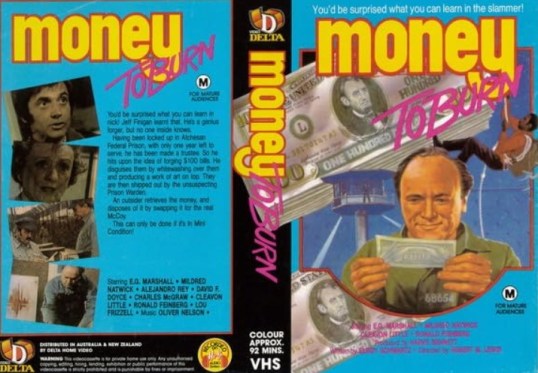
For someone who has spent the past few years in prison, Jed Finnegan (E.G. Marshall) sure is a nice old man!  He runs the prison print shop and all of the other prisoners love him.  The guards trust him.  The warden (David Doyle) is really impressed with Jed’s watercolors and is interested in helping Jed launch a career as an artist after he gets out of prison.  Every weekend, Jed’s wife, Emily (Mildred Natwick), comes up to the prison with a picnic basket and she has lunch with her husband.  Jed admits that his wife is not a particularly good cook but it’s obvious that he really looks forward to her visits.

Emily’s sweet nature keeps a lot of people from noticing that she is just as cunning and clever a criminal as Jed ever was.  She knows that Jed had printed up one million dollars in counterfeit bills and she is looking forward to helping him exchange the fake money for real money.  Jed’s plan is to steal the payroll of the local army base and just leave the fake money in place of the real money.  However, Jed’s been in prison for so long that he doesn’t know that the military no longer pays anyone in cash.  Everyone’s paying everyone by check!

(This film is very much from the 70s.  While Jed and Emily were shocked to discover that people were no longer being paid in cash, I was shocked to discover that they were being paid by check.)

Working with two recently released ex-cons (played by Cleavon Little and Alejandro Rey), Emily tries to find a new way to switch out the money.  She discovers that there’s an incinerator nearby where the government burns the currency that it no longer needs.  But it won’t be easy to break in and make sure that the right money get burned….

And that’s not even mentioning the trouble of getting the fake money out of the prison in the first place!

Money to Burn is likable mix of comedy and (very mild) action.  It’s a film about criminals but they’re very likable criminals who go out of their way not to hurt people.  Emily is even happy about the idea of not only stealing a million dollars but also helping the government out by taking the old currency off their hands.  Marshall, Natwick, Little, and Rey all give such warm and cheerful performances that you can’t help but hope that they get away with their scheme.  The film, which deftly balances comedy and drama, clocks in at a brisk 73 minutes and it has an absolutely wonderful twist ending.  This is definitely a heist film that deserves to be better known.

Love on the Shattered Lens: Coffy (dir by Jack Hill)


It may seem odd to describe Coffy as being a love story.

After all, this is a film that is perhaps best known for a scene in which Pam Grier (as Nurse Coffin, a.k.a. Coffy) shoots her lying boyfriend in the balls.  Coffy is often described as being the epitome of 70s grindhouse, a film in which Pam Grier takes on drug dealers, the Mafia, and a corrupt political establishment with a combination of shotguns and shanks.  Coffy is perhaps Grier’s best-known films and it features one of her best performances.  There’s nothing more empowering than watching Pam Grier take down some of the most corrupt, arrogant, and disgusting men to ever appear in a movie.  It’s a violent and gritty film, one that opens with a drug dealer’s head literally exploding and never letting up afterwards.  There are many different ways to describe Coffy but it’s rarely called a love story.

But here’s the thing.  A film about love doesn’t necessarily have to center around romantic love.  Coffy is about love but it’s not about any love that Coffy may have for her boyfriend, the duplicitous politician Howard Brunswick (Booker Bradshaw).  Instead, the love at the center of this film is the love that Coffy has for her sister, who died from a heroin overdose.  It’s her sister’s death that leads to Coffy first seeking revenge but that’s not the only love that motivates Coffy.  There’s also the love that Coffy feels for her community.  Throughout the film, we hear about how the black community is being destroyed by the drugs that are being pushed into their neighborhoods by white mafia dons like Arturo Vitronia (Allan Arbus, who was once married to the iconic photographer, Diane Arbus).  It’s not a random thing that, for all of Coffy’s anger, she saves her most savage revenge for the members of her community who are working with the white mobsters, men like the pimp, King George (Robert DoQui), and her own boyfriend, Howard.

Throughout the film, Coffy says that she feels like she’s “in a dream” and Pam Grier gives an intelligent performance that suggests that, even after her mission is complete, Coffy will never be the same.  She’s not a natural killer.  She’s a nurse and it’s her job to save lives.  But when she sets out to get revenge on those who killed her sister and who are destroying her community, Coffy shows no mercy.  When she violently interrogates another victim of the drug trade, Coffy shows the junkie no sympathy because sympathy isn’t going to solve the problem.  Coffy is determined and the reason why she succeeds is because none of her victims realize just how serious she is.  Coffy uses her beauty to distract them and then, when they aren’t looking, she strikes.  By the end of the film, she’s walking alone on the beach and the viewer is left to wonder what’s going on inside of her head.  After all the people that Coffy has killed, can she ever go back to simply working the night shift at the ER?  After you’ve seen life and death at its most extreme, can things ever go back to the way that they once were?

And listen, I’m generally a pacifist and I’m not a huge fan of real-life vigilante justice and I’ve signed many petitions against the death penalty but it’s impossible not to cheer for Coffy.  Pam Grier gives such a committed performance that it’s impossible not to get sucked into her mission.  (It helps, of course, that most of the people who she targets are legitimately terrible human beings.)  The brilliance of Grier’s performance comes in the quiet moments.  Yes, she’s convincing when she has to shoot a gun and she delivers vengeful one-liners with the best of them.  But the film’s best moments are the ones were Grier thinks about how her life has become a dream of violent retribution and where she allows us to see the love for her sister and her community, the same love that is motivating all of the bloodshed.

Coffy is a rightfully celebrated film.  For once, a cult film actually deserves its cult.  It’s one of the best of the old grindhouse films and, in fact, to call it merely an exploitation film actually does a disservice to how effective a film Coffy actually is.  It’s just a great film period.

http://www.youtube.com/watch?v=ZTugAPqacBs

Horror on the Lens: Night Slaves (dir by Ted Post)


For today’s horror on the lens, we have the 1970 made-for-TV movie, Night Slaves!

In this atmospheric film, an estranged married couple (James Franciscus and Lee Grant) find themselves in a small town.  It seems like a friendly enough place.  I mean, Leslie Nielsen is the sheriff!  How could anything go wrong in a town protected by Leslie Nielsen?

However, at night, the town changes.  Only Franciscus seems to notice all of the townspeople wandering about like zombies.  Is he going crazy or has he stumbled across something sinister?

You’ll have to watch find out!

Enjoy!