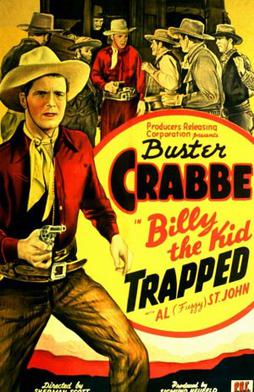
Billy “The Kid” Bonney (Buster Crabbe) and his two buddies Fuzzy (Al St. John) and Jeff (Bud McTaggart) are just trying to mind their own business and make a living in the old west but they keep getting accused of every crime that happens. This time, they’re sentenced to hang for a crime they didn’t commit. Luckily, a group of strangers break Billy and his friends out of jail and send them on their way to the next town. However, the men who broke them out of jail are soon committing crimes while disguised as Billy, Fuzzy, and Jeff! Billy teams up with Sherriff Masters (Ted Adams) to stop the imposters, who are working for Boss Jim Stanton (Glenn Strange).
One of the joys of Poverty Row westers like this one is that they always featured the same stock company. Al St. John was everyone’s sidekick. Ted Adams was often a sheriff. Glenn Strange was always the criminal mastermind pulling the strings. Milton Kibbee was always a corrupt judge or ranch owner. George Cheseboro, Horace B. Carpenter, Jack Curtis, and Budd Buster are amongst the very familiar faces in Billy The Kid Trapped. It gives each film a homey feel that will be appreciated by fans of the genre. The hero of the films often changed but the stock company always remained the same.
I like the idea behind Billy The Kid Trapped but the film still feels repetitive, even though it’s less than an hour long. After Billy captures the men who are imitating him and his friends, a crooked judge sets the men free and the immediately go back to imitating Billy. Billy has to capture them all over again. No wonder Billy aged so quickly! (Buster Crabbe was in his mid-thirties when he was playing The Kid.) The movie does have all the usual gunfights and horse chases that people watch these movies for. It’s comforting that, no matter what, the villain is always going to turn out to be Glenn Strange.
It’s a tale as old as time. During the days when the west was wild, the U.S. Army is planning on setting up a new outpost near a town so the bad guys want to run all the ranchers off of their land so that they can be the ones to sell it. Sheriff Carson (Ted Adams) is corrupt and working for the bad guys so the ranchers have to turn to Billy the Kid (Buster Crabbe) and his sidekicks, Jeff (Dave O’Brien) and Fuzzy (Al St. John) for help. When Jeff is wounded in a fight, Fuzzy takes him to Doc Hagen (Milton Kibbee), little suspecting the doctor is actually the leader of the bad guys and using his medical practice to kill anyone who won’t give up their land!
Coming to us straight from Poverty Row, this B-western is interesting in that it seems to take a very cynical view of law enforcement. Sheriff Carson is corrupt and Billy and his friends are running from the law themselves. Buster Crabbe’s Billy the Kid films always kept it unclear why Billy was in trouble with the authorities. Crabbe’s Billy the Kid always seemed to be the nicest guy in the west. (Of course, Crabbe was also 33 and no longer seemed like he should have been known as “the Kid.”) Eventually, the series was retconned and Buster Crabbe was no longer playing Billy the Kid but instead he was playing an upstanding citizen named Billy Carson.
Crabbe may not be a convincing outlaw but he is a convincing hero, which is all these films really required. Billy the Kid’s Smoking Guns is a little bit interesting because of the character of Doc Hagen, whose occupation makes him a little more memorable than typical B-western bad guy. The film is also interesting in that, for once, there’s no love interest. Instead, it’s just men in hats shooting at each other. That probably made the film’s youthful target audience happy.
The real-life Billy The Kid was killed when he was only 21 and after he had been an outlaw for only three years. Buster Crabbe would g0 on to play Billy (or o some variation of Billy) until he was closing in on 40.
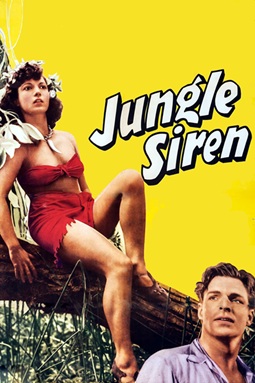
Captain Gary Hart (Buster Crabbe) and his sidekick, Sgt. Mike Jenkins (Paul Bryar), are sent to the jungles of Africa, where Nazi infiltrators are encouraging Chief Selangi (Jess Lee Brooks) to side with the Third Reich and allow them to set up a base. In their effort to stop the Nazis, Hart and Jenkins are aided by Kuhlaya (Ann Corio), a woman whose parents were killed by Selangi and who now lives in the jungle with a chimpanzee and a doctor (Milton Kibbee) who serves as her protector. Kuhlaya carries a bow and arrow, which she used to battle the Nazis. Hart and Jenkins have actual guns and probably could have ended the Nazi plot early just by using them as soon as they arrived but then the movie couldn’t be stretched to 68 minutes.
This is a pretty bad Poverty Row film, memorable just for Crabbe’s typically earnest and athletic performance and the presence of Ann Corio, who was a famous stripper in the 40s who tried to transition into films after Mayor La Guardia ordered the closure of New York’s burlesque houses. Corio had legs for miles but she was a terrible actress. At one point, Mike Jenkins says that if he keeps exercising, “I’ll have a physique like Buster Crabbe!” That’s about as clever as this slow-moving film gets.
As is typical of jungle films that were made in the 40s, the “tribesmen” are pretty much treated as if they’re interchangeable and the only one who is given a personality is the evil Selangi. Several of them are killed over the course of the movie, not because they were doing anything wrong but just because they were in the wrong place. (The most egregious example is an innocent native who ends up with one of Kuhlaya’s arrows in his back because he was unfortunate enough to step in front of Selangi at the last moment.) No one, our heroes included, really seems to care about them or their future. Even by the standards of the era, JungleSiren feels extremely condescending and prejudiced in its portrayal of the natives. The idea that the Nazis, with their Aryan obsession, would ever team up with Chief Selangi is just one of the film’s problems.
Director Sam Newfield was responsible for some entertaining and cheap westerns. I’ve reviewed a few of them. He should have stayed out the jungle.
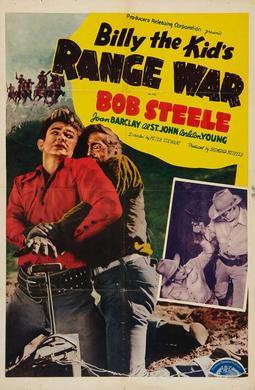
At least that’s the claim of Billy The Kid’s Range War, in which Billy (played by middle-aged Bob Steele) is a do-gooder with a comedic sidekick named Fuzzy (Al St. John) and a hankering to help Ellen Gorman (Joan Barclay) bring a new stagecoach line to town. Williams (Karl Hackett) does want to the Gorman family to success so he hires Buck (Rex Lease) to dress up like Billy the Kid and ride a horse that looks like Billy the Kid’s and commit crimes, like killing Ellen’s father. Framed for all those crimes that he didn’t commit and with his best friend (Carleton Young) ordered to arrest him, Billy decides to go under cover so that he can clear his good name. Someone pretending to be Billy the Kid got him into this mess. Now, Billy’s going to get out of it by pretending to be someone else.
The action is pretty standard for a B-western. Mostly, it’s interesting to see a movie where Billy the Kid is actually a nice guy who gets framed. No wonder a whole generation grew up with no idea about true history of the American frontier. Sam Newfield directed a handful of Billy the Kid films and the capable Bob Steele starred in most of them but this is the only one that I’ve sat down and watched and it actually left me missing the production values of the Johnny Mack Brown films. For fans of these type of westerns, there’s the promise of seeing familiar actors like George Cheseboro and Ted Adams doing there thing. Even the outstanding character actor Milton Kibbee makes an appearance. For those who do not like westerns, this film is not going to change their minds.
Despite the promise of the title, there is no range war in this movie. There’s just Billy the Kid, trying to clear his good name.
On the frontier, someone is raiding the homes of ranchers like Jim (Henry Hall) and Judy Barton (Paula Raymond). The Homeowners Association summons Steve Roper (Charles Starrett) to bring a stop to the raids. Everyone suspects that Cal Matson (Steve Darrell) and his son, Rob (Billy Halop), are behind the raids but Steve, as the Durango Kid, discovers that a third party is trying to set everyone at war with each other for his own benefit.
The entry in the Durango Kid series was Charles Starrett’s 103rd western. It’s not a particularly distinguished entry, relying heavily on stock footage. I did find the idea of the film’s bad guy trying to manipulate the Bartons and the Matsons into destroying each other to be interesting but the movie doesn’t do much with it and the identity of main villain will be obvious to anyone who watches the film. There is one good scene where Steve disarms three bad guys and then makes them walk all the way back to town without their boots on. Steve doesn’t mess around.
Smiley Burnette provides the comic relief and a few songs. This time, Smiley’s a dime store writer researching his next book. Musically, he is accompanied by The Sunshine Boys. 103 movies in and Smiley still hasn’t figure out that Steve and Durango are one of a kind.
Tom and Fred Denton (Preston Foster and Jim Davis) are two frontier lawmen who are frustrated with their jobs. They are both owed backpay. When they shoot an outlaw, they are expected to pay the $80 burial fee. Neither Tom nor Fred feels that they are appreciated by banks and the railroads that expect them to risk their lives on a daily basis.
When Tom and Fred are informed that their younger brother, Matt (Kim Spalding), has been convicted of murder and sentenced to hang in another town, they ride off to save him.
Even though Tom and Fred can both provide an alibi for Matt and it is obvious that Matt has been framed by a corrupt railroad agent, the town is still determined to hang him. Tom and Fred manage to rescue him from the gallows but, in the process, a deputy is killed. Now wanted by the authorities, the Denton brothers are forced to team up with the same outlaws that they used to hunt. Soon, the Dentons are robbing banks and trains and their old friend, Pete Coleman (Monte Blue), has been ordered to captured them, dead or alive.
One of the many low budget westerns to be produced by the Lippert Company, Three Desperate Men is a cut above the usual B-western. None of the Dentons want to be outlaws but they are forced into it by circumstances out of their control. The real villains of the film are the bankers and the railroad tycoons who hoard the land and the money and who try to cheat men like Tom and Fred out of their rightfully earned wages. The Denton brothers ultimately decide that their number one loyalty is to each other and that leads to the movie’s fatalistic conclusion, which is surprisingly violent for a 1951 western. Preston Foster, Jim Davis, and Monte Blue head a cast that is full of tough and authentic western veterans and the action scenes are imaginatively staged by director Sam Newfield. Three Desperate Men is a B-western that can be enjoyed even by those who don’t like westerns.
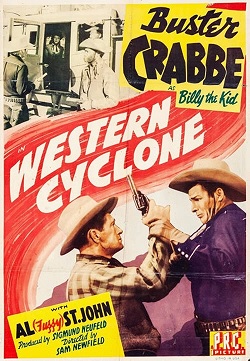
Feeling that the old west has become a dangerous place, law-abiding gunslinger Billy the Kid (Buster Crabbe) fakes a stagecoach robbery and pretends to kidnap the governor’s daughter, all to show him that the west needs more law enforcers. The governor is so impressed by Billy’s ruse that he agrees to stand tough on crime. This upsets Dirk Randall (Glenn Strange, who also played Frankenstein’s monster is some of the later Universal horror films), a businessman who has been funding the criminals in order to make the governor look weak so that Randall could defeat him in the next election.
Randall orders one of his men to pull a gun on Billy while Billy is leaving the local saloon. Billy pulls and fires his own gun in self-defense but it’s Randall who actually kills the man by shooting him in the back and then running off in the confusion. Because the man was shot in the back, Billy is accused of murder, arrested, and sentenced to death in record time. With Billy in jail, it falls to his comic relief sidekick, Fuzzy Jones (Al St. John), to prove that Billy didn’t actually fire the shot that killed the man.
By most accounts, Billy the Kid was a nasty piece of work who would kill anyone who look at him in the wrong way but, in the 30s, the character was the hero of a series of 42 Westerns that all featured him as a hero and a valued member of the community. (Originally, Bob Steele played Billy. Buster Crabbe took over the role with the seventh film.) Western Cyclone was the 17th Billy the Kid film and, as long as you’re not a stickler for historical accuracy, it’s an entertaining B-western. The plot is formulaic but Crabbe was a good hero, Strange was a diabolical villain, and, for once, Al St. John got to play an important role in resolving the film’s story. Fuzzy Jones did some impressive detective work. The real Billy the Kid probably could have used someone like Fuzzy in his corner.
Gary Farrell (Buster Crabbe) is a widowed truck driver who wants his son to have a better life than his old man. Good luck pulling that off on a salary of $45 a week. Gary enters a boxing tournament, just hoping to win enough money to pay for his son to go to military school. But, under the tutelage of veteran trainer Pop Turner (Milton Kibbee), Gary becomes a real contender. He also becomes a first class heel, turning his back on his old, honest lifestyle and getting involved with fast-living socialite, Rita London (Julie Gibson). Can Gary’s friends and newspaper reporter Linda Martin (Arline Judge) get Gary to see the error of his ways?
The Contender, which is in the public domain and can be viewed at the Internet archive, is a typical poverty row production, with all the expected boxing clichés. Gary’s initial rise is just as predictable as his downfall and eventual redemption. For fans of Buster Crabbe, though, it is a chance to see Crabbe playing someone other than Tarzan, Flash Gordon, or Buck Rogers. (Crabbe was the only actor to play all three of these roles over the course of his long career. He also appeared as Billy the Kid in several westerns.) Though he was a swimmer and not a boxer, Crabbe’s natural athleticism made him a good pick for the role of Gary. Julie Gibson is sexy and fun as the bad girl and be sure to keep an eye out for Glenn Strange, who plays Gary’s best friend. Just as Crabbe was forever typecast as Flash Gordon, Strange will always be remembered for replacing Boris Karloff in the role of Frankenstein’s Monster.
If you’re a regular reader of this site, it will not take you by surprise to learn that the 1933 Best Picture Nominee, 42nd Street, is one of my favorite films of all time.
I mean, how couldn’t it be? Not only is it a pre-Code film (and we all know that pre-Code films were the best) and one the features both Ginger Rogers and Dick Powell in early roles but it’s also a film that depicts the backstage world of a stage musical with such a combination of love and snark that it will be familiar to everyone from community theater nerds to Broadway veterans. 42nd Street is a classic musical, though I have to admit that I think the majority of the songs are a bit overrated. Even more importantly, 42nd Street is the ultimate dance film. The film’s big production number, choreographed and filmed in the brilliant and flamboyant Busby Berkeley style, is such an iconic moment that it’s still being imitated and lovingly parodied to this day.
Every dance movie owes a debt to 42nd Street but few have come close to matching it. Remember how much we all hated Smash? There were a lot of reasons to hate Smash but the main reason was because it tried to be 42nd Street and it failed. There can only be one 42nd Street.
It’s hard to estimate the number of show business clichés that currently exist as a result of 42nd Street. Then again, it can be argued that they were clichés before they showed up in 42nd Street but 42nd Street handled them in such an expert fashion that they were transformed from being urban legends to immortal mythology.
42nd Street takes place in the backstage world, following the production of a Broadway musical through casting to rehearsals to opening night. It’s an ensemble piece, one populated by all the usual suspects. Julian Marsh (Warner Baxter) is the down-on-his-luck producer who desperately needs a hit. Dorothy Brock (Bebe Daniels) is the celebrated star who is dating a rich, older man (Guy Kibbee, who made quite the career out playing rich, older men) while secretly seeing her ex, a down-on-his-luck Vaudevillian (George Brent). From the minute that we first see Dorothy, we know that she’s eventually going to end up with a boken ankle. It’s just a question of which chorus girl will be promoted to take her place. Will it be “Anytime” Annie (Ginger Rogers) or will it be the naive and wholesome Peggy (Ruby Keeler)? You already know the answer but it’s still fun to watch.
If you had any doubts that this was a pre-code film, the fact that Ginger Rogers is playing a character named “Anytime” Annie should answer them. 42nd Street is often described as being a light-hearted camp spectacle but there’s a cynicism to the film, a cynicism that could only be expressed during the pre-code era. The dialogue is full of lines that, just a few years later, would never have gotten past the censors.
(This is the film where it’s said that Anytime Annie “only said no once and then she didn’t hear the question!” This is also the film where Guy Kibbee cheerfully tells Annie that what he does for her will depend on what she does for him. Just try to get away with openly acknowleding the casting couch in 1936!)
The menacing shadow of the Great Depression looms over every glossy production number. Julian needs a hit because he lost all of his money when the Stock Market crashed and if the show is not a hit, everyone involved in the production will be out on the streets. The chorus isn’t just dancing because it’s their job. They’re dancing because it’s an escape from the grim reality of the Great Depression and, for the audience watching, the production numbers provided a similar escape. 42nd Street said, “Yes, life is tough. But sometimes life is fun. Sometimes life is sexy. Sometimes, life is worth the trouble.” Someday, 42nd Street promises, all the misery will be worth it.
Ultimately, 42nd Street is all about that iconic, 20-minute production number:
42nd Street was nominated for best picture but it lost to the nearly forgotten Cavalcade.
 Billy “The Kid” Bonney (Buster Crabbe) and his two buddies Fuzzy (Al St. John) and Jeff (Bud McTaggart) are just trying to mind their own business and make a living in the old west but they keep getting accused of every crime that happens. This time, they’re sentenced to hang for a crime they didn’t commit. Luckily, a group of strangers break Billy and his friends out of jail and send them on their way to the next town. However, the men who broke them out of jail are soon committing crimes while disguised as Billy, Fuzzy, and Jeff! Billy teams up with Sherriff Masters (Ted Adams) to stop the imposters, who are working for Boss Jim Stanton (Glenn Strange).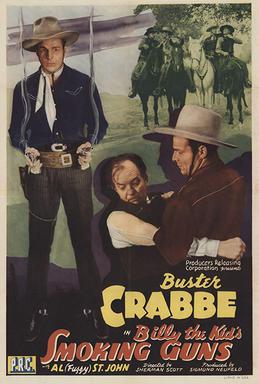


 Gary Farrell (Buster Crabbe) is a widowed truck driver who wants his son to have a better life than his old man. Good luck pulling that off on a salary of $45 a week. Gary enters a boxing tournament, just hoping to win enough money to pay for his son to go to military school. But, under the tutelage of veteran trainer Pop Turner (Milton Kibbee), Gary becomes a real contender. He also becomes a first class heel, turning his back on his old, honest lifestyle and getting involved with fast-living socialite, Rita London (Julie Gibson). Can Gary’s friends and newspaper reporter Linda Martin (Arline Judge) get Gary to see the error of his ways?
 Through the Shattered Lens