Retro Television Review: Fantasy Island 7.10 “Goin’ On Home/Ambitious Lady”


Welcome to Retro Television Reviews, a feature where we review some of our favorite and least favorite shows of the past!  On Tuesdays, I will be reviewing the original Fantasy Island, which ran on ABC from 1977 to 1984.  Unfortunately, the show has been removed from most streaming sites.  Fortunately, I’ve got nearly every episode on my DVR.
This week is another trip to the Island that feel a bit too familiar.

Episode 7.10 “Goin’ On Home/Ambitious Lady”

(Dir by Don Ingalls, originally aired on January 7th, 1984)

Nope.  I’m just not going to do it.  I refuse to spend too much time on this episode.  This episode felt like a rehash of several earlier episodes, all of which worked considerably better and didn’t feature Lawrence hovering in the background.

Billy Joe Pine (Mickey Gilley) is a country-western star who comes to the Island because he wants to be reunited with the family that he left behind when he traveled from the farm to …. Nashville, I guess.  His father (Leif Erickson) forgives him but his younger brother (John Dennis Johnston) is less inclined.  Mickey Gilley was a real-life country western singer and the only reason I know this is because he appeared previously on Fantasy Island as himself.  That episode wasn’t great but it was a masterpiece compared to this one.  “They don’t let you swim in your long johns!” is a line that is uttered at one point and I cringed like I’ve never cringed before.  This whole thing just felt rehashed and tired.

The second fantasy featured fashion designer Bryana Spencer (Mary Ann Mobley) and her husband, Fred Nelson (Ron Ely).  Fred gave up a promising entertainment career so that he could work as the exclusive emcee for Bryana’s fashion shows.  Bryana’s fantasy is for Fred to find the success that he gave up while Fred’s fantasy is for Bryana and him to experience that type of love that they felt for each other before Bryana became successful.  In other words, it’s time for another Fantasy Island fashion show!

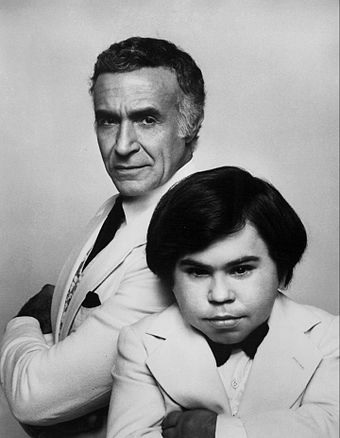
Character actor George Wyner (you would recognize him) made me smile as the fashion show’s choreographer but otherwise, this was a pretty boring fantasy.  Mobley and Ely didn’t have much chemistry.  Then again, neither did Roarke and Lawrence.  The entire time I watched this episode, I kept thinking to myself, “Tattoo liked country western music.  Tattoo liked fashion shows.  This could have been a great Tattoo episode!”

This was not a great trip to the Island.
Retro Television Review: Fantasy Island 6.5 “Everybody Goes to Gilley’s/Face of Fire”


Welcome to Retro Television Reviews, a feature where we review some of our favorite and least favorite shows of the past!  On Tuesdays, I will be reviewing the original Fantasy Island, which ran on ABC from 1977 to 1984.  Unfortunately, the show has been removed from most streaming sites.  Fortunately, I’ve got nearly every episode on my DVR.

This week, Fantasy Island goes country.

Episode 6.5 “Everybody Goes to Gilley’s/Face of Fire”

(Dir by Jerome Courtland, originally aired on November 20th, 1982)

Mickey Gilley is a country-western singer who comes to Fantasy Island because he wants to finally become a star after years of struggling.  Tattoo, who is a huge country music fan, puts on a cowboy hat and decides that he’ll be Gilley’s “exclusive manager.”  Not so fast, Mr. Roarke says.  Apparently, there’s a country-western bar on the other side of the Island and the owner, Mr. Sherwood (Dennis Cole), has a fantasy of finally having a successful bar.  Roarke arranges for Gilley and Sherwood to become partners.  Gilley is a star whenever he performs in Sherwood’s bar.  In the end, Sherwood and Gilley leave the Island together with Sherwood as Gilley’s new manager.

I’m not a huge country music fan so I have to admit that, until I watched this episode, I had no idea who Mickey Gilley was. (In fact, in my first draft of this review, I repeatedly called him “Dennis Gilley,” so that tells you how much I know about county-western singers.)  Gilley actually was a country music star, one who did spend several years toiling away in small clubs before he finally found success.  This role was autobiographical for him.  It’s a bit odd that he plays himself but maybe he was a big deal in 1982.  As I said, country music is not my area of expertise and 1982 is a bit before my time.  What I can say is that, on the show, Gilley was portrayed in a way that kind of made him seem like a jerk.  I mean, the nonstop complaining and all the demands!  “I’m not here for romance,” he tells Roarke at one point.  Don’t tell Mr. Roarke how to do his job, Gilley!

The other storyline was a take on Jane Eyre.  Jean Harrigan (Lynn Redgrave) is from Nevada, despite being totally English.  She needs a million dollars.  A mysterious rich guy (David Hedison) offers it to her if she can survive a weekend at his home.  His crazy wife is locked away in a bedroom.  She ends up catching on fire towards the end of the episode, freeing things up for Jean and the rich guy.  What’s interesting is that the rich guy says that he originally met Jean when his car broke down in the Nevada desert and Jean gave him a ride.  What’s interesting about this is that, when the legendary Howard Hughes died, a man named Melvin Dummar claimed that he had once given Hughes a ride after coming across him stranded in the Nevada desert and, in return, Hughes left him a good deal of his fortune.  Dummar even produced a will in support of his claim.  The courts ruled the will to have been a forgery and Dummar never received his money, though there still are people out there who defend “the Dummar will” and claims that he was telling the truth about meeting Hughes.  Fortunately, Jean does get her money and a chance to spend some time with the totally charming and handsome David Hedison.

(Hedison was also the best Felix Leiter, appearing in Live and Let Die and License to Kill.)

Perhaps not surprisingly, I preferred the gothic story to the country music story.  I appreciated that Tattoo got to do something this episode.  The scene where he declares himself to be Gilley’s manager felt like a throwback to the show’s earlier seasons.  This journey to the Island was a mixed bag for me, though overall it was a pleasant trip.

Smokey And The Good Time Outlaws (1978, directed by Alexander Grasshoff)


After meeting a talent agent while spending a night in jail, aspiring singer J.D. (Jesse Turner) and his best friend, The Salt Flat Kid (Dennis Fimple), decide to leave Texas for Nashville.  J.D. wants to be a star and the Salt Flat Kid is a ventriloquist who doesn’t go anywhere without his dummy.

On the way to the Grand Old Opry, they pick up two women (Dianne Sherrill and Marcia Barkin), one of whom was engaged to marry the idiot nephew (Gailard Sartain) of Nashville’s Sheriff Leddy (Slim Pickens).  The sheriff sets out after the two men, planning on sending them back to Texas.

Despite the title and the subplot about the sheriff searching for his nephew’s former future wife, Smokey and the Good Time Outlaws doesn’t have much in common with Smokey and the Bandit.  J.D. has a Burt Reynolds-style mustache but he’s not a bandit.  He is just someone who wants to be a star and most of the movie is about him and the Salt Flat Kid tying to make their way onto the stage of the Grand Old Opry.  Helping them out is an eccentric woman named Marcie (who is played by Hope Summers, who older viewers will immediately recognize as having been Clara Edwards on The Andy Griffith Show).  When J.D. can’t get an audition, it occurs to him to just rush out on stage and start performing.

This film was a dream project for Jesse Turner, who was a real-life country musician.  He co-wrote and produced the film, as well as starred in it.  Jesse Turner wasn’t much of an actor but he’s surrounded by a good supporting cast.  Slim Pickens steals the show as a more menacing version of Buford T. Justice but he’s not in the film nearly enough.  Dennis Fimple is likable but appears to be too old to be known as “the Kid.”  You can tell this is a movie because no one is creeped out by the Kid’s ventriloquist dummy.

Smokey and the Good Time Outlaws was made for the Southern drive-in circuit and it is good-natured, even if the story is never that interesting.  Country music fans of a certain age will appreciate it.