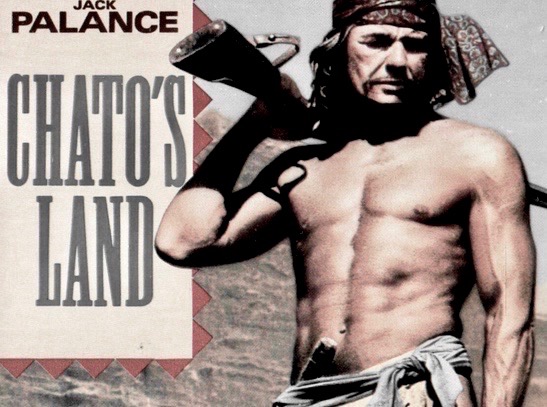
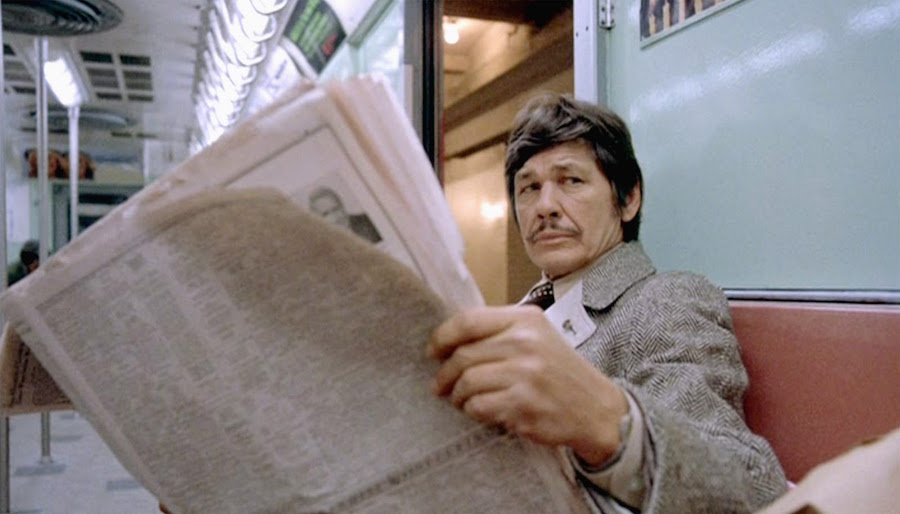
CHATO’S LAND (1972) – Jack Palance leads a posse after Charles Bronson!


One of the most enjoyable things about being a dad is introducing your favorite things to your kids. I taught my son Hank the sports of basketball, baseball, and golf, and even now there’s nothing we enjoy doing more together than playing a round of golf. Of course, as one of the world’s biggest Charles Bronson fans, I’ve introduced him to many films starring my cinematic hero. It seems that two movies have stood the test of time and have gone on to become two of his favorite movies. The fact that THE DIRTY DOZEN (1967) is one of his favorites isn’t a big surprise as he’s always enjoyed playing video games set during World War II. The other, CHATO’S LAND (1972), was more of a surprise. A few years ago, when Hank was home from college, I asked him if there was a movie he wanted to watch. It could have been any movie in the world, and I was honestly a little surprised when he said he’d been wanting to watch CHATO’S LAND again. Needless to say, this dad was very proud. 

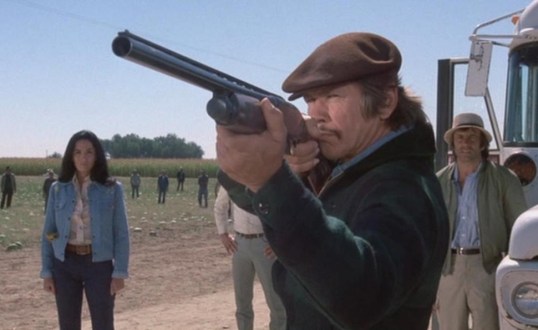
Charles Bronson is Pardon Chato, a half breed Apache who’s minding his own business and having a drink in the saloon, when a small-town sheriff decides to give him hell just for being a “breed.” Forced to kill the racist POS in self-defense, Chato heads out of town a day ahead of the posse led by the former confederate Captain Quincey Whitmore (Jack Palance). Whitmore may be leading the posse, but the Hooker Brothers (played by Simon Oakland, Ralph Waite, and Richard Jordan) are just as bigoted as the sheriff who was killed, and they set about bullying their neighbors into joining their hunt for Chato. A couple of the guys who go along because it’s “expected of them” are Joshua Everette (James Whitmore) and Gavin Malechie (Roddy McMillan). When the posse comes across Chato’s home and woman, some of the members decide the wise thing to do is rape her and tie her up as bait. This is clearly not going to work out well for the posse, even those who tried to stop the rape. Using his sneaky Indian skills and the help of a fellow Indian, Chato is able to create a diversion and rescue his woman, but his friend is killed in the process. With his friend murdered and his woman brutalized and raped, Chato is no longer willing to just run away. From this point forward, the hunters will become the hunted as he leads them all further into CHATO’S LAND. 

There are several things that I find interesting about CHATO’S LAND. This is the first of six films that director Michael Winner and Charles Bronson would make together. They would all be financially successful films with THE MECHANIC (1972) and the original DEATH WISH (1974) standing out as true 70’s classics. Charles Bronson’s last number one box office hit would be DEATH WISH 3 (1985), which would also be his final film with Winner. It should also be noted that the character of Chato would be an early precursor of the kind of character Bronson would go on to embody almost exclusively throughout the rest of his career, that of the quiet but deadly man of action. Chato only says 13 lines in the entire movie and most of those are in a Native American dialect. Chato doesn’t have that much actual screen time either, but his presence dominates every scene. He’s like the angel of death hanging over the entire proceedings waiting to strike, and Winner continues to build on this tension as the film moves towards its inevitable conclusion. It’s an incredible, physical performance that can only be delivered by an actor like Bronson. Finally, the film has an outstanding cast, a cast that Winner himself would call “as good a cast as I ever assembled.” In addition to Bronson, Jack Palance is excellent as the confederate captain who’s never gotten over losing the war, and who now finds himself losing the battle to control the men in the posse. James Whitmore and Roddy McMillan are solid as a couple of decent men who went along because they felt it was their duty to their neighbors, who now find themselves caught up in a bad situation with even worse men. And finally, Simon Oakland, Ralph Waite & Richard Jordan are the kind of men you love to hate as the ignorant and bigoted Hooker brothers. It doesn’t hurt your feelings at all to see those guys get what’s coming to them.

Overall, CHATO’S LAND is a very good western, dominated by Bronson’s presence in the same way that JAWS (1975) is dominated by a giant killer shark. It was also a hugely profitable film upon its initial release, guaranteeing that Bronson would continue to get starring roles in films backed by American studios. Bronson liked to work with the same directors once he felt comfortable with them, and his collaboration with Winner would prove to be extremely fruitful and help turn him into one of the biggest box office stars in America. Thanks, Michael! 

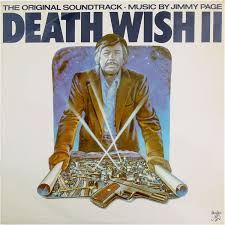
Happy Birthday, Jimmy Page & thanks for the DEATH WISH II soundtrack!


I’m a movie guy more than a music guy, but I still love Jimmy Page. His soundtrack for DEATH WISH II has been a part of my entire life. It’s such a strange, unique score, but it seems to work perfectly for the movie. I was only around 10 years old when I first saw an “edited for TV” version of the movie in ‘83 or ‘84. To be completely honest, the music kinda scared me. I laugh when I type that now, but it’s the truth! Parts of the soundtrack were rearranged again a few years later for DEATH WISH 3, the Charles Bronson movie I’ve watched more than any other.

Happy Birthday, Mr. Page!! Thanks so much for being Michael Winner’s neighbor and composing that soundtrack. This guy from Arkansas truly appreciates it!

I’ve attached a link to the soundtrack below for your listening pleasure!

THE MECHANIC (1972) – Celebrate the New Year with one of Charles Bronson’s most iconic roles!


THE MECHANIC features an iconic performance by Charles Bronson, a performance that would represent a blueprint for the type of character he would play in many films…the strong, silent, unstoppable, man of action.  Bronson plays Arthur Bishop, a hit man with a gift for planning and executing his hits in a way that make the deaths look like natural deaths rather than murders.  Facing health issues and loneliness, he takes on a young protégé named Steve McKenna, played by Jan-Michael Vincent.  This upsets his bosses in the underworld because he takes on the apprentice without asking them.  Will they allow him to train up this new protégé and complete tag team hits going forward, or will they decide that Bishop is no longer worth the risk?          

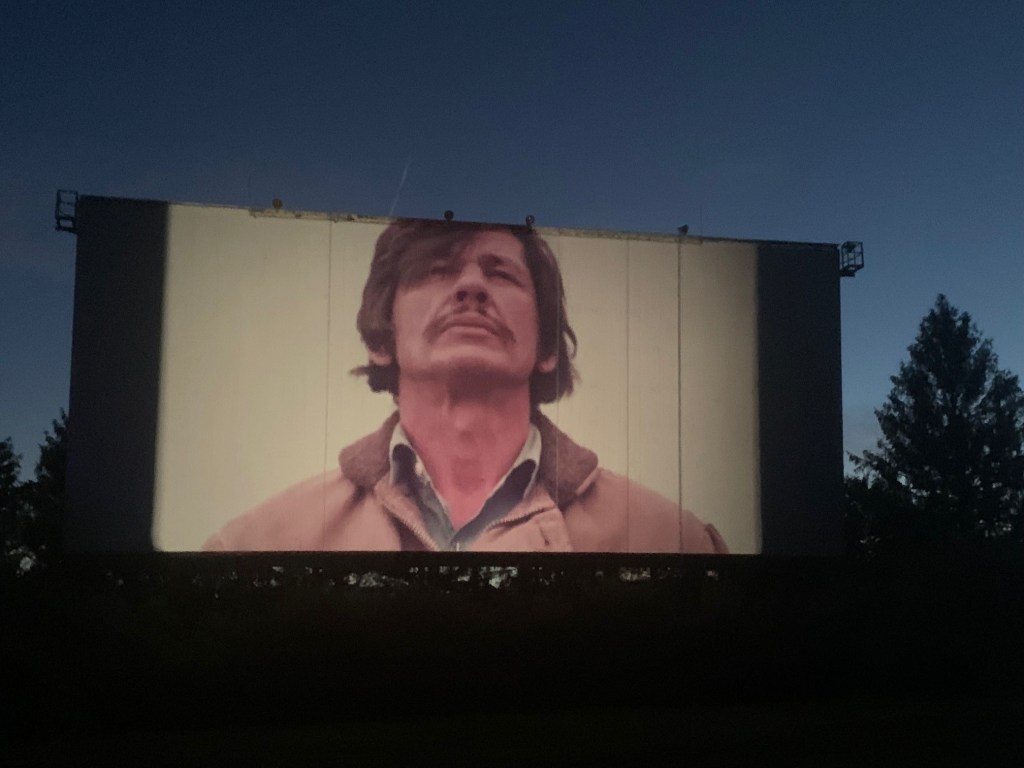
I’ll start off by stating up front that I love THE MECHANIC.  The first Charles Bronson movie I ever owned on VHS was a nearly unwatchable, 2nd hand version of the film, but I still tried to watch it.  The first Charles Bronson movie I ever saw on the big screen was a beautiful 35mm print of the film at the Mahoning Drive-in theater in Lehighton, PA.  I also believe that this film has the best ending of any Charles Bronson film.  Needless to say, the following review will be full of praise, so if you’re looking for a real critical take on the piece, this is probably not the place to look!

To start off, THE MECHANIC has a uniquely amazing opening sequence.  The first 16 minutes of the film features hitman Bishop going through the mundane tasks of setting up a hit.  We watch him set up shop across the street from the mark, we watch him break into the mark’s apartment to rig the things needed to accomplish the hit, we watch him squeeze a wax ball, etc.  Bishop speaks no dialogue during these 16 minutes, and the only things we hear are the sounds of the soundtrack and the street.  Bronson’s unique screen presence makes it mesmerizing.  Could you imagine an action film trying this strategy in this day and age?   

Once Bishop has successfully completed the first hit, we’re introduced to Bishop’s world outside of what we’d observed during the opening sequence.  We meet Harry McKenna (Keenan Wynn), the “uncle-like” figure who has gotten himself in trouble with the organization.  We’re not surprised who’s given the job to eliminate this problem.  We meet Harry’s son Steve (Jan-Michael Vincent) who hits it off with Bishop at the funeral where their relationship really begins.  On a side note, the film’s script featured these two characters as gay men, and the sexuality element was going to be a major way that Steve would get close enough to Bishop to gain his trust.  That part of the script was changed to get Bronson and secure financing for the film.  Since that element is not part of the movie I’ll move on.  We meet a prostitute (Jill Ireland) who’s visited by Bishop.  This is a very interesting scene that gives us a strong insight into just how lonely Bishop is and also helps us understand why he’s open to the idea of bringing on an apprentice.  I think Jill Ireland is quite effective in her one scene.

Once the various characters are introduced, the film settles nicely into a mentoring relationship between Bishop & Steve.  The experienced hitman shares his knowledge, and we follow along with them as they complete various assignments.  The movie seems most interested in the relationship between the men, but this is an action movie, so we have a couple of very solid action sequences in the middle portion of the film, as well as the end.  Director Michael Winner, who directed Charles Bronson in six different films, stages these sequences extremely well, especially the sequence that ends the film in Naples, Italy.  We see necks snapped.  We see faces knuckle punched.  We see a motorcycle chase ending with a motorcycle flying off a cliff and exploding into a ball of flames upon impact.  We see boats exploding.  We see Bronson using my favorite weapon, the pump shotgun, with expert precision.  We see cars chasing each other along the Italian coast.  We see bombs being dropped out of moving cars with precision timing to blow up the cars behind them.  We even see a bulldozer pushing a moving car off the side of a cliff.  It’s some amazing stuff, with Bronson & Vincent appearing quite badass at times.  And then the ending, the ending that proves just how awesome Bishop truly is!  I won’t say anymore about that.  Just watch and enjoy! 

**BONUS CONTENT** – We dedicated an episode of the “This Week in Charles Bronson” podcast to THE MECHANIC. It was one of the most enjoyable episodes for me to record. If you’re interested in learning more about the film from a group of guys who love Charles Bronson, give it a listen!

DEATH WISH 3 – The movie I’ve watched more than any other!


I’m on Day 3 of my discussion of Charles Bronson’s DEATH WISH series in chronological order. This series has brought me countless hours of entertainment over the last 40 years, so enjoy and let me know your thoughts!

DEATH WISH 3 is a very important movie to me. I recently closed my celebration of Charles Bronson’s 103rd birthday movie marathon on November 3rd with another viewing of DEATH WISH 3, the film that turned me into the only Charles Bronson superfan in Toad Suck, Arkansas. After a day of celebratory viewings of CHATO’S LAND, 10 TO MIDNIGHT (on VHS), FROM NOON TIL THREE, COMBAT: HERITAGE (on VHS), THE SEA WOLF (on VHS), and the original DEATH WISH, I had no choice but to watch DEATH WISH 3, a movie I have watched well over 100 times over the course of my life. DEATH WISH 3 is one of only four Charles Bronson films that I have seen on the big screen, as I was able to watch it at the Mahoning Drive-In in Lehighton, PA in June of 2022.

The third entry in the DEATH WISH franchise begins with Paul Kersey (Charles Bronson) riding a Go Big Red Trailways bus into New York City. Since this is an odd numbered DEATH WISH film, it takes place in New York. The even numbered films take place in Los Angeles. Kersey looks kind of grumpy as he rides into town. I would definitely avoid sitting next to him if I was a passenger on the same bus that day. We learn that Kersey’s coming into town to visit his old buddy, Charlie. Unfortunately, his arrival coincides with members of a violent street gang breaking into Charlie’s apartment and beating him to death. Just after the punks go running away from the scene of the crime, Kersey walks into Charlie’s apartment to find the man clinging to his last breath of life and asking Kersey to “take care of his things, until I get back.” Some of Charlie’s neighbors had called the police a little earlier, and they arrive just in time to find Kersey standing over the body, so they arrest him for his old buddy’s murder. This seems reasonable since Kersey is the only person wearing a sports jacket and button up shirt in this gang infested area. Kersey is taken to the police station where a group of cops commence to beating the crap out of him in hopes of getting a confession. After a few punches to the gut by the cops and the old “you can have water if you tell us what we want to know” routine, Lt. Richard Shriker (Ed Lauter) enters the room and promptly asks “Who’s this dude?” You see, Kersey is going under the alias Paul Kimble, but Shriker recognizes the dude as Paul Kersey, the vigilante from the original DEATH WISH. Shriker goes on to explain that he was with the New York PD the night they brought in a vigilante with a bullet in his leg who was out like a light. Having the vigilante in town again, light bulbs immediately go off over Shriker’s head and he quickly hatches a plan. It seems a gang of criminals, led by Mandy Fraker (Gavan O’Herlihy) has taken over the community and police have been powerless to stop them. First, it’s really hard to catch the gang members because some of them can run really fast, and second, when they finally do catch them, the gang members have lawyers who can get them off. Lt. Shriker decides he’ll let Kersey out of jail, but only if Kersey is willing to resume his vigilante ways, shoot some of the creeps, and even throw some street info the police department’s way so they can get a few busts. Paul Kersey immediately agrees even though he seems kind of tired. You can’t help but wonder if Kersey might be needing the release that only can be achieved through violence against creeps. In short order, Kersey sets up shop in his old buddy’s apartment so he can take care of his things, gets to know the local residents, waits for an arsenal of African big game pistols and rocket launchers to arrive via UPS, makes love to public defender Kathryn Davis (Deborah Raffin), and eats all sorts of local delicacies like stuffed cabbage and broiled chicken. As an added bonus, the neighborly Bennett (Martin Balsam) just happens to have a couple of Browning machine guns in his closet that he was somehow able to smuggle home from World War II. It’s against this backdrop that Kersey sets out to wage a one-man war against the violent gang that has turned the corner of Sutter and Belmont into hell on earth!

There’s not much I can say about DEATH WISH 3 that hasn’t already been said.  It’s a wild, over the top action film that would mark the 6th and final film that Bronson would work on with director Michael Winner.  It would also be Charles Bronson’s last film that would rise to #1 at the U.S. box office when it premiered on November 1st, 1985.  It features some fun performances, especially from Ed Lauter as Lt. Shriker, Gavan O’Herlihy as gang leader Mandy Fraker, and Kirk Taylor as the gang member known as the Giggler who “can really move,” but who’s still not fast enough to outrun a bullet! A pre-Bill and Ted’s Alex Winter also plays a gang member named Hermosa, continuing the series tradition of casting actors as street creeps who would go on to be a bigger star a few years down the road. DEATH WISH 3 is not a great movie in the traditional sense, but it’s one of the most enjoyable movies ever made if you’re in the right frame of mind. 

DEATH WISH 3 is the movie most responsible for my obsession with Charles Bronson. I received it as a Christmas present in 1986 when I was thirteen years old, and I proceeded to watch it almost daily for months. It was the only Bronson film I owned on VHS so I would watch it almost every night unless I had a basketball game, or I had been able to rent a different Bronson film from the video store.  I know every line in the film and no other movie holds more nostalgic value in my life. DEATH WISH 3 is a 5-star movie in my book in so many ways that have nothing to do with critical acclaim. As long as I’m breathing, long live DEATH WISH 3!!!

BONUS: We completed a roundtable a few weeks back on the THIS WEEK IN CHARLES BRONSON PODCAST, where we spend the entire episode discussing what we love about DEATH WISH 3. I had a blast on the episode with my partner in crime Eric Todd, as well as fellow “Buchinsky Boys” Chris Manson & David Mittelberg. We even throw some love TSL’s way during the episode. Give it a listen if you get the chance!

DEATH WISH II – Bronson wears a beanie!


I’m on Day 2 of my discussion of Charles Bronson’s DEATH WISH series in chronological order. This series has brought me countless hours of entertainment over the last 40 years, so enjoy and let me know your thoughts!

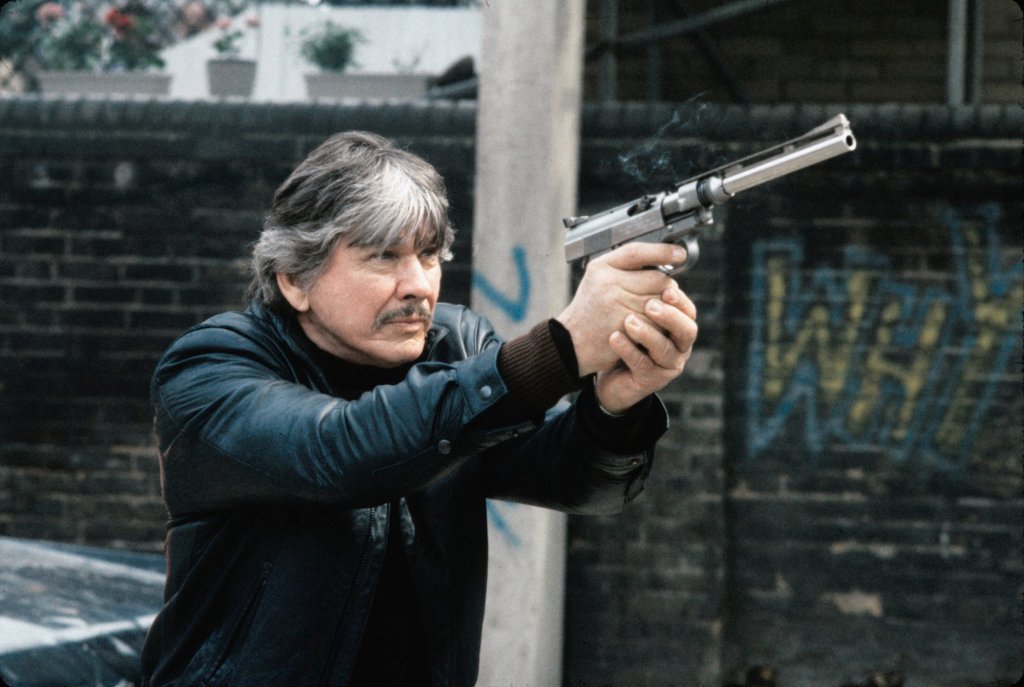
Charles Bronson returns as vigilante Paul Kersey in DEATH WISH II. In this installment, Kersey is trying to get his life back on track in Los Angeles with his daughter Carol, who’s still traumatized from the events of the first film, and with his new lady friend Geri Nichols (Jill Ireland). One day when he takes these two out for a fun day of shopping and ice cream, Kersey runs afoul of a group of young thugs who take his wallet. They use the wallet to find Kersey’s address, stand outside his house and make a plan like they’re diagramming a back yard football play, and then break in and rape his housekeeper. They set up shop to wait on Kersey to come home. When Kersey and his daughter finally arrive, the thugs knock out Kersey and kidnap his daughter. They take her back to their warehouse / hideout, where they rape her and she then falls to her death trying to escape. After this series of horrific events, Paul Kersey again turns vigilante to hunt down and kill every person responsible. 

DEATH WISH II (1982) came along at a time in Charles Bronson’s career when he needed a box office hit. His prior three movies, DEATH HUNT, BORDERLINE & CABOBLANCO, had barely made a dent at the box office. Around the same time that Bronson needed a hit, the infamous Cannon Films, recently purchased by cousins Menahem Golan & Yoram Globus, was also looking to make a big splash in the American movie market. Cannon decided that a sequel to DEATH WISH was just what they needed, and with a big paycheck, they were able to convince Bronson to come along for the ride. Director Michael Winner was also hired to direct. The resulting film was a big success, earning back eight times its production budget at the box office alone. Its success also started a relationship between Bronson & Cannon Films that lasted for a total of eight films all the way to the end of the 1980’s. 

Now that we’ve discussed how important DEATH WISH II was to extending Charles Bronson’s leading man career and providing Cannon Films a needed hit, let’s talk about the movie itself. I’m just going to say upfront that it’s my least favorite of the DEATH WISH series. Even though it presents itself as a serious film, it’s more of an exploitative retread of the 70’s classic than a realistic continuation of the Kersey character. And the first thirty minutes is hard to watch. Not content with just allowing Kersey to lose a beloved family member, Winner has crafted two graphic rape and murder sequences. These scenes are rough. While they do make sure we want to see Paul Kersey get his revenge, they leave a bad taste in our mouth that doesn’t go away as the creeps are being dispatched one by one. Vincent Gardenia returns as Frank Ochoa, the New York detective who investigated the original vigilante killings in DEATH WISH. Gardenia was so good in the original, but he’s not given much to do here. Jill Ireland doesn’t really add much either as his new lady friend. 

This is a Charles Bronson film though, so there are definitely some things about DEATH WISH II that I really do like. First, I think Bronson looks like a total badass in his beanie that he wears when he’s hunting down the creeps on the mean streets of LA. It’s a classic 80’s Bronson look. Second, Kersey has some cool sayings as he dispatches the bad guys. The “Do you believe in Jesus” exchange is the best example. Third, it’s fun seeing a young Laurence Fishburne show up as one of the creeps, extending the franchise’s ability to cast future big stars as horrific rapists. Jeff Goldblum had that distinction in DEATH WISH. And finally, Led Zeppelin guitarist Jimmy Page composed the music for DEATH WISH II. It’s a memorable soundtrack that’s different than just about anything I’ve ever heard. It’s the most unique thing about the entire movie! 

The bottom line is that I would watch Charles Bronson read a phone book, so I will always find something to enjoy about his films. Well, maybe every one but LOLA. DEATH WISH II isn’t as fun as most Bronson movies, even if it does have some good moments. I’m glad DEATH WISH 3 went a completely different direction with Kersey’s character.

BONUS: Robert “Bobby” Lyons had a part in DEATH WISH II. On our THIS WEEK IN CHARLES BRONSON PODCAST, my partner Eric Todd and I interviewed Bobby about his time on DEATH WISH II and a whole bunch of other topics. He has some interesting stories to tell about working with Charles Bronson, as well as clashing on the DEATH WISH II set with Michael Winner. Give it a listen if you get a chance!

DEATH WISH – It’s a wonderful life…at least it has been for me!


Over the next 5 days, I will discuss Charles Bronson’s DEATH WISH series in chronological order. This series has brought me countless hours of entertainment over the last 40 years, so enjoy and let me know your thoughts!

“Don’t ever make a death wish, because a death wish always comes true!” – I’ve always thought this was kind of a corny saying on the original DEATH WISH trailer, but as one of the world’s biggest Charles Bronson fans, I still hold the original DEATH WISH (1974) in extremely high regard. This is the 70’s revenge classic that made Bronson a box office superstar in his home country, while simultaneously influencing the way vengeance was depicted on screen for decades to come. DEATH WISH is one of the most underrated and influential films from a decade that was full of great films.  

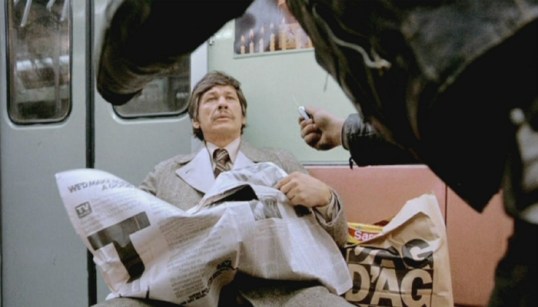
If you’re reading this review, I’d be about 99% positive that you know the basic story of the film. Charles Bronson plays Paul Kersey, a conscientious objector whose wife is killed and whose daughter is raped by a group of criminal thugs in New York City. When the police are incapable of providing justice, Kersey turns into a sidewalk vigilante and stalks the streets and subways of New York, luring thugs to mug him so he can shoot them with his 32-caliber Colt Police Positive pistol. Vincent Gardenia plays detective Frank Ochoa, who’s put in charge of finding the vigilante and putting an end to his one-man mission of justice.  

It’s been 50 years since DEATH WISH was released into theaters and it’s hard to fathom just how controversial the film was in its time, especially since I wasn’t even 1 year old when it was released. The graphic rape scene that kicks off the events of the film, combined with the vigilante subject matter, turned off so many big stars, including Jack Lemmon, Henry Fonda and George C. Scott. This opened up the door for Charles Bronson who didn’t have any such misgivings. They just didn’t understand what a nerve the film would touch with the filmgoing public, who were tired of their cities being overrun by violent criminals. The movie became an audience participation movie unlike any others of the time with cheering in the seats every time Kersey offed another criminal. The controversial film became one of the top box office hits of the year and the biggest of Bronson’s career. 

DEATH WISH was the fourth of six films directed by Michael Winner and starring Charles Bronson. In typical Winner fashion, the film has some strange touches, but the director is extremely effective in building the motivation for vigilante justice that was required for the film to thrive. He handles the action sequences well, and his cast is outstanding. Bronson & Gardenia are perfect in the lead roles, and the lovely Hope Lange has the brief, infamous role as Kersey’s brutalized wife. Stuart Margolin is especially memorable as the Arizona businessman who gives Kersey his gun. There are also a number of actors in small roles who were not well known when the movie was made who would go on to successful film careers. The biggest is Jeff Goldblum who has the most memorable role of the three muggers who attack Kersey’s wife and daughter at the beginning of the film. It’s a brief, but no holds barred performance for sure. Oscar winning actress Olympia Dukakis has a small role as a cop who expresses her frustration about the amount of leg work expected of her by Detective Ochoa. And finally, Christopher Guest has one scene as a young cop who finds the wounded vigilante and recovers his gun.  

On a personal note, this film holds a special place in my heart as the first Charles Bronson film I ever saw. It was probably in 1984 or ‘85, and I stayed up with my dad to watch the late movie on our local TV station. The movie happened to be DEATH WISH. As bad things were happening to Kersey’s family at the beginning of the film, my dad told me not to worry, that “Charles would get them.” That intrigued me and let me know that Bronson had a reputation that preceded him. From that point forward, I wanted to rent a Charles Bronson film every time we went to the video store. And the rest, as they say, is history!

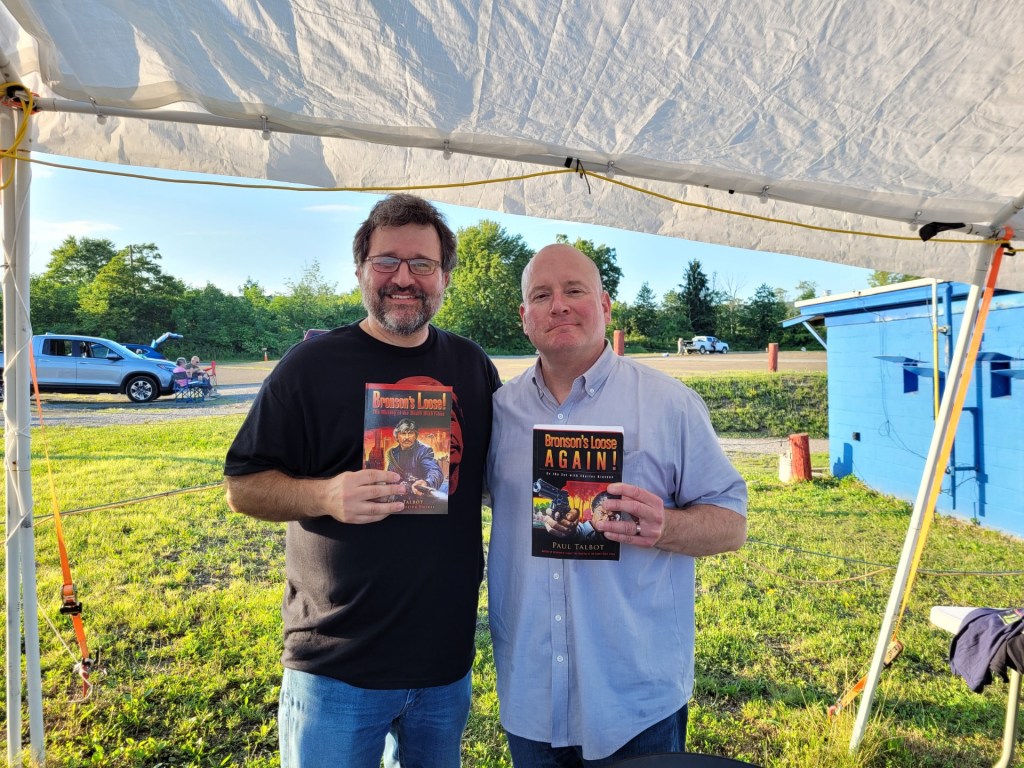
BONUS: The definitive book about the DEATH WISH film series was written by my friend, author and film historian Paul Talbot. The name of the book is BRONSON’S LOOSE: THE MAKING OF THE DEATH WISH FILMS. If you have any interest in Charles Bronson, the DEATH WISH series or Cannon Films, I can’t recommend Paul’s books more highly.

4 Shots From 4 Films: Special Charles Bronson Birthday Edition


4 Or More Shots From 4 Or More Films is just what it says it is, 4 shots from 4 of our favorite films. As opposed to the reviews and recaps that we usually post, 4 Shots From 4 Films lets the visuals do the talking!

Today is the 100th anniversary of the birth of an actor who is very popular here at the Shattered Lens, Charles Bronson!  In honor of the momentous occasion, we now pay tribute to the one and only Bronson with….

4 Shots From 4 Charles Bronson Films

Death Wish (1974, dir by Michael Winner, DP: Arthur Ormitz)

Mr. Majestyk (1974, dir by Richard Fleischer DP: Richard Kline)

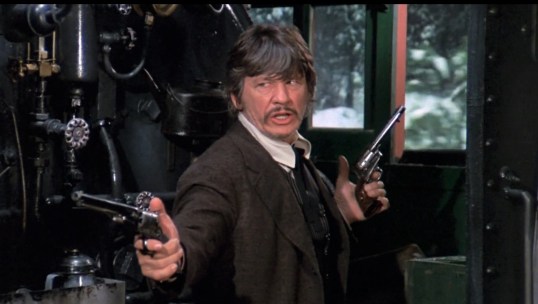
Breakheart Pass (1975, dir by Tom Gries, DP: Lucien Ballard)

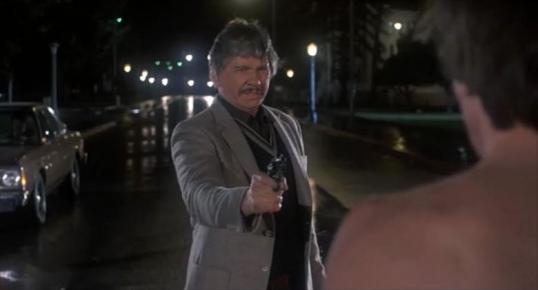
10 To Midnight (1983, dir by J. Lee Thompson, DP: Adam Greenberg)

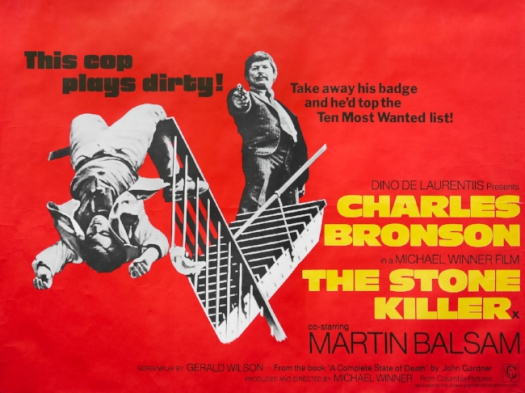
Happy Birthday Charles Bronson!: THE STONE KILLER (Columbia 1973)


gary loggins's avatarcracked rear viewer

Charles Buchinsky was born November 3, 1921 in the coal-country town of Ehrenfield, PA to a Lithuanian immigrant father and second-generation mother. He didn’t learn to speak English until he was a teen, and joined the Air Force at age 23, serving honorably in WWII. Returning home, young Charles was bitten by the acting bug and made his way to Hollywood, changing his last name to ‘Bronson’ in the early fifties. Charles Bronson spent decades toiling in supporting parts before becoming a name-above-the-title star in Europe.

By the 1970’s, Bronson had begun his long run as an action star. THE STONE KILLER capitalizes on the popularity of Cop and Mafia movies of the era, with Our Man Bronson as Lou Torrey, a Dirty Harry-type who shoots first and asks questions later. After he kills a 17-year-old gunman in the pre-credits opening, Torrey is raked over the coals by the New…

View original post 398 more words

Bronson’s Old: Death Wish 3 (1985, directed by Michael Winner)


To quote Roger Murtaugh, “I’m too old for this shit.”

It has been ten years since Paul Kersey (Charles Bronson) left New York City and the place has gone to Hell.  It’s no longer just muggers that you have look out for.  Now, there are roving street gangs of directionless teenagers, terrorizing the elderly and forcing them to live like prisoners in their own apartment building.

One street corner now looks like a war zone, controlled by spiky-haired, face-painting punks who look like something from a Mad Max movie.  Manny Fraker (Gavan O’Herlihy) rules this street corner, supported by a gang that worships him as if he was some sort of god.  Manny thinks that he is immortal but he’s just targeted the wrong person.  The gang may think that Charley (Francis Drake) is just a defenseless old man but what they don’t know is that, when Charley served in Korea, his best friend was Paul Kersey.

The past few years have been busy for Paul.  He’s killed muggers and rapists in Los Angeles, Chicago, and Kansas City and now he’s returned to New York City, to visit his old friend Charley.  Paul arrives at Charley’s apartment just in time to witness Fraker’s gang murdering him.  The gang flees and when the police arrive, they take Paul into custody.

While public defender Kathryn Davis (Deborah Raffin) tries to figure out why Paul is being held in jail, Paul has a conversation with Lt. Shriker (Ed Lauter).  Shriker remembers Paul as being the New York vigilante and he has a proposition for him.  Paul can kill as many members of Fraker’s gang as he wants, as long as he allows the police to take the credit and reports everything that he discovers to Shriker.  Paul agrees.

In the neighborhood, Paul starts to put Fraker and his gang (one of whom is played by pre-Bill and Ted Alex Winter) in their place.  In a scene borrowed from Brian Garfield’s original Death Wish novel, he uses a used car as bait to gun down two aspiring car thieves.  When Paul gets a new gun, he tests it out on a depraved mugger known as the Giggler.  Though some might call him a serial killer, Paul is soon a hero to the entire neighborhood.  Though Charley may be gone, Paul befriends the other residents of the apartment.  He shows the elderly Kaprovs how to catch anyone trying to climb through their window.  He protects Maria Rodriguez (Marina Sirtis) from the gang.  Best of all, he befriend Bennett Miller (Martin Balsam), a World War II vet who still remembers how to load a machine gun.

(Balsam and Bronson previously co-starred in The Stone Killer, though in that one Bronson was a cop and Balsam was on the other side of the law.)

He also finds time to pursue a relationship with Kathryn Davis.  This is one recurring element in the Death Wish franchise that has never made sense to me.  Paul always has a new girlfriend, despite the fact that almost every woman that he ever gets involved with ends up getting killed.  Paul also only seems to go out with women who would be upset to discover that they were dating a notorious vigilante.  In Death Wish II, he went out with a crusading journalist who was against the death penalty.  In Death Wish 3, he falls for a public defender whose job is to provide legal counsel to the very people that Paul is trying to kill.  After Death Wish 3, Paul would date yet another crusading journalist and, finally, the ex-wife of a notorious mobster.  Maybe Paul should just give up and concentrate on mourning his wife.

Michael Winner returned to direct Death Wish 3 and, this time around, he imagines New York City as being a post-apocalyptic wasteland, full of abandoned buildings and murderous scavengers.  Imagine A Clockwork Orange if Charles Bronson suddenly showed up to shoot Alex and the Droogs.  As played by Gavan O’Herlihy, Manny Fraker is the type of seemingly indestructible bad guy who can actually give Paul Kersey a challenge, something that was missing from the previous films.

The other thing that distinguishes Death Wish 3 is that it was one the only film in the franchise to directly confront an obvious truth.  Charles Bronson was 53 when the first Death Wish was released.  By the time he made Death Wish 3, he was 64 and decades older than the typical action star.  (As way of comparison, Clint Eastwood was 55 when Death Wish 3 was released and was already experimenting with less action-orientated roles.)  By partnering him with Martin Balsam and the other elderly residents of the neighborhood, Death Wish 3 not only acknowledged Bronson’s advanced age but also took advantage of it.  Death Wish 3 is a film where the old folks finally get to teach the young punks a thing or two.  If the other Death Wish films were about one man fighting a lonely war, Death Wish 3 is about a community refusing to be silenced.  The chance to put those kids in their place even seems to perk up Charles Bronson, who gives one of his best performances in Death Wish 3.

Death Wish 3 may have been roundly despised by the critics but it’s the best of the Death Wish sequels.  It made a fortune at the box office so naturally, another sequel would follow.

Tomorrow: Death Wish 4: The Crackdown!

Bronson’s Back!: Death Wish II (1982, directed by Michael Winner)


To quote John McClane, “How can the same shit happen to the same guy twice?”

It has been eight years since Paul Kersey (Charles Bronson) lost his wife and single-handedly cleaned up New York City.  The first Death Wish ended with Paul in Chicago, preparing to gun down a new group of criminals.  I guess Chicago didn’t take because, at the start of Death Wish II, Paul is in Los Angeles and he’s working as an architect again.  He has a new girlfriend, a bleeding heart liberal reporter named Geri (Jill Ireland, Bronson’s real-life wife) who is against the death penalty and who has no idea that Paul used to be New York’s most notorious vigilante.  Having finally been released from the mental institution, Carol (Robin Sherwood) is living with her father but is now mute.

Crime rates are soaring in Los Angeles and why not?  The legal system is more concerned with the rights of the criminals than the victims and Paul has retired from patrolling the streets.  But when a group of cartoonish thugs rape and kill his housekeeper and cause his daughter to fall out of a window while trying to escape them, Paul picks up his gun and sets out for revenge.

Death Wish II was not the first sequel to Death Wish.  Brian Garfield, the author of the novel on which Death Wish was based, never intended for Paul to be seen as a hero and was disgusted by what he saw as being the film’s glorification of violence.  As “penance,” he wrote a sequel called Death Sentence, in which Paul discovered that he had inspired an even more dangerous vigilante.  When Menahem Golan and Yoram Globus bought the rights to produce a second Death Wish film, they decided not to use Garfield’s sequel and instead went with a story that was co-written by Golan.

It’s the same basic story as the first film.  Again, Paul is a mild-mannered architect who is a liberal during the day and a gun-toting reactionary at night.  Again, it’s a home invasion and a death in the family that sets Paul off.  Again, Paul gets help from sympathetic citizens who don’t care that the police commissioner (Anthony Franciosa) wants him off the streets.  Jeff Goldblum played a rapist with a switch blade in the first film.  This time, it’s Laurence Fishburne who fills the role.  (Fishburne also carries a radio, which he eventually learns cannot be used to block bullets.)  Even Detective Ochoa (Vincent Gardenia) returns, coming down to Los Angeles to see if Paul has returned to his old ways.

The main difference between the first two Death Wish films is that Death Wish II is a Cannon film, which means that it is even less concerned with reality than the first film.  In Death Wish II, the criminals are more flamboyant, the violence is more graphic, and Paul is even more of a relentless avenger than in the first film.  In the first Death Wish, Paul threw up after fighting a mugger.  In the second Death Wish, he sees that one of the men who raped his daughter is wearing a cross, leading to the following exchange:

“Do you believe in Jesus?”

“Yes, I do.”

“Well, you’re going to meet him.”

BLAM!

Death Wish II is the best known of the Death Wish sequels.  It made the most money and, when I was a kid, it used to show on TV constantly.  The commercials always featured the “You believe in Jesus?” exchange and, every morning after we saw those commercials, all the kids at school would walk up to each other and say, “You believe in Jesus?  Well, you’re going to meet him.”  It drove the teachers crazy.

Overall, Death Wish II is a lousy film.  Michael Winner, who was always more concerned with getting people into the theaters than anything else, directs in a sledgehammer manner that makes his work on the first film look subtle.  He obscenely lingers over every rape and murder, leaving no doubt that he is more interested in titillating the audience than getting them to share Paul’s outrage.  The script is also weak, with Geri so poorly written that she actually gets more upset about Paul going out at night than she does when she learns that Paul’s daughter has died.  When Paul sets out to track down the gang, his method is to merely wander around Los Angeles until he stumbles across them.  It doesn’t take long for Paul to start taking them out but no one in the gang ever seems to be upset or worried that someone is obviously stalking and killing them.

There are a few good things about the film.  Charles Bronson was always a better actor than he was given credit for and it’s always fun to watch Paul try to balance his normal daily routine with his violent night life.  Whenever Geri demands to know if he’s been shooting people, Paul looks at her like he is personally offended that she could possibly think such a thing.  Also, the criminals themselves are all so cartoonishly evil that there’s never any question that Paul is doing the world a favor by gunning them down.  For many otherwise sensible viewers, a movie like Death Wish II may be bad but it is also cathartic.  It offers up a simple solution to a complex issue.  In real life, a city full of Paul Kerseys would lead to innocent people getting killed for no good reason.  But in the world of Death Wish II, no one out after nightfall is innocent so there’s no need to worry about shooting the wrong person.

Finally, the film’s score was written by the legendary Jimmy Page.  The studio wanted Isaac Hayes to do the score but Winner asked his neighbor, Page.  Page took the film, retreated into his studio, and returned with a bluesy score that would turn out to be the best thing about the movie.  The soundtrack was the only one of Page’s solo projects to be released on Led Zeppelin’s record label, Swan Song Records.

Tomorrow, Bronson returns with Death Wish 3!