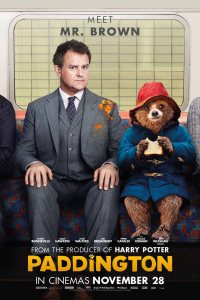
When I was little, I owned a stuffed Paddington Bear. When I found out Heyday Films was working on a movie for the character, I immediately added it to my watch list. From the audience’s reaction, made up mostly of families and a few dates, it seemed to be well received. American audiences may not be familiar with Paddington, even though the Orange Marmalade eating bear has had tons of books, toys and cartoons in the UK over the last 50 years. He even has his own float in the Holiday parades we have here in New York City.
The movie, directed by Paul King, finds young Paddington (Ben Wishaw – Layer Cake, Skyfall) traveling to London after an Earthquake destroys his home in Darkest Peru. His Aunt and Uncle (played by Imelda Staunton and Michael Gambon, respectively) have told him of how wonderful London is, but he finds it’s not exactly as kind as he was led to believe. While Wishaw wouldn’t be my first through to voice Paddington, he fits the role quite well, giving the character a sense of polite innocence that’s spot on to how I recalled him.
The Brown family discovers Paddington and takes him in, in the hopes that they can locate the individual who discovered Paddington’s Aunt and Uncle during an expedition many years ago. When an evil taxidermist (played by Nicole Kidman in a turn that feels eerily similar to what she did in The Golden Compass) discovers Paddington, she makes it her goal to have him added to her collection.
Paddington’s supporting cast seems to either have former Harry Potter or Layer Cake stars. Downton Abbey’s Hugh Bonneville plays the overprotective Brown father. Sally Hawkins (Layer Cake, Godzilla) plays Mary, who helps Paddington along his trip. Weasley mom Julie Walters has a fun role as the house nanny, and finally, Doctor Who’s Peter Capaldi is the nosy next door neighbor that doesn’t take too kindly to having furry neighbors around town. It looks like everyone enjoyed themselves on the production, and seeing Capaldi play someone so odd was a little weird.
For young viewers, Paddington is a treat, with a focus on acceptance, family and the notion that sometimes one can hold on too tight to children in an effort to keep them safe. It might a gross out in some ways, depending on some of the scenes that include earwax licking and passing gas. Some may find the notion of a taxidermist a little scary, but my audience seemed to be okay with it. There are very few elements of violence – most of it the playful type found in films like Home Alone. Nicole Kidman may appear scary to some, but at it’s heart, Paddington tries to keep everything as accessible as it can for everyone.
Musically, Sigur Ros provides some great music that flows with the scenes, and the production itself moves almost in the same fashion as Alfonso Cuaron’s Harry Potter and the Prisoner of Azkaban, via the use of screen wipes and subtle season changes. The CGI for the film is done well, though I can’t say it’s very subtle. A casual view could probably spot what’s CGI and what isn’t, but since it’s for kids, they won’t really care.
Overall, it was fun to revisit Paddington. I didn’t have much in the way of expectations, but was a little amazed at how well it actually held up. I found myself smiling more often than I thought I would, honestly.
There’s really only one reason to see the 2006 remake of The Omen and that’s the fact that the priest who convinces Ambassador Thorn to adopt the Antichrist is played by the great Giovanni Lombardo Radice.
If you’re a fan of Italian horror, you’ll immediately know who Radice is and, whenever he appears in The Omen, you’ll be momentarily excited. After all, Radice is an actor who has given memorable performances in films made by iconic directors like Lucio Fulci, Ruggero Deodato, Antonio Margheriti, Michele Soavi, and Martin Scorsese. He’s appeared in everything from City of the Living Dead to Cannibal Apocalypse to The House On The Edge of the Park toStagefright to Gangs of New York. As both a horror icon and an excellent actor who has always been gracious and friendly to his fans, Giovanni Lombardo Radice is one of those actors who movie bloggers like me are always happy to see in any film.
(And, if anyone deserves a role in a Quentin Tarantino film, it’s Giovanni Lombardo Radice.)
And Radice gives a really great performance in The Omen. He plays the role with just the right combination of menace and regret. When he first appears, you can tell that he’s determined to get Robert Thorn to adopt Damien but that he’s not particularly happy about having to do it. He may be one of the bad guys but he’s a bad guy with a conscience. Later, when Radice makes a second appearance, it momentarily re-energizes the film. He’s just got such a unique screen presence that, whenever he’s on-screen, Radice reminds you of the film that you want The Omen to be.
As for the rest of the remake — well, it’s all kind of pointless. The film is largely a scene-by-scene remake of the first Omen and, unfortunately, it never quite answers the question of why the film needed to be remade in the first place. The Gregory Peck role is played by Liev Schrieber while his wife is played by Julia Stiles. The doomed photographer is played by David Thewlis. Mia Farrow shows up in the role of the sinister nanny and Mia actually does a pretty good job but whenever she was delivering her lines, it was impossible for me not to imagine a remake of The Final Conflict where Ronan Farrow plays Damien.
Otherwise, the same characters die as in the original film and, often times, they die in the exact same way. It’s really almost lazy how little the remake changes from the original. And, ultimately, it makes the entire movie feel more than a little pointless. You’re left with the feeling that the only reason the Omen was remade was so that it could be released on June 6th, 2006 (a.k.a. 6-6-06).
So, when it comes to The Omen, stick with the original but watch the remake for Giovanni Lombardo Radice.
For today’s horror on the lens, we have The Beast Must Die. In this 1974 film, millionaire Tom Newcliffe (Calvin Lockhart) invites a group of people to spend the weekend at his mansion. Tom explains that one of them is a werewolf and therefore “must die.”
But who is the werewolf? Tom has come up with several werewolf tests but, actually, it turns out that the easiest way to discover the identity of the werewolf is to just let the werewolf kill everyone who isn’t a werewolf. Or, at least, that’s the way it seems to me.
The best thing about The Beast Must Die is that it features a 30-second werewolf break where the audience is encouraged to announce who they think the werewolf is before the actual solution is revealed!
Seriously, many movies would be greatly improved with a werewolf break.
Well, we all knew it would have to end someday and now, it’s over. The Harry Potter film series, which began way back in 2001, is concluding right now in a theater near you. On Friday night, me, Jeff, my sister Erin, and our friend Evelyn went down to the AMC Valley View and we saw Harry Potter and the Deathly Hallows, Part 2.
The cinematic story of Harry Potter is over and yes, I did cry as I watched it end. I didn’t just cry because of the movie, though the movie itself is one of the best of the year and it has one of those wonderful endings that just makes it impossible to remain dry-eyed. No, I cried because — with this film — an era of my life is truly over.
When the first Harry Potter film came out, I was only 16 and still trying to deal with the fact that I had been diagnosed as being bipolar just a few weeks earlier. I felt alone and broken and destined to spend the rest of my life on the outside looking in. The three hours that I spent watching Harry Potter and the Sorcerer’s Stone were three hours when I didn’t have to worry about suddenly bursting into tears and having everyone around me worrying about whether or not I was actually taking my hated medication. For three hours, I could escape to another world where those who were different were celebrated precisely because they were different. For three hours, I could imagine that just maybe I had a special purpose for existing too and maybe I had benevolent wizards and witches looking out for me too. And I’m sorry if all that sounds trite in retrospect but, when you’re 16 and you think you’re too damaged to love, anything that gives you hope and pleasure in the present is a precious treasure.
Over the years, I eventually came to realize that being bipolar was hardly a curse and, as I matured and grew up and discovered new things, there was always a Harry Potter film either playing or about to come out. Whether I was escaping high school, graduating college, or dealing with just every good or bad thing that makes up life, Harry Potter — this character who I first met (in book form) when I was 13 — was always there. So, at the risk of sounding overdramatic, the end of Harry Potter is the end of a chapter of my life.
One final personal note: As I watched Harry Potter and the Deathly Hallows, Part Two, I had three dolls (or action figures, as boys insist on calling them) in my purse. These dolls — Harry, Hermione, and Ron — came out around the same time as the second Harry Potter film and my mom (who collected dolls) ordered them off of Ebay three years ago, shortly before she entered the hospital for the final time. Now, my mom was not a huge fan of the Harry Potter series but she knew that I loved it and that’s why she made those dolls her final gift to me.
And those are some of the reasons why I found myself crying as I watched the finale of Harry Potter. However, there’s another reason why I cried and that’s that this is just a great film and the perfect conclusion to the series.
Essentially, Harry Potter and the Deathly Hallows, Part Two starts up immediately after the conclusion of Part One. Dobby is dead, Lord Voldemort (a wonderfully neurotic Ralph Fiennes) and the Death Eaters are intent on destroying everything, and Severus Snape (Alan Rickman, wonderful as always) is in charge of Hogwarts. After spending the first part of Deathly Hallows as fugitives, Harry Potter, Ron Weasley, and Hermione Granger (Daniel Radcliffe, Rupert Grint, and Emma Watson) return to Hogwarts to take a final stand against Voldemort. Things end in a surprisingly bloody battle (this film is not for children) that leaves several characters dead and ultimately reveals that one wizard wasn’t the saint we always assumed he was while another is revealed to be the secret hero of the entire series.
Let’s get one question out of the way right now: will non-Harry Potter fans be able to follow this film? Uhmmm…no. Sorry. Then again, why would a non-Harry Potter fan be at a film called Harry Potter and The Deathly Hallows Part Two anyway? I mean, seriously, if you’re just going to film because everyone else is doing it than who are you to bitch anyway? This is what you non-Harry Potter fans need to do. Stop reading this review. Go watch the previous Harry Potter films. Watch them in order. Take your time because Deathly Hallows is going to be in theaters for a while. And then, once you’ve become immersed in the story, go see how it all concludes. And then come back here and read rest of this review.
Okay, so is everybody up to date?
Cool.
One of the more interesting features of the Harry Potter series is that so many different directors (each with his own definite, individual style) have been involved in bringing these films to the screen. Among Harry Potter fans, hours can literally be spent debating the merits (and weaknesses) of Chris Columbus, Alfonso Cuaron, Mike Newell, and David Yates. My own theory is that each director was perfectly suited for each film he directed. The audience-friendly vision of Chris Columbus was what the first two films needed, just as Prisoner of Azkaban needed Cuaron’s far darker vision and Mike Newell’s attention to character made Goblet of Fire one of the best of the Harry Potter films. And while David Yates may not be as well-known (or critically acclaimed) as Newell or Cuaron, he brings exactly the right tone to Harry Potter and the Deathly Hallows, a perfect combination of spectacle and humanity. It is to Yates’ credit that the scenes in which the characters simply talk to each other are just as compelling as the dramatic sequences where Voldemort and the Death Eaters attack Hogwarts. Yates understands that this material could easily come across as silly or childish and to his credit, he never allows the audience to simply dismiss this film as a lot of blathering about wands and CGI magic. As opposed to other directors who have given us summer blockbusters, Yates takes his film seriously.
And, fortunately, so does his cast.
One of the great pleasures of the Harry Potter series is that it’s given American audiences the chance to discover (and rediscover) some of the great British character actors and a lot of them show up (some for only a matter of minutes) here in the finale. Maggie Smith, Jim Broadbent, Julie Walters, Robbie Coltrane, Gary Oldman, John Hurt, David Thewlis, Emma Thompson, and Jason Isaacs all put in appearances. Kelly MacDonald has a great scene playing a ghost, Helena Bonham Carter is perfect as the evil Bellatrix Lestrange, and Alan Rickman is brilliantly ambiguous as Severus Snape. (And yes, Snape’s actions are explained in this film and yes, I did cry.)
Ralph Fiennes plays so many villains that I now find myself expecting him to show up killing people in every movie I see. He’s like a British Christopher Walken. Still, it’s easy to take an actor like Fiennes for granted. For the entire Harry Potter series to work, Lord Voldemort can’t just be an ordinary villain. He’s got to be the sum total of all things evil and deadly. You’ve got to believe that people would be scared to speak his name. Great heroes need a great villain and Fiennes’ Voldermort is a great villain.
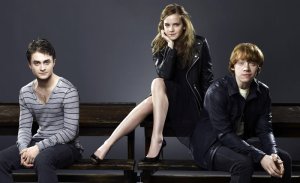
Ultimately, however, the true credit for the success of the Harry Potter series belongs to three actors who have literally grown up on the movie screen — Daniel Radcliffe, Rupert Grint, and Emma Watson. The producers are fortunate indeed that the cute kids that they cast over a decade ago have all grown up to be talented, attractive, and likable actors. If the first part of Harry Potter and the Deathly Hallows seemed to showcase both Grint and Watson (almost to Radcliffe’s expense), part 2 is most definitely centered on Harry Potter. That doesn’t mean that Watson and Grint aren’t good in this film. They are and they get to share one of the best movie kisses of 2011. (As well, for those who keep count, Grint says “Bloody Hell,” three times in the film.) But, for obvious reasons, this film is all about Harry and Radcliffe’s performance as Harry. It’s a challenge for Radcliffe and it’s a challenge that he more than succeeds at conquering. As the film ended, I realized that I was sad to know that the adventures of Harry Potter were done but I was excited to see what the future will hold for Radcliffe, Grint, and Watson.
Incidentally, Harry Potter and the Deathly Hallows Part 2 has been released in both 3-D and 2-D. We saw the 3-D version and if you have any knowledge of how I feel about 3-D (and how motion sick I tend to get while watching 3-D films) then that should show you just much I love the Harry Potter series. I loved it so much that I was even willing to overlook my hatred of 3-D. The 3-D here (which was added after the film has already been filmed) doesn’t really add much to the movie. There were a few cool moments where I was all like, “Look, I can reach out and grab a piece of Voldemort,” but otherwise, the 3-D was a negligible factor as far as the overall film was concerned.
Still, there was one interesting thing about the 3-D. The theater we saw the movie in was half-way empty. At the same time, the neighboring theater — in which the 2-D version was playing — had a line of people waiting to get in. They were not only waiting to see the 2-D version, they were waiting to see a showing that wouldn’t even begin until a full 90 minutes after the 3-D version started. I mention this because, in the wake of Avatar, so many people have taken it for granted that 3-D is the future of movies and soon, as long as a film is in 3-D, we won’t have to worry about the difficult stuff like an interesting plot or compelling characters. However, 3-D has become an overexposed gimmick. For every film like Cave of Dreams that uses 3-D to craft an actual artistic statement, there’s a 1,000 films like Priest which use 3-D just because it’s an easy way to trick sucks into spending an extra dollars to see a crappy film.
What so many filmmakers seem to forget is that the majority of film goers are not looking for 3-D. We’re just looking for a good film. And sometimes — like with Harry Potter and the Deathly Hallows — we get lucky and we find a great film.
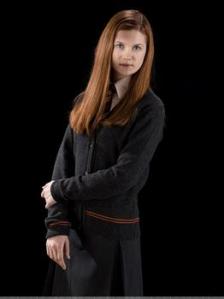
(Oh, and one last thing: I know everyone always expects me to claim to be just like Hermione but actually, I’ve always related more to Ginny Weasley. Like her, I’m the youngest of four siblings, I’ve got red hair, and I always get my man, in the end.)
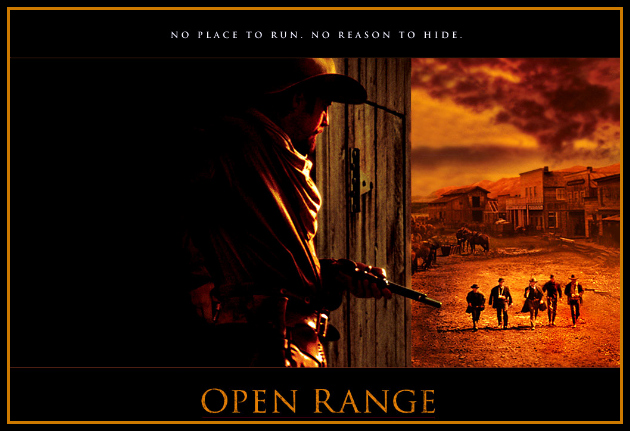
2003 marked a sort of a small comeback for Kevin Costner both as a director and as an actor. The work in question was the very well-done Western, Open Range. Open Range was a moderately budgeted film which has more in common with Costner’s first directorial work, Dances with Wolves than his last big-budget flop, The Postman.
The film was an adaptation of the Lauran Paine novel, The Open Range Men, and it captures much of the themes found in the novel. This was probably due to the fact that screenwriter Craig Storper didn’t deviate from the novel’s basic story. There were no superfluous action sequences and gunfights to ratchet up the action. Everything about Open Range was about the gradual and inevitable final confrontation between the “free-grazers” and the “barbed-wire” men. The free-grazers were played by Kevin Costner and Robert Duvall as Charles Waite and Boss Spearman, respectively. On the other side of the conflict was Michael Gambon playing Denton Baxter, the ruthless land-baron whose attempt to keep the free-grazers from grazing on his land also hides another agenda. Caught in-between these two strong-willed groups were the people in the town Baxter pretty much controls through his “town marshal” (played with fake bravado by James Russo) and the herd helpers under Boss Spearman’s employ.
The theme of freedom to roam the open country versus the rights of a landowner echoes throughout the film. Set in the latter end of the 19th-century, Open Range shows the clash of the more natural ways of the Old West slowly eroding to be replaced by the more industrial, monopolistic practices that became prevalent during the 1880’s, also known in US History as the Gilded Age. Even the personalities of the conflicting characters mirror this theme as the free-grazers only want to use the land as it has been used for years upon years and thats sharing between all men of the West. The land-baron has other ideas in mind and everything boils down to him owning everything around him, even if it means using ruthless tactics to gather even more property.
Open Range also has a bit of modernism in its subplot of Charley Waite’s growing attraction to the sister of the town doctor and the same sister’s well-rounded characterization. It’s not often that a traditional Western shows women in a very positive light instead of the usual submissive and stay-at-home characters of Western’s past. This could also be attributed to the wonderful, underrated performance by Annette Bening who plays Sue Barlow, the doctor’s sister and Charley Waite’s love interest. Bening doesn’t play Sue as the traditional Western female. She also doesn’t go overboard and turn Sue into a 20th-century feminist. She instead plays the character as someone who knows her place in the world, but also one who is strong-willed and willing to stand for what is right.
Open Range was a wonderful throwback to what made such modern Westerns like Unforgiven and Tombstone such a success both for traditionalists and new fans. Kevin Costner’s direction was very low-key. Allowing the story to tell itself at its own pace until the final confrontation. The final gunfight in the end gets a lot of well-earned attention from critics and fans. The entire sequence takes at least 10-15 minutes from start to finish. The fight itself was done in a realistic fashion. There was no sharpshooter dead-eyes in this film, but individuals who had skill but still missed. It was a fight where it wasn’t who was the fastest, but who was the calmest under fire. There’s also a suddenness to the brutality in the final gunfight that demystifies the old-style Western shootouts of past. Some complained that the film was very slow and took too long to get to the “good stuff”, but I actually thought the gradual pacing of most of the film’s length gave the final confrontation even more impact. Costner seem to have learned the lesson all good directors know: less means more.
Open Range won’t go down as a great piece of film making. It surely won’t go down as one of the best in history. What Open Range did accomplish was putting the Western back to its epic and majestic roots, but at the same time keeping the intimacy of a character-driven story. In time, Open Range would probably go down as one of the underrated gems of the last decade and find a place next to its closest comparison, Unforgiven, as one of the best Westerns of the new era.
 Hello there, and Happy New Year!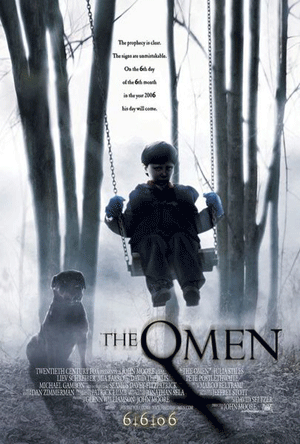


 Through the Shattered Lens