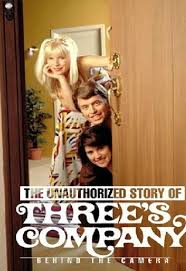
Behind the Camera: The Unauthorized Story of Three’s Company (2003, directed by Jason Ensler)


Do you remember Three’s Company?

The sitcom was a big hit when it aired in the 70s and 80s and it still gets a lot of play in syndication today.  Based on a British sitcom (and you would really be surprised to how closely the first season followed the original series), Three’s Company starred John Ritter as Jack Tripper, an aspiring chef who moved in with two single women, Janet (Joyce DeWitt) and Chrissy (Suzanne Somers).  Because their impotent landlord (Norman Fell) didn’t want people of the opposite sex living with each other unless they were married, Jack pretended to be gay.  Every episode centered around a misunderstanding, though it was Suzanne Somers’s performance as the perpetually bouncy and braless Chrissy Snow that made the show a hit.  The show fell apart when Somers asked for more money, Ritter and DeWitt got angry with her, and the studio bosses lied to everyone.  Today, the show is legendary as an example of how backstage tension can end even a popular series.

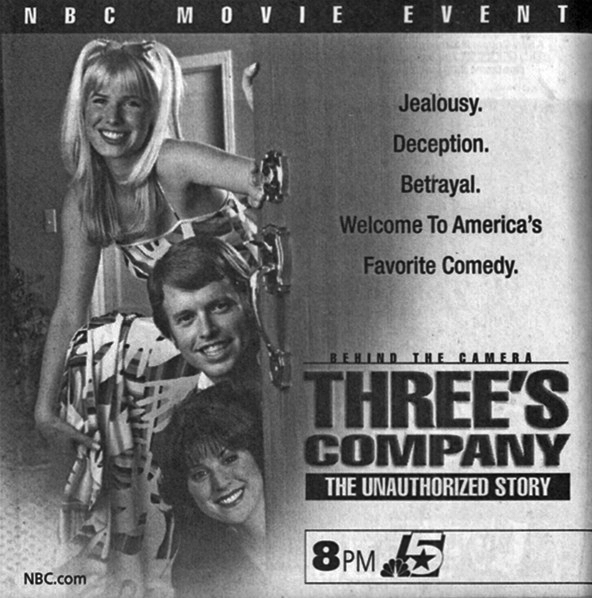
Behind The Camera: The Unauthorized Story of Three’s Company attempts to dramatize the success and eventual downfall of Three’s Company.  Joyce DeWitt appears at the beginning and the end to talk about how important she thinks the show was.  In the movie, she is played by Melanie Paxson.  John Ritter is played by a lookalike actor named Bret Anthony while an actress named Jud Taylor plays Somers.  Brian Dennehy plays ABC president Fred Silverman and other executives are played by Daniel Roebuck, Wallace Langham, Gary Hudson, and Christopher Shyer.  The movie recreates all of the drama that went on during Three’s Company without offering much insight or really anything new to the story.  Even though the movie was co-produced and hosted by Joyce DeWitt, Suzanne Somers is really the only sympathetic character in the movie.  DeWitt comes across as being jealous while Anthony plays John Ritter as being a bland nonentity who chooses his own success over being honest with his costars.  The network executives are more interesting, just because watching them provides a glimpse into how real producers and showrunners picture themselves.  They just wanted to make a good show about a sex addict pretending to be gay so he could live with two attractive, single women but the agents and the network presidents just keep getting in the way!  Won’t someone please think of the mid-level network executives?

Bland though this recreation was, it was enough of a rating hits that NBC went on to produce several more Behind The Camera films.  Three’s Company was only the beginning.
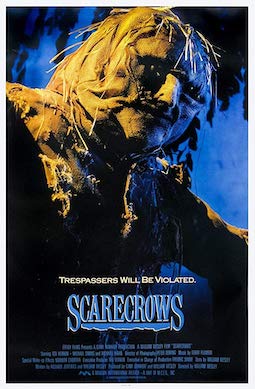
The TSL Horror Grindhouse: Scarecrows (dir by William Wesley)


The 1988 film Scarecrows is one that has a very simple but also very effective premise.

Scarecrows are scary as Hell.

And you know what?  There’s a lot to be said for the premise.  Seriously, I have no problem with clowns but scarecrows definitely make me nervous.  It’s the way that they’re just left out there in the middle of a field, tied to a post and seemingly staring at the world through black eyes.  I know that some people try to make scarecrows less creepy by giving them smiles but, to me, a smiling scarecrow is even creepier than a scarecrow with no expression at all.  At night, whenever you see the shadow of a scarecrow in the distance, it’s always easy to imagine it climbing off of its post and walking towards your house, its dark eyes focusing on your bedroom window the whole way.  If you’re not scared of scarecrows, you’re not paying attention.

(Of course, perhaps the scariest thing about scarecrows is that crows don’t seem to be particularly scared of them.  I mean, if the crows have figured out that they’re not human, what’s the point of having them unless you’re going to use them to summon evil spirits?)

Scarecrows opens with a daring heist.  Five paramilitary mercenaries, people who are paid to fight and kill for a living, steal three million dollars from Camp Pendleton and then force pilot Al (David James Campbell) and his teenager daughter, Kellie (Victoria Christian), to fly them to Mexico.  However, in the middle of the flight, one of the merceneries grabs the money and a parachute and jumps from the plane.  Two other mercenaries jump after him while the remaining two force Al to land the airplane.  The plane ends up landing outside of a small farm, one that appears to be deserted except for all the scarecrows….

Now, seriously, think about this.  The majority of the characters in this film are mercenaries.  They’ve been trained in every form of combat.  They’ve got weapons and they know how to use them.  They are used to fighting and, in fact, they even look forward to it.  Not only are they mercenaries but they’ve also just successfully robbed a MARINE base.  You don’t mess with the Marines unless you’re very stupid or very confident or maybe both.  Adam Driver was a Marine.  Do you want Adam Driver mad at you?  My point is that these characters are not your run-of-the-mill horror movie victims.

And yet, one-by-one, they’re taken out by the scarecrows.  We get a bit of backstory about the scarecrows when the mercenaries stumble across a farmhouse and discover that it was owned by three Satanists who transferred their souls into the scarecrows.  But really, that’s not important.  What is important is that the scarecrows will emerge from the darkness and kill anyone who lets their guard down.  The scarecrows even talk to each other!  TALKING SCARECROWS!  AGCK!

Anyway, Scarecrows is an effective, quickly-paced, and atmospheric horror film, one that I really enjoyed when I watched it last October.  The scarecrows make for efficient and frightening monsters.  This is the film that proves that scarecrows are scarier than clowns.

Seriously, don’t mess with the scarecrow.