October Positivity: Hidden Secrets (by Carey Scott)


2006’s Hidden Secrets takes place over the course of one very long weekend.

The death of their friend Chris has reunited a group of acquaintances, who gather for the funeral and then end up staying with Chris’s sister, Sherry (Tracy Melchior), for the weekend.  The men gather on her roof and hammer tiles.  The women …. well, for the most part, the women are just portrayed as being catty and judgmental.

For instance, Rhonda (Autumn Paul), who is married to Christian book author Harold (Gregg Brinkley), is offended that Gary (John Schneider) is doing stem cell research and is a Jewish agnostic who spends most of his time challenging Rhonda’s super-strict interpretation of the Bible.  Interestingly enough, considering that this is a Pureflix film, Rhonda is not portrayed in a positive light and Gary usually gets the better of her in their arguments.  Rhonda even apologizes at the end for being so judgmental.  Of course, since this is a Pureflix film, Gary still ends up converting.

Pastor Jeremy (David A.R. White) is dating reporter Rachel (Staci Keanan).  Rachel suspects that Jeremy is still in love with his ex-girlfriend, Sherry.  Rachel is correct.  You have to feel bad for Rachel, who certainly deserved better than she got in this movie.  Jeremy and Rachel end up sharing a bed at Sherry’s house, which freaks Jeremy out because he’s all about abstinence.

Michael (Corin Nemec) is a gay Christian who practices celibacy and whose main function seems to be to offer people advice.

Anthony (Sean Sedgwick) is a rough and tumble guy who shows up with his latest girlfriend, Sally (Rachael Lampa), and who takes her out dancing for her birthday, even though Rhonda says that Christians shouldn’t dance.

The film follows these characters over the weekend, basically doing a Big Chill sort of thing.  Rhonda judges everyone.  Gary is sarcastic.  Jeremy is torn between Sherry and Rachel.  The night of dancing for Sally’s birthday turns into an extended scene where Anthony, Jeremy, and Harold take to the stage and perform a song. It all wraps up with everyone confessing their fears during a church service and I have to admit that I felt sorry for all the people at the church who probably didn’t have the slightest idea why one group of people suddenly hijacked the service to discuss their own problems.

As far as PureFlix films go, this one was well-made and it actually did have some potential.  No one was completely right and no one was completely wrong.  The main message seemed to be accept and love one another.   That said, it also had some fairly serious flaws.  John Schneider doesn’t give a bad performance but he was still miscast as a Jewish abortionist.  I love Corin Nemec and he gave one of the better performances in Hidden Secrets but the film used his character to promote the destructive “ex-gay” movement and it’s difficult not to be bothered by that.  And finally, the resolution of Sherry/Jeremy/Rachel love triangle left me feeling that Jeremy was essentially a terrible, self-absorbed person.  I don’t think that was what the film was going for but, regardless….

Hidden Secrets is an uneven film, to say the least.  At its best, it made me miss some of my old friends.  It’s been a while since we’ve all gotten together.  Hopefully, when we next see each other, it won’t be at another funeral.
4 Shots From 4 Films: Special 1976 Edition


4 Shots From 4 Films is just what it says it is, 4 shots from 4 of our favorite films. As opposed to the reviews and recaps that we usually post, 4 Shots From 4 Films lets the visuals do the talking!

Today, let us take a look back at a classic cinematic year.  It’s time for….

4 Shots From 4 1976 Films

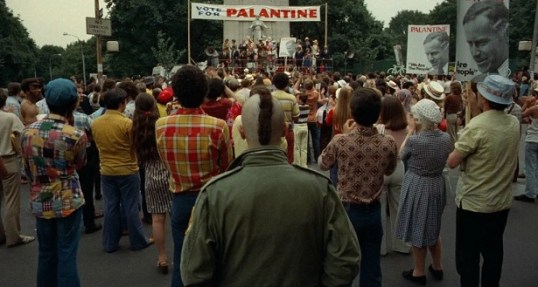
Taxi Driver (1976, dir by Martin Scorsese, DP: Michael Chapman)

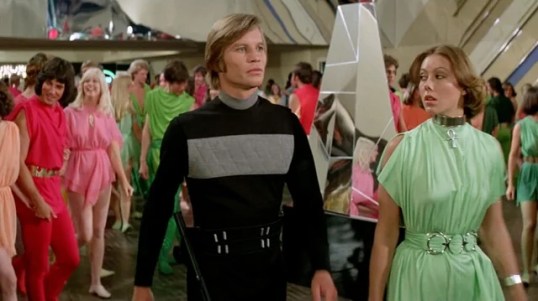
Logan’s Run (1976, dir by Michael Anderson, DP: Ernest Laszlo)

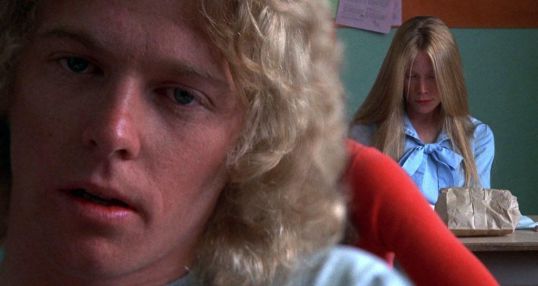
Carrie (1976, dir by Brian De Palma, DP: Mario Tosi)

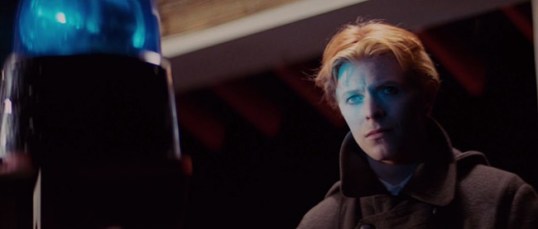
The Man Who Fell To Earth (1976, dir by Nicholas Roeg, DP: Anthony Richmond)

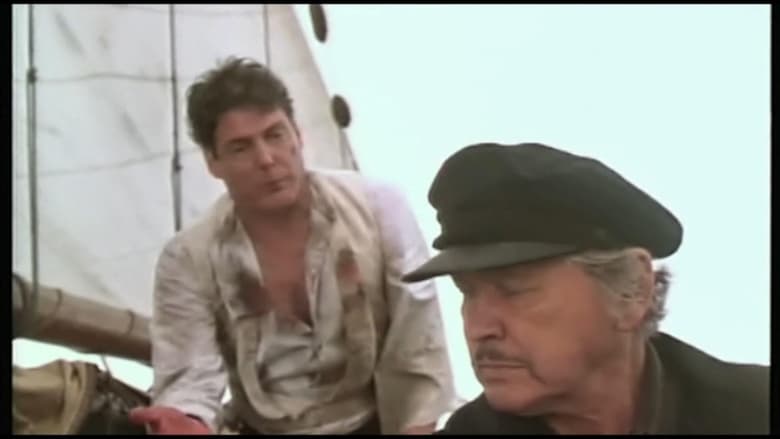
THE SEA WOLF (1993) – Charles Bronson vs. Superman!


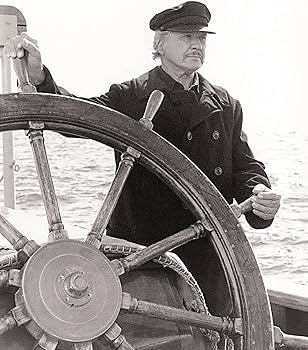
Back in the early 90’s, I was finishing up my high school years and starting up my college years, but I was still paying attention to every move my movie hero Charles Bronson was making. Bronson was at a very difficult place personally during those years as he was continuing to mourn the passing of his wife, Jill Ireland, and it really shows in his choice of roles. His first two films of the 90’s, THE INDIAN RUNNER and YES VIRGINIA, THERE IS A SANTA CLAUS, featured the aging star in the roles of a man dealing with great suffering and loss. Bronson’s third role, as Captain Wolf Larsen in the made for cable TV film, THE SEA WOLF (1993), featured him as the “thinking man’s megalomaniac” from Jack London’s work of classical literature. I couldn’t wait to see the film, but I had just one small problem. We didn’t have cable-TV in Toad Suck, Arkansas, so I would not be able to watch it on the night of its April 18th, 1993 premiere on the TNT channel. It was tough waiting a few months for that VHS release, but it was worth it! 

In a nutshell, Charles Bronson plays Wolf Larsen, the captain of the ship The Ghost, who saves shipwrecked aristocrat Humphrey Van Weyden (Christopher Reeve) and con woman Flaxen Brewster (Mary Catherine Stewart). He saves them, but once they’re on board his boat, they find out that Larsen rules over the crew with an iron fist. They also find out that he’s on a life or death mission to find his brother, Death Larsen, and exact revenge for past conflicts. Will they be able to survive this voyage?

Charles Bronson had mostly steered clear of roles that could be described as “villainous” later in his career, but it must have felt great to take on one of Jack London’s most famous characters. I remember the advertising would show him maniacally spouting lines like, “It’s better to reign in hell than serve in heaven!” Wolf Larsen is a man of contradictions. He’s ruthless and mad with power when it comes to the men and his boat, but he also appreciates great works of literature and philosophy. Even at 71 years of age, the icon is able to project arrogant menace and brute strength. Charles Bronson and Wolf Larsen almost seem made for each other, and he’s fantastic in the role. It’s his strongest performance of the 1990’s. 

There’s another great performance in the film, and it comes from Christopher Reeve as Humphrey Van Weyden. Most famous as Superman, Reeve was not having a lot of success at this point in his film career and was wanting meatier roles when he accepted this part. I was blown away with his performance as the intelligent and bullied aristocrat-turned-cabin boy who is forced to resort to some level of savage and barbaric behavior in order to survive Larsen’s boat! Christopher Reeve had really become a good actor at this point in his career, and he handles the role expertly. You believe his transformation throughout the course of the film as he adapts to the brutal conditions aboard the ship yet still retains his humanity. Reeve himself has been quoted as saying that THE SEA WOLF was a project “I really believed in and still think of as some of my best work.” I couldn’t agree more, Mr. Reeve. 

THE SEA WOLF was directed by veteran filmmaker Michael Anderson who had been working since the 1940’s with credits like AROUND THE WORLD IN 80 DAYS (1956) and LOGAN’S RUN (1976) to his name. He and Bronson were roughly the same age, and they’re both in fine form. In order for these types of films to work, you need a good director who can deliver a solid finished project and Anderson brings his A-game to this production. 

I’ve included the trailer for THE SEA WOLF below:

4 Shots From 4 Films: Special Michael Anderson Edition


4 (or more) Shots From 4 (or more) Films is just what it says it is, 4 (or more) shots from 4 (or more) of our favorite films. As opposed to the reviews and recaps that we usually post, 4 (or more) Shots From 4 (or more) Films lets the visuals do the talking.

105 years ago today, Michael Anderson was born in London.  Anderson may have never become a household name but he directed some memorable movies.  Around The World in 80 Days proved that audiences love spectacle and celebrity cameos and it won the Oscar for Best Picture of 1956.  (Though Anderson was nominated for best director, the award went to George Stevens for Giant.)  However, I think that Anderson’s best-remembered film is probably Logan’s Run.  Whenever I shout, “I hate outside!” or I reply to a simple question with, “There is no sanctuary,” people always seem to automatically know which film I’m referencing.  Anderson followed up Logan’s Run with Orca, which is one of the better Jaws rip-offs.

Today, we honor the career and legacy of Michael Anderson with….

4 Shots From 4 Michael Anderson Films

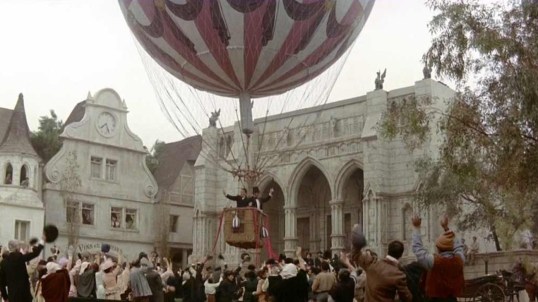
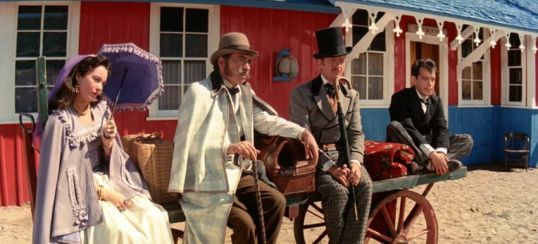
Around The World in 80 Days (dir by Michael Anderson, DP: Lionel Lindon)

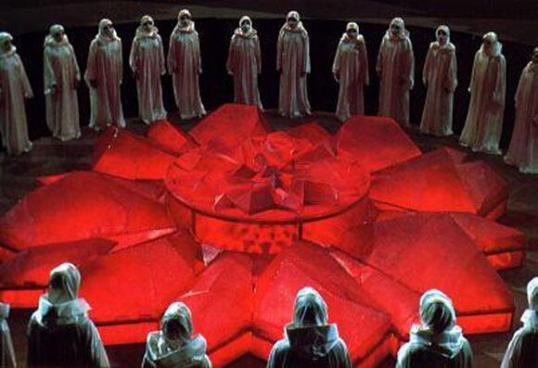
Logan’s Run (1976, dir by Michael Anderson, DP: Ernest Laszlo)

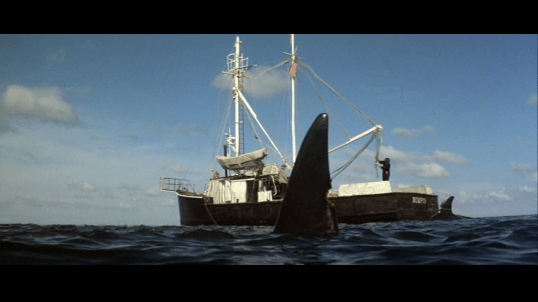
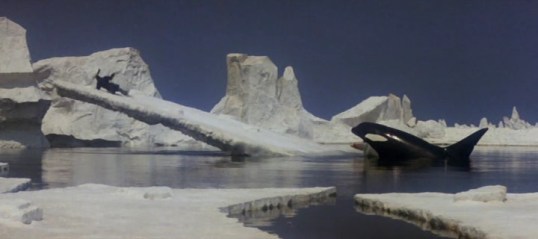
Orca (1977, dir by Michael Anderson, DP: J. Barry Herron and Ted Moore)

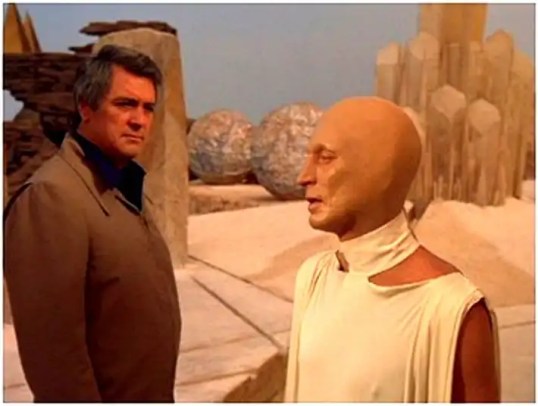
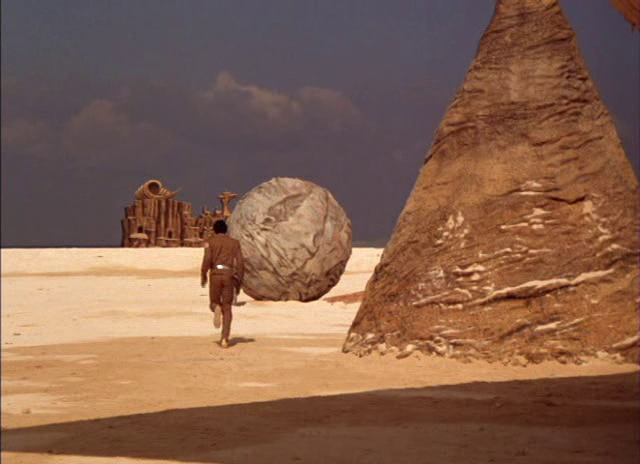
The Martian Chronicles (1980, directed by Michael Anderson, DP: Ted Moore)

Film Review: The Shoes of The Fisherman (dir by Michael Anderson)


The 1968 film, The Shoes of The Fisherman, opens in a snowy Siberian labor camp.  For the past twenty years, this camp has been the home of Kiril Pavlovich Lakota (Anthony Quinn), the Ukrainian archbishop of Liviv.  Kiril is unexpectedly released by Russia’s new leader, Piotr Ilyich Kamenev (a very British Laurence Olivier).  After explaining to Kiril that Russia and China are on the verge of nuclear war due to a famine that has been instigated by U.S. sanctions, Kamenev tells Kiril that he is being released on the condition that he tell no one about the conditions at the Russian labor camp.  Kiril starts to protest just for Father Telemond (Oskar Werner), the Vatican’s representative, to say that the conditions have already been agreed to.

In Rome, Kiril meets the Pope (John Gielgud), who makes the humble Kiril a cardinal, over Kiril’s objections that he just a “simple man.”  Later, when the aged Pope suddenly dies, Kiril is unexpectedly elected, as a compromise candidate, to succeed him.  Still humble and considering himself to be a simple man with a simple mission, Kiril suddenly finds himself as one of the most revered and powerful men on the planet.  With Father Telemond as his secretary, Kiril tries to make the Vatican responsive to the needs of the people and sets out to bring peace between the Russians and the Chinese. That turns out to be easier said than done, especially when Telemond himself is eventually accused of heresy for his progressive views.

(And yes, Telemond is a Jesuit….)

The Shoes of the Fisherman is a type of film that should be familiar to anyone who has any knowledge of the Hollywood studios in the 60s.  It’s the type of big and self-serious film that was meant to tell audiences, “You won’t find anything this opulent and important on television!”  The cast is designed to appeal to everyone.  Anthony Quinn and Laurence Olivier are there for the older viewers (especially the older viewers who made up the majority of the Oscar voters in 1968) while, for the younger voters, there’s handsome Oskar Werner as a Jesuit who interpretation of the Gospels is so radical that even Pope Francis would probably tell him to step back a little.  For the older, anti-communist viewers, there are scenes that portray the harsh conditions at a Siberian labor camp.  The commies put Kiril in prison so he must be one of the good guys.  And for the younger, more liberal viewers, there was the suggestion that the threat of World War III was largely due to the actions of the American government.  And, just in case there was still anyone who thought that television was preferable to a prestige picture, TV star David Janssen shows up as a cynical reporter whose wife (played by Barbara Jefford) is a doctor who Kiril helps to get some medicine for one of her dying patients.  Director Michael Anderson includes enough sudden zoom shots to let younger viewers know that he’s with them while still directing in a stately enough manner to appeal to the older viewers.

The end result is a film that is big and grand but also rather slow.  The film gets bogged down in subplots that don’t really add much to the overall story.  We spend way too much time with the reporter and his wife.  Anthony Quinn does a good enough job as Kiril, giving a rather subdued performance by Quinn standards.  (A scene where Kiril recites a Jewish prayer for a dying man is wonderfully acted by Quinn, who seems to truly be emotionally invested in the film’s message of togetherness.)  Laurence Olivier is not at all convincing as a Russian but still, he has the stately bearing of a man used to being in power.  Like many of the studio productions of the late 60s, The Shoes of The Fisherman tries a bit too hard to strike a balance between old school Hollywood and the counterculture and the film ultimately feels rather wishy-washy as a result.  It’s a noble film with good intentions but it’s not particularly memorable.

The Martian Chronicles: Episode 3: The Martians (1980, directed by Michael Anderson)


Episode 2 of The Martian Chronicles ended with Sam Parkhill (Darren McGavin) helplessly watching as Earth was consumed by nuclear fire.  Episode 3 opens with Col. John Wilder (Rock Hudson) returning to Earth in 2006 and discovered that the entire planet is dead.  He had hoped to find his brother and rescue him but instead, all Wilder finds is a video of his brother being vaporized by an atomic blast.

Back on Mars, the planet is nearly deserted.  Most of the human colonizers were ordered to return to Earth before the war broke out and, as a result, they died in the atomic inferno.  Only a few humans remain on Mars.  One of them, Ben Driscoll (Christopher Connelly), is excited to discover another survivor named Genevieve (Bernadette Peters) but he abandons her when he discovers that she’s too high-maintenance for him.  He decides he’d rather live alone.  (Too mean-spirited to really be funny, this was the weakest short story in Rad Bradbury’s collection and it’s also the weakest segment of the miniseries.)  Wilder and Father Stone (Roddy McDowall) visit another survivor, a scientist named Peter Hathaway (Barry Morse).  Peter lives with his devoted wife and daughter but when he dies of heart attack, they barely notice because they’re robots.

The first hour of the final episode of The Martian Chronicles is considerably weaker than the two episodes that proceeded it.  After the effective scenes of Wilder exploring Earth, the series is suddenly taken over by Christopher Connelly, playing a character that we’ve never seen before and who isn’t very likable.  The Ben and Genevieve sequence is weak and never that funny, despite Peters’s skill with comedy.  The sequence with Dr. Hathaway and the robots feels like a dry run for something Ray Bradbury would have written for The Twilight Zone.

Fortunately, the final segment of The Martian Chronicles swoops in to save the series.  Col. Wilder and his family spend the day camping at the same ancient Martian city where, during the first episode, Spender tried to convince Wilder not to allow Mars to be colonized.  While walking around the ruins of the city, Wilder meets what is either the ghost or the future projection of a Martian.  They have a friendly and philosophical conversation.  They talk about how The Martian doesn’t know if he’s from the past or if he’s from the future but it doesn’t matter.  Returning to his family, Wilder looks at their reflection in Briggs Canal and he say that, with Earth gone, they are now the Martians.  With Earth in ruins and only a few humans left, it’s up to the survivors to combine the ways of Earth with the ways of Mars and create a new world.  Though Hudson is usually held up as being the epitome of a stuff actor, when he made The Martian Chronicles, he had the right amount of gravitas to make the final scenes work.

The Martian Chronicles is an uneven miniseries.  The first episode is so good that the two that follow struggle to keep up.  But just, as in Bradbury’s book, the ending is perfectly realized and it still work, ever after all these years later.

The Martian Chronicles: Episode 2: The Settlers (1980, directed by Michael Anderson)


The first episode of The Martian Chronicles ended with a dying Jeff Spender (Bernie Casey) warning John Wilder (Rock Hudson) that humans settling on Mars would be the worst thing that could ever happen to the once powerful red planet.

The second episode, called The Settlers, sets about to prove Spender right.  By 2004, humans are desperately leaving the war-torn Earth for a new home on Mars.  They rename all of the Martian landmarks, honoring the men who died exploring the planet.  In one of the few deliberately funny moments of this entire miniseries, it’s revealed that the canal that Briggs threw his beer cans in was eventually named Briggs Canal.  There’s one unfortunate shot of a line of miniature space ships that are supposed to be orbiting Mars and waiting for their chance to land.  The episode then gets down to showing what the settlers do to Mars.

It’s nothing good.  The main town looks like a traveling carnival, full of bars and crime.  Many of the people who come to Mars are people who are fleeing something on Earth and Col. Wilder has his hands full trying to keep the peace.  All of the Martians are believed to be dead but it turns out that there are still a few out there.  Using their mental powers, they disguise themselves as humans.  A large part of the second episode deals with a Martian who approached an elderly couple, disguised as their dead son.  Even though they know that he’s not really their son, they allow him to live in their home.  But, when the Martian goes to the city, he becomes overwhelmed by all the thoughts that bombard his mind.  Everyone sees him as being someone that they care about.  Even the local priest, Father Peregrine (Fritz Weaver), sees the Martian as being Jesus.  (That’s no big deal today but that had to have been controversial in 1980.)  Eventually, the Martian becomes so overwhelmed that he dies while a group of humans gawk at him.

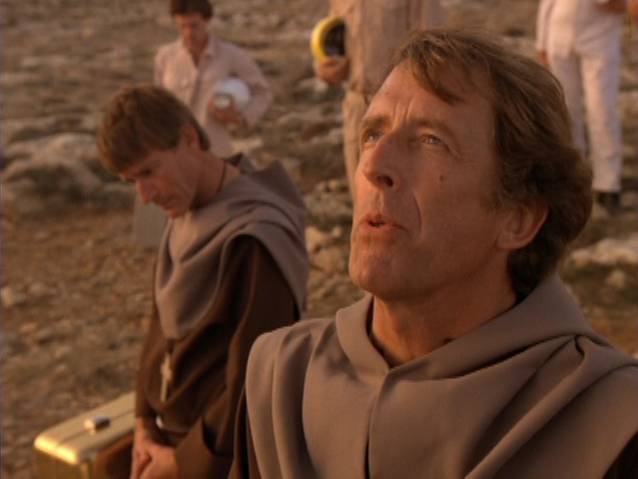
As for Father Peregrine and Father Stone (Roddy McDowall, who spent most of his later years appearing in miniseries like this one), they explore the Martian mountains, searching for three lights that have been reported as hovering in the sky.  When they find the lights, the lights explain that they are ancient Martians who long ago abandoned their corporeal bodies.  They also somewhat implausibly say that they worship the same God as the two priests.  In a departure from Bradbury’s original short stories (in which Bradbury was skeptical about the idea of bringing religion to the Mars), Father Peregrine commits to building a church so that, even on the Red Planet, people can worship.

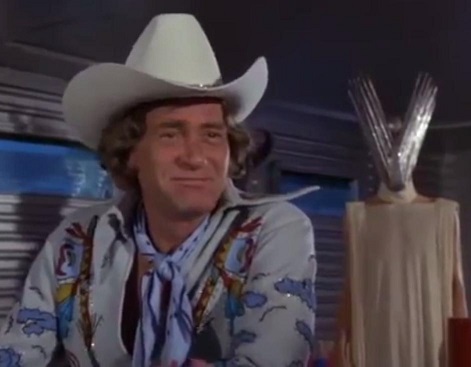
Finally, Sam Parkhill (Darren McGavin) has achieved his dream of building a restaurant on Mars.  He says that, as soon as more Earthlings arrive, he’ll be rich because every trucker will stop off at his place for a bite to eat.  When a Martian suddenly shows up in the diner, Parkhill panics and shoots him.  When more Martians show up, Parkhill flees.  It’s only when the Martians catch up to him does he learn that they’re giving him a grant for half the land on Mars.  “Tonight’s the night,” they tell him, “Prepare.”  Old Sam Parkhill’s pretty excited until he looks through a space telescope and sees that Earth, the home of his future customers, is now glowing with the sure sign of nuclear fire.  I can’t remember how old I was when I first saw this episode on late night Baltimore TV but I do remember being thoroughly freaked out by the scene where Sam watches as a fiery glow encircles the Earth and the planet’s green surface turns brown.  It’s the most powerful moment in the miniseries and a fitting visualization of Bradbury’s concerns about the nuclear age.

As for the rest of The Settlers, it’s good but it’s not as strong or as cohesive as the first episode.  The Martin shapeshifter story is good but the two priests in the mountains felt like they were included to keep religious viewers happy and their segment takes too many liberties with Bradbury’s original material.  Then, Darren McGavin returns to the story. dressed like a cowboy and getting chased by a Martian sandship and The Martian Chronicles goes back to being one of the coolest miniseries to ever be broadcast.

With Earth dead, would Mars follow?  That was the theme of the next episode of The Martian Chronicles, which we’ll look at tomorrow.

The Martian Chronicles: Episode 1: The Expeditions (1980, directed by Michael Anderson)


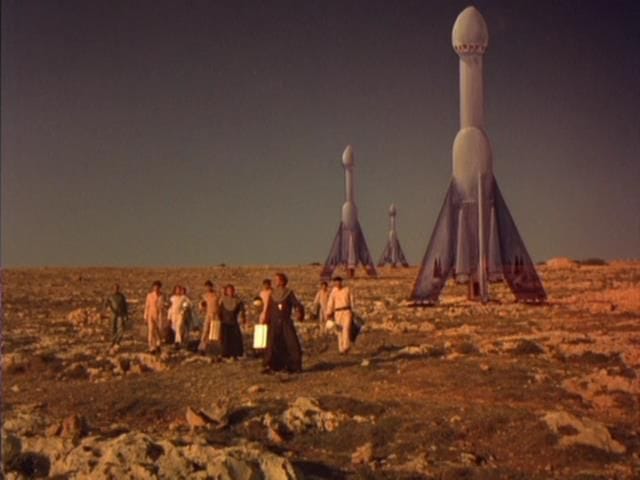
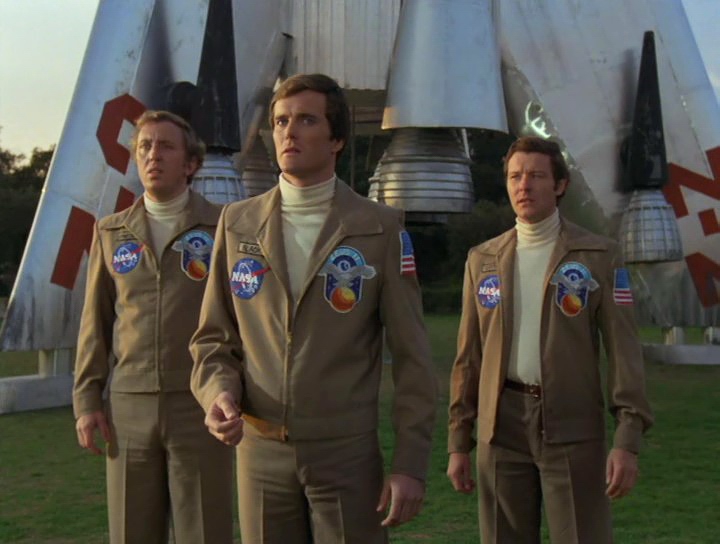
In 1980, NBC adapted the Ray Bradbury short story collection, The Martian Chronicles, into a three-part miniseries.  Though Bradbury’s original book featured short stories that were only loosely connected by two shared locations (Earth and Mars), the miniseries connected most of the stories through the character of Colonel John Wilder (Rock Hudson), the NASA project director who headed up the project to colonize Mars and who later regretted his decision after it became clear that humanity was going to treat Mars just as badly as they treated their previous home.  The miniseries was adapted by Richard Matheson and directed by Michael Anderson.

Unfortunately, the miniseries itself was not a hit with critics, who complained that the story moved too slowly.  Audiences, having just experienced Star Wars and Close Encounters of the Third Kind, were not impressed with the special effects, in which miniatures were used to simulate spacecraft flying through space.  Despite all of that, though, The Martian Chronicles has built up a cult following.  I can remember first catching the miniseries playing late at night on one of the local station in Baltimore.  I’ve always liked it.  It’s not as good as Bradbury’s original collection, of course.  But the miniseries still has its strengths, despite the miniatures.

The first and best episode of the miniseries was The Expeditions.  Starting with a recreation of Viking 1 landing on Mars in 1976, the episode jumps forward to the far future of 1999!  The first manned spacecraft lands on Mars and the two astronauts aboard are promptly killed by the first Martian that they meet, an angry husband who thinks that one of the astronauts is going to have an affair with his wife.

The second expedition is led by Captain Arthur Black (Nicholas Hammond, best-know for playing Spider-Man in the late 70s TV series).  When they land on Mars, they discover that the formerly Red Planet now looks like Black’s childhood home of Green Bluff, Illinois.  All of their relatives are waiting for them!  Falling into the belief that they’ve returned to the past, the astronauts are killed by their “families” that night.  It turns out that the Martians were using Black’s memories to set a trap for them.  As the Martian who disguises himself as Black’s brother explains it, they’ve seen, in the minds of the astronauts, what the humans are doing to their own planet and they can’t allow that to happen to Mars.  “Forgive us,” the Martians says, “we were once an honorable race.”  In one of the best scenes in both the book and the miniseries, the Martians still have an Earth-style funeral for the men that they’ve killed because they too got sucked into the world that they created and came to care about the men they felt they had to kill.

Years later, a third expedition arrives.  This one takes up the majority of the episode.  It’s led by Colonel Wilder himself and includes Sam Parkhill (Darren McGavin), Jeff Spender (Bernie Casey), Briggs (John Cassady), and McClure (Peter Marinker).  Almost all of the Martians have apparently died, the victims of the Earth germs that were brought to the planet by the second expedition.  While Parkhill plots to open a barbecue joint and Briggs gets drunk and tosses his empty beer cans into a waterway that he christens, “Biggs Canal,” Spender investigates a deserted Martian city.  Unlike the others, Spender is in awe of the Martian civilization and angry that it’s been so casually destroyed.  When Spender returns, he declares himself to be “the last Martian” and tries to kill the members of the expedition.

Of the three episodes, The Expeditions is the one that sticks closest to the stories on which it was based, in both content and theme.  Not surprisingly, it’s also the best of the miniseries, with each vignette working as both a separate story and a part of a larger whole.  It’s the episode that sticks closest to what Bradbuy himself was going for in his original collection.  While the miniature spaceships are a distraction, the desolate Martian landscape is sharply realized and the first episode is full of striking shots, from the Martian husband walking through the red desert to “greet” the first expedition to the funeral for the second expedition to the final battle between Spender and the survivors of the third expedition.  Among the members of the cast, Nicholas Hammond and Bernie Casey are the stand-outs but everyone plays their part well.  Darren McGavin is always a welcome presece in any miniseries and John Cassady is so obnoxious as Briggs that it’s impossible not to see where Spender is coming from.  (Back when the IMDb still has message boards, every message on Cassady’s board was someone posting about Briggs Canal.)  Rock Hudson is as stiff as ever but it’s appropriate for his character.  The scene where he and Bernie Casey debate whether humanity is worthy of a planet like Mars is well-acted by both actors, with the different opinions of their characters reflected in the different performing styles of the two actors.  Though the miniseries never explicitly states it, it is perhaps not a coincidence that Spender, as the only black character in the miniseries, is the only one to truly understand what humans colonizing Mars could lead to.

The Expeditions ends with Spender warning that humans will destroy Mars if they’re allowed to colonize it.  The next episode would explore whether he was correct.  We’ll take a look at The Settlers tomorrow.

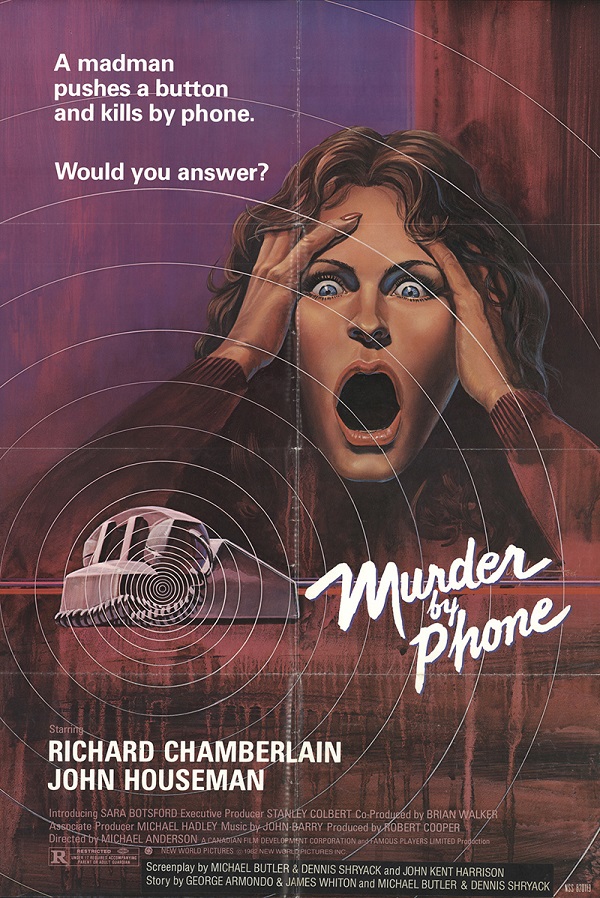
Murder by Phone (1982, directed by Michael Anderson)


Here’s a movie that will make you thankful for the death of landline phones.

People across Toronto are answering phones and blowing up.  Someone has created a device that can send a blast of electricity through the phone line.  The blast is so powerful that it causes hemorrhaging before it blows its victim off of their feet and then melts their phone.  The first victim is a woman who makes the mistake of answering a pay phone.  (It was 1982.  Pay phones were very popular with the youngsters.)  Her college professor (Richard Chamberlain!) decides to investigate her death.  Helping him, for at least a few scenes, is his mentor (John Houseman!!).

Chamberlain and Houseman were serious actors so who knows why they’re in this largely tepid thriller.  But present they are and one of them eventually makes the mistake of answering his phone and seeing a legitimate actor have to pretend to die in such a stupid way almost makes the movie worth the trouble of watching.

Despite all of the killer phone stuff, Murder by Phone is pretty slow and the murderer turns out to be pretty boring.  I only watched it because it was directed by Michael Anderson, who also directed The Martian Chronicles, which I’m planning on reviewing tomorrow.  He also directed a legitimate Best Picture winner (Around the World in 80 Days) and Logan’s Run so he had it in him to do a better job with the promising material in Murder By Phone than he did.  Instead of going all out with the science fiction elements, Anderson directed the movie like it was an episode of a cop show.  It’s disappointing because the story really had potential to be something better.  When it comes to movies about killer phone calls, the top prize still goes to Telefon.

The movie is also known as Bells, which sounds even worse than Murder By Phone.

4 Shots From 4 Films: Special Michael Anderson Edition


4 (or more) Shots From 4 (or more) Films is just what it says it is, 4 (or more) shots from 4 (or more) of our favorite films. As opposed to the reviews and recaps that we usually post, 4 (or more) Shots From 4 (or more) Films lets the visuals do the talking.

101 years ago today, Michael Anderson was born in London.  Anderson may have never become a household name but he directed some memorable movies.  Around The World in 80 Days proved that audiences love spectacle and celebrity cameos and it won the Oscar for Best Picture of 1956.  (Though Anderson was nominated for best director, the award went to George Stevens for Giant.)  However, I think that Anderson’s best-remembered film is probably Logan’s Run.  Whenever I shout, “I hate outside!” or I reply to a simple question with, “There is no sanctuary,” people always seem to automatically know which film I’m referencing.  Anderson followed up Logan’s Run with Orca, which is one of the better Jaws rip-offs.

Today, we honor the career and legacy of Michael Anderson with….

4 Shots From 4 Michael Anderson Films

Around The World in 80 Days (dir by Michael Anderson, DP: Lionel Lindon)

Logan’s Run (1976, dir by Michael Anderson, DP: Ernest Laszlo)

Orca (1977, dir by Michael Anderson, DP: J. Barry Herron and Ted Moore)

The Martian Chronicles (1980, directed by Michael Anderson, DP: Ted Moore)