Review: Nachtreich/Spectral Lore – The Quivering Lights


I tend to avoid split albums. A lot of times, it seems to me, you just end up with two bands’ b-sides that they couldn’t justify releasing independently. But after my first glorious encounter last year with Spectral Lore–Greece’s one-man circus of musical awesome complements of Ayloss–I am ready to lick up any and every track he’ll throw at me. Germany’s Nachtreich, on the other hand, are not a band I would probably ever stumble upon without this release. I gather that they aren’t really metal. They have metal tendencies on this album to be sure, but from what I’ve read they fall more into the neoclassical sphere. But even if I wanted to skip over their tracks–and I don’t–you can’t really do that on this album. It is not a product of two bands throwing whatever they feel like into the mix, but rather a pretty well-planned collaboration.

Track: Spectral Lore – Quivering

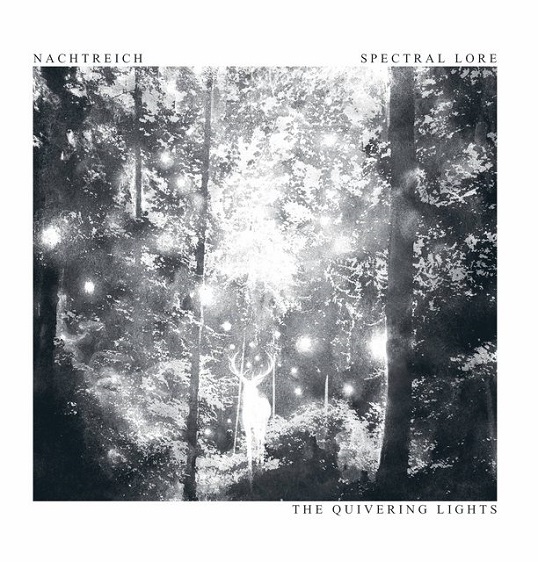
At 46 minutes, The Quivering Lights certainly carries the content of a full length album. The track order, moreover, intermixes the two artists’ contributions to create a single picture rather than two shorter sides to a story. The album kicks off with Nachtreich performing a pretty piano and string piece that would not feel out of place in a movie soundtrack. The first four minutes of “Lights” invite the listener into a warm, subtle scene appropriate for the album’s cover art, and then a lot of things change. We suddenly find ourselves beneath a wall of heavy distortion and arpeggiated piano, as the violin carries on the opening lament to a slow drum plod. It’s a bit jarring–not necessarily in a good or intended way–and it ends as abruptly as it arrived. A calmer piano carries out into the first Spectral Lore track.

On “Quivering”, the track sampled above, Spectral Lore prove more than adequate to answer Nachtreich’s proficiency at writing soft, moody music for piano and string. This song too moves on into metal, but here you have a much greater sense of what’s coming. Spectral Lore, moreover, kick off the black metal in the same grand form that III had brought to my attention last year. Ayloss’s ability to flow in and out of tremolo and double bass is spectacular. The guitar melody is goddamn beautiful, and the drumming restrains itself to maintain a mood devoid of aggression. The fuzzy, expansive vocal noise Ayloss generates feels totally at one with the atmosphere, fading back into an endless horizon. There is no sense of departure from the original landscape set by “Lights”, but rather a sort of heightened state of awareness in which you see all of the shapes and colors in exquisite detail.

Track: Nachtreich – Ghost Lights

The only downside to “Quivering” is that it so overshadows the metal side of Nachtreich that it makes the latter feel almost laughably simplistic. This effect is forgotten soon enough, as Nachtreich’s second contribution, “Greyness”, gives us a beautiful viola and violin duet without any hint of metal (or piano for that matter). On “Ghost Lights”, Nachtreich return to heavy sounds in more measured steps. Growled vocals appear first, creeping up from beneath a shroud of string and piano. It seemed out of place at first, but the more I listen the more I like it. As with Spectral Lore, Nachtreich’s vocals don’t carry the slightest sense of aggression. But here there is no harmony, either. The feeling is of some fetid taint beneath the surface, darkening the landscape. When “Ghost Lights” finally dawns its distortion, the transition is far more natural and compelling.

“Vanishing”, the next Spectral Lore track, picks up right where “Ghost Lights” ends, continuing the same melody on guitar, but it soon proves to be the longest (mostly) continuous chunk of metal on the album. A good bit darker and more chaotic than “Quivering”, its quality is not as forthcoming, but considering how long III took to grow on me, I am not about to write it off. The final song on the album, “Reflection”, is six minutes of brooding acoustic guitar. It feels to me like a song that ought to lead somewhere, and I was a bit startling to realize the album was over.

All in all, The Quivering Light is definitely worth checking out if you’re a fan of Spectral Lore. Don’t let the fact that it is a split turn you away, and don’t blow off the Nachtreich songs either. But if you are new to the band, III is still the place to start. I wouldn’t say Nachtreich impressed me enough to seek them out, but another day and another mood I might yet have a go at them. Their 2009 album Sturmgang got pretty positive reviews. The two bands adapt to each other nicely, and if I sometimes get a suspicion in the back of my mind that Spectral Lore vastly outclass Nachtreich, well, the key word is sometimes. The feeling certainly does not permeate the album, and it easily could have given the way these bands aimed to create a single cohesive work. The Quivering Light feels less disjointed than a lot of albums by one band let alone two. I think the opening track, “Lights”, is the weakest link, and the album is a fairly solid ride through to the end once you get over than hump.

The Quivering Lights, by Nachtreich and Spectral Lore, is available on Bandcamp via Bindrune Recordings.
Review: Pyramids – A Northern Meadow


Pyramids are four seemingly random Joes from Denton, Texas, who have managed to attract some huge names in the world of music, possibly through their completely ridiculous album covers. Well, maybe not that, but the genre-defying oddity known as Pyramids and their associated acts have shown an uncanny knack for recruiting stars to their projects. Originally signed to Aaron Turner’s (Isis, Old Man Gloom) acclaimed Hydra Head Records, they managed a transition to metal’s newest cutting edge label, Profound Lore, as soon as the former went defunct. Their self-titled debut in 2008 scored Colin Marston (Krallice), Vindsval (Blut Aus Nord), and Justin Broadrick (Godflesh, Jesu), among others, to contribute to a remix album, while band leader R. Loren’s White Moth and Sailors with Wax Wings projects have featured David Tibet (Current 93), Alec Empire (Atari Teenage Riot), Jonas Renkse (Katatonia), John Gossard (Weakling), Simon Scott (Slowdive), Hildur Guðnadóttir (múm), and Aaron Stainthorpe (My Dying Bride), to name… a few? The 2009 follow-up, a collaborative album with Nadja, featured Simon Raymonde (Cocteau Twins), and there’s an Ulver remix of it floating around out there. They also lead some cassette tape project with 49 bands I’ve never heard of and This Will Destroy You.

In spite of the absolutely ridiculous, confounding string of names I just threw out, this band remains pretty damn obscure. A Northern Meadow, their first full-length since 2009, may well change all that, with positive reviews on sites like Pitchfork Media ensuring them a moment in the spotlight. Moreover, Colin Marston and Vindsval are active guest musicians this time, with pretty encompassing roles.

track: “In Perfect Stillness, I’ve Only Found Sorrow

The opening track, “In Perfect Stillness, I’ve Only Found Sorrow”, kicks off with Marston’s quintessential tremolo and Vindsval’s equally iconic drum programming, while R. Loren’s vocals quickly cue us into the fact that this isn’t going to be a straight metal album. Instead, we face a prolonged melancholy that finds its essence in the vocals and never really resolves into anything. This brooding approach carries throughout the album, but as the minutes tick by you can notice a slight sort of development–little hints at a more complex animal below the surface. “The Earth Melts Into Red Gashes Like The Mouths Of Whales” rises out of the plod for thirty seconds of really catchy guitar before dissolving back into bleak noise. “The Substance Of Grief Is Not Imaginary” feels like a Blut Aus Nord song in slow motion, offering all of their accustomed madness with none of the speed or volume, while Loren briefly confounds the mood with a really beautiful but short lived vocal melody. “Indigo Birds” extends the vocal presence, with Loren singing longer with more effects and range. As the song dissolves out into distorted droning and ultimately three minutes of dissonant synth, the album approaches a modest transition in character. The interlude resets the mood, allowing the remainder of the album to take, I think, a slightly more abrasive or confrontational approach.

Track: “I Am So Sorry, Goodbye

The second half of the album is more distinct, with more drive in the guitar and a faster rate of transition. “I Have Four Sons, All Named For Men We Lost To War” starts off with the most crushing tones on the album, enhanced in their finality by the still slow pace set by Vindsval’s drums. “I Am So Sorry, Goodbye” has a really memorable industrial groove, with some synth tones that invoke for the first time in me a real vision of something… perhaps ancient, a sort of primordial ruin made all the older by Loren’s forlorn, beautiful vocals. Like “Indigo Birds”, the song dissolves out into low-tuned guitar and synth droning, but the feeling is more complete. The substance of the song gives you more to reflect on in the haze of noise that follows.

On “I Am So Sorry, Goodbye” and growing throughout the remainder of the album, Loren’s vocals start to sound subtly reminiscent of Chino Moreno to me–high-pitch meanderings that feel slightly unstable yet always harmonious. It’s an effect he pulls off well, and it makes the album feel rather back-loaded to me. “Consilience” wraps things up with a turn back to the darker side. More chaotic, and with a new touch of pessimism to the vocals, it concludes an already morbid album on a particularly bleak note. Oppressive synth creeps its way in a bit earlier, and a hard stop takes us to fading noise and silence.

A Northern Meadow leaves me with pretty mixed feelings. R. Loren has a clear aural agenda that he sticks to throughout, yet I can’t escape the feeling that the album’s highest points were those most distant from the overarching theme. The beat-down opening of “I Have Four Sons…”, the synth early in “I Am So Sorry, Goodbye”, Marston’s driving 30-second sweep in “The Earth Melts…”, the short-lived vocal burst at the start of “My Father, Tall as Goliath”… I find myself anticipating these finer moments through a lot of the moody grind, rather than just enjoying the ride and taking the highs as they hit me. That grind has a lot of character at times, especially the further into the album I get, but not enough to match the talent Loren was working with here.

I guess I would say that A Northern Meadow is a very unique album, and I love Loren’s dedication to uniting awesome musicians, but I don’t feel very compelled to keep listening to it as the novelty begins to wear off. If its slightly chaotic morbidity strikes a chord with you, you might love it, but if you can’t connect to that feeling it will inevitably grow tedious at times. Marston’s noodling isn’t extensive enough to keep me constantly engaged the way a Krallice album can–a tall order, considering how equally brilliant that band’s other three members are–nor do I think Vindsval’s drum tones hold up in this sort of mono-tempo drag. It doesn’t help that both musicians inevitably play themselves. Like say, Humphrey Bogart or Morgan Freeman, they are so distinctly themselves that you feel like you’re hearing the actors, not the characters they are meant to portray. There is nothing of the instrumental synergy both produce in their main bands. I don’t hear the chemistry of two great musicians working together here. I just hear two great musicians, like some mash-up with Loren mixing vocals and synth into the pot. There may be some truth to that: if I understood Loren’s recent interview with Decibel Magazine correctly, I’m pretty sure Vindsval and Marston had no direct communication while crafting this.

I’m not saying A Northern Meadow is bad. Not at all. But it does leave me wanting something more. I can’t help but wonder what could come out of Loren, Marston, and Vindsval sitting down in a recording studio together, and I suspect it would be something more substantive than this, with a lot more motion and a lot less gloom. But that meeting might be pretty difficult to arrange, and who knows whether they would see eye to eye if Loren had allowed them less freedom to do their own things. I might yet get into this, if I can get over what it isn’t sufficiently to appreciate what it is.

RIP Dave Brockie, 1963-2014


One of the greatest minds in music passed away yesterday at the tragically early age of 50. You’ve probably never heard of David Brockie, but I bet you have at least seen a few images or video clips of him on stage as Oderus Urungus, the well-endowed Scumdogian leader of GWAR. Beyond masterminding the band’s famous in-your-face stage antics, Brockie managed to infuse America’s most politically incorrect band with some incredibly clever lyrics and a sardonic whit that seemed to criticize the real atrocities in this world even while pretending to glorify them.

Here is a look at the more human side of the late, great David Brockie. You will always be my favorite live musician, and you’ve taken us beyond hell! I hope you can rest more peacefully now.

My Top 10 Metal Albums of 2013


It’s that time again. In spite of 2013 being pretty much the worst year of my life, I found it a lot easier to select a top 10 list than in 2012. Odd-numbered years almost always seem to produce a wider selection of good music, and I can confidently state that each of these at least border on excellence. Here goes:

10. Ihsahn – Das Seelenbrechen (track: Regen)

There was never a bad Emperor album. Ihsahn’s solo career hasn’t been quite as consistent. The Adversary was an outstanding start, but I barely noticed angL. After was a blast, Eremita something of a bore. Well, what do you know; the cycle continues, and Das Seelenbrechen is outstanding. Eremita seemed all about rhythmic grooves and eclectic interludes, neither of which painted a grand picture for me to take hold of. Das Seelenbrechen, without reducing any of the progressive rock peculiarities for which Ihsahn is famous, reinvests its tension in song structure and the subtler stuff of atmospheric appeal. At times it delves heavily into the world of drone metal, with Tobias Ørnes Andersen pulling off his best Atsuo impression and Ihsahn showing that his unique vocals are pretty well suited for the genre as they stand. The most impressive track on the album might be “Pulse”, if only for the fact that Ihsahn was able to stray so far from his comfort zone and still pull off an excellent song, but my personal favorite has to be “Regen”.

9. Ash Borer – Bloodlands (track: Oblivion’s Spring)

I missed out on Ash Borer’s acclaimed 2011 debut and the 2012 full-length to follow, but the Bloodlands “EP” (it’s still 35 minutes long) found itself well embedded in my subconscious this year. Like many of my selections, I never really sat down and gave it my undivided attention from start to finish. It was a busy year, and most of my albums were experienced as background music rather than a main event. I was kind of surprised to find just how many times I’d listened to this album throughout the year. It was never really on my radar, but I kept playing it time and time again. A twisted, bleak, highly atmospheric recording, Bloodlands successfully captures a traditional black metal vibe that is neither overly passionate nor distractingly aggressive. It’s a pleasant break from the otherwise welcome trend towards a less sinister, more humanizing approach to the genre.

8. Westering – Joy (track: This Will Quiet Us)

Joy is definitely the weirdest album I’ve heard this year that actually worked. Bryan Thomas’s second release as Westering is a cracked window peering into folk, industrial, and maybe even 80s pop scenes, sensible to melodic appeal yet firmly rooted in black metal tradition. To label it another “shoegaze black metal” album would hardly do it justice; the warbling walls of distortion don’t angelicize the metal, but rather demonize the more direct pop elements, creating a final product basked in darkness yet awkwardly catchy and familiar.

http://www.youtube.com/watch?v=Xa6dRnT4Bj8

7.Ensemble Pearl – Ensemble Pearl (track: Island Epiphany)

It’s sad that this album has gone almost completely unnoticed in 2013. It’s sad that people regard it as another Boris album, or as “Boris and Sunn O))) Part 2”. Because, while it shares much in common with Altar, the cast is quite different and the end product surprisingly even better than its predecessor. While Atsuo Mizuno and Stephen O’Malley reunite, Takeshi and Wata are out, as well as Greg Anderson. Michio Kurihara steps up to the plate along with a fellow I’ve never head of–Bill Herzog–to complete the lineup. The sound these four have managed to assemble is flawless. Smooth as glass and black as night, Ensemble Pearl is a compelling example of music’s capacity to paint a scene more vivid than sight can ever offer.

http://www.youtube.com/watch?v=EcimCb52O9w

6. Paysage d’Hiver – Das Tor (track: Macht des Schicksals)

Like Ash Borer, Paysage d’Hiver provided ideal background music for me throughout the year. With a similar appreciation for late 90s/early 2000s atmospheric black metal aesthetics, Das Tor presents a significantly noisier, more trance-inducing break from current metal trends. I fell in love with this album’s capacity for endless repetition as the backdrop for work, reading, and just about any other activity that requires concentration. This particular style of black metal has always really zoned me in and helped me to focus, and Paysage d’Hiver’s take on it is substantially better than most.

5. Mechina – Empyrean (track: Anathema)

Fear Factory’s 1998 opus, Obsolete, was the last industrial death metal album to really blow me away. A lot of bands go there, but few, at least in my experience, are willing to fully nerd out into uncompromised sci-fi fantasy. There is something about the death metal mentality that inclines most bands to play with their nuts out, and it rarely works in their favor. Mechina don’t fall for that. They have no qualms whatsoever about employing clean vocals, dramatic symphonics, and operatic hymns to serve their end. Empyrean paints a lush vision of a futuristic world of technology and galactic combat on the brink of apocalypse. Really stellar stuff. … ha..ha… hmm…

4. Summoning – Old Mornings Dawn (track: Old Mornings Dawn)

It took Summoning seven years to release a new album. I would not be surprised if they were hard at work on it that whole time. Not quite as perfect as Let Mortal Heroes Sing Your Fame, Old Morning Dawn is nevertheless an instant essential within the Summoning discography, never wavering an inch from the solid sound they forged a decade ago. I can’t think of too many albums I’ve anticipated for this long that didn’t let me down (Falkenbach’s Tiurida in 2011 might be the most recent exception), and for that, coming from one of my favorite bands ever, Old Mornings Dawn easily slides in towards the top of my chart.

http://www.youtube.com/watch?v=HyHrKDcRadg

3. Cara Neir – Portals to a Better, Dead World (track: Peridot)

I remember when I was first getting into black metal and a friend of mine was doing the same with screamo. They seemed like two incommensurable paths at the time. We’d trade the best of what we found, and I love a lot of screamo because of it, but that was his genre and this was mine. There just wasn’t all that much in common between Carpathian Forest and City of Caterpillar.

Times have changed, and much for the better. I’ve tossed around “screamo” and “black metal” in the same sentence before (Roads to Judah), but this is certainly the most raw realization of the two as one that I have heard so far. Portals to a Better, Dead World is another fine product of a new era of metal artists informed beyond their flagship genre. It might not achieve the fame of Deafheaven’s Sunbather, but the two go hand in hand.

2. Deafheaven- Sunbather (track: Dream House)

And that brings us to the most hyped metal album of 2013. Sunbather turned more heads than Roads to Judah, and certainly more than Liturgy’s Aesthethica or Krallice’s Diotima back in 2011. But while the mainstream world regrettably failed to recognize that year as the grand coalescence of heavy metal’s mid-2000s paradigm shift, on Sunbather we reap its fruits. This album is not the novelty many would like to make of it; it is an affirmation of things already come to pass, and a glorious one at that. Music seems to come in sequences of waves, the reluctant undertow of their predecessors slowly dissipating beneath the growing weight of those rushing to shore. Sunbather basks in a new era of aesthetics and ingenuity first dreamed by the likes of Ulver, pressed into form by Agalloch and Alcest, and finally swept into the mainstream three years ago. Love it while it lasts, and amuse yourself with the die-hards that will rip this to shreds rather than embrace it.

1. Peste Noire – Peste Noire

And then there was one. I proclaimed Peste Noire the best album of 2013 about an hour after it leaked back in June, and nothing since has come even close to shaking that resolve. I’ve been doing a “top 10 album” list now every year since 2002, and Peste Noire is the only band to ever take the #1 spot twice, but never mind that. Ballade cuntre lo Anemi francor has absolutely nothing on what you will experience here. Let’s try “top 10 metal albums ever recorded”. I have never heard anything quite this clever, filthy, intelligent, and depraved in my life. Famine’s “black ‘n’ roll” sound has never been better, and Peste Noire can rightly be regarded as the refinement of all of the finest features of his past four albums rolled out into one.

The album is heavily enhanced by Famine’s new willingness to tell us what it’s all about. Up through the release of L’Ordure à l’état Pur in 2011, it was anyone’s guess what Famine’s peculiar album antics were all about. He was completely inaccessible as an individual, and his lyrics have always been in French. The man behind the music has since emerged full-formed as an internet personality, conducting interviews, approving lyric translations, and responding to forum inquiries in surprisingly fluent English. He’s revealed himself as an extremely culturally and musically informed character with a sardonic sense of humor that seems to abate the more offensive features of his image, and he completely reformed my view on L’Ordure à l’état Pur–an album I’d initially disregarded, but have since grown to love.

I tried to give Peste Noire a fair review over the summer, but I couldn’t quite do it justice. This article does. Skip to 20 minutes in the above video if you care to hear my favorite track on the album: “Niquez Vos Villes”.

Enjoy, and Happy New Year!

Horror Music


http://www.youtube.com/watch?v=AFSDR1iJrZ4

I suppose if I asked most people what music they identified with horror, John Carpenter’s “Halloween Theme” and Mike Oldfield’s “Tubular Bells” (The Exorcist) would come up first. After that, you’d get a lot of Rob Zombie and Glenn Danzig. So right off the bat, you’re looking at an enormous variety of sounds and styles connected mainly by association. While John Carpenter’s work was intentionally composed for the film in which it appeared, “Tubular Bells” was originally a 50 minute progressive rock opus that was anything but sinister or foreboding in its full form. Misfits was a goth punk band that happened to favor horror themes. White Zombie’s horror imagery was more a matter of crudeness and vulgarity in the spirit of GWAR; their sound was a frontrunner in the emergence of industrial groove metal, and the greatest “horror” associated with Rob was the countless terrible nu metal spinoffs. A couple of “top ten horror songs” lists I stumbled upon even list Bobby Boris Pickett’s “Monster Mash” and Richard O’Brien’s “Time Warp”. I mean, “Monster Mash” is a fun Halloween song, sure, but horror? Really? And the Rocky Horror Picture Show does make me want to vomit, but we have to draw the line somewhere.

Suffice to say, “horror” music is not a genre at all. Simply associating a song with a scene or theme is enough to relate them; Huey Lewis and the News will probably make me smile and think of Christian Bale chopping people to bits in his apartment for the rest of my life. But there are definitely certain musical attributes that conjure in us a less glitzy feeling of dread than Hellbilly Deluxe. That skittering cockroach beat in the background of Halloween is completely unnerving; Carnival music is way creepier than Stephen King’s It; Black Sabbath’s appreciation for diabolus in musica virtually invented heavy metal; and it took a firm dose of the blues in 1988 for Danzig to capture a sense of the sinister that Misfits could never convey.

I don’t believe that any particular musical formula is the coalescence of evil. The music we find most haunting is derived from association too, but it connects in more subtle ways than say, the fact that a particular song appears in a horror film or mentions witches in the chorus. The real deal distorts what comforts us, denies our sense of order, and pries upon our innocence. Through a musical medium as through any other, horror focuses on shattering the lens through which we perceive reality as an ordered, logical construct. It reminds us of the real nightmares in life while nullifying our means to counteract them. It takes us to the world of the child, where emotional extremes enhance our senses of comfort and terror alike.

The carnival tune and music box are prime targets, conjuring in our minds a time when fear was more potent. The brief piano loop, the simple hum, the monotone drone–these bring us to solitude and isolation through minimalism. Effective horror themes offer no comforting symphony or rock ensemble to encase us in a nuanced world. They surround us with something singular and far from warm, or with nothing at all. The wind chimes warn of a storm; when none is coming, the darkness is all the more unnatural. The cathedral bell, a sign of fellowship on a Sunday morning, also tolls for death. A twitch, a buzz, a repeated knocking, a bit of static–things that would otherwise annoy us–exploit the close connection between discomfort and tension.

Or else we can completely overwhelm the senses with noise that strips away the familiarity which typically diminishes extreme music’s effect, leaving us a nervous wreck. When Blut Aus Nord chose to employ programmed, industrial blast beats in their 777 trilogy, they effectively eliminated the one element of the music that would have sounded too familiar to disturb. Instead, the epileptic guitar finds companionship in a persistent, unnatural clatter designed to place us permanently on edge.

Other bands have found other means to the same end. Peste Noire’s unique “black ‘n’ roll” sound enlivens a standard formula for “evil” music with a pep and a grin, giving the brutalizer a human face in the spirit of medieval sadism. Sunn O))) are inclined to drone on for ages, developing a false sense of comfort before infusing their deep buzz with a caterwaul of shrill pitches and clattering chimes. (I actually had a guy start freaking out on me at work one day when “Cry For The Weeper”, which he didn’t even notice playing, hit the 3:55 mark.)

http://www.youtube.com/watch?v=CTsj5Bz2hPY

And lastly, we can’t forget the power of lyrics to render a song gruesome. The stereotypical lines of a black metal song–nonsense about necromoonyetis and an appeal to Satanism far less disturbing than the average Christian commentator on Fox News–are pure cheese, and they entertain us in a manner similar to your typical zombie flick. But when you first heard Smashing Pumpkin’s “x.y.u.”, you probably got a feeling more akin to Henry: Portrait of a Serial Killer.

Horror in lyrics is something a bit the opposite of horror in sound; it strikes us most deeply when we can be convinced that there is absolutely nothing supernatural about it. There are certainly a few exceptions–Townes Van Zandt’s tall tale in “Our Mother the Mountain” chills me to the bone–but generally speaking, the real atrocities committed throughout human history far exceed the limits of our imaginations. Vlad Tepes was worse than any vampire, and from Elizabeth Bathory and Ariel Castro to Hernando Cortes and Adolf Hitler, we are flooded by examples of direct personal cruelty and dehumanized mass slaughter. When a song manages to make us think of these individuals and events beyond the safety blanket of historical narrative, an authentic feeling or horror is hard to deny.

Ten Years #28: Týr


Decade of last.fm scrobbling countdown:
28. Týr (1,101 plays)
Top track (75 plays): Hail to the Hammer, from various albums
Featured track: Regin Smiður, from Eric the Red (2003)

Viking metal, pagan metal, folk metal, call it what you will–it’s pretty impressive that Týr have managed to capture an extraordinary vision of the Norse past with absolutely no traditional instrumentation or synth choruses to speak of save the human voice. Since their second album, Eric the Red, Týr have revolved around Heri Joensen’s breathtaking vocals. Their unique brand of progressive rock instrumentation is heavy enough to blast out your stereo and yet entirely subservient to the driving vocal anthems. I would be very interested to gain a better understanding of where Joensen’s dedication to tradition gives way to his unique creativity as one of the most innovative musicians making music today–of the extent to which his vocals are derived from Faroese tradition. With an educational background in both vocals and Indo-European linguistics, he probably has a better idea than most of how traditional Germanic and Norse singing must have sounded, and I feel a sense of solidarity between the band and other students of folk vocalization such as Latvia’s Skyforger. At the same time, I gather that Norse musical tradition is a far more elusive beast than its eastern counterparts.

As a modern band, Týr seem to me the most central act of the whole “viking metal” scene. The term is a bit of a ruse, in so far as it lacks both the stylistic conformity of most genre labels and the acknowledged generality of catch-alls like “folk metal”. Whether a band might garner the label depends upon so many nuance factors that it is much easier to agree upon which acts ought to receive it than to discuss why. Attempts to properly define it are few and far between. The Wikipedia article on “viking metal”, for instance, is largely substantiated by a thesis on folk metal submitted by Aaron Patrick Mulvany in 2000. That is only 12 years removed from Bathory’s Blood Fire Death–now a quarter of a century behind us–and two years prior to one of the most significant bands of the “genre”‘s debut. With the utmost respect for anyone who acknowledges folk metal as a legitimate subject for scholarship (I’m looking forward to reading Mulvany’s thesis, available online, over the next few days), I would ascribe to him the gift of prophecy were it not hopelessly dated. But while I would say that Bathory was fundamentally black metal, Amon Amarth death metal at their core, Falkenbach hopelessly under-appreciated, and Thyrfing given to fantasy, the inherent catch-all-ism of progressive metal (not the Dream Theater worship standardized derivative) lends to Týr a sense of authentic originality. As a metal act they do their own thing, and that makes their tradition-influenced vocals and lyrics emerge with no strings attached.

Týr’s music is neither too confrontational nor too fanciful to be generally accessible. They are, in the very least, the first band I would recommend to an inexperienced listener who asked me what specifically Norse-derived folk metal sounded like. Their sound bleeds an authentic scholarly interest in Norse culture and plugs the myriad gaps with progressive rock that is both down to earth and impressively original. You’ll find no fallback to Tolkien here (album cover aside), and no hell-raising or Transylvanian hunger either; it’s something a bit more Apollonian, and exciting all the same. If I could pick any one artist to spend an evening in a pub with, Heri Joensen may very well top my list.