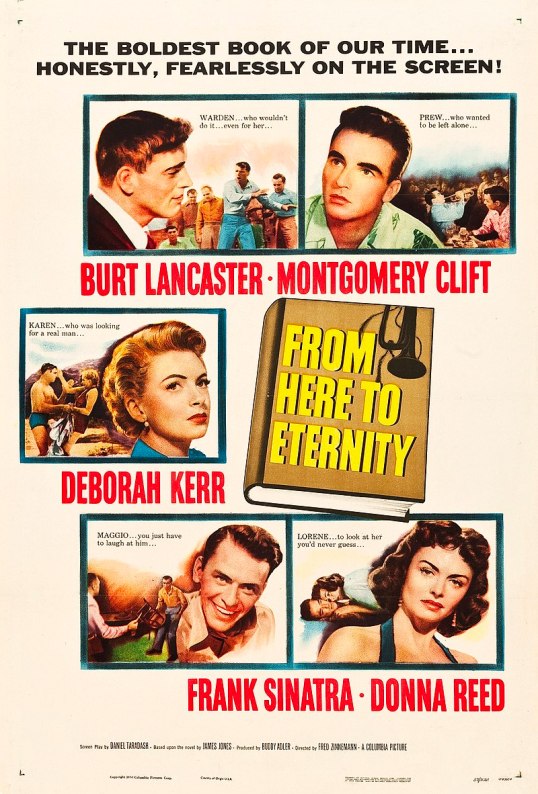
“The boldest book of our time,” shouts the poster art for 1953’s From Here To Eternity, “honestly, fearlessly brought to the screen!”
And indeed, James Jones’s novel was brought to the screen about as boldly as a studio film could be brought in 1953. The book told the story of several soldiers in the days immediately before the attack on Pearl Harbor. The Production Code was still in effect and, as a result, a few changes were made to the film’s plot. Donna Reed played Lorene, a character who is described as being a “hostess” at social club but who, in the book, worked at a brothel that was popular with the soldiers from a nearby army base. In the book, an unfaithful husband gives his wife a venereal disease that leads to her getting a hysterectomy. In the movie, Karen’s (Deborah Kerr) hysterectomy was the result of a miscarriage that occurred after she discovered her husband was being unfaithful. The book was critical of the Army and featured officers who faced no consequences for their actions. The movie definitely presents the enlisted men as being at the mercy of officers but the worst of the officers is ultimately disciplined. The movie was made with the cooperation of the U.S. Army and, as a result, the film’s villains — like Captain Holmes (Philip Ober) and the monstrous Fatso Judson (Ernest Borgnine) — were portrayed as being aberrations who did not represent the Army as a whole. That said, the film version of From Here To Eternity is still a powerful, moving, and daring film. What couldn’t be shown on screen is still suggested. One might not see the specifics of what Fatso Judson does to Maggio (Frank Sinatra) in the stockade but it’s not difficult to figure out.
The film follows one company of soldiers as they laugh, fight, and fall in love while stationed in Hawaii. They spend time training for a war that most of them think will never come. Captain Holmes is more concerned with his regimental boxing team than the prospect of going to war and is confused when Private Prewitt (Montgomery Clift) refuses to stop back into the ring. Prewitt, who takes pride in his ability as a bugler, quit boxing after he blinded an opponent in the ring but Holmes doesn’t care. Holmes wants another trophy for his office. He orders Sgt. Warden (Burt Lancaster) to make life Hell for Prewitt until Prewitt agrees to box. Warden, who has seen a lot of officers come and go and who has been tempted to become an non-commissioned officer himself, is having an affair with Holmes’s wife, Karen. Meanwhile, Prewitt and his friend Maggio spend their time looking forward to the weekends they’re allowed to spend off the base. Prewitt has fallen in love with Lenore but, as with all the men in From Here To Eternity, Prewitt’s true love is for the army. Even with Holmes pressuring him to box, Prewitt’s loyalty is to the men with whom he serves. There’s a lot of drama, a lot of death, and a lot of romance. This is the film in which Burt Lancaster and Deborah Kerr make out on the beach while the tide rolls in. But, when Pearl Harbor is attacked, all of the drama and all of the romance is forgotten as America goes to war.
From Here To Eternity is one of the best films of the 1950s and certainly one of the more worthy winners for Best Picture. Intelligently directed, wonderfully acted, deliriously romantic, and finally rather sad, it’s a film that embraces the melodrama without ever hitting a false note. Burt Lancaster’s rugged weariness, Montgomery Clift’s method sensitivity, Frank Sinatra’s naturalism, Ernest Borgnine’s crudeness, Deborah Kerr’s classiness, and Donna Reed’s earnestness all come together to create a film in which the characters feel real and alive. Warden, Prewitt, Lenore, Karen, and Maggio are all interesting, multi-faceted people, trying to find some sort of happiness in the shadow of an inevitable war. The viewer may sometimes have mixed feelings about their actions (and Borgnine’s Judson is one of the most loathsome roles that the normally likable Borgnine ever played) but you never cease to care about them and their stories. With all of the characters and the affairs and the secrets, From Here To Eternity can feel like a soap opera but it’s also a portrait of a world that is on the verge of changing forever.
A few years ago, I attended a screening of From Here To Eternity at the Dallas Angelika. This is a film that definitely deserves to be seen on the big screen. From the famous scene on the beach to the attack on Pearl Harbor to the tragic final moments, this is a big movie that deals with big emotions and big moments. It’s one of the best.


 Through the Shattered Lens