This creepy little story of paranoia and murder in the London fog features an excellent performance from Laird Cregar and is definitely one of the best films ever made about Jack the Ripper!
The 35th film in Mill Creek’s Fabulous Forties box set was — wait a minute? I’m on my 35th Fabulous Forties review? Let’s see — there’s 50 films in the box set so that means that I only have 15 more of these to write and I’ll be done! And then I can move onto the Nifty Fifties, the Sensation Sixties, the Swinging Seventies, and the Excellent Eighties! YAY!
Anyway, where was I?
Oh yeah, the 35th film.
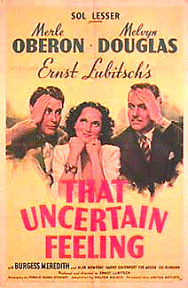
First released in 1941, That Uncertain Feeling is a movie about sophisticated people doing silly things. Socialite Jill Baker (Merle Oberon) gets the hiccups whenever she gets nervous or irritated. Her trendy friends suggest that she try the new big thing: seeing a psychoanalyst! At first, Jill is reluctant but eventually, she gives in to the pressures of high society and she goes to visit Dr. Vengard (Alan Mowbray). Dr. Vengard tells her that her hiccups are a result of her marriage to Larry (Melvyn Douglas) and suggests that the best way to cure them would be to get a divorce.
At first, Jill is horrified at the suggestion. Whatever will people think if she gets a divorce!? However, Larry is kind of a condescending jerk. (Or, at least, he comes across as being a jerk when viewed by 2016 standards. By 1941 standards, I imagine he’s supposed to be quite reasonable.) And Jill happens to meet another one of Vengard’s patients, an outspoken pianist named Alexander Sebastian (Burgess Meredith).
Soon, Jill is not only contemplating getting a divorce from Larry but perhaps marrying the eccentric Sebastian as well! When Larry realizes that Jill is dissatisfied with their marriage and that she is attracted to Sebastian, he gives her a divorce. He even pretends to be an abusive husband so that she can file for divorce on grounds of cruelty. (It’s funnier than it sounds.) Jill and Sebastian get engaged but, once Larry starts to date again, Jill realizes that she’s not quite over her ex…
I was really excited when I saw that The Uncertain Feeling was an Ernst Lubitsch film. Lubitsch directed some of my favorite Golden Age comedies, films like Ninotchka and Heaven Can Wait. But That Uncertain Feeling is not quite up to the standard of the other Lubitsch films that I’ve seen. As played by Burgess Meredith, Sebastian never comes across as being a realistic rival to Larry. The character is so cartoonishly eccentric that it becomes impossible to see what Jill sees in him. At the same time, Larry comes across as being such a chauvinist that it’s far easier to understand why Jill would divorce him than why she would ever want to take him back. The end result is a rare Lubitsch misfire.
However, as long as we’re talking about Lubitsch, make sure to see The Smiling Lieutenant if you get the chance. Now, that’s a good Lubitsch film…
This afternoon, as part of my mission to see every single film ever nominated for best picture, I watched Alexander Korda’s 1933 biopic The Private Life of Henry VIII.
Now, I have to admit that I’ve never been a big fan of the historical King Henry VIII as I have a hard time finding much sympathy for a man who beheads one wife, not to mention two of them. I like to imagine that he met his end in much the same way that Joe Spinell meets his end at the end of Maniac, with all of his dead wives suddenly showing up and ripping off his head. But, Henry is one of those larger-than-life historical figures that always seems to end up as the subject of movies, speculative fiction, and, of course, Showtime television series.
The Private Life of Henry VIII is one of the better known recreation of Henry’s life on-screen. For the most part, the film ignores Henry’s policies as king and instead is a darkly humorous recreation of his relationships with five of his six wives. (His first marriage, to Catherine of Aragon, is ignored.) The episodic film opens with the execution of Anne Boyelen (Merle Oberon). This sequence establishes the film’s tone early and it’s actually a lot more cynical than we usually expect a film from 1933 to be. In between shots of Boyelen waiting to meet her fate, we get extended scenes of two executioners — one French and one English — arguing about which nationality is better when it comes to chopping off heads. Meanwhile, the members of Henry’s court spend their time whispering innuendo about Henry’s new wife, Jane Seymour (Wendy Barrie). When Henry (played by Charles Laughton) finally shows up on the scene, he turns out to be a buffoon, a childish man who happens to control the destiny of England. After Jane dies in childbirth, Henry marries Anne of Cleves (played by Laughton’s wife, Elsa Lanchester). Anne, however, finds Henry to be repulsive and, in the film’s most obviously comedic segment, she goes out of her way to make herself as sexually unappealing as possible in order to convince Henry to give her a divorce. (This, of course, led to the split between England and the Catholic Church but the film doesn’t dwell on that. This is a comedy, not Man For All Seasons.) After the divorce, Henry finally marries Catherine Howard (Binnie Barnes) who has spent the whole movie pursuing Henry. For the first time in the movie, Henry is portrayed as being truly in love, unaware (at first) that Catherine only married him for his crown and is actually having an affair with Thomas Culpepper (Robert Donat).
The Private Life of Henry VIII was not the first movie to be made about Henry VIII but it’s probably the most influential because of Charles Laughton’s Oscar-winning performance in the title role. Laughton’s performance pretty much set the standard as far as future Henry’s were concerned. His Henry is buffoonish womanizer who does everything to excess. (This is the film that pretty much created the whole image of monarchs as men who don’t use forks, knives, or spoons.) However, as over-the-top as Laughton’s performance may seem, it’s actually full of very subtle moments that suggest the actual human being lurking underneath all of the bluster. It’s hard not to sympathize with Laughton’s Henry as he struggles to explain what sex is to Anne of Cleves or with his obvious pain when he discovers that he’s been betrayed by the only one of his wives that he actually loved.
(Of course, any similarity between Laughton’s Henry and the real-life Henry is probably a coincidence.)
The Private Life of Henry VIII was the first British film ever nominated for best picture and, perhaps because it wasn’t made by the Hollywood establishment, it hasn’t aged as terribly as most films from the 30s. While the film does have its slow spots, the performances of Laughton, Oberon, and Lanchester still hold up well and some of the film’s dark comedy almost feel contemporary. Oddly enough, this British film about English history lost to an American film about English history, Cavalcade.
(I should mention that I haven’t seen Cavalcade so I can’t say whether it was a better film. I’m going to have to see Cavalcade eventually but it’ll be later than sooner as the movie is only available as part of a DVD boxed set that costs close to 300 dollars. Agck!)

 Through the Shattered Lens