Retro Television Reviews: Death Sentence (dir by E.W. Swackhamer)


Welcome to Retro Television Reviews, a feature where we review some of our favorite and least favorite shows of the past!  On Sundays, I will be reviewing the made-for-television movies that used to be a primetime mainstay.  Today’s film is 1974’s Death Sentence!  It  can be viewed on YouTube!
There’s been a murder!

A young woman has been strangled in her own home.  The nosy neighbor (Hope Summers) testifies that the woman often argued with her woman and that she heard the woman yelling on the night of the murder.  The husband, John Healy (Nick Nolte), is found in a neighborhood bar and, when he’s brought back to his house, his drunken reaction to seeing his dead wife doesn’t do much to keep him from looking totally guilty.

However, the viewer knows that John is innocent because the viewer has already seen that the woman was murdered by Don Davies (Laurence Luckinbill), the man with whom she was having an affair.  She demanded that he leave his wife for her and Don, realizing that his cheating was about to revealed, responded by strangling her.

Don’s wife is Susan Davies (Cloris Leachman), who knows that she and Don have been going through a rough patch but who certainly had no idea that Don was cheating on her.  Shortly after the murder, Susan is called up for jury duty.  She’s placed on the jury and told that she will be an important part of a major trial.  As a result, she and the other jurors will be sequestered in a hotel….

And who is the defendant in this trial?  John, of course!

As opposed to the other members of the jury, who are ready to convict John even before the first bit of testimony is heard, Susan pays attention to what is said in the courtroom.  She listens to Lubell (Alan Oppenheimer), the prosecutor.  She listens to Tanner (William Schallert), the defense attorney.  She comes to believe that John is innocent but will she be able to hold her own against the rest of the jury?  And will she ever figure out that the murder was actually committed by her husband?

It’s an intriguing premise, even if it is a bit far-fetched.  I mean, it really is an amazing coincidence that Susan just happened to end up on the jury for a case involving a murder that was actually committed by her husband.  However, this is a made-for-television movie and, as soon as “Produced by Aaron Spelling” appears on the screen, most viewers should be savvy enough to know what they’re getting into.  Instead, the main problem with the film is that it opens by showing us who the murderer is.  Therefore, there’s really zero suspense as to who actually committed the crime.  Instead, the viewer spends the entire movie waiting for Susan to catch up.  Since the majority of the film takes place in court, it’s a very talky film but there’s no joy to be found in paying close attention to every word said and picking up on the details that will allow you to solve the crime for yourself.  This is a case where the film spoils its biggest twist and, despite good performances from Leachman and Luckinbill, it’s a bit dull.

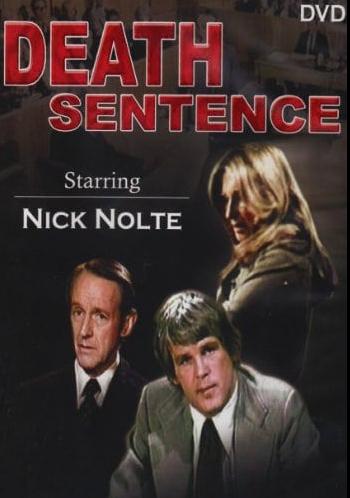
(Nick Nolte, for his part, spends most of the movie silently sitting in the courtroom.  He’s not bad and his look of anguish is believable but it’s hardly a starring role, regardless of what the film’s video packaging might otherwise claim.)

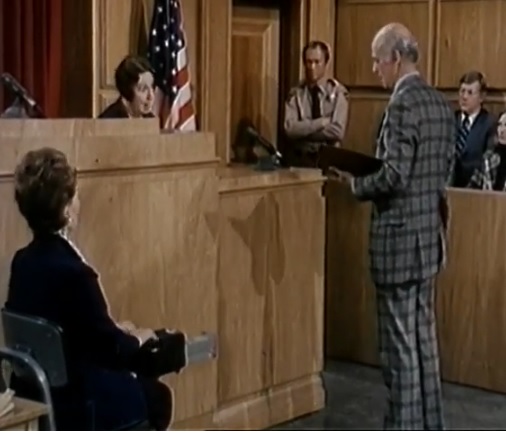
In the end, what I’ll mostly remember about Death Sentence were the atrocious fashion choices made by the prosecutor.  Seriously, would you trust a man wearing this suit?
18 Days of Paranoia #1: The Flight That Disappeared (dir by Reginald Le Borg)


Way back in the early days of the site, I did a series of reviews called 31 Days of Paranoia, in which I reviewed films about mysteries, cover-ups, and conspiracies.  Unfortunately, because I wasn’t all that disciplined about posting during the early days of the Shattered Lens, my 31 Days of Paranoia ended up being something like 24 days.  Still, it was a lot of fun and, historically, it was important because it was the very first “themed” series of reviews that I had ever done.  Shattered Politics, Embracing the Melodrama, Back to School, Sprin Breakdown, and all the rest started with 31 Days of Paranoia.

So, with this being the 10-year anniversary of the Shattered Lens’s founding and Spring Breakdown wrapping itself up tomorrow, I figured why not return to where it all started.  From now til April, please enjoy …. 18 Days of Paranoia!

We begin with:

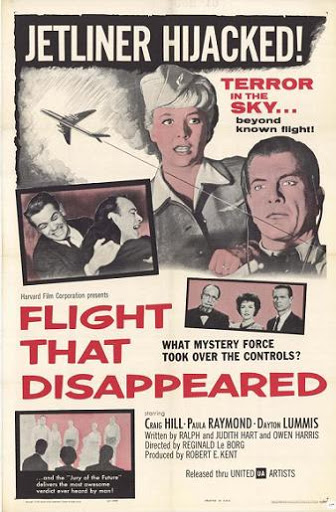
The 1961 film, The Flight That Disappeared, deals with an airplane that …. wait for it …. disappears!

What’s happened to Trans-Coast Airways Flight 60?  When it first took off from Los Angeles, everything seemed fine.  It was carrying a small but well-behaved group of middle-aged people to Washington D.C.  The pilots all seemed like good professionals.  The two flight attendants were busy serving people coffee and having conversations about whether or not one of them would ever get married.  She had every right to be concerned, of course, seeing as how she was in her 20s and still unmarried and childless, despite the fact that this film was made in 1961.

It doesn’t take too long for something strange to happen.  The plane suddenly starts to climb upward, eventually going up over 10 miles high in the sky.  The pilots can’t do anything to get the plane to come back down.  Due to the lack of oxygen, some of the passengers start to pass out.  One passenger panics and opens a door, out of which he promptly falls.  Oddly, this doesn’t create the whole vacuum effects that we always see in other movies where a window or a door is opened while a plane is in the air.  Stranger still, no one thinks to close the door afterwards.  Was this intentional or was it just crappy filmmaking?  It’s hard to say.

Why is the plane being lifted up into the air?  Could it have something to do with the three atomic scientists who are all on the plane?  One of them, Dr. Morris (Dayton Lummis), is wearing glasses and has a van dyke beard so you know he’s smart!  It turns out that Dr. Morris has been working on the Beta Bomb, which is apparently the most powerful atomic bomb ever built.  I kept waiting for someone to ask Dr. Morris why it was called the Beta Bomb and not the Alpha Bomb or the Omega Bomb or the Big Scary Bomb or the …. well, seriously, anything would be better than Beta Bomb!  Everyone in the movie says, “Beta Bomb,” in a tone that’s meant to communicate reverence but it just sounds too much like “Beta Male” for me to really take it seriously.

But, again, who is responsible for the flight climbing?  Is it the Russians?  Is it aliens?  Is it some enemy of the American way?  While everyone else on the plane is passed out, the three scientists find themselves awake.  Their watches are no longer running and, despite the fact that they appear to be alive, their hearts are no longer beating.  Are they dead?  Or have they been transported to the future where they will now be put on trial for the crime of developing the Beta Bomb?

Of course, the thing with being put on trial in the future is that it provides the perfect defense for making weapons in the present.  “Hey,” a smart defense attorney would say, “you’re still alive in the future and you’ve got time travel technology so what are you bitching about?”  But the jurors explain that they’re actually the ghosts of the people who would have been born in the future if not for the Beta Bomb which …. what?  So, is the plane in the future or is it in the afterlife?  The film itself doesn’t seem to be sure.

I’m probably making it sound like this is a more intriguing film than it actually is.  This movie is about 72 minutes long and all the stuff with the people in the future takes place during the final 10 minutes.  That means that the film is essentially just 60 minutes of people saying, “We’re still climbing.”  From a historical point of view, it’s an interesting example of people being paranoid about the arms race.  (If the film were made today, the future the ghostly jurors would be the souls of people who were not born in the future due to climate change.)  From an entertainment point of view, it’s a forgettable dud.