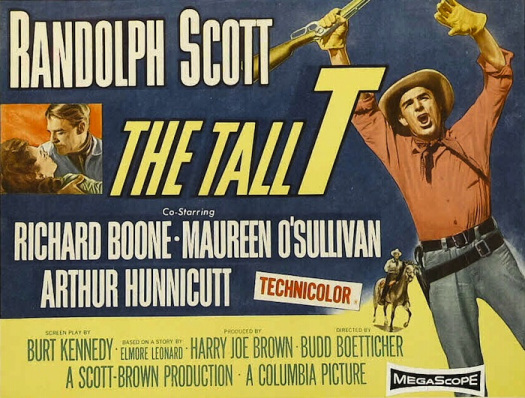
THE TALL T (1957) – Budd Boetticher and Randolph Scott, a match made in heaven!


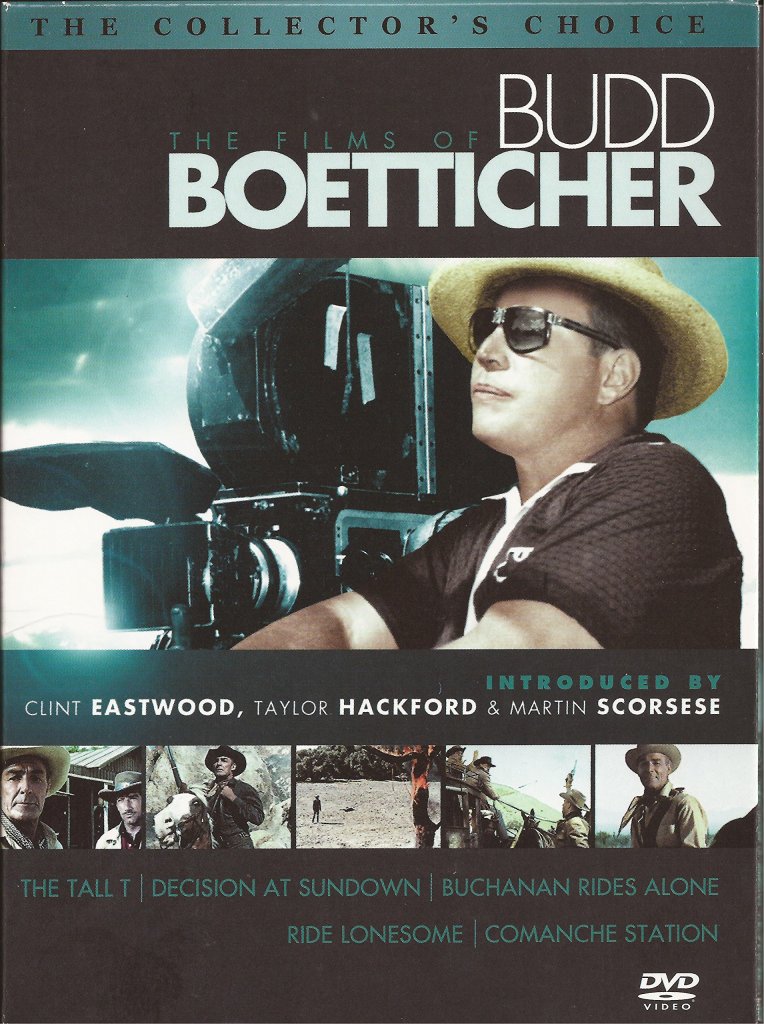
There was a time in my life, before streaming existed, where it seemed like I wanted to buy every movie that interested me in the slightest. The main ways I looked for new movie releases was to go to a store like the Hastings Entertainment Superstore and look at their inventory, or look at the new and recent releases on Amazon’s online store. I could spend hours looking for movies in either location, and I did. Sometime in 2008, I ran across a DVD box set described as “The Films of Budd Boetticher” that contained introductions by the likes of Martin Scorsese, Taylor Hackford, and Clint Eastwood. The films included on the box set were THE TALL T, DECISION AT SUNDOWN, BUCHANAN RIDES ALONE, RIDE LONESOME, and COMANCHE STATION. I remember seeing the names of these movies at various times in my life in my movie books. They had never really caught my attention, although I do remember that they would receive good reviews. This set did catch my attention, however, based on the interesting packaging and the fact that Scorsese and Eastwood were both singing the praises of the films. I did a little bit of quick research and decided to just buy the boxset. I’m glad to report that these films have turned into some of my very favorite movies, and I sing their praises to anyone who will listen.
Version 1.0.0

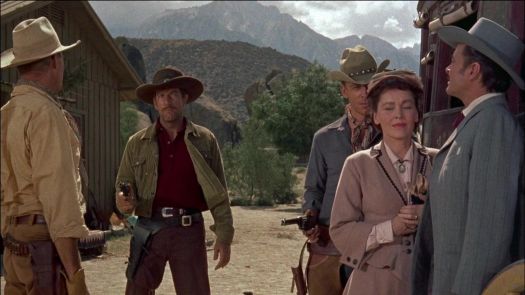
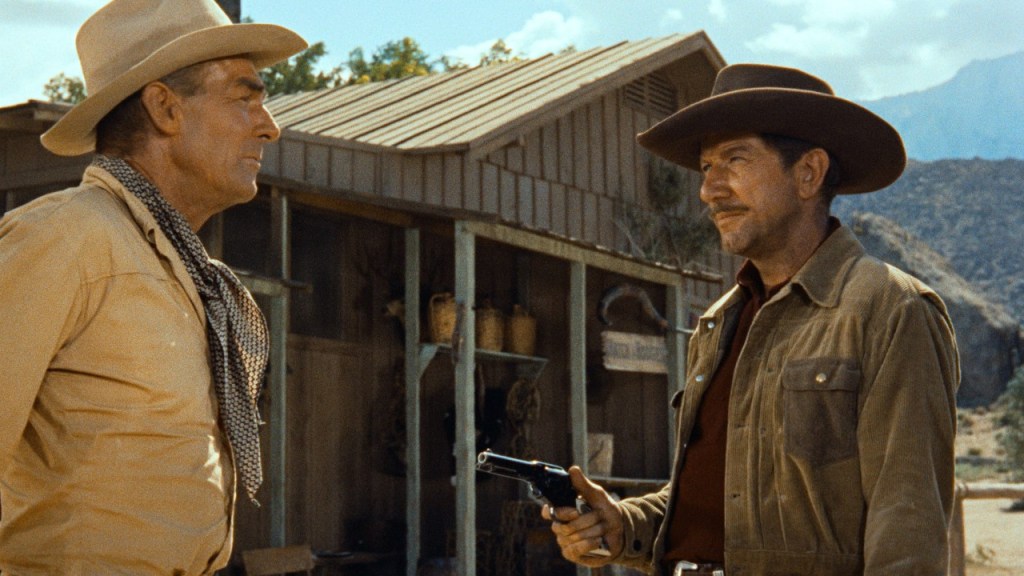
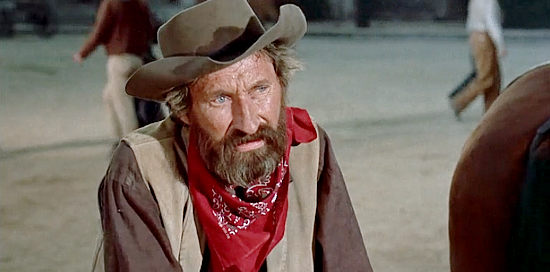
The earliest movie in this set is THE TALL T from 1957, which is based on Elmore Leonard’s short story, “The Captives.” The story opens with our hero Pat Brennan (Randolph Scott) stopping by the Sassabee Stagecoach Station and visiting with the owner Hank (Fred Sherman) and his son, Jeff (Christopher Olsen). Brennan seems like a good-natured guy who has a nice visit with the two and even agrees to purchase young Jeff some striped candy when he stops in the town of Contention later that day. Brennan heads on to Contention where we meet Ed Rintoon (Arthur Hunnicutt), a stagecoach driver who has been hired to take Willard and Doretta Mims (John Hubbard and Maureen O’Sullivan) to Bisbee for their honeymoon. Rintoon and Brennan are clearly old friends. As part of their various conversations, we learn that Doretta Mims is the daughter of Old Man Gateway, the man with the richest copper claim in the territory. After saying goodbye to Rintoon and buying young Jeff his striped candy, Brennan continues on to Tenvoorde’s (Robert Burton) ranch, in hopes of buying a seed bull for his own start-up ranch. For many years, Brennan had been the ramrod on Tenvoorde’s ranch, and the old man clearly wants him to come back. Tenvoorde offers Brennan a chance to get his bull for nothing, but he has to ride the bull to a stand still. If he can’t do it, then Tenvoorde keeps the bull and Brennan’s horse. Brennan takes him up on the offer, falls off the bull, dives into water trough to avoid getting stomped by the bull, and then heads back towards his ranch with nothing but his wet clothes and saddle. As he’s walking down the road, Rintoon comes by on his stagecoach with Mr. and Mrs. Mims. They pick Brennan up and give him a ride. When they stop back at the Sassabee Stagecoach Station, Hank and Jeff are nowhere to be seen. Rather, a voice from inside the station says “Drop your guns and come on down.” Frank Usher (Richard Boone) and young Billy Jack (Skip Homeier) emerge from the station with their guns drawn. When he’s getting down off the stagecoach, Rintoon goes for his shotgun and is shot down by another man, Chink (Henry Silva), whose been waiting in the shadows. These three men are waiting to rob the next stagecoach that comes along. They’ve already killed Hank and Jeff, and are planning to kill every person on this coach, when Willard tells them that his wife Doretta is from the richest family in the territory. Willard tells the three outlaws that Old Man Gateway will pay good money to get his daughter back, if they will just let them live. Usher, the leader of the bunch, likes this idea and sends Billy Jack and Willard back to Contention to request $50,000 from Gateway for the safe return of his daughter. With the endgame changed, Usher takes Brennan and Mrs. Mims to their hideout to wait to get their money from Gateway. Brennan knows that it’s just a matter of time before they are all killed, and he tells Mrs. Mims that they will need to be looking for any possible opportunity to escape.

THE TALL T is just so good. It’s amazing how much drama that director Budd Boetticher could fit into these films that all had running times of less than 80 minutes. The story is simple, but it deals with big themes like honor, cowardice, true love, sociopathic evil, and big dreams. Credit here has to be given to Elmore Leonard, the writer of the short story the film is based on. It must also be given to Burt Kennedy. Kennedy wrote the scripts for THE TALL T, RIDE LONESOME, and COMANCHE STATION. He’s not the credited writer for BUCHANAN RIDES ALONE but he did uncredited work on the script. Kennedy would go on to have a good career writing and directing his own westerns, like SUPPORT YOUR LOCAL SHERIFF, THE TRAIN ROBBERS, and HANNIE CAULDER, but his work with Boetticher is definitely some of his very best.

It’s also amazing how spare and simple everything looks in the THE TALL T. The land is just so dry, with nothing but big rocks and not a tree in sight. Growing up in Arkansas, I’m used to green fields and trees and flowers. It can almost feel like you’re choking on dust just watching this film.

The casting always seems to be perfect in Boetticher’s films. Randolph Scott is simpatico with Boetticher. His character here is a good man who will do what it takes to survive while also keeping his honor intact. Boetticher and Scott are truly a match made in heaven. Richard Boone is great as Frank Usher, the leader of the outlaws. He could have killed Scott’s character Brennan, but he is glad to have an honorable man to talk to after spending all of his time with Billy Jack and Chink. Boone somehow makes his outlaw leader into an honorable man even though he’s done many dishonorable things. It’s an impressive feat. Maureen O’Sullivan has an important role as Doretta Mims, the rich but plain woman, who married Willard because she was afraid she’d end up all alone. Her career goes all the way back to the 1930’s where she played Jane in the original Tarzan movies. She’s a good actress whose character undergoes the widest arc in the entire movie. Henry Silva’s Chink is a sociopath who is keeping score of the number of people he kills. Boone’s Usher would have been much better off if he would have gone with Chink’s advice and put Brennan and the Mims’ in the well back at the Sassabee station! Based on his nonchalant penchant for violence, you can see how Henry Silva would go on to having an amazing career playing bad guys. The last person I want to mention in the cast is Arthur Hunnicutt, who played Ed Rintoon. Hunnicutt is special to me because he comes from the hills of Arkansas, from a little town called Gravelly. He attended the same college I attended, although it was called the Arkansas State Teachers College when he was there. It was the University of Central Arkansas when I came through. Hunnicutt specialized in wise, rural characters. He was even nominated for an Acadamy Award a few years earlier for a movie called THE BIG SKY. He’d go on to be in so many good movies, including playing “Bull” in EL DORADO with John Wayne. I’m just proud of the guy for growing up in extreme rural Arkansas and then becoming a great character actor in Hollywood. I’ll watch anything he’s in.
I recommend all of these Budd Boetticher / Randolph Scott westerns, and THE TALL T is one of the very best!
Lisa Reviews An Oscar Nominee: The Barretts of Wimpole Street (dir by Sidney Franklin)


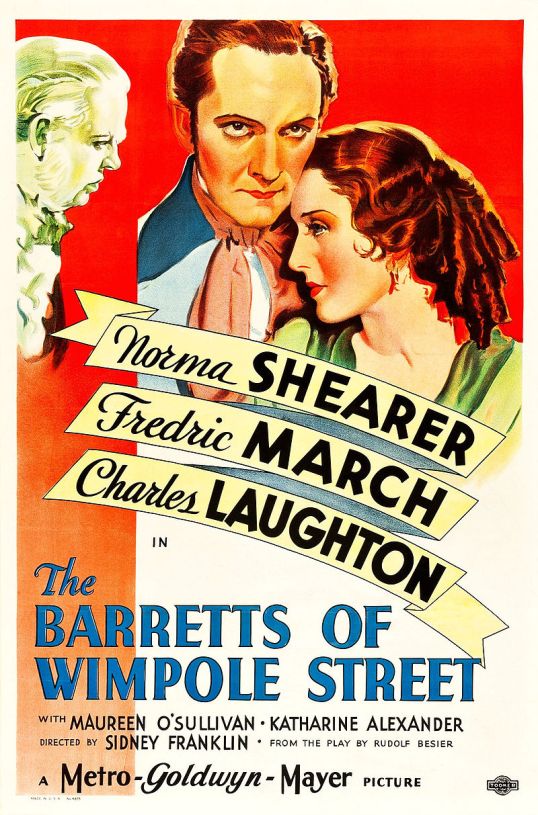
The 1934 best picture nominee, The Barretts of Wimpole Street, takes place largely in one room.

That room is a bedroom located in a mansion that sits on Wimpole Street in London.  The room is occupied by Elizabeth (Norma Shearer), a sickly woman who has spent years in bed and who is barely able to walk.  She is the eldest of 11 siblings and all of them live in the house together, under the watchful eye of their tyrannical father, Edward (Charles Laughton).  Edward has forbidden any of his children from ever leaving home.  None of them are to get married.  In fact, none of them are to have even a relationship.  Even when he hears that a trip to Italy could actually improve Elizabeth’s health, he sternly forbids her from leaving.  Edward is obsessed with sin.  As he explains it, he was once a sinner himself.  In fact, he was such a sinner that he sometimes lost control of himself.  Now that he’s a father and a widower, Edward deals with his less savory impulses through constant prayer and he’s determined to never allow his children to fall into sin as well.

Despite her father’s attempts to keep her isolated from the outisde world, Elizabeth has managed to find an escape.  She’s a poet and her words have won her admirers from around world.  One of those admirers is another poet, a young man named Robert (Fredric March), who frequently writes her letters about his love of her work.  One day, in the middle of a snowfall, Robert shows up at the house on Wimpole Street and requests to see Elizabeth.  Robert tells her that her poetry has not only inspired him but it has also caused him to fall in love with her.  When Elizabeth explains that she is dying and cannot leave the bedroom, Robert says that she’s going to live forever.  After Robert leaves, Elizabeth manages to stand and, for the first time in years, walks over to the window to watch as he departs.

Sounds like a perfect love story, right?  Well, there’s a problem.  Edward has absolutely no intention of allowing Elizabeth to leave the house, regardless of how much her health improves after her initial meeting with Robert.  He is determined to keep her in that bedroom and, this being a pre-code film, it becomes obvious that there’s more to Edward’s behavior than just being an overprotective father.  Though the dialogue may be euphemistic, Edward’s incestuous desires are plain to see.  It’s there every time that he leers as his daughters while also saying that he’ll be sure to pray for their souls.  It’s there in the film’s final moments, when Edward makes a request that’s so dark and cruel that it will take even a modern audience by surprise.  Charles Laughton played a lot of villains over the course of his long career but Edward is perhaps the most monstrous.

As a film, The Barretts of Wimpole Street is undeniably stagy and it’s a bit overlong as well.  Charles Laughton so dominates the film with menace that he threatens to overshadow not just March and Shearer but also Maureen O’Sullivan, who plays one of Elizabeth’s sisters.  But no matter!  I absolutely love The Barretts of Wimpole Street.  The house is gorgeous, the plot is wonderfully melodramatic, and Shearer and March both have a wonderful chemistry.  You can debate whether or not March and Shearer are credible as poets but, ultimately, what matters more is that they are totally believable as soul mates.  From the minute they first meet, you simply buy them as a couple that is meant to be.  Robert’s earnestness is perfectly matched with Elizabeth’s growing strength and it’s impossible not to cheer at least a little when Elizabeth first manages to walk down a staircase without collapsing.

Of course, as any student of literature should be aware, Robert is Robert Browning and Elizabeth is Elizabeth Barrett.  In real life, Robert Browning did arrange a meeting with Elizabeth after having read her poetry and, as well, it’s been said that Elizabeth’s father did not approve of her relationship with Robert.  It’s also apparently true that Edward actually did disinherit any of his children who married.  As for the other details of Edward’s depiction in The Barretts of Wimpole Street, it’s unknown how close to the truth Laughton’s performance may have been.

The Barretts of Wimpole Street is a wonderful historical romance.  It was Oscar-nominated for best picture, though it lost to a far different romance, It Happened One Night.

Cleaning Out The DVR: Let Us Live! (dir by John Brahm)


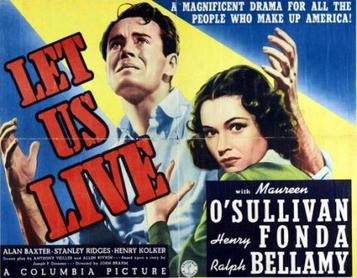
In the 1939 film, Let Us Live!, Henry Fonda plays Brick Tennant.  Brick is a poor but honest taxi driver who has always lived a law-abiding life and who is looking forward to marrying waitress named Mary Roberts (Maureen O’Sullivan).  However, when a taxi is used as a getaway car in a violent robbery that leaves a policeman dead, Brick finds that he’s a suspect.

At first, Brick isn’t too worried.  It turns out that every taxi driver in Boston is apparently being considered a suspect.  Brick is just 1 out of 120.  However, when the police bring Brick in to take part in a lineup, one of the witnesses insists that Brick and his friend, Joe Linden (Alan Baxter), were involved in the robbery.  Despite the fact that Brick and Mary were at a church, planning their wedding, during the robbery, Brick and Joe are arrested and put on trial for murder.  Despite Brick’s initial faith in the system, he and Joe are convicted and sentenced to die.

On death row, Brick faces the inhumane reality of American justice.  He watches as other prisoners slowly lose their mind as a result of neglect and abuse.  He watches as another prisoner drops dead in front of him, to the indifference of the guards.  Even when Mary tells him that she’s still looking for evidence that will exonerate him, Brick says that he no longer cares.  The state of Massachusetts is determined to kill him and he doesn’t believe that there’s any way stop them.  As Mary puts it, Brick is now dead inside.

Still, Mary continued to investigate.  Helping her is a police detective named Everett (Ralph Bellamy).  Everett comes to realize that two innocent men are sitting on Death Row but will he and Mary be able to find the real culprits before the state executes Brick and Joe?

While watching Let Us Live, I found it impossible not to compare the film to The Wrong Man, another film in which Henry Fonda played an innocent man being railroaded by the system.  Both The Wrong Man and Let Us Live were based on a true stories, though Let Us Live takes considerably more liberty with its source material than The Wong Man does.  Whereas The Wrong Man is a docudrama that’s full of moody atmosphere courtesy of director Alfred Hitchcock, Let Us Live is much more of a fast-paced, melodramatic B-move.

That said, Let Us Live! is still a definitely effective look at how an innocent man can be railroaded by a system that’s often more concerned with getting a quick conviction than actually searching for the truth.  Sadly, the issues that Let Us Live deals with are just as relevant today as they were in 1939.  The film’s power comes from Henry Fonda’s performance as Brick.  It’s truly heart-breaking to watch Brick go from being a cheerful optimist to a man who has been so broken down by American justice that he can’t even bring himself to celebrate the news that he might be released.  The film ends on a grim note, a reminder that some damage cannot be undone.

Let Us Live! is another good but obscure film that I discovered through TCM.  Keep an eye out for it!

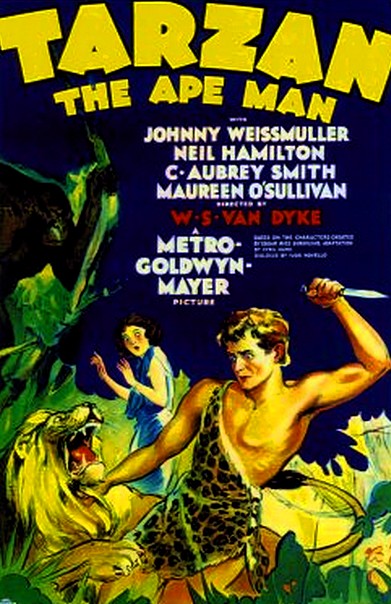
Going Ape!: TARZAN, THE APE MAN (MGM 1932)


gary loggins's avatarcracked rear viewer


Edgar Rice Burroughs’ Lord of the Jungle first hit the screen way back in 1918 with Elmo Lincoln as Tarzan. Many actors since then have donned the loin cloth, but for me the definitive movie Tarzan remains Johnny Weissmuller , who swung from his first Hollywood vine in MGM’s TARZAN, THE APE MAN, and played  the part for 16 years in 12 films.

Elderly John Parker and his young partner Harry Holt are in deepest Africa searching for the legendary “elephant’s graveyard”, which contains a fortune in ivory, but is considered sacred ground by the native tribes. Parker’s daughter Jane shows up, a spirited girl who’s no ball of fluff, but can hold her own. When Jane insists on accompanying the men on their journey, Parker scoffs, but Harry signs off because of course he’s immediately smitten with her.The jungle trek is fraught with perils, like a dangerous river crossing…

View original post 623 more words

Well of Loneliness: Randolph Scott in THE TALL T (Columbia 1957)


gary loggins's avatarcracked rear viewer

I’ve told you Dear Readers before that Randolph Scott stands behind only John Wayne in my personal pantheon of great Western stars. Scott cut his cowboy teeth in a series of Zane Grey oaters at Paramount during the 1930’s, and rode tall in the saddle throughout the 40’s. By the mid-50’s, Scott and his  producing partner Harry Joe Brown teamed with director Budd Boetticher and writer Burt Kennedy for seven outdoor sagas that were a notch above the average Westerns, beginning with SEVEN MEN FROM NOW. The second of these, THE TALL T, remains the best, featuring an outstanding supporting cast and breathtaking location cinematography by Charles Lang, Jr.

Scott plays Pat Brennen, a friendly sort trying to make a go of his own ranch. Pat, who comically lost his horse to his old boss in a wager over riding a bucking bull, hitches a ride with his pal Rintoon’s…

View original post 449 more words

Film Review: Pride and Prejudice (dir by Robert Z. Leonard)


On this date, in 1813, Jane Austen’s Pride and Prejudice was first published.  The book was published Thomas Egerton, who bought the rights for £110.  Apparently, Austen didn’t expect the book to become the success that it did.  As a result, she ultimately only made  £140 off of the book.  (Egerton made considerably more.)  When the book was originally published, Austen’s name was nowhere to be found on the manuscript.  Instead, it was credited to “the author of Sense and Sensibility.”

(When Sense and Sensibility was originally released, it was simply credited to “A Lady.”)

The rest, of course, is history.  205 years after it was first published, Pride and Prejudice remains one of the most popular and influential novels ever written.  Every year, new readers discover and fall in love with the story of outspoken Elizabeth Bennet, the proud Mr. Darcy, the pompous Mr. Collins, and the rather sleazy George Wickham.  There have been countless film and television adaptations.  My personal favorite is Joe Wright’s 2005 version, with Keira Knightley as Elizabeth.  My least favorite would have to be Pride and Prejudice and Zombies.

The very first film adaptation of Pride and Prejudice was released in 1940.  Originally, the movie was envisioned as being a George Cukor film that would star Norma Shearer and Clark Gable.  However, the film’s production was put on hold after the death of Shearer’s husband, the legendary Irving Thalberg.  When the film finally resumed pre-production in 1939, Gable was now busy with Gone With The Wind.  Cast in his place was Robert Donat (who, interestingly enough, would have played Rhett Butler if Gable had refused the role).  With the film originally meant to be filmed in Europe, the outbreak of World War II led to yet another delay.  By the time production resumed, Cukor had been replaced by Robert Z. Leonard and Norma Shearer had also left the project.  With Gone With The Wind breaking box office records, MGM came up with the idea of once again casting Vivien Leigh opposite of Clark Gable.  However, Gable eventually left the film and Laurence Olivier, looking for a chance to act opposite Leigh, agreed to play Darcy.  However, the studio worried that casting Olivier and Leigh opposite each other would lead to negative stories about the two of them having an affair despite both being married to other people.  So, Leigh was removed from the project and Greer Garson was cast.  Olivier was so annoyed with the decision that, after Pride and Prejudice, it would be eleven years before he would work with another American studio.

Despite all of the drama behind-the-scenes, MGM’s version of Pride and Prejudice is a thoroughly delightful film, one full of charming performances and witty lines.  Though she was 36 when she made Pride and Prejudice, Garson is still the perfect Elizabeth, giving a lively and intelligent performance that stands in stark contrast to the somewhat staid films that she was making at the same time with Walter Pidgeon.  As for Olivier, from the first minute he appears, he simply is Darcy.  That said, my favorite performance in the film was Edmund Gwenn’s.  Cast as Mr. Bennet,  Gwenn brought the same warmth and gentle humor to the role that he would later bring to Kris Kringle in Miracle on 34th Street.  I also liked the performances of Maureen O’Sullivan as Jane and Edward Ashley as disreputable Mr. Wickham.

Pride and Prejudice is not an exact adaptation.  For one thing, the movie takes place in the early Victoria era, supposedly because MGM wanted to cut costs by reusing some of the same costumes that were previously used in Gone With The Wind.  As well, Lady Catherine (Edna May Oliver) is no longer as evil as she was in the novel.  Finally, because the production code forbid ridicule of religion, the theological career of Mr. Collins (Melville Cooper) was considerably downplayed.  Not even Jane Austen (or, more specifically, the film’s screenwriter, Aldous Huxley) could defy the Code.

Seventy-eight years after it was first released, the 1940 version of Pride and Prejudice holds up surprisingly well.  It’s an enjoyable film and one that, despite a few plot changes, remains true to the spirit of Austen.

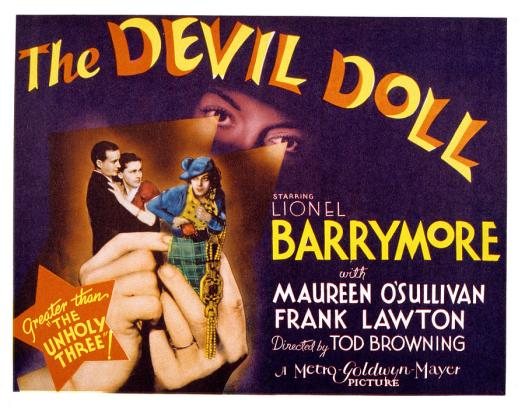
Halloween Havoc!: THE DEVIL DOLL (MGM 1936)


gary loggins's avatarcracked rear viewer

Producer/director Tod Browning’s THE DEVIL DOLL is a film reminiscent of his silent efforts with the great Lon Chaney Sr. This bizarre little movie doesn’t get the attention of Browning’s DRACULA or FREAKS ,  and the ending’s a bit on the sappy side, but on the plus side it features Lionel Barrymore dressed in drag for most of the time, some neat early special effects work, and a weird premise based on a novel by science fiction writer A. Merritt, adapted for the screen by Guy Endore, Garrett Ford,  and Erich von Stroheim (!!).

Barrymore stars as Devil’s Island escapee Paul Lavond, and he pretty much carries the picture. Lavond and fellow con Marcel (Henry B. Walthall ) make it to Marcel’s home, where wife Melita (a pop-eyed Rafaela Ottiano) has been keeping the faith on her hubby’s experimental work… turning animals miniature, to solve the coming food shortage…

View original post 396 more words

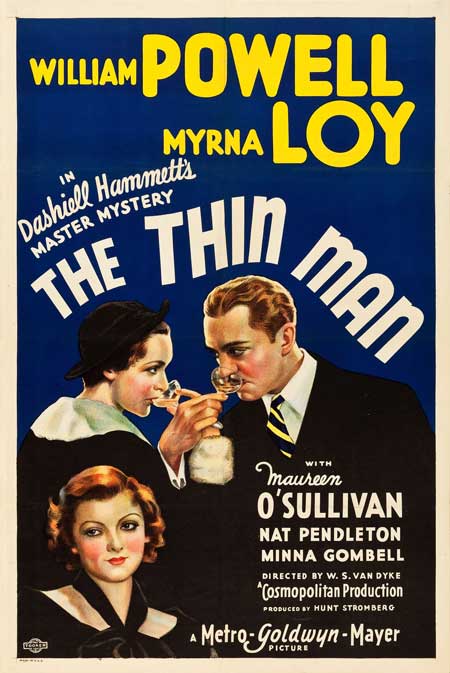
Lisa Reviews An Oscar Nominee: The Thin Man (dir by W.S. Van Dyke)


the_thin_man_1934_poster

Last night, I rewatched the classic 1934 mystery-comedy, The Thin Man.

And you know what?

Nick and Nora Charles should be everyone’s relationship goal.

Technically, The Thin Man is a murder mystery and it’s actually a pretty good one.  While I was rewatching the film, I was surprised to see that the whodunit aspect of the plot held up far better than I remembered.  But, ultimately, the movie is really a portrait of the ideal romance.  Every couple should aspire to be like Nick and Nora.

Nick Charles (William Powell) is a retired private detective, an unflappable gentleman who speaks exclusively in quotable quips.  Nick is the type who can apparently spend every hour of the day drinking without ever getting stupidly drunk.  He has beautiful homes on both coasts and a list of friends that would make anyone jealous.  Whether cop or crook, everyone loves Nick.

Nora Charles (Myrna Loy) is Nick’s wife.  She’s independently wealthy.  She’s beautiful.  She’s always chic.  She is always the smartest and funniest person in the room.  And she’s probably the only person who can outquip Nick.  Nora loves Nick’s lifestyle, whether they’re throwing a party or literally shooting ornaments off of a Christmas tree.  As Nora says at the end of one crowded party, “Oh, Nicky, I love you because you know such lovely people.”

And, of course, there’s Asta.  Asta is their terrier.  If Nick and Nora are the ideal couple, Asta is the ideal pet.  Asta is just as quick to investigate a mystery as Nick and Nora.  Asta may be a playful dog but he’s also remarkably well-behaved.  No insistent yapping.  No accidents on the carpet.  No growling at visitors.  As I’ve mentioned many times on this site, I’m not a dog person but I love Asta.

It’s not just that Nick and Nora are obviously in love and, in this pre-code film, they’re actually allowed to express that love.  And it’s not just that they say things in The Thin Man that they wouldn’t be allowed to get away with in the film’s sequels.  (If you have any doubt that this is a pre-code film, just check out the scene where the police are going through Nora’s dresser.  “What’s that man doing in my drawers?” Nora demands while Nick does a double take.)  It’s that Nick and Nora seem to be having so much fun.  They’re wealthy.  Other than to themselves, they really have no commitments.  (Nick only comes out of retirement because Nora say she thinks a mystery sounds like it would be fun to solve.)  They have no children to worry about.  Even if you don’t want to be either Nora or Nick by the end of this film, you’ll still definitely want to hang out with them.

The Thin Man is a murder mystery.  In fact, it’s probably one of the most enjoyable movies ever made about a double murder.  Dorothy Wynat (Maureen O’Sullivan) asks Nick to help find her father (Edward Ellis), the thin man of the title.  The investigation leads to a rather complicated mystery, one in which everyone that Nick and Nora meets is a suspect.  I have to admit that, with my ADD, I always have a hard time following all of the clues.

Of course, so does Nick.  That truly is part of the appeal of The Thin Man.  Nick is often confused about what it all the clues and evidence add up to but that never seems to upset him.  He and Nora are too busy enjoying themselves to get upset. That’s one reason why, even after you know who the murderer is, The Thin Man is a movie that’s enjoyable to watch over and over again.  The Thin Man is less about the mystery and more about the way Nick and Nora manage to throw the perfect dinner party even as they reveal who the murderer is.

1934 was a good year for comedy.  The Thin Man was nominated for best picture but it lost to another charming little comedy, It Happened One Night.

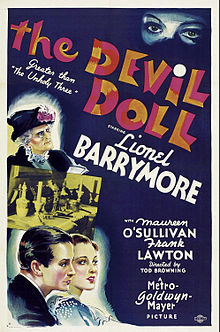
Horror Film Review: The Devil-Doll (dir by Tod Browning)


devil_dollposter

Paul Lavond (Lionel Barrymore) was just your ordinary Parisian bank owner until he was wrongly convicted of robbery and murder.  Sentenced to Devil’s Island and estranged from his beloved daughter, Lorraine (Maureen O’Sullivan), Paul spends 16 years plotting how to clear his name and progressively growing more bitter and angry.

He also befriends a scientist named Marcel (Henry B. Walthall).  Marcel has figured out the formula for shrinking people.  He’s convinced that shrunken people will eat less, use less fossil fuels, and take up a lot less space on the planet.  They’ll probably also be less likely to wage war on each other.  That’s right — the secret to world peace is shrinking the population.

However, Paul has other plans for that shrinking formula!  What better way to clear his name and seek revenge than by using a shrunken army of henchmen?

Uhmmm — okay, it sounds a little bit overcomplicated to me but who am I to doubt the wisdom of Lionel Barrymore?

(Yes, I know he’s Paul Lavond but, honestly, Lionel Barrymore is Lionel Barrymore regardless of who he’s playing.)

Anyway, Paul and Marcel escape from Devil’s Island but Marcel dies shortly afterward.  Paul, however, forms a partnership with Marcel’s widow, Maleta (Rafaela Ottiano).  Disguising himself as an elderly woman, Paul returns to Paris.  Not only does he use his disguise to watch over his daughter (who doesn’t realize that the kindly old woman is actually her father) but he also starts to develop quite a reputation for selling incredibly realistic dolls…

The Devil-Doll is an odd little mix of comedy and melodrama and, to be honest, it’s a bit too uneven to really work.  That said, the film is definitely worth watching just for the sight of Lionel Barrymore playing an elderly woman.  (Classic film lovers will immediately notice that, when in disguise, Lionel greatly resembles his sister, Ethel.)  This Christmas, when I’m watching It’s A Wonderful Life for the 100th time and Mr. Potter is cackling and plotting to put the Bailey Building and Loan out of business, I’ll have a hard time not thinking about The Devil-Doll.

The Devil-Doll was one of the final films to be directed by the legendary horror specialist, Tod Browning.  I’ve read that Browning’s later films suffered because Browning plunged into depression after the death of Lon Chaney, Sr. and he never quite recovered.  And, really, The Devil-Doll feels like a film that would have been perfect for Chaney’s unique talent.

But, that said, Lionel Barrymore appears to be having a lot of fun as Paul and his performance is the main reason to watch the film today.

The Holy Grail of Bad Cinema: THE PHYNX (Warner Brothers 1970)


gary loggins's avatarcracked rear viewer

phynx1

(WARNING: The movie I’m about to review is so bad, I can’t even find a proper poster for it. Beware… )

I was so excited when I  found out TCM was airing THE PHYNX at 4:00am!  I’d heard about how bad it for years now, and couldn’t wait to view it for myself today on my trusty DVR. I wasn’t disappointed, for THE PHYNX is a truly inept movie, so out of touch with its audience… and just what is its audience? We’ve got a Pre-Fab rock band, spy spoof shenanigans, wretched “comedy”, and cameos from movie stars twenty years past their prime. Just who was this movie made for, anyway?

The film defies description, but I’ll give it a whirl because, well because that’s what I do! We begin as a secret agent attempts to crash into Communist Albania in unsuccessful and unfunny ways, then segue into some psychedelic cartoons…

View original post 1,064 more words