In 1997, a 27 year-old man named Andrew Cunanan went on a killing spree, one that took him from San Diego to Miami Beach. Though the FBI were already looking for him, Cunanan did not receive national attention until July 15th, 1997. That was the day that Cunanan shot and killed fashion designer Gianni Versace in front of Versace’s mansion. By that time, Cunanan had already killed at least four other people. A week after killing Versace, Cunanan would take his own life, shooting himself on a houseboat that he had broken into.
Andrew Cunanan’s motives have remained a mystery. It is known that at least two of the victims, Jeff Trail and David Madson, was acquainted with Cunanan. Madson had a long-distance relationship with Cunanan that he ended a year before he was murdered. Cunanan reportedly described Madson as being “the love of his life,” though Cunanan also apparently had a history of lying. Whether Cunanan knew Chicago businessman Lee Miglin before killing him is a matter of some controversy. It’s agreed that cemetery caretaker William Reese was only killed because he came across Cunanan stealing his truck. Whether or not Cunanan had ever met Versace before in not known. Cunanan claimed he had but, again, Cunanan had a history of lying.
In 2018, Cunanan and his crimes were the focus of the second season of Ryan Murphy’s American Crime Story. Darren Criss won an Emmy for playing Cunanan and the series itself was critically acclaimed. Personally, I thought the series started out strong but ran out of gas about halfway through as it became clear that Andrew Cunanan, much like the Menendez brothers, wasn’t really that interesting of a character. Indeed, watching the show, I got the feeling that Cunanan’s main motivation was bitterness over the fact that he was essentially a fairly boring and uninteresting person. He didn’t have much of a personality so he tried to fill that void by going after people who did.
American Crime Story may be the best-known dramatization of Cunanan’s crimes but it was hardly the first. In 1998, less-than-a-year after Cunanan’s suicide, Menahem Golan’s The Versace Murder was released on video. Shane Perdue played Andrew Cunanan. A sad-eyed Franco Nero played Gianni Versace. Steven Bauer and Renny Roker played the two FBI agents who pursued Cunanan across the country. The film was shot in 20 days and watching it, it’s easy to see that it was a rush job. Some scenes run too long, some scenes run too short. Occasionally, the background music is so overwhelming that it’s a struggle to hear what anyone’s saying. It’s definitely an exploitation film, made quickly as to capitalize on the interest in the case before everyone moved on.
And yet, it’s a strangely effective film. A lot of that is due to the performance of Franco Nero, who doesn’t get a lot of screen time but who still makes a definite and even poignant impression as Versace. The film’s strongest moments come towards the end, when the two FBI agents come across as a vigil being held in front of Versace’s mansion and they realize just how much Versace meant to the people of Miami Beach. Matt Servitto and David Wolfson are also sympathetic as David Madson and Jeff Trail. These three performances capture the tragedy of Cunanan’s crimes. In the end, the fact that Shane Perdue is a bit bland in the role of Andrew Cunanan feels almost appropriate. Whether it was intentional or not, Menahem Golan’s The Versace Murder reminds us that Andrew Cunanan’s victims deserve to be remembered far more than the man who killed them.
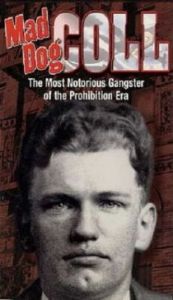 New York. The prohibition era. The Coll Brothers, Vincent (Christopher Bradley) and Peter (Jeff Griggs), are sick of working for the Irish gangster, O’Malley (William Anthony La Valle). They want to hang out at the Cotton Club with big time gangsters like Lucky Luciano (Matt Servitto), Legs Diamond (Will Kempe), and Dutch Schultz (Bruce Nozick). Vincent has fallen in love with Lotte (Rachel York), a singer at the club but the club’s owner, Owney Madden (Jack Conley), makes it clear that Lotte is too good for a low-rent thug. After killing O’Malley, Vincent and Peter go to work for Dutch Schultz but soon, they grew tired of the low wages that Schultz pays them. The Colls decide to strike out on their own, leading to all out war with New York’s organized crime establishment.
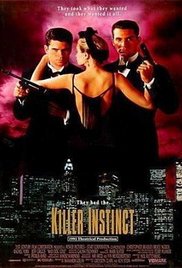 Mad Dog Coll was one of two gangster movies that Menaham Golan produced, back-to-back, in Russia. In fact, Mad Dog Coll may be the first American film in which Russia stood in for America instead of the other way around. Though this film was produced after Golan broke up with his longtime producing partner, Yoram Globus, Mad Dog Coll still has a definite Cannon feel to it. It is low-budget, fast-paced, unapologetically pulpy, and entertaining as Hell. For a Golan production, the performances are surprisingly good. Bruce Nozick steals the entire movie as crazy Dutch Schultz. None of it is subtle but it is enjoyable in the way that only a Greydon Clark-directed, Menahem Golan-produced gangster film can be. 1920s New York is recreated on Russian soundstages. The threadbare production design and cardboard cityscape brings a Jon Pertwee/Tom Baker-era Dr. Who feel to the movie. All that is missing is The Master brewing up moonshine and the Daleks exterminating the Chicago Outfit.
 Through the Shattered Lens