A Movie A Day #107: The Legend of the Lone Ranger (1981, directed by William A. Fraker)


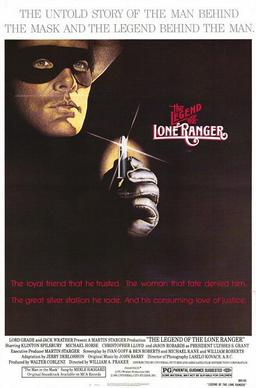
Long before he found fame playing Deputy Hawk on Twin Peaks, Michael Horse made his film debut in one of the most notorious box office flops of all time, The Legend of the Lone Ranger.  

Michael Horse played Tonto, the young Comanche who rescues his childhood friend, John Reid (Klinton Spilsbury), and nurses him back to health after Reid has been attacked and left for dead by the notorious outlaw, Butch Cavendish (Christopher Lloyd).  Reid was a civilian, accompanying a group of Texas Rangers led by his older brother, Dan (John Bennett Perry).  When Cavendish attacked, John was the only survivor.  John wants to avenge his brother’s death but first, Tonto is going to have to teach him how to shoot a six-shooter and how to ride his new horse, Silver.  Finally, John is ready to don the mask and becomes the Lone Ranger.  It’s just in time, because Cavendish has kidnapped President Grant (Jason Robards).

An even bigger flop than the more recent Lone Ranger film starring Armie Hammer and Johnny Depp, The Legend of the Lone Ranger failed for several reasons.  For one thing, the film has a major identity crisis.  The violence is not for kids but most of the dialogue and the performances are.  For another thing, it takes forever for John Reid to actually put on the mask and become the Lone Ranger.  By the time the William Tell Overture is heard, the movie is nearly over.

It was made to capitalize on the same type of nostalgia that previously made Superman a hit and, just as Superman introduced the world to Christopher Reeve, The Legend of the Lone Ranger introduced the world to a football player turned actor, named Klinton Spilsbury.  Unfortunately, the world did not want to meet Klinton Spilsbury, whose blank-faced performance was so bad that James Keach was brought in to dub over all of his dialogue.   Spilsbury did not help himself by reportedly acting like a diva during the shooting, demanding constant rewrites, and getting into bar brawls offset.  Of the two actors who made their screen debuts in The Legend of the Lone Ranger, Michael Horse has worked again.  Klinton Spilsbury has not.

When The Legend of the Lone Ranger went into production, the film’s producers made the incredibly boneheaded move of getting a court injunction barring Clayton Moore (who had played the role on TV) from wearing his Lone Ranger uniform is public.  Since the semi-retired Moore was living off of the money that he made appearing as the Lone Ranger at country fairs and children’s hospitals, this move was a public relations disaster.  (For his part, Moore filed a counter suit and continued to make appearances, now wearing wrap-around sunglasses instead of his mask.)  Moore refused to appear in a cameo and spent much of 1981 speaking out against the film.

Finally, the main reason that Legend of The Lone Ranger flopped was because it opened on the same Friday as a little film called Raiders of the Lost Ark.

The rest is history.

Star Vehicle: Burt Reynolds in WHITE LIGHTNING (United Artists 1973)


gary loggins's avatarcracked rear viewer

wl1

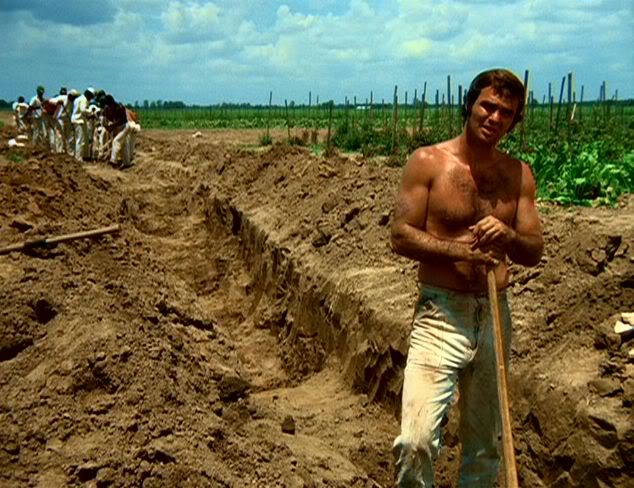
Burt Reynolds labored for years in the Hollywood mines, starring in some ill-fated TV series (his biggest success on the small screen was a three-year run in a supporting role on GUNSMOKE) and movies (nonsense like SHARK! and SKULLDUGGERY) before hitting it big in John Boorman’s DELIVERANCE. Suddenly, the journeyman actor was a hot property (posing butt-naked as a centerfold for COSMOPOLITAN didn’t hurt, either!), and studios were scurrying to sign him on to their projects. WHITE LIGHTNING was geared to the Southern drive-in crowd, but Reynolds’ new-found popularity, along with the film’s anti-authority stance, made it a success across the nation.

wl22

WHITE LIGHTNING takes place in rural Arkansas, and Gator McKluskey (Burt) is doing a stretch in Federal prison for running moonshine. His cousin visits and tells Gator his younger brother Donnie was murdered by Sheriff J.C. Connors, the crooked boss of Bogan County. A raging Gator tries to escape, but is immediately caught, so he…

View original post 690 more words

A Movie A Day #8: White Lightning (1973, directed by Joseph Sargent)


white-lightning-02

A year after co-starring in Deliverance, Burt Reynolds and Ned Beatty reunited for another movie about life in the backwoods, White Lightning.

White Lightning starts with two hippies, bound and gagged and floating in a canoe.  While a banjo plays in the background, two rednecks use a shotgun to blow the canoe into pieces.  They watch as the hippies drown in the swamp.  It turns out that one of those hippies was the brother of legendary moonshiner and expert driver, Gator McCluskey (Reynolds).  Gator is doing time but when he hears that his brother has been murdered, he immediately realizes that he was probably killed on the orders of corrupt Sheriff J. C. Connors (Ned Beatty).  The Feds arrange for Gator to be released from prison, on the condition that he work undercover and bring them enough evidence that they can take Connors down.

Back home, Gator works with a fellow informant, Dude Watson (Matt Clark), teams up with local moonshiner, Roy Boone (Bo Hopkins), and has an affair with Roy’s girl, Lou (Jennifer Billingsley).   Connors and his main henchman, Big Bear (R.G. Armstrong) both suspect that Gator and Dude are working for the government.  Since this is a Burt Reynolds movie, it all ends with a car chase.

A classic of its kind and a huge box office success, White Lightning set the template for almost every other film that Burt Reynolds made in the 1970s and 80s.  There is not much to the movie beyond Burt’s good old boy charm and Ned Beatty’s blustering villainy but if you’re in the mood for car chases and Southern scenery, White Lightning might be the movie for you.   Joseph Sargent also directed the New York crime classic, The Taking of Pelham One Two Three, and he gives White Lightning an edginess that would be lacking from many of Burt Reynolds’s later movies.

For tomorrow’s movie a day, it’s the sequel to White Lightning (and Burt Reynolds’s directorial debut), Gator.

white-lightning-05

Pure 80s Hokum: Let’s Get Harry (1986, directed by Alan Smithee)


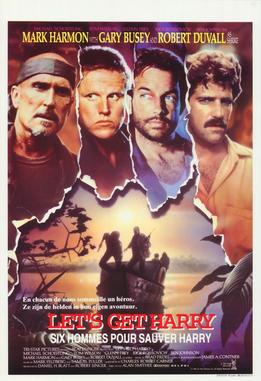
Lets-get-harry-movie-poster-1986-1020362350Let’s Get Harry opens deep in the jungles of Columbia.  The newly appointed American Ambassador (Bruce Gray) is touring a newly constructed water pipeline when suddenly, terrorist drug smugglers attack!  The Ambassador, along with chief engineer Harry Burck (Mark Harmon, long before NCIS), is taken hostage.  Drug Lord Carlos Ochobar announces that both the Ambassador and Harry will be executed unless the U.S. government immediately releases Ochobar’s men.  However, the policy of the U.S. government is to not negotiate with terrorists.  As grizzled mercenary Norman Shrike (Robert Duvall) explains it, nobody gives a damn about a minor ambassador.
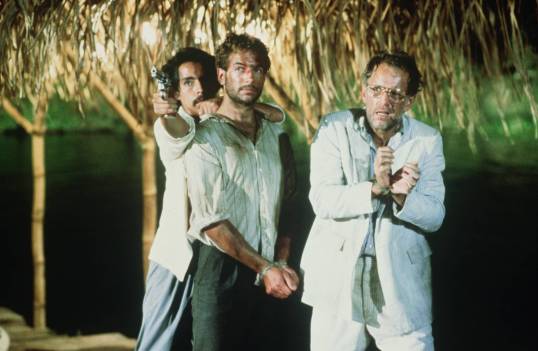
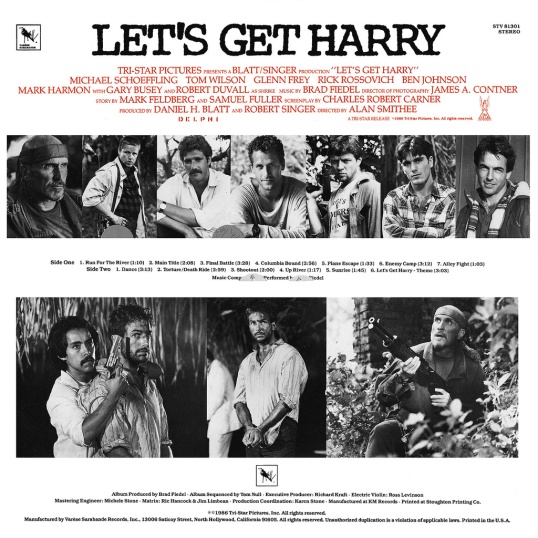
Nobody in a small blue-collar town in Illinois gives a damn about the ambassador either.  But they do give a damn about their friend Harry!  When its obvious that the bureaucrats up in Washington are not going to do anything, Harry’s younger brother, Corey (Michael Shoeffling, Sixteen Candles), decides that he and his friends are going to go to Columbia themselves and get Harry!  Helping him out are Bob (Thomas F. Wilson, Back to the Future), Kurt (Rick Rossovich, Top Gun), Spence (Glenn Frey!), and Jack (Gary Busey).  If Jake Ryan, Biff Tannen, Slider, Buddy Holly, and the guy from the Eagles who wasn’t Don Henley can’t get Harry, then who can!?

There were a lot of these “American rescue mission” movies made in the 80s, everything from Uncommon Valor to The Delta Force to the Rambo films.  Plotwise, Let’s Get Harry adds little to the genre.  It’s about as simplistic and implausible as a Donald Trump campaign speech.  A bunch of terrorists are holding American hostages and making us all look bad while the establishment refuses to do anything about it?  Don’t worry!  Here come a bunch of heavily armed, no-nonsense American citizens to save the day and make America great again!

letsgetharry_640x360

There are two things that distinguish Let’s Get Harry.  First, Let’s Get Harry is one of the many films to have been credited to Alan Smithee.  From 1968 to 2000, Alan Smithee was the official pseudonym used by directors who wanted to disown a project.  Smithee has been credited as directing everything from Solar Crisis to Morgan Stewart’s Coming Home to The O.J. Simpson Story.  In the case of Let’s Get Harry, Smithee was standing in for veteran director Stuart Rosenberg (probably best known for Cool Hand Luke).  Rosenberg originally only planned for Mark Harmon to be seen only at the end of the film, much like Matt Damon in Saving Private Ryan.  When TriStar Pictures demanded extra scenes featuring Harmon being taken and held hostage, Rosenberg took his name off the film.

(Before Rosenberg signed on to direct, Let’s Get Harry started out as a Sam Fuller project and he received a story credit on the film.  With the exception of some of the scenes with Harmon, which may have been shot by a different director, Rosenberg’s direction was adequate but Let’s Get Harry really does cry out for a director like Sam Fuller.)

Secondly, there is the cast, which is a lot more interesting than would be typically found in a low-budget, 80s action film.  Not surprisingly, by respectively underplaying and overplaying, Duvall and Busy give the two best performances.  Meanwhile, lightweight Mark Harmon gives the worst.  Perhaps because of the conflict between Rosenberg and the studio over his character, Harmon spends the entire movie looking lost.

lgh

As an exercise in patriotic wish fulfillment, Let’s Get Harry is pure 80s hokum.  It may be dumb but it is also entertaining.  After all, any film that features not only Robert Duvall, Gary Busey, and Ben Johnson, but also Glenn Frey is going to be worth watching.  Let’s Get Harry has never been released on DVD and is currently only available on VHS.  Somebody needs to do something about this.

Let’s get Harry on DVD!

lgh2