Avenging Angelo (2002, directed by Martyn Burke)


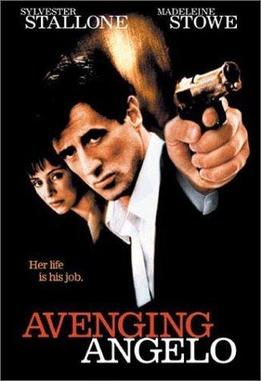
When mob boss Angelo (Anthony Quinn) is assassinated on the orders of the son of a former rival, bodyguard Frankie Delano (Sylvester Stallone) takes it upon himself to protect Angelo’s daughter, Jennifer (Madeleine Stowe).  The problem is that Jennifer, who was adopted by a normal couple, doesn’t know that she is the daughter of a mobster.  Her life and her marriage are already falling apart even before Frankie reveals the truth to her.  All she wants to do is disappear into the pages of a romance novel written by her favorite writer, Marcello (Raoul Bova) but Marello is not quite what he seems.

Sylvester Stallone has had a long career, full of high points (Rocky, First Blood, The Expendables, Creed) and low points (too many to list).  Avenging Angelo, made at a time when it was assumed that the aging Stallone would never again play Rocky Balboa or John Rambo, is a moderate low point.  It’s no Rocky but it’s still better than Stop!  Or My Mom Will Shoot!  Overall, it’s not very good and a lot of the humor falls flat but Stallone and Madeleine Stowe are both likable and they have a few moments that display what seems like genuine chemistry.  It’s still a slow movie that awkwardly mixes comedy and action but it was not the disaster that I was expecting it to be when I first found it on Tubi.  It’s more forgettable than bad.  If there is anything to really regret when it comes to Avenging Angelo, it’s that Anthony Quinn did not get a more memorable swan song.

Avenging Angelo was Stallone’s second movie to go straight to video.  It’s easy to forget not but the conventional wisdom in 2002 really was that Stallone was washed up.  There were jokes about whether or not he would follow Schwarzenegger’s lead and go into politics.  Stallone, however, proved all the naysayers wrong, proving that he could still throw punches as Rocky Balboa and John Rambo while The Expendables revealed a Stallone who could finally laugh at himself.  Avenging Angelo turned out to be not the end of Stallone’s career but instead just a detour.  Say what you will about the man and his movies, Sylvester Stallone is an American institution.
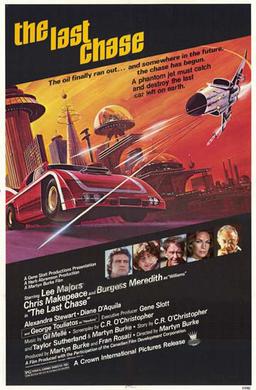
The Last Chase (1981, directed by Martyn Burke)


In the near-future (the movie takes place in 2011 but it was made in 1981 and it’s 2020 today so you do the math), over half of humanity has been wiped out by a plague and America has been taken over by a totalitarian government.  The government has outlawed cars and instead requires everyone to use public transportation.  The are rumors that, if you can make your way to Free California, you can drive whatever and whenever you want.  But to do that, you’d have to be able to drive down a highway and no one has a car!

Franklyn Hart (Lee Majors) is a former race car driver who lost his family to the plague and who now serves as an official government spokesman, encouraging people to ride public transportation and to not use fossil fuels.  However, Hart doesn’t believe what he’s preaching.  In fact, in a secret basement, he has a car!  It’s an orange Porsche and, by breaking into junkyards at night, he’s been able to get the parts necessary to rebuild its engine.  His plan is to show up the government by driving the Porsche across the country, all the way to California.  Accompanying Franklyn will be Ring McCarthy (Chris Makepeace), a bullied teenage computer expert who needs a father figure.  That sounds like a job for Lee Majors!

With Franklyn now driving across the country, the government knows that they have to stop him!  But how?  Because all of the other cars have been destroyed, the police have to ride around on golf carts that can’t keep up with a Porsche.  Since they’re apparently not a very well-organized group of fascists, they also don’t have any drones, bombs, or apparently anything else that they could use to take the incredibly conspicuous race car that is driving across America.  The government turns to J.G. Williams (Burgess Meredith), mostly because Williams owns a fighter plane that was last used in the Korean War.  Williams agrees to stop Franklyn and Ring but secretly, he finds himself sympathizing with their cause.

The most interesting thing about The Last Chase is the idea of California becoming a libertarian paradise where the residents are rebelling against overly stringent environmental regulations.  That alone makes this a fun film to watch on Earth Day.  Unfortunately, The Last Chase never really lives up to its intriguing premise.  Ironically, for a film called The Last Chase, there just aren’t enough chase scenes.  Instead, the movie spends a lot of time on Ring needing a father figure and Franklyn needing a new family to replace the one that he lost and who wants to see that when you could be watching an orange Porsche racing down the highway?  This is a movie that calls out for a Mad Max approach but instead, it’s more of an After School special about accepting your stepfather and running away with him to California.  It’s a strange message but at least the car’s cool.

You Say You Want A Revolution: Power Play (1978, directed by Martyn Burke)


PowerPlay1978

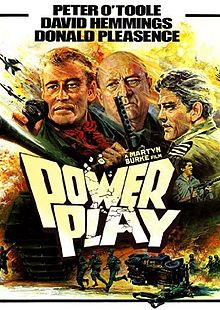
When I was 16, I would spend every weekend down at a small, used video store that was a few blocks away from my house.  One afternoon, I was looking for a video to rent when I came across a battered VHS box.  On the front of the box, Peter O’Toole smoked a cigar and sat on top of a tank.  The back cover described the film as being about revolution and promised exciting action.  A critic was quoted as saying that the movie was “an intelligent political thriller!”  Because I was obsessed with politics, that caught my attention.  I rented the movie, took it home, and watched it twice.

The name of the movie was Power Play.

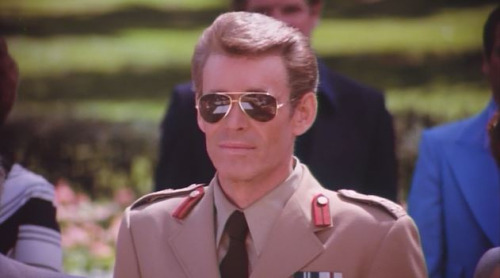
In an unnamed Eastern European country, a corrupt and despotic dictator rules with an iron hand.  Dissidents are regularly arrested and executed.  Corrupt government officials live in luxury while the rest of the country is trapped in poverty.  After a friend’s daughter is tortured and murdered by the secret police, Colonel Narriman (David Hemmings) teams up with Dr. Rosseau (Barry Morse) to plot a coup.  In order to the overthrow the government, the conspirators have to hide their plans from Blair (Donald Pleasence), the sadistic head of the secret police, and convince Colonel Zeller (Peter O’Toole) to join them and bring his tanks over to their side.

power

Power Play may be forgotten today but it made a big impression on me when I first watched it.  Power Play not only showed what it was like to live in a totalitarian society but also attempted to realistically portray what it would take to overthrow a dictatorship.  Power Play spends as much time on the plotting of the revolution as it does on the revolution itself, with special attention given to Rousseau’s attempts to secure international support for the coup.  David Hemmings is great in the main role and Donald Pleasence is Himmleresque as Blair.  Even Peter O’Toole’s infamous 1970s hamminess seems appropriate for the character of Col. Zeller.  Power Play is a must see for aspiring revolutionaries every where.

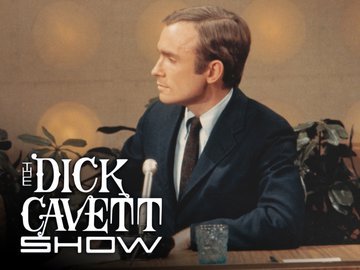
Incidentally, Power Play opens with one of the conspirators being interviewed by Dick Cavett, meaning that Power Play can be added to Annie Hall and A Nightmare On Elm Street 3: Dream Warriors on the list of films in which Dick Cavett has played himself.

the-dick-cavett-show