Film Review: Any Which Way You Can (dir by Buddy Van Horn)


In this 1980 sequel to Every Which Way But Loose, Philo and his orangutan Clyde are still living next door to Orville (Geoffrey Lewis) and his mother (Ruth Gordon).  Philo is still working as a truck driver but he’s becoming far better known as a bare-knuckles brawler.  In fact, when another famous fighter named Jack Wilson (William Smith), moves to the area, everyone assumes that Jack wants to challenge Philo.  It turns out that Jack’s actually a pretty nice guy.  He and Philo become jogging buddies.

Remember Lynn Halsey-Taylor (Sondra Locke), the extremely self-centered singer who broke Philo’s heart in the first film?  Well, she’s back and she’s changed her ways.  When she and Philo meet in a bar, Lynn apologizes to him for her past behavior and soon, she and Philo are a couple again.  Booo!  Seriously, Eastwood and Locke somehow have even less chemistry here than they did in the first film.  (Again, Locke and Eastwood were in a relationship at the time, which makes their total lack of chemistry even more interesting to consider.)  Everyone in the film is surprisingly forgiving of Lynn, considering that she was portrayed as being nearly sociopathic in the previous film.  Even Clyde seems to be happy to have her back.  Of course, Clyde gets to have a romance of his own, with another orangutan.  Clyde has sex with his partner while Philo and Lynne fool around in the room next door.  It’s …. kind of weird.

Anyway, the Mafia really wants Philo and Jack to fight so they decide to kidnap Lynn in order to force the fight to happen.  Instead, Jack and Philo team up to rescue Lynn and to put those gangsters in their place.  That might sound dramatic but this film is very much a redneck comedy so these are probably the least intimidating mafia soldier that I’ve ever seen.  Just as the previous film’s outlaw bikers (and they also make a return appearance in this film) were too buffoonish to be truly menacing, the same is true of the Mafia in this film.

In the end, Philo and Jack do have a fight but it’s under their own terms and, afterwards, they accompany each other to the hospital.  It’s kind of a nice moment, really.  Even after beating the hell out of each other and causing more than a few broken bones, Philo and Jack are still friends.  It’s a nice touch that Jack was played by William Smith, who was a bit of a low-budget version of Clint Eastwood.

Indeed, with Geoffrey Lewis relegated to a supporting role and Sondra Locke abducted by the mafia, the friendship between Philo and Jack becomes the heart of the film and if there is really anything that makes this film memorable, it’s the scenes that Eastwood shares with William Smith.  These two tough guys actors seem to have a natural understanding of each other and their friendship and mutual respect feels real.  They may fight but it’s only out respect for each other.  It’s a shame that Eastwood and Smith didn’t team up for more films.

Any Which Way You Can is an amiable comedy.  It’s not as much fun as Every Which Way But Loose.  Beverly D’Angelo’s Echo is missed but she was presumably busy filming Coal Miner’s Daughter at the time.  The film works best as a buddy movie.  Clint Eastwood, William Smith, Geoffrey Lewis, and an orangutan.  What a team!

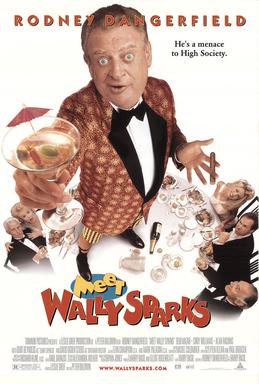
Meet Wally Sparks (1997, directed by Peter Baldwin)


Wally Sparks (Rodney Dangerfield) is a talk show host with a program that is so raunchy that even Jerry Springer says, “At least this isn’t The Wally Sparks Show!”

Despite being a huge hit amongst teens and college students, the show is on the verge of being canceled by the head of the network, Mr. Spencer (Burt Reynolds, wearing a fearsome toupee).  He is tired of Wally’s antics and he tells Wally and his producer, Sandy Gallo (Debi Mazar), that they have a week to make the show respectable.

Wally doesn’t know what to do.  Wally Sparks act respectable?  Wally’s a guy who don’t get no respect, no respect at all.  Then Sandy finds a letter inviting Wally to attend a party at the home of Georgia Governor Floyd Patterson (David Ogden Stiers), a noted critic of the show.  Hoping to get the interview that will save the show, Wally and Sandy head down south.

At the party, Wally acts like Wally and scandalizes all of the politicians and socialites.  He also shares a bottle of whiskey with a horse and then rides the horse through the mansion.  The party is a disaster but, after Wally claims that he can’t walk because of a spinal injury he suffered when he fell off the horse, the Governor allows him to recuperate in the mansion.  Wally causes more chaos while also teaching the Governor’s wife (Cindy Williams) how to play strip poker and eventually exposing a scheme to blackmail the Governor into building  a Confederate-themed amusement park.

Rodney Dangerfield playing a talk show host sounds like a great idea and there are a lot of talented people to be found in Meet Wally Sparks.  Debi Mazar is an actress who should have appeared in a lot more movies and she and Rodney Dangerfield make a good team.  The movie actually gets off to a funny start, with a montage of actual talk show hosts talking about how much they hate Wally Sparks and his show.  Gilbert Gottfried has a cameo as a manic guest and Wally repeats some of Rodney Dangerfield’s classic jokes.

Unfortunately, the movie starts to fall apart as soon as Burt Reynolds threatens to cancel the show for being too lowbrow.  No network executive has ever threatened to cancel a show that’s bringing in the ratings, regardless of how lowbrow it might be.  Things get even worse after Wally goes to Atlanta and ends up staying there.  The movie tries to recreate the Snobs vs. the Slobs dynamic of previous Dangerfield films but the Governor comes across as being such a decent man that there’s no joy to be found in watching his life get turned upside down.  The movie has a surprisingly large number of subplots, including one about Wally’s son (Michael Weatherly) falling for the Governor’s daughter (Lisa Thornhill), but most of them go nowhere and just distract from the man who should have been the film’s main attraction, Rodney Dangerfield.  By the end of the movie, even the usually irrepressible Dangerfield seems to have been neutered.

Rodney Dangerfield was a national treasure but Meet Wally Sparks was not the best showcase for his persona or his style of humor.  Fortunately, Caddyshack and Back To The School are available to watch anytime that we need a good laugh and we want to show Rodney Dangerfield a little respect.

A Movie A Day #325: Damnation Alley (1977, directed by Jack Smight)


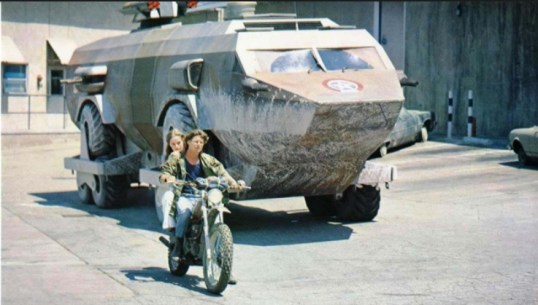
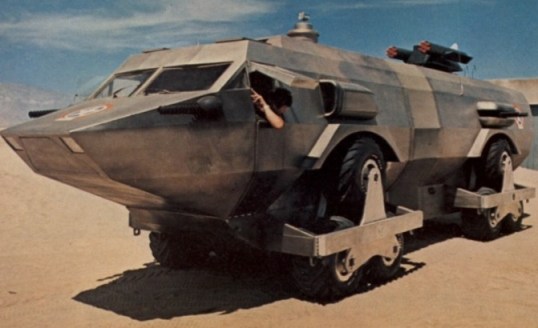
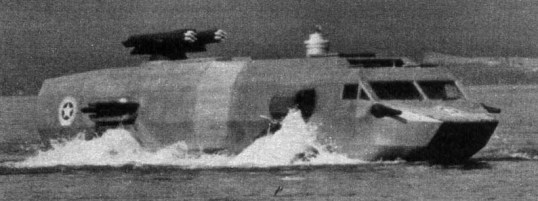
Anyone who has seen Damnation Alley knows that the only thing that matters is the Landmaster.

Damnation Alley has a slight plot.  A nuclear war has knocked the Earth off of its axis.  The skies are green and purple.  The scorpions are huge and the cockroaches eat humans.  Crazed survivors are living like savages, attacking anyone that they come across.  When a radio signal seems to indicate that there might still be civilization in Albany, four military men (George Peppard, Jan-Michael Vincent, Paul Winfield, and Kip Niven) decide to drive across the country to check it out.  To reach Albany, they will have to cross an inhospitable stretch of land called Damnation Alley.  They will be making the journey in two Landmasters, amphibious vehicles that provide RV comfort with the extra advantage of a rocket launcher.  Along the way, they fight scorpions, roaches, and pick up some extra passengers (Dominique Sanda and Jackie Earle Haley).

The radioactive sky looks cool but otherwise, the scorpions and the cockroaches are all obviously fake and no one in the cast makes any effort to do more than recite their lines.  But no one who has watched Damnation Alley cares about any of that.  We just want to drive a Landmaster.

There is nothing that the Landmaster cannot do.  It  can speed across desert sand.  It can tear up city streets.  It can break through walls.  It can turn into a boat.  It can fire missiles.  It also appears to be bigger on the inside than the outside, just like the TARDIS.  Either that or whoever did the set design for Damnation Alley was not detail-oriented.

Despite the awe-inspiring Landmaster, Damnation Alley was neither a critical nor a box office hit.  It was one of two science fiction films released by 20th Century Fox in 1977.  The other one was Star Wars, which was a good movie but didn’t have a Landmaster.

As for the Landmaster itself, it currently resides in California and has appeared in a handful of other movies.  Sadly, it missed out on the opportunity to appear in any of the Smoky and the Bandit movies.  Burt Reynolds driving a Landmaster?  That would have been box office gold.

Right, Burt?