Love On The Shattered Lens: The Bitch (dir by Gerry O’Hara)


“Joan Collins is THE BITCH” announced the opening credits of the 1979 film, The Bitch.  Seriously, how can you not love a film that opens that way?

Joan Collins returns of Fonatine Khaled, the character that she previously played in The Stud.  Once again based on a novel by Jackie Collins, The Bitch follow Fontaine as she adjusts to life as a freshly divorced woman.  Though she received a good deal of money in the divorce and she has her own personal fortune as well, Fontaine is struggling to maintain her extravagant lifestyle.  A new disco has opened and is taking away the crowds that used to populate her club.  She’s running out of cash and soon, she might not even be able to fly first class!

It’s on an airplane that she meets Nico (Michael Colby, who is not particularly charismatic but still isn’t quite as dull as Oliver Tobias was in The Stud).  In an amusing in-joke, the movie that they watch on the plane is The Stud.  Nico says that he can’t decide if the movie is funnier with the sound or without.  “It’s not meant to by funny,” Fontaine replies.  Nico claims to be a wealthy Italian businessman, which immediately gets Fontaine’s attention.  Of course, Nico’s lying.  He’s actually a con artist and a jewel thief.  Fontaine figures that out when Nico tries to use her to smuggle a diamond through customs.  Fontaine is angered but she’s intrigued.

Nico is in debt to the Mafia.  The head of the British mob is a man named … and I’m not making this up …. Thrush Feathers (Ian Hendry).  Thrush Feathers demands that Nico cause a horse to lose an upcoming race.  The horse belongs to Fontaine’s friends from the first film, Vanessa (Sue Lloyd) and Mark Grant (Mark Burns).  Thrush Feathers also offers to help Fontaine keep her club open but his help comes with a price.  Whatever the price is, could it possibly be worse than being named Thrush Feathers?  Seriously, in what world is someone with that name going to take over a London crime syndicate?  How do you go from the Kray Brothers to Thrush Feathers?

Anyway, the plot really isn’t that important.  There’s a lot of double crosses and manipulation as Fontaine lives up to the title of the film.  The plot is really just an excuse to tease the viewer with visions of the decadent rich.  The clothes are expensive.  The mansions are ornate.  The conversations are always arch and full of double entendres.  This film is less about how the rich live and more about how middle class like to imagine the rich live.  It’s also about sex, though none of it quite reaches the lunatic abandon of The Stud’s swimming pool orgy scene.  The important thing is that whole thing is scored to a disco beat.

As with The Stud, it’s Joan Collins who holds the film together, giving a fierce and uninhibited performance in which she gleefully embraces the melodrama and delivers her lines with just enough attitude to let the viewer know that she’s in on the joke.  “Bitch” may have been meant as an insult but, as played by Joan Collins, Fontaine wears the title as a badge of honor.  She understands what had to be done to survive in a male-dominated world and she makes no apologies for it.  Even more importantly, she knows that once you fly first class, you can never go back.

The Bitch is not necessarily good but it is definitely fun in its sordid way.
Love On The Shattered Lens: The Stud (dir by Quentin Masters)


Oliver Tobias is …. THE STUD!

It is true that Oliver Tobias does play the title character of this 1978 British film, which was itself based on a novel by Jackie Collins.  Tobias is cast as Tony Blake, a youngish Englishman who runs the hottest discotheque in the UK.  He runs it on behalf of its actual owner, the decadent Fontaine Khaled (Joan Collins).  Fontaine is married to the fabulously wealthy Benjamin Khaled (played by Walter Gotell, who also had a recurring role in the James Bond films as the head of the KGB) but she seeks her carnal pleasure elsewhere.  Tony’s job and all the glamour that goes with it is dependent upon being Fontaine’s personal plaything.  If Fontaine wants to do it in the elevator while the security cameras film, that is what’s going to happen.  If Fontaine wants Tony to take part in a swimming pool orgy while she swings back and forth over the festivities, that’s what is going to happen.  Tony Blake is the stud, after all.

Tony, however, tires of all the nonstop decadence.  He’s not as empty-headed as Fontaine assumes him to be.  Tony’s complicated.  Tony has feelings.  At least, that’s what the films wants us to believe.  To be honest, Tony is kind of boring but we’ll get to that later.  Tony allows himself to be used by Fontaine but he finds himself truly falling in love with Fontaine’s stepdaughter, Alexandra (Emma Jacobs).  But does Alexandra feel the same way towards Tony or is she just using Tony to get revenge on her hated stepmother?

Let’s start with something positive about this film.  The Stud is one of the most 70s movies ever made.  Everything from the fashion to the slang to the cinematography to the wah wah soundtrack simply screams 70s.  There’s several scenes that take place in the discotheque.  Very few of them actually move the story forward in any meaningful way but they do give you a chance to look at the clothes and the haircuts and to listen for the sound of people snorting cocaine in the background.  If you’re a student pop culture or if you’re just fascinated by the tacky and the trashy, the film is very enjoyable on that level.  There’s also a lot of sex, all of it filmed in vibrant color and featuring a camera that will not stop moving as The Stud tries to convince us that it’s actually high art.

Unfortunately, the stud of the title is a bit of dud.  (And they say I’m not a poet!)  Oliver Tobias is handsome and has a superficially charming screen presence.  But, whenever he has to deliver dialogue or show any hint of emotion, the film falls flat.  As played by Tobias, Tony just comes across as a bland gigolo, enjoyable to look at but impossible to really care about.  The film is so dominated by Joan Collins’s cheerfully over-the-top performance as Fontaine that Tobias seems to spend a lot of the movie disappearing into the background.  Indeed, Collins’s performance is the best thing about the film.  She fully understand what type of movie she’s appearing in and she fully embraces the melodrama, delivering her arch dialogue with just the right amount of self-awareness to suggest that she’s in on the joke.

The Stud is a love story featuring people who are only capable of loving themselves.  At its worst, it gets bogged down in Tobias’s dull lead performance.  At its best, its trashy fun with a disco beat.  I like trashy fun so I can excuse the boring leading man.  A good beat that you can dance to can make up for a lot.

Horror on TV: One Step Beyond 3.26 “Signal Received” (dir by John Newland)


Tonight’s episode tells the story of three sailors who hear an unexpected message on the radio.  Two of the sailors hear that their ship will soon sink.  The third sailor hears that he will live a long and fulfilling life.

One Step Beyond always claimed that all of its stories were “based on fact.”  This episode actually goes the extra mile by interviewing one of the real-life sailors about the message and about whether or not he believes in the supernatural.

This episode originally aired on April 4th, 1961.

Embracing the Melodrama Part II #61: Home Before Midnight (dir by Pete Walker)


-Home_Before_Midnight-_DVD_coverIf there’s any director who deserves to be rediscovered and be given a critical reevaluation, it’s … well, I was going to say that it’s Pete Walker but honestly, I’ve only seen a handful of Walker’s films.  And really, my admiration of Walker as a filmmaker is largely due to one film, 1974’s Frightmare.  So, I’ll just say that, based on Frightmare, Walker might deserve a critical reevaluation.

Unfortunately, I’m not reviewing Frightmare right now.  Instead, I’m taking a quick look at another Pete Walker film, 1979’s Home Before Midnight.

It’s going to be a quick look because there’s really not that much to say about Home Before Midnight.  The film opens with two 14 year-old girls hitchhiking.  Carol (Debbie Linden) is blonde and wild.  Ginny (Alison Elliott) is brunette and responsible.  They end up getting picked up by a truck driver who quickly decides that he’d rather just give a ride to Carol.  So, Carol and the driver drive off together and Ginny ends up alone and, once again, hitchhiking.  Eventually, Ginny is picked up by Mike (James Aubrey), a songwriter in his 30s.

Not realizing that Ginny is only 14 years old, Mike takes her back to his flat and they have sex.  Afterward, Mike discovers just how young Ginny is and tells her that they can be friends but that they can’t have sex because it’s illegal.  Ginny agrees.

And then Mike and Ginny end up having sex again anyway…

Anyway, as you can probably guess, things don’t go well as far as Mike and Ginny’s “romance” is concerned.  Though Ginny swears to her parents that she and Mike are just friends, her parents see Mike being interview on television, along with an unlikely rock star named Nick (Chris Jagger, far less charismatic brother of Mick).  When Mike is asked if he has a girlfriend, Nick announces that not only does Mike have a girl but her name is Ginny.  Soon, Ginny is moving on to boys her own age and Mike is on trial.

As someone whose first “serious” boyfriend was 9 years older than her and who has always appreciated a certain maturity in men, there were a few bits of Home Before Midnight to which I could relate.  Occasionally, the first part of the film even captures the excitement of having a secret and forbidden love.

But ultimately, the film just fails.  To put it lightly, Home Before Midnight is no An Education.  Instead, it’s a painfully boring film, one that pretends to examine a serious issue but then doesn’t even play fair.  We’re told that Ginny is 14 but the actress playing her was 20 and looked and acted like she was close to 30.  As well, about 90 minutes into the film, Ginny’s personality is totally changed, the better to portray Mike as somehow being a victim.  The film makes so many excuses for Mike and the camera spends so much time lingering on Ginny’s frequent naked body (and remember, Ginny is being played by a 20 year-old but is only supposed to be 14) that it actually becomes creepy to watch.

Ultimately, the most interesting thing about Home Before Midnight is the fact that it features Mick Jagger’s younger brother, Chris, in a supporting role.  Chris Jagger looks close enough to Mick that you would guess that they were related.  But Chris has absolutely none of Mick’s charisma and it’s actually funny to hear Chris continually being described as being one of the biggest stars in the world.  Chris Jagger makes Justin Bieber look like Adam Levine.

If you still want to see this boring and creepy movie, it’s currently available on Netflix.  However, I would suggest that your time would be better spent watching any other Pete Walker film.

http://www.youtube.com/watch?v=50fylKl8XsE

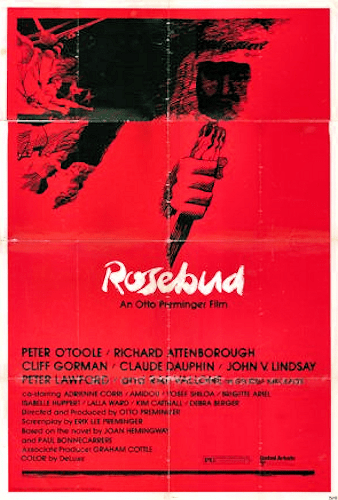
Shattered Politics #37: Rosebud (dir by Otto Preminger)


Rosebud_-_1975_-_Film_Poster

Before I review the 1975 film Rosebud, allow me to tell you about how I first discovered the existence of this particular film.

The greatest used bookstore in the world is located in Denton, Texas.  It’s called Recycled Books and it is three stories of pure literary goodness!  (Plus, there are apartments on the top floor where I attended some pretty interesting parties but that’s another story….)  When I was attending the University of North Texas, I used to stop by Recycled Books nearly every day.  One day, I happened to be searching the Film and TV section when I came across a beat-up paperback called Soon To Be A Major Motion Picture.

This book, which was written by Theodore Gershuny, told the story of how the previously acclaimed director Otto Preminger attempted to make a film about terrorism.  Starting with the attempts of Preminger’s son, Erik Lee Preminger, to come up with a workable script and then going on to detail how Peter O’Toole came to replace Robert Mitchum as the star of the film and ending with the film’s disastrous release, Soon To Be A Major Motion Picture proved to be a fascinating read.

After finishing the book, I simply had to see Rosebud for myself.  Unfortunately, at that time, Rosebud had not yet been released on Blu-ray or DVD.  So, I actually ended up ordering an old VHS copy of it.  The tape that I got was not in the best condition but it played well enough and I can now say that, unlike the majority of people in the world, I’ve actually seen Rosebud!

Which is not to say that Rosebud is any good.  It’s not the disaster that I had been led to expect.  In fact, it probably would have been more fun if it had been a disaster, as opposed to being just a forgettable film from a director who was probably capable of better.  Preminger started his career in the 30s and was considered, at one point, to be quite innovative.  He directed Laura and Anatomy of a Murder, two great films.  Unfortunately, there’s really nothing innovative about his direction of Rosebud.  In Gershuny’s book, Preminger comes across like an intelligent and thoughtful man who was too set in his ways to realize that what was shocking in 1959 was no longer that big of a deal in 1975.  (And, needless to say, it’s even less of a big deal in 2015.)

As for what Rosebud‘s about, it’s about a man named Sloat (Richard Attenborough), a former journalist who now lives in a cave in Israel and dreams of establishing a worldwide terrorist network.  Under Sloat’s direction, terrorists storm a yacht named the Rosebud and take the girls on board hostage.  The girls are wealthy and privileged.  Their fathers are judges, senators, and businessmen.  CIA agent Larry Martin (Peter O’Toole) is tasked with tracking down and rescuing the girls.  If it sounds like an action film — well, it’s not.  This is not a prequel to Taken.  Instead, it’s a very talky film that has a few isolated good moments and performances but otherwise, is fairly forgettable.

That said, the film does have an interesting cast.  Peter O’Toole seems bored by his role (and who can blame him?) but Attenborough briefly livens things up in the role of Sloat.  As for the girls being held hostage, they’re not given much to do.  One of them is played by a young Isabelle Huppert.  Long before she would play Samantha on Sex and the City, Kim Cattrall plays a hostage here.  The English hostage is played by Lalla Ward, who is now married to Richard Dawkins.

And then there’s the girl’s parents, who are played by an odd assortment of character actors.  Raf Vallone, an Italian, plays a Greek.  (His daughter, meanwhile, is played by the French Isabelle Huppert.)  Peter Lawford, looking somewhat dazed, shows up as Lalla Ward’s father.  (One of the sadder scenes in Gershuny’s book deals with Lawford’s attempts to remember his lines.)  And than, in the role of Cattrall’s father, we have a very distinguished looking man named John Lindsay.

John Lindsay was the former mayor of New York City, a man who ran for President in 1972 and, three years later, attempted to launch a new career as an actor.  Rosebud was his both his first and final film.  (Rumor has it that Martin Scorsese attempted to convince Lindsay to play Senator Palatine in Taxi Driver but Lindsay turned the role down.)  Lindsay is not particularly memorable in Rosebud.  It’s not so much that Lindsay gives a bad performance as much as it’s just the fact that he has a very bland screen presence.  That blandness probably served him well as a politician but, as an actor — well, let’s just say that John Lindsay was apparently no Fred Thompson.

And so that’s Rosebud.  It’s a film that, much like Maidstone, you can only appreciate if you know what went on behind the scenes.  I can’t really recommend Rosebud but, if you ever come across a battered old copy of Soon To Be A Major Motion Picture in a used bookstore, be sure to buy it!

Seriously, you will not be sorry.