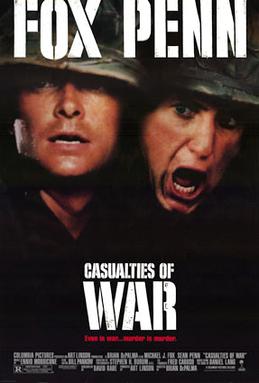
 Private Max Eriksson (Michael J. Fox) is a new arrival in Vietnam, a young infantryman who is called a “cherry” by his fellow soldiers. No one wants to get close to Eriksson because everyone knows that it’s the new guy who is most likely to make a mistake and get himself killed. The only person who seems to care whether Eriksson lives or dies is Sgt. Tony Messerve (Sean Penn), a squad leader who is so tough and battle-worn that it is easy to forget that he is only 20 years old. After a member of Messerve’s squad is killed in a firefight and Messerve’s squad had been denied leave despite all of the stress and pressure that they’ve been under, Messerve decides that, during their next mission, the squad is going to kidnap a woman from a village and take her with them.
Eriksson, who is still naive enough to sincerely say, “We’re supposed to be here to help these people,” is horrified by Messerve’s actions. At first, only he and Diaz (John Leguizamo) refuse to take part in raping the terrified woman (Thuy Thu Le). Diaz soon caves to the pressure from the rest of the squad and joins in. Only Eriksson continues to refuse but his attempt to help the woman escape fails when the members of the squad murder her during a firefight with the Viet Cong. After the battle, the wounded Eriksson discovers that no one in command wants to hear about what happened. Messerve’s second-in-command, Clark (Don Patrick Harvey), targets Eriksson, trying to shut him up permanently.
One of the many Vietnam films to come out after the success of Platoon, Brian De Palma’s Casualties of War is an intense and disturbing recreation of a true story. After years of being accused of making misogynistic and exploitive films, De Palma made an effective and sensitive anti-war film, one that did not exploit the suffering of the kidnapped woman but instead portrays the depravity of war and the courage it takes to do the right thing when everyone around is ordering you not to. While it always takes a while to get used to Michael J. Fox in a serious role (and, at the start of the film, he really does seem to be miscast), he eventually gives the best performance of his career in Max Eriksson and, by using a framing device of Eriksson back in the United States after completing his tour, both De Palma and Fox show how the Eriksson, like countless other veterans, is still haunted by what he saw in Vietnam even after he returns home. Sean Penn is equally impressive as Messerve, playing him as someone who sacrificed his soul in order to survive in Vietnam. Messerve has come to view the entire country with contempt and, in his twisted way, he sees kidnapping the woman as a way to reward his squad for all that they’ve endured. The rest of the cast is also strong, with John C. Reilly making his acting debut as a member of the squad.
Not surprisingly, the dark and disturbing Casualties of War was a box office disappointment. It’s still one of most harrowing films made about Vietnam and one of De Palma’s best.
 In 1951, Norman Dale (Gene Hackman) arrives in the small Indiana town of Hickory. He is a former college basketball coach who has been hired to coach the high school’s perennially struggling basketball team. Emphasizing the fundamentals and demanding discipline from his players, Dale struggles at first with both the team and the townspeople. When he makes an alcoholic former basketball star named Shooter (Dennis Hopper) an assistant coach, he nearly loses his job. Eventually, though, the Hickory team starts winning and soon, this small town high school is playing for the state championship against highly favored South Bend High School.
 Through the Shattered Lens