Icarus File No. 18: Brewster McCloud (dir by Robert Altman)


First released in 1970, Brewster McCloud takes place in Houston.

A series of murders have occurred in the city.  The victims have all been older authority figures, like decrepit landlord Abraham Wright (Stacy Keach, under a ton of old age makeup) or demanding society matron Daphne Heap (Margaret Hamilton, who decades earlier had played The Wicked Witch in The Wizard Of Oz).  The victims all appear to have been killed by strangulation and all of them are covered in bird droppings.  Perplexed, the Houston authorities call in Detective Frank Shaft (Michael Murphy) from San Francisco.  Shaft only wears turtlenecks and he has piercing blue eyes.  He looks like the type of guy you would call to solve a mystery like this one.  It’s only later in the film that we discover his blue eyes are due to the contact lenses that he’s wearing.  Frank Shaft is someone who very much understands the importance of appearance.  As one detective puts it, when it comes to Shaft’s reputation, “The Santa Barbara Strangler turned himself in to him.  He must have really trusted him.”

Perhaps the murders are connected to Brewster McCloud (Bud Cort), who lives in a bunker underneath the Astrodome and who seems to be fascinated with birds.  Brewster dreams of being able to fly just like a bird and he’s spent quite some time building himself a set of artificial wings.  A mysterious woman (Sally Kellerman) who wears only a trenchcoat and who has scars on her shoulder blades that would seem to indicate that she once had wings continually visits Brewster and encourages him to pursue his dream.  However, she warns him that he will only be able to fly as long as he remains a virgin.  If he ever has sex, he will crash to the ground.

Brewster thinks that he can handle that.  Then he meets a tour guide named Suzanne Davis (Shelley Duvall, in her film debut) and things start to change….

Brewster McCloud is a curious film.  The story is regularly interrupted by a disheveled lecturer (Rene Auberjonois) who is very much into birds and who, over the course of the film, starts to more and more resemble a bird himself.  The film is full of bird-related puns and there are moments when the characters seem to understand that they’re in a movie.  Frank Shaft dresses like Steve McQueen in Bullitt and his blue contact lenses feel like his attempt to conform to the typical image of a movie hero.  (A lengthy car chase also feels like a parody of Bullitt’s famous chase scene.)  When the old woman played by Margaret Hamilton dies, the camera reveals that she’s wearing ruby slippers and a snippet of Somewhere Over The Rainbow is heard.  As played by Bud Cort, Brewster is the perfect stand-in for the lost youth of middle class America.  He knows that he’s rebelling against something but he doesn’t seem to be quite sure what.  Brewster, like many idealists, is eventually distracted by his own desires and his once earnest plans come cashing down.  Brewster becomes an Icarus figure in perhaps the most literal way possible, even if he doesn’t come anywhere close to reaching the sun.  As with many of Altman’s films, Brewster McCloud is occasionally a bit too esoteric for its own good but it’s always watchable and it always engages with the mind of the viewer.  One gets the feeling that many of the film’s mysteries are not necessarily meant to be solved.  (Altman often said his best films were based on dreams and, as such, used dream logic.)  With its mix of plain-spoken establishmentarians and quirky misfits, Brewster McCloud is not only a classic counterculture film but it’s also a portrait of Texas on the crossroads between the cultures of the past and the future.

Though it baffled critics when it was released, Brewster McCloud has gone on to become a cult film.  It’s a bit of a like-it-or-hate-it type of film.  I like it, even if I find it to be a bit too self-indulgent to truly love.  Quentin Tarantino, for his part, hates it.  Brewster McCloud was released in 1970, the same year as Altman’s Oscar-nominated M*A*S*H.  (Both films have quite a few cast members in common.)  Needless to say, the cheerfully and almost defiantly odd Brewster McCloud was pretty much ignored by the Academy.

Previous Icarus Files:
  1. Cloud Atlas
  2. Maximum Overdrive
  3. Glass
  4. Captive State
  5. Mother!
  6. The Man Who Killed Don Quixote
  7. Last Days
  8. Plan 9 From Outer Space
  9. The Last Movie
  10. 88
  11. The Bonfire of the Vanities
  12. Birdemic
  13. Birdemic 2: The Resurrection 
  14. Last Exit To Brooklyn
  15. Glen or Glenda
  16. The Assassination of Trotsky
  17. Che!

Horror Book Review: The Texas Chainsaw Massacre Companion by Stefan Jaworzyn


Originally released way back in 1974, The Texas Chainsaw Massacre continues to be one of the most iconic and influential horror films of all time.

Not only did the film terrify generations of filmgoers, it also undoubtedly inspired many people who lived up north to swear that they would never visit Texas.  (Speaking as a Texan, I appreciate it!)  So powerful was the impact of The Texas Chainsaw Massacre that it is regularly cited as being one of the first “gore” films, despite the fact that barely a drop of blood is seen throughout the entire film.  Instead, what is seen is Sally (played by Marilyn Burns) screaming while running and Leatherface (Gunnar Hansen) dancing with that chainsaw.

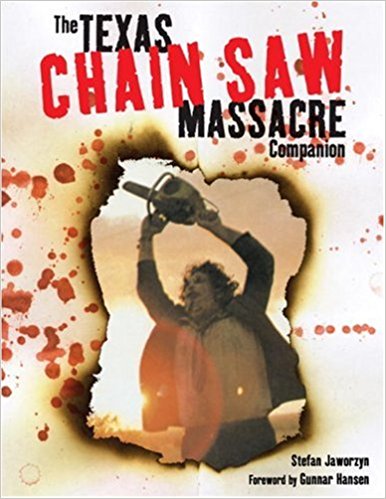
So, how did a group of hippies in Austin come to make one of the most famous movies of all time?  That is the question that is answered in the 2004 book, The Texas Chainsaw Massacre Companion.  Written by Stefan Jaworzyn and featuring a foreword by Gunnar Hansen, this breezy and entertaining book contains almost everything you could possibly want to know about this film.  The book is largely an oral history, featuring lengthy quotes from the film’s cast and crew.  (For the most part, Jaworzyn allows the interviews speak for themselves and only occasionally interjects any editorial commentary.)  Along with detailing the film’s infamously difficult production (with Marilyn Burns nearly being driven to the point of an actual breakdown and Hansen, an otherwise sensitive poet, coming close to being possessed by his murderous character at one point), the companion also deals with crimes of Ed Gein and Tobe Hooper’s career both before and after his best known film.

Most interesting, to me, were the sections that dealt with how the head of the Texas Film Commission helped to secure The Texas Chainsaw Massacre a national distribution deal.  Considering that The Texas Chainsaw Massacre basically portrayed Texas as being a place where you could get killed if you made a wrong turn, the involvement of the Texas Film Commission may seem strange at first.  Some of the interviews in the book seem to suggest that the head of the Commission had a crush on Marilyn Burns.

It’s an entertaining book, even if I don’t agree with everything that Jaworzyn says.  (He calls Psycho overrated at one point.)  With the recent deaths of Marilyn Burns, Gunnar Hansen, and Tobe Hooper, The Texas Chainsaw Massacre Companion now serves as something of a tribute to these three artists and the film that, to the surprise of everyone, changed cinema forever.

Halloween Havoc!: THE TEXAS CHAINSAW MASSACRE (Bryanston Pictures 1974)


gary loggins's avatarcracked rear viewer

texas1

The first time I watched THE TEXAS CHAINSAW MASSACRE was at a drive-in around 1975. I remember laughing hysterically at the film; of course, I was tripping my brains out on mescaline at the time and laughed at anything! I’ve since viewed the film several times without chemical enhancement and I’m no longer laughing. I like it a lot, it’s a scary little exploitation shocker for sure, but one thing that really irks me is a  certain segment of critics who treat it as some kind of metaphor with deep meaning.

Don’t get me wrong, there’s a lot to like here. The tension is gripping, the horror relentless, and Tobe Hooper did a terrific job working with a miniscule budget. It’s just that over the years, critics have overanalyzed the thing to death, expounding on the political and cultural ramifications of it’s themes and blah, blah, blah. Whether or not all this blathering about…

View original post 615 more words

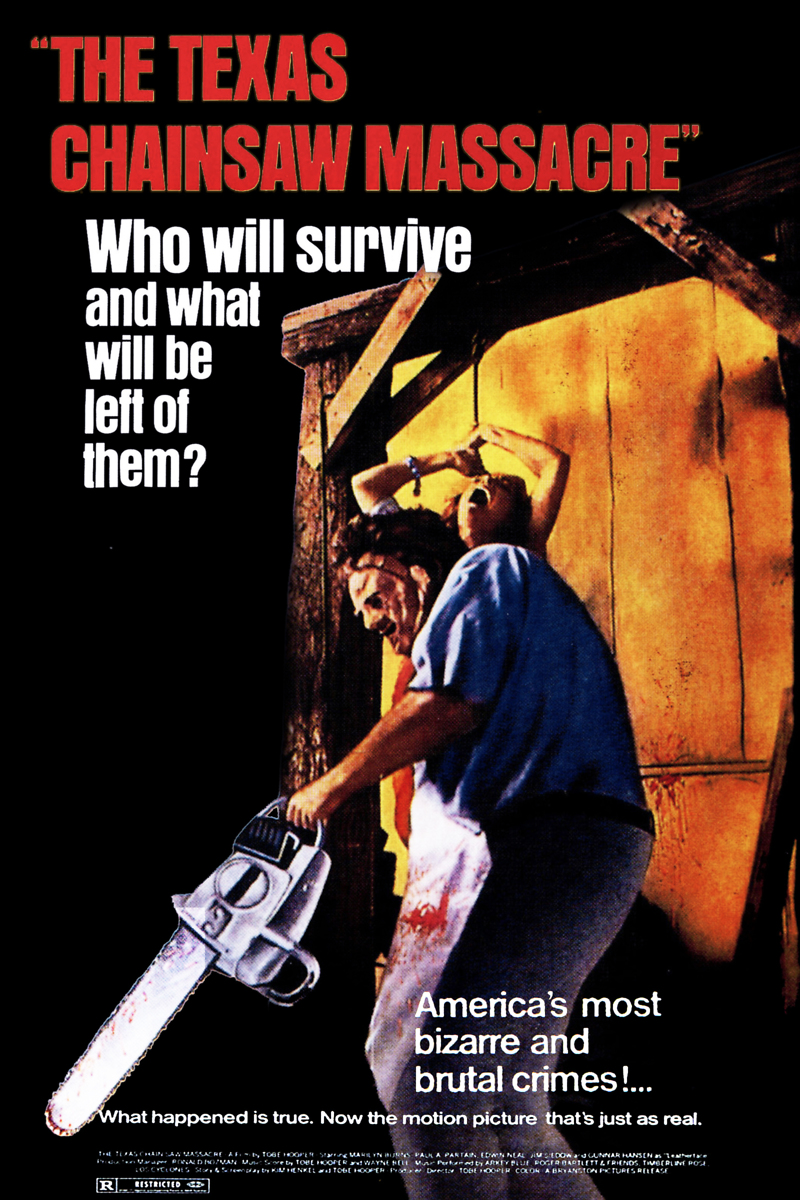
Horror Film Review: The Texas Chainsaw Massacre (dir by Tobe Hooper)


TheTexasChainSawMassacre-poster

Occasionally, I get asked why I am always making mean-spirited jokes about Vermont.  Well, believe it or not, there is a reason!  Would you believe that it all goes back to The Texas Chainsaw Massacre?

In an editorial that was posted on this very site, I argued that one reason why, ever since it was initially released in 1974, The Texas Chainsaw Massacre has remained an iconic horror film is because the title specifically alerts you that the film takes place in Texas.  For whatever reason, people across America are terrified of my home state.  Despite the fact that we’re all pretty friendly down here, people are scared to death.  They think we’re all walking around with guns or that something’s bad is going to happen if you make a wrong turn.  (And, of course, folks from up north can’t handle the fact that the temperature occasionally gets above 85. “OH MY GOD, IT’S GLOBAL WARMING!” the tourists shout.  No, morons — it’s just summer in Texas.)  In order to prove my point, I pointed out that no one would want to see a movie called The Vermont Chainsaw Massacre.

For good measure, I may have then added, “Fuck Vermont.”  Because — well, why not?*

Within hours of posting that editorial, I heard from someone in Vermont and OH MY GOD, she was so offended!  Seriously, she seemed to be really upset that I was suggesting that nobody would be scared of getting horribly murdered while driving through Vermont!

So, to the people of Vermont, accept my apologies.  Y’all are just as capable of killing people with a chainsaw as we are, okay?

Seriously, though, The Texas Chainsaw Massacre would never work if it was set in Vermont.  That’s not just because Vermont su …. uhmm, is a lovely state.  That’s because The Texas Chainsaw Massacre is a uniquely Texan film.  One reason why this film is so successful is because it was made by Texans and it starred Texans (no inauthentic accents here!) and it was filmed in Texas during the summer.  From the minute we see that van driving down the road, we feel the isolation of the characters.  Every frame of the film is filled with Texas heat and humidity and, as such, the audience can almost literally feel how uncomfortable it is inside the van, so much so that you really can’t blame everyone for wanting to get out and walk around for a while.  Ultimately, the burning sun is as important a character in this film as Sally (Marilyn Burns), her obnoxious wheelchair-bound brother Franklin (Paul A, Partain), or Leatherface (Gunnar Hansen), the hulking cannibal who chases after them with a chainsaw.

Actually, it’s a little bit difficult to know what to say about The Texas Chainsaw Massacre.  It’s such a famous film that even people who haven’t seen it feel as if they had.  And every review always points out the reasons why it works: the film is shot in an almost documentary style, Marilyn Burns was one of the great scream queens, Leatherface’s final dance with his chainsaw is pure nightmare fuel, and, despite the fearsome title, next to no blood is actually seen on screen.  This is one of those films where we imagine we see a lot more than we actually do.  Despite being advertised as being a “chainsaw massacre,” only one person actually falls victim to a chainsaw and he’s so obnoxious that you’re kind of happy that he finally stopped talking.

They may not be much blood on the screen but this is still one of the most stomach-churning films ever made.  When Sally finds herself trapped in the house with Leatherface and his family, that house is so filthy and disgusting that you can literally smell the rotting flesh coming off the screen.  This may be a case of my own OCD speaking but the squalor of that house tends to disturb me even more than some of the murders.

Speaking of the murders, the death of Jerry (Allan Danziger) always freaks me out.  Jerry is looking for his other dead friends when Leatherface appears out of nowhere and hits him with a sledgehammer.  Up until that point, Jerry seemed like the smartest of the five people to find themselves wandering around that desolated part of South Texas.  Certainly, if I had been there, I probably would have wanted to stay with Jerry.  Perhaps that’s why Jerry’s high-pitched scream before getting killed always disturbs me.  If you’ve seen enough slasher movies, you know that the men in these movies — no matter what is happening to them — hardly ever scream.  When Jerry does so, it makes the movie feel real in a way that most film influenced by Texas Chainsaw do not.

Listen, Vermont … I’m sorry you can’t have a chainsaw massacre of your very own.  But The Texas Chainsaw Massacre is a part of our history and, despite the negative implications of the name, we do take a certain amount of pride in it.  It is truly one of the great horror films.  Ignore the remakes, which were made by non-Texans and are all so excessively stylized that you have to wonder if the filmmakers even saw the original.

One final note: The Texas Chainsaw Massacre also has one of the truly great trailers.  Check it out below!

http://www.youtube.com/watch?v=eY4ldz615FA

——

* I should mention that I can usually trust someone around here to ask me if I really want to say something like “Fuck Vermont” before I hit publish.  But that weekend, Arleigh was on vacation and this was before I had recruited my sister to come work here so there really wasn’t anyone else around the TSL offices who was used to dealing with me and my impulsive nature.  I tried to show the post to Leonard to get his opinion about the F Vemont line but he was busy watching hockey…