An Offer You Can’t Refuse #1: The Public Enemy (dir by William Wellman)


For this month, I’ve decided to review movies about mobsters.

There’s no specific reason for that, beyond the fact that I just happen to love mobster movies.  Of course, a good gangster film is rarely just about crime.  Anyone who has ever seen The Godfather can tell you that.  At their best, American gangster films are about the American dream and the lengths that some will go to achieve it.

Plus, they’re just a lot of fun to watch.  Some of the greatest actors of all time made their mark in gangster films.

Take 1931’s The Public Enemy, for instance.

Produced during the final days of prohibition and the early years of the Great Depression, The Public Enemy tells the story of three boys who grew up poor.  Tom Powers (James Cagney) and his friend, Matt Doyle (Edward Woods) pursued a life of crime, rising through the ranks of organized crime before eventually meeting a tragic end.  The third, Mike Powers (Donald Cook), stayed on the straight-and-narrow path.  He went into the Marines and he rebuked his brother, Tom, when he discovered that Tom’s money was due to “blood and beer.”

The film opens and closes with a title card that basically tells us that Mike Powers has the right idea but, when you watch the film, you can’t help but wonder if maybe Tom had a point about his brother being kind of a sap.  Mike might be a decent citizen and he might have a chestful of medals as the result of his wartime heroics but what else does he have?  Tom Powers, meanwhile, has no education and, it would appear, no conscience, no real friends, and no one that he really loves and yet he becomes a rich man who is acquainted with powerful figures.  While Mike stays at home with their mother, Tom lives in an ornate penthouse.  When his first girlfriend (Mae Clarke) gets on his nerves, Tom shoves a grapefruit in her face and then gets an even more glamorous girlfriend, Gwen (Jean Harlow).  (Meanwhile, even dumb old Matt is doing okay for himself, marrying a woman played by Joan Blondell.)  It’s hard not to imagine that the film’s original audience — who were still reeling from the Stock Market Crash of 1929 — looked at Mike and Tom Powers and quickly decided that they’d much rather be a part of Tom’s life than Mike’s.  Even if Tom is destined for an early grave or a lifetime behind bars, at least he appears to be having fun.  Speaking for myself, I’d much rather go out with the guy who has nice clothe and his own luxury apartment than with the self-righteous dud who is still living at home with his mother.

Of course, another reason why we gravitate towards Tom Powers is because he’s played by James Cagney, who was one of the most charismatic of the stars of Hollywood’s Golden Age and whose performance still holds up today.  Cagney gives a ferocious performance, snarling out his lines and always moving like a caged animal, even when he’s just preparing to have breakfast.  He’s full of an energy that’s both dangerous and exciting to watch.  Cagney also brings a very powerful anger to the role of Tom Powers.  As played Cagney, Tom Power is not just a criminal because he’s greedy.  He’s also a criminal because he has no use for a society that he feels has rejected him since birth and which has never given him a fair chance.  He becomes wealthy not just because he wants money but because he wants to taunt everyone who ever said that he wouldn’t amount to anything.  He’s every crime is more than act of greed.  It’s also an act of rebellion, a joyful to a society that wants to tell people what they’re allowed to believe and do.  He’s the ultimate 1930s rebel, giving the the finger to not only the two Hoovers (Herbert and J. Edgar) but also to the good government leftists would be soon be swept into power with FDR.  Despite the fact that The Public Enemy was made nearly 90 years ago, there’s nothing creaky about Cagney’s performance.  It still feels vital and powerful today and it elevates the entire film.

The Public Enemy holds up surprisingly well.  The film may be close to 90 but Cagney’s ferocious performance still feels fresh and powerfully alive.


Halloween Havoc!: FRANKENSTEIN (Universal 1931)


gary loggins's avatarcracked rear viewer

Two hundred years ago, Mary Wollstonecraft Shelley unleashed her novel FRANKENSTEIN upon an unsuspecting world. The ghastly story of a “Modern Prometheus” who dared to play God and his unholy creation shocked readers in 1818, and over the past two centuries has been adapted into stage plays, radio dramas, television programs, comic books, and the movies, most notably James Whale’s seminal 1931 FRANKENSTEIN, featuring not only a star-making  performance by Boris Karloff as the Creature, but ahead of its time filmmaking from Whale.

Director James Whale and his star

James Whale had directed only two films before FRANKENSTEIN (JOURNEY’S END and WATERLOO BRIDGE), but the former stage director certainly adapted quickly to the new medium of talking pictures. The story had been made three times for the silent screen, but the new sound technology adds so much to the overall eeriness of the film’s atmosphere. Whale was obviously influenced by…

View original post 580 more words

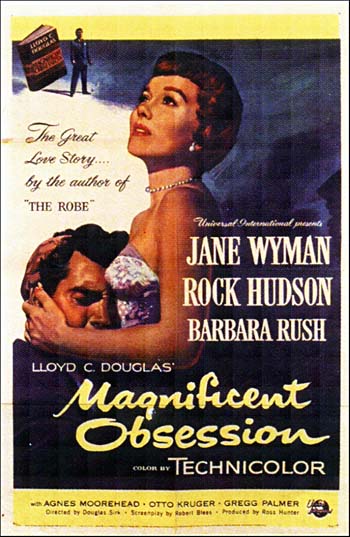
Embracing the Melodrama Part II #20: Magnificent Obsession (dir by Douglas Sirk)


Magnificent_obsessionThere’s a scene early on in the 1954 melodrama Magnificent Obsession in which formerly carefree millionaire Bob Merrick (Rock Hudson) meets with an artist named Edward Randolph (Otto Kruger).  We know that Randolph’s brilliant because he speaks in a deep voice, tends to be unnecessarily verbose, and often stares off in the distance after speaking.  Bob wants to know about a dead doctor who was a friend of Randolph’s.  Randolph explains the late doctor’s philosophy of doing anonymous good works.  Bob’s mind is blown.  (Hudson, who was never the most expressive of actors, conveys having his mind blown by grinning.)

“This is dangerous stuff,” Randolph warns him, “One of the first men who used it went to the cross at the age of 33…”

And a heavenly chorus is heard in the background…

And that one line pretty much tells you exactly what type of film Magnificent Obsession is.  It’s a film that not only embraces the melodrama but which also holds on tight to make sure that the melodrama can never escape.  There’s not a single minute in this film that is not hilarious overwritten.  It’s not just Randolph who tends to be portentous in his pronouncements.  No — everyone in the film speaks that way!

The dead doctor is dead specifically because of Bob.  Apparently, the doctor had a heart attack but the local hospital’s only resuscitator was being used to save the life of Bob who, while the doctor was dying, was busy recklessly driving a boat.

Helen (Jane Wyman), the doctor’s widow is, at first, bitter towards Bob and when Bob offers to donate $250,000 to the hospital, Helen refuses to accept his check.  This leads to Bob doing a lot of soul-searching and eventually having his life-changing conversation with Randolph.  Excited at the prospect of doing anonymous good works for the rest of his life, Bob tracks down Helen and tries to tell her that he’s a changed man.  Helen, however, wants nothing to do with Bob and ends up getting hit by a car while running away from him.  Helen survives but now, she’s blind!

Now, at this point, you might think that Bob has done enough to ruin Helen’s life.  At least, that’s the way that Helen’s family views it and when Bob attempts to visit her in the hospital, they order him to go away.

Eventually, Helen comes home from the hospital and starts to adjust to a life without eyesight.  One day, she meets a man on the beach and they start up a tentative romance.  What she doesn’t realize, at first, is that the man is Bob!  By the time she does realize who the man is, Helen has fallen in love with him.  However, she feels that it wouldn’t be fair to Bob to pursue a relationship with him and she leaves him.

So, of course, Bob’s response is to go to medical school and become a neurosurgeon.  Many years later, Helen has a brain tumor and needs an operation to survive.

Can you guess who her surgeon turns out to be?

Magnificent Obsession is almost a prototypical 1950s melodrama.  It’s big, it’s glossy, it’s self-important, and undeniably (and occasionally unintentionally) funny.  Even the total lack of chemistry between Hudson and Wyman somehow adds to the film’s strange charm.  It’s hard not to admire a film that starts out over-the-top and just grows more excessive from there.

Watching Magnificent Obsession is a bit like taking a trip into a parallel, technicolor dimension.  It’s strange, fascinating, and far more watchable than it should be.