Today, the Shattered Lens wishes a happy birthday to the one and only Liza Minnelli. Here she is, in today’s scene that I love, performing Money with Joel Grey in 1972’s Cabaret.
Today, the Shattered Lens wishes a happy birthday to the one and only Liza Minnelli. Here she is, in today’s scene that I love, performing Money with Joel Grey in 1972’s Cabaret.
Today, the Shattered Lens wishes a happy birthday to the one and only Liza Minnelli. Here she is, in today’s scene that I love, performing Money with Joel Grey in 1972’s Cabaret.
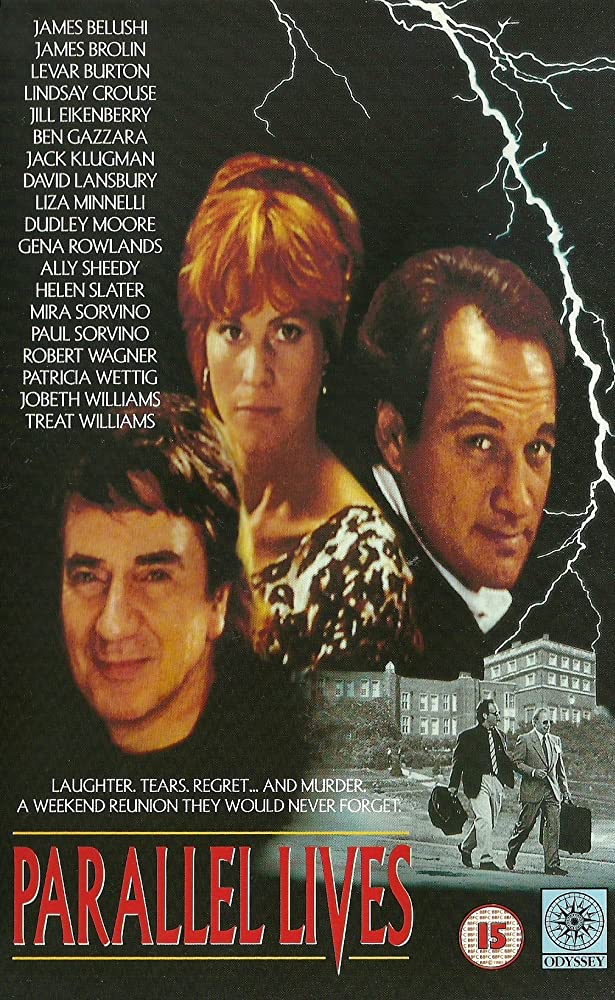 A large group of people gather together one weekend for a fraternity/sorority reunion. Since college, some of them have become rich and powerful. Some of them are now famous. Some of them are now seedy and disreputable. They all have college memories, though there’s such a wide variety of age groups represented that it’s hard to believe that any of them actually went to college together. After the men spend the day playing practical jokes and touch football and the women spend the night talking about their hopes and dreams, they wake up the next morning to discover the someone has murdered Treat Williams. A pony-tailed sheriff (Robert Wagner) shows up to question everyone.
Parallel Lives was made for Showtime with the help of the Sundance Institute. Today, it’s a forgotten film but, for some reason, it was very popular with American Airlines during the summer of 1997. That summer, when I flew to the UK, Parallel Lives was one of the movies that we were shown. (It was the second feature. The first feature was Down Periscope, a submarine comedy starring Kelsey Grammar. Fourteen year-old me enjoyed Down Periscope but, in retrospect, it wasn’t much of a flight.) A month and a half later, when I flew back to the U.S., Parallel Lives was again one of the films shown on the flight! For that reason, I may be the only person on the planet who has not forgotten that a film called Parallel Lives exists.
Parallel Lives, I later learned, was an entirely improvised film. The huge cast were all given their characters and a brief outline of the film’s story and they were then allowed to come up with their own dialogue. Unfortunately, no one did a very good job of it and the men were reduced to bro-ing it up while the women spent most of the movie having extended group therapy. The story doesn’t add up too much and, even when I rewatched it from an adult’s perspective, I wasn’t sure what I was supposed to get out of everyone talking about how different the real world was from college. Technically, the film’s a murder mystery but you can’t improvise a successful murder mystery. This film proves that point.
Of course, it doesn’t help that there are 26 characters, all trying to get a word in at the same time. Some of the roles don’t make much sense. Dudley Moore shows up, playing an imaginary friend. (How do you improvise being a figment of someone’s imagination?) James Brolin introduces himself to everyone as being, “Professor Doctor Spencer Jones” and that appears to be as far as he got with his improv. Ben Gazzara is a gambler and Mira Sorvino is the prostitute that he brings to the reunion while Mira’s father, Paul Sorvino, moons the camera several times. Jack Klugman is a senator with Alzheimer’s and Patricia Wettig is his daughter. The majority of the movie centers around Jim Belushi, playing a reporter and falling in love with JoBeth Williams. Liza Minnelli, Helen Slater, Levar Burton, Lindsay Crouse, Matthew Perry, Ally Sheedy, and Gena Rowlands all have small roles. How did so many talented people come together to make such a forgettable movie and why did American Airlines decide it was the movie to show people on their way to another country? That’s the true mystery of Parallel Lives.
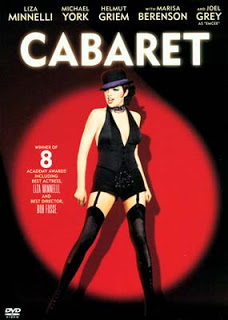
The Godfather is such a classic film that it’s always somewhat surprising to be reminded that it wasn’t exactly an Oscar powerhouse. When the Academy Awards for 1972 were handed out, The Godfather may have won Best Picture, Adapted Screenplay, and Actor but, out of 10 nominations, that’s all it won. Francis Ford Coppola did not win Best Director, Gordon Willis was not even nominated for Best Cinematography, and neither Al Pacino, James Caan, nor Robert Duvall won Best Supporting Actor. According to the fascinating book Inside Oscar, Godfather producer Al Ruddy started his acceptance speech by acknowledging that, “We were getting a little nervous there.”
When you look at the 1972 Academy Awards, what quickly becomes obvious is that the year’s big winner was Cabaret. All of those Oscars that people naturally assume went to The Godfather? They went to Cabaret. Out of ten nominations, Cabaret won eight. It set a record for the most Oscars won by a film that did not win best picture.
If it hadn’t been for The Godfather, Cabaret would have won best picture and it would have totally deserved it. Oh my God — how I envy all of our readers who were alive in 1972! How wonderful it must have been to have not one but two legitimately great and groundbreaking films released in the same year! Five years ago, I was lucky enough to see both The Godfather and Cabaret on the big screen and it was an amazing experience but I can only imagine what it was like to discover these two films for the very first time, with no preconceived notions.
Seriously, I need a time machine and I need it now.
Cabaret takes place in Berlin in 1931. Germany is still struggling to recover from World War I. When the reserved English academic Brian (Michael York) first arrives in the city, he barely notices the buffoonish men standing on street corners, handing out anti-Semitic pamphlets. He’s more interested in earning his doctorate. When he moves into a boarding house, he meets and cautiously befriends Sally Bowles (Liza Minnelli), a free-spirited American actress who dances at the Kit Kat Klub. When Sally tries to seduce Brian, he is curiously passive. Finally, after she asks him if he doesn’t like girls, Brian tells her that he’s tried to have sex with three separate women and each time, he failed. However, Sally is not one to give up and eventually she does manage to seduce Brian, telling him that the other women were just the “wrong three girls.”
To make money, Brian gives English lessons. One of his students is the wealthy and innocent, Natalia (Marisa Berenson). While Brian teachers her English and Sally gives her advice about sex and love, Natalia finds herself more and more of an outsider in Berlin. She’s Jewish and as a result, her dog is murdered. Fritz Wendel (Fritz Wepper) falls in love with Natalia but marrying her means publicly revealing that he’s Jewish and putting both of their lives in danger.
Sally performs at the Kit Kat Klub, where the Emcee (Joel Grey) gives the wealthy audiences a taste of decadence. At first, the audience is full of well-dressed and upper class people but, with each performance, we notice that the audience is changing. More humorless men in uniforms appear at the tables, like constantly multiplying cancer cells. Outside the Klub, men are attacked in the streets but the show inside continues. Though they may not know it (and Sally would certainly never admit it), we watch the performances in Kit Kat Klub with the full knowledge of what is going to eventually happen to the majority of the people who we see on stage. (That the Emcee is played by an actor who is both Jewish and gay only serves to drive the point home.) As a result, the performances are both entertaining and ominous at the same time.
It’s easy to be critical of Sally. In fact, I think it’s a little bit too easy for some critics. Sally may be apathetic and she may be self-centered and apolitical but how different is she from most of us? With the exception of Natalia, Sally may be the only truly honest character in the film. She alone understand that life is a nonstop performance and that there’s nothing she can do to change the world in which she’s found herself. All she can do is look out for herself.
Sally and Brian eventually meet and enter into a brief ménage à trois with Max (Helmut Griem), a wealthy baron. Sally occasionally allows herself to dream of being a baroness while Brian struggles to deal with the jealousy he feels towards both Max and Sally.
Of the three of them, Brian is the only one to eventually become alarmed by the rise of the National Socialism. Sally refuses to take consider anything that’s happening outside of her own life and her own dreams. Meanwhile, Max holds the Nazis in disdain but insists that the aristocracy can control them and that the Nazis are useful for keeping the lower classes in line.
And then this happens:
This scene is one of the most important in the history of cinema and it’s one that is even more relevant today than ever. With the U.S. currently in the middle of a bitter and angry election cycle, everyday seems to bring more of the political mob mentality that this scene epitomizes. In Cabaret, the mob sang in a beer garden. In the modern world, they hop on twitter and start hashtags.
Whenever I watch Cabaret, I always think about that old man in the beer garden. He alone sits there and does not sing. He alone seems to understand.
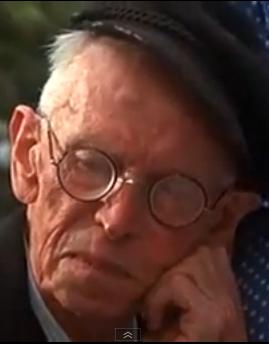
Cabaret is a powerful and important film, now more than ever.

When I decided that I was going to post a series of dance scenes that I love, I knew I’d have to include at least one scene from Cabaret.
But which scene?
Bob Fosse’s 1972 film is a treasure trove for those of us who love dance.
In the end, I went with Money because it’s true.
Money does make the world go around.
 Through the Shattered Lens