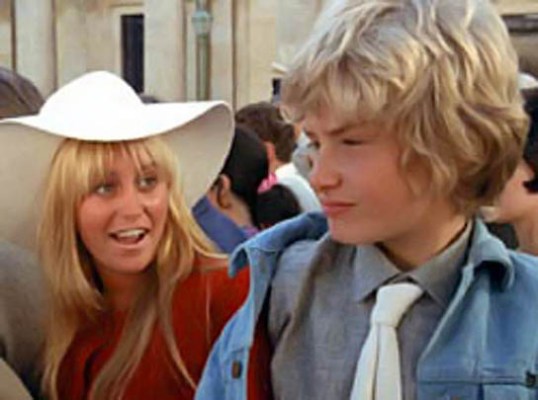
In Eyewitness (which is also known as Sudden Terror), eleven year-old Ziggy (Mark Lester) witnesses a policeman (Peter Vaughan) assassinating a visiting African dignitary but, because he has a history of “crying wolf,” he can’t get anyone to believe him. Not his older sister, Pippa (Susan George). Not his grandfather (Lionel Jeffries), the lighthouse keeper. Not the housekeeper, Madame Robiac (Betty Marsden). Not even Tom Jones (Tony Bonner), a tourist who fancies Pippa. When he sees two policemen driving up to his grandfather’s lighthouse, Ziggy panics and runs. Though John Hough’s direction, which is full of zoom shots and Dutch angles, is dated, Eyewitness holds up well as a tight thriller. Susan George was beautiful in 1970 and Peter Vaughan is a great villain.
If Sam Peckinpah had ever made a children’s movie, it would probably look a lot like Eyewitness. The movie starts out with Ziggy playing on the beach and pretending to be a soldier while imaginary gunshots and explosions are heard in the background. It ends with a strange joke about a man who looks like Hitler, followed by a cheery freeze frame. In between all that cheeriness, the assassin and his brother (Peter Bowles) chase Ziggy across Malta and kill anyone who gets in their way, from a friendly priest to a ten year-old girl being held by her father. I counted ten onscreen death, which is a lot considering that this British movie was released at a time when some were still arguing that Jon Pertwee-era Dr. Who was too scary for children. There’s even an exciting car chase that ends with one car overturned and the blood-covered survivors struggling to drag themselves out from underneath the wreckage. How many British children were traumatized by Eyewitness?
Last year, Gary reviewed the first of the Hammer Frankenstein films, The Curse of Frankenstein.For today’s horror film review, I’m going to take a look at the second movie in Hammer’s Frankenstein series, 1958’s The Revenge of Frankenstein!
The Revenge of Frankenstein opens where The Curse of Frankenstein ended. The monster (played by Christopher Lee in the first film) has been destroyed and Baron Frankenstein (Peter Cushing) has been sentenced to be executed for the monster’s crimes. However, the Baron escapes the guillotine. Instead, he arranges for a priest to be beheaded in his place. Working under the name Dr. Stein, the Baron escapes to another village and, after several years, re-establishes himself as a wealthy and respected doctor. While most of his patients are rich, Dr. Stein also helps the poor and the disabled. By all accounts, he’s doing wonderful work but he’s also deliberately enigmatic, refusing to join the local doctors council.
Right from the beginning, we’re reminded of just how different Hammer’s Baron Frankenstein was from Universal’s version of the good doctor. In the Universal films, Dr. Frankenstein — regardless of whether the doctor in question was Henry, Wolf, or Ludwig — was always portrayed as being misguided but ultimately noble. If any of the Universal Frankensteins had been sentenced to death, it’s probable that they would have put on a stoic face, walked to the guillotine, and allow their head to roll. In fact, they would have felt so responsible for the actions of the Monster that they probably would feel it was their moral duty to allow themselves to be executed.
That’s not the case when it comes to Hammer’s Baron Frankenstein. Baron Frankenstein feels no guilt over what the Monster has done. Go the guillotine? No way! Baron Frankenstein is determined to create life and if creating life means that other, lesser mortals end up dead … well, so be it. As opposed to the Universal Frankensteins, who all developed god complexes after the success of their experiment, Baron Frankenstein has his god complex from the beginning. And if Baron Frankenstein is a god, why shouldn’t a priest be sacrificed for the good of the Baron’s work?
Anyway, Dr. FrankenStein and his assistant, Dr. Kleve (Francis Matthews) are determined to once again bring the dead back to life. This time, the plan involves transplanting the brain of hunchback Karl (Oscar Quitak) into a physically strong body (played by Michael Gwynn). Dr. Kleve is worried that a brain transplant could lead to unforseen complications. For instance, one of Dr. Stein’s chimpanzees reacts to being given an orangutan’s brain by turning into a cannibal. However, Stein tells Dr. Kleve not to worry about it. After all, what could go wrong?
Well, a lot goes wrong. It’s a Frankenstein movie, after all.
I have to admit that, while I love Hammer’s Dracula films, I’ve never been a huge fan of their take on Frankenstein. While Peter Cushing always makes for a wonderfully compelling and often chillingly evil Baron Frankenstein, the majority of the Hammer Frankenstein films always seem to move way too slowly. Whenever I watch one of them, I always find myself growing rather impatient with the endless scenes of grave robbery and body stitching. “HURRY UP AND BRING THAT DAMN THING TO LIFE!” I’ll find myself shouting.
However, I was actually pleasantly surprised by how well The Revenge of Frankenstein holds up. That Cushing would give an excellent performance as Baron Frankenstein is to be expected. But really, the entire film is well-acted and both Oscar Quitak and Michael Gwynn give poignant performances as Frankenstein’s latest experiment. It’s a visually vibrant and nicely paced horror film, one that never drags like some of the later Hammer Frankenstein films.
The Curse of Frankenstein and The Revenge of Frankenstein make for a great double feature, especially in October!
So, earlier today, I got off work early so I could go to Noon Mass with my sister and we both got our ashes. And I’m sure that will take some people by surprise because I’m not exactly the most faithful or devout of Catholics. But what can I say? I love the ornate ritual of it all.
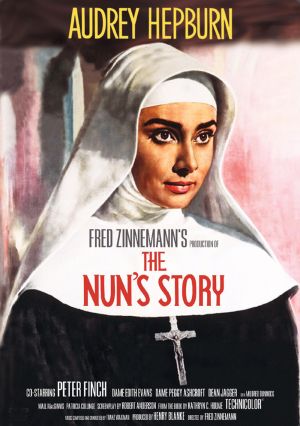
And, as a part of my own personal ritual, I washed my forehead before I left the church. Erin and I had a great vegetarian lunch at Cafe Brazil and then we came home and I turned on the TV and what should be finishing up on TCM but the 1959 best picture nominee, The Nun’s Story. Fortunately, I had already set the DVR to record The Nun’s Story and so, on this most Catholic of days, I was able to watch this most Catholic of best picture nominees.
The Nun’s Story tells the story of Gaby (Audrey Hepburn), the daughter of a famous Belgian doctor (Dean Jagger). At the start of the film, Gaby has entered a convent because she wants to become a missionary nursing sister in the Belgian Congo. However, before Gaby can go to the Congo, she has to learn to give up her own rebellious streak and individual independence. Taking the name Sister Luke, she excels at her medical training but, because it is felt that she is still too independently minded, she is not sent to the Congo but instead assigned to work in a mental hospital. It’s there that her independent streak nearly gets her killed when she is fooled by a dangerous patient who claims to be the Archangel Gabriel. It is only after she takes her final vows that Sister Luke is finally sent to the Congo and it is there that she’s forced to work with the abrasive agnostic Dr. Fortunati (Peter Finch). Of course, as Sister Luke goes through her own spiritual struggles, the world inches closer and closer to the start of a second world war. When war does break out, Sister Luke finds herself torn between her vow of obedience (which includes remaining political neutral) and the realities of living in a country that’s been occupied by the Nazis.
1959 was apparently a good year for religious films. Not only did Ben-Hur win best picture, but The Nun’s Story also received 8 nominations. Reportedly, The Nun’s Story was the most financially successful film to be released by Warner Bros, up to that point. If Wikipedia is to be believed, it was also Audrey Hepburn’s personal favorite of the many movies that she made.
When seen today, probably the first thing that people notice about The Nun’s Story is that it’s extremely long and occasionally rather slow. The film follows Gaby from the minute she enters the convent to the moment that she makes her final choice about whether to be obedient to herself or to her vows and, during that time, it examines every single detail of her life in glorious Technicolor. A lot of emphasis is put on the rituals that Sister Luke goes through on her way to taking her final vows. Now, if you’re like me, all of the rituals are fascinating to watch and produce a whole host of conflicting emotions. Even as I found myself admiring Sister Luke’s dedication and her sacrifice, I still kept wondering — much as she did — if it was all really worth giving up her independence. But, I also have to admit that I found myself wondering if someone from a Protestant background would feel the same way.
To a certain extent, I really hate to say that you probably have to come from a Catholic background to truly enjoy any film. But I certainly think that’s the case with The Nun’s Story. But, even Protestants and skeptics will appreciate Audrey Hepburn’s wonderful lead performance. She keeps this film grounded and makes her mostly internal conflict of faith compelling. In a career that was full of great performance, this is one of Audrey’s best.

 Through the Shattered Lens