About halfway through 1974’s Airport 1975, Sid Caesar has one of the greatest lines in film history.
“The stewardess is flying the plane?”
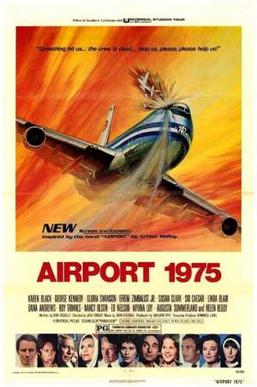
Hell yeah, she is! After a collision with another plane takes out the crew of a Broening 747, it’s up to head flight attendant Nancy (Karen Black) to keep the plane from crashing until another pilot can somehow be lowered into the cockpit of the stricken airliner. Nancy’s never flown an airplane before but she is dating Al Murdock (Charlton Heston), who may be scared of commitment but who is still described as being one of the greatest pilots who has ever lived. None other than Joe Patroni (George Kennedy) says that no one knows more about flying than Al Murdock.
George Kennedy is the only cast member to return from the original Airport. When we previously met Patroni, he was the cigar-chewing chief mechanic for Trans World Airlines. In Airport 1975, he’s suddenly an executive with Columbia Airlines. His wife (Susan Clark) and his son (Brian Morrison) are also on the plane. Joe Patroni and Al Murdock are determined to bring that plane safely to the ground in Salt Lake City and if that means dropping a pilot into the cockpit from a helicopter, that’s what they’ll do. It’s all a question of whether or not Nancy can keep that plane from crashing while they round up a helicopter and a pilot.
Airport 1975 is so famous for being the movie where the stewardess is flying the plane that it’s often overlooked that it’s also the film where Linda Blair plays a young girl in need of a kidney transplant. When Sister Ruth (Helen Reddy) sees that the girl has a guitar with her, Ruth sings a folk song that has everyone on the airplane smiling. (If I was on a plane and someone started playing folk music, I’d probably jump out. That may seem extreme but seriously, you don’t want to test me on how much I dislike the folk sound.) This scene was, of course, parodied in Airplane! In fact, it’s pretty much impossible to watch Airport 1975 without thinking about Airplane!
It’s also overlooked that Gloria Swanson is one of the many stars to appear in this film but Swanson is the only one playing herself. Gloria Swanson starts as Gloria Swanson and I assume that this 1974 film was set in 1975 in order to generate some suspense as to whether or not Swanson was going to survive the crash. Swanson talks about how, in 1919, Cecil B. DeMille flew her over California. She does not talk about Joseph Kennedy or Sunset Boulevard and that’s a shame. As I watched Airport 1975, I found myself thinking about how different the film would have been if Gloria Swanson had been the one who had to pilot the plane instead of Karen Black.
“Gloria Swanson is piloting the plane?”
As entertaining as that would have been, it would have meant missing out on Karen Black’s intense performance as Nancy. At times, Nancy seems to be so annoyed with the situation that one gets the feeling that she’s considering intentionally crashing the plane into one of Utah’s mountains. At other times, she seems to be at a strange sort of peace with whatever happens. There’s a scene where she attempts to clear some of the clutter in the cockpit and an instrument panel falls on her head and it’s such a powerful moment because I know the exact same thing would have happened to me in that situation. There’s another moment where I’m pretty sure she accidentally kills the first pilot who attempts to drop into the cockpit and again, it’s a mistake that anyone could have made. The film doesn’t call her out on it because the film understand that none of us are perfect, except for Charlton Heston.
Speaking of which, Karen Black’s emotional performance contrasts nicely with the performance of Charlton Heston. This is perhaps the most Hestonesque performance that Charlton Heston ever gave. Al Murdock is confident, he doesn’t suffer fools, and he’s condescending as Hell. Every time he calls Nancy “honey,” you’ll want to cringe. And yet, it’s hard not to appreciate someone who can be so confident while wearing a tight yellow turtleneck. Charlton Heston watches as the first pilot to attempt to enter the cockpit plunges to his death and immediately declares that it’s his turn to try. “Get me in that monkey suit!” he snaps and it’s such a Heston moment that you have to love it.
There’s a ton of people in this movie. Norman Fell, Jerry Stiller, and Conrad Janis play three rowdy drunks. Erik Estrada, Efrem Zimbalist, and Roy Thinnes are the unfortunate members of the flight crew. Dana Andrews has a heart attack while piloting a small private plane. Myrna Loy appears not as herself but as Mrs. Delvaney, who spends almost the entire flight drinking. Christopher Norris plays Bette, who says that she may look like a teenager but she prefers to be called “Ms. Teenager” and that she’s trained in Kung Fu. Beverly Garland played Dana Andrews’s wife. Larry Storch is an obnoxious reporter. Character actor Alan Fudge plays Danton, the Salt Lake City controller who keeps Nancy calm until Charlton Heston can start snapping at people.
The first time that I watched Airport 1975, I was pretty dismissive of it but, over the years, I’ve rewatched it a few times and I have to admit that I’ve fallen in love with this wonderfully ridiculous film. There’s just so many odd details, like American Graffiti showing up as the plane’s in-flirt entertainment and Sid Caesar saying that he’s only on the flight because he has a small role in the movie and he finally wanted to see it. (It seems like it would have been cheaper to just go to a drive-in but whatever.) And there’s Karen Black, giving the performance of a lifetime and letting us all know that, in 1975, the stewardess flies the airplane!
And she does a damn good job of it too!
 Through the Shattered Lens