October Hacks: Alice, Sweet Alice (dir by Alfred Sole)


Eh.  The 1976 film, Alice, Sweet Alice, is one of the few slasher films to have found critical acclaim and to have been seriously studied in the years after its release but I have to admit that it’s never done much for me.

It’s a film that takes place in 1961, in a Catholic neighborhood of Patterson, New Jersey.  It’s perhaps the ugliest setting of a film outside of Combat Shock The houses that we see are run-down.  The apartment building in which much of the action takes place is dirty and rat-infested.  Even the local church looks like it could use a bit of spring cleaning.  Of course, if you think the neighborhood looks ugly, you should see some of the people who live in it.  There’s really not anyone in this film who could be considered to be at all appealing.  Everyone’s either angry or disturbed or grotesquely obese or pervy.  It’s one of those films where everything is so dirty and sleazy that it’s hard not kind of laugh at it all.  John Waters could have worked wonders with this neighborhood but Alfred Sole, Alice’s director, seems to take his story just a little too seriously to give it the camp approach that it deserves.

(In fact, probably the only appealing sight in Alice, Sweet Alice is a picture of John F. Kennedy that is seen hanging in a few offices.  There’s a lot of not positive things that can be said about JFK but at least he was handsome.)

Anyway, the plot deals with Alice Spages (Paul Sheppard), an annoying twelve year-old sociopath who lives in the desolate apartment building and who enjoys tormenting people by putting on a Halloween mask and scaring them.  Alice is basically a bully but I think we’re supposed to sympathize with her because she’s rebelling against the suffocating hypocrisy all around her.  Again, whatever.  I was a brat when I was 12 years old too.

Alice’s younger sister, Karen (Brooke Shields, making her film debut), is as perfect as Alice is troublesome.  Everyone loves Karen, except for Alice who is obviously jealous.  On the day of her first communion, Karen is strangled to death by someone wearing a Halloween mask and a yellow raincoat, one that looks a lot like the one that Alice owns.  The killer steals Karen’s crucifix and tries to set the body on fire.  Father Tom (Rudolph Willrich) is annoyed that the ceremony has been interrupted.  Actually, it’s hard to think of a moment in this film in which Father Tom isn’t annoyed by something.

Did Alice murder her sister?  A lot of people think so, especially after other people who get on Alice’s nerves end up getting attacked.  Alice ends up getting sent to a mental hospital but, of course, Alice isn’t the murderer.  Who is the murderer?  No need for me to say.  If you watch the film, you’ll figure it out easily on your own.

Alice, Sweet Alice is often described as being an early slasher film.  If anything, it’s more of an American giallo, with the emphasis being on figuring out who is the killer behind the mask.  Many critics have praised Alice, Sweet Alice for its atmosphere and its anti-religious subtext but, to be honest, I’ve always found it to be kind of boring.  Part of the problem is that every character is so repulsive (physically, mentally, and morally) that it’s difficult to really care about whether or not they die or if they’re the guilty party.  Even Alice comes across like someone who is destined to start fires once she grows up.  None of the actors gives a good enough performance to hold your attention.  The film attempts to criticize the Church, as many giallo films did.  But one need only compare Alice Sweet Alice to other anti-clerical giallo films, like Lucio Fulci’s Don’t Torture A Duckling or Aldo Lado’s Who Saw Her Die? , to see how simplistic and superficial Alice, Sweet Alice‘s approach really is.

Anyway, a lot of people will disagree with this review and that’s fine.  Some films work for some people while failing to work for others and, in this case, Alice Sweet Alice is just a film that does not work for me.  Que sera sera.

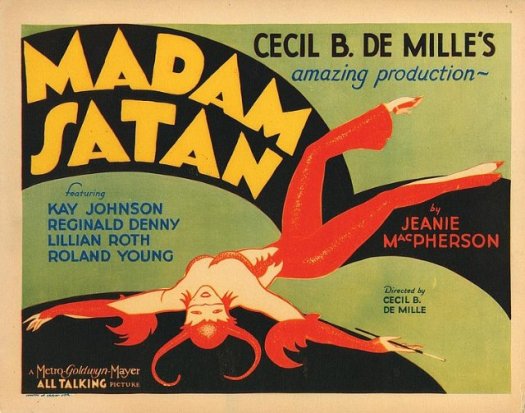
Cecil B. DeMented: MADAM SATAN (MGM 1930)


gary loggins's avatarcracked rear viewer

It’s wild! It’s weird! It’s Cecil B. DeMille’s  MADAM SATAN, a movie I’ve heard about for decades, but never had the chance to catch, until now. It’s got a little something for everybody, from drama to comedy to musical numbers to half-naked women to jazz baby Lillian Roth! Was it worth the wait, Dear Readers? Well… read on!

Better hold on to your seats though, as MADAM SATAN shifts abruptly in tone throughout it’s running time. It’s slow going the first few minutes, starting out as a stiff drawing-room drama. Angela Brooks (Kay Johnson) is worried about her dissipating  marriage to Bob, who neglects her and stays out all night. Now here comes comedy, with Bob (Reginald Denny ) and his pal Jimmy (Roland Young) trying to sneak in at dawn, two wasted wastrels drunk as the proverbial skunks. Suddenly, out of nowhere, the maid (Elsa Peterson) breaks out…

View original post 542 more words

Lisa Reviews An Oscar Nominee: The Love Parade (dir by Ernst Lubitsch)


Love_Parade

Recently, as a part of TCM’s 31 Days of Oscar, I watched the 1929 musical The Love Parade.

Now, I have to admit that this was one of those movies that I started watching with a lot of pre-conceived notions.  While I happen to enjoy movies from all eras, I sometimes have a hard time adjusting to the style of the films that were made in the early days of the sound era.  Often times, it’s obvious that these films were made by directors and actors who were still struggling to make the transition from silent to sound cinema.  As a result, it’s not uncommon for films of this era to come across as being stiff and stagey.

But I needn’t have worried.  While The Love Parade does have its occasionally stagey moments, it actually holds up remarkably well.  For a film that was made 89 years ago, The Love Parade is still a lot of fun and surprisingly entertaining.  It helps, of course, that The Love Parade was made before the adoption of the infamous Production Code and, as such, it’s allowed to show off a racy sense of humor that keeps the film from feeling too dated.

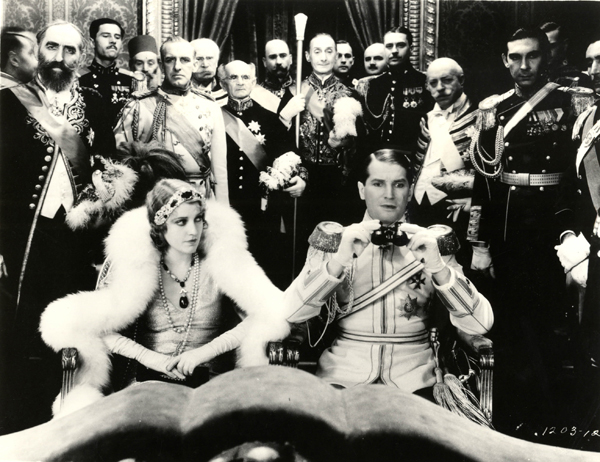
As for the film itself, it deals with Queen Louise (Jeanette MacDonald), the young ruler of the European kingdom of Sylvania.  Despite the fact that Louise is a capable ruler, her subjects worry that she has yet to get married.  When her advisors inform her that she is running the risk of never marrying, Louise dismisses their concerns in a very Pre-Code way.  She lifts up her skirt, shows off her left leg, and says that there’s only one other leg as perfect as her left leg.  She then extends her right leg.  Since I basically do the same thing every single day, that was the moment when I realized that she might be the Queen and I might just be an outspoken redhead but I could still totally relate to Louise.

After showing off her legs, Louise deals with the issue of Count Alfred (Maurice Chevalier), a diplomat at Sylvania’s Paris embassy.  Apparently, Alfred ended up having an affair with every woman at the embassy (including the ambassador’s wife) and he has been recalled to Sylvania.  After reading the details of his sexual exploits, Louise decided that she has to meet Alfred for herself.

(And again, we’re reminded that this is a Pre-Code film.)

Alfred and Louise meet, fall in love, and marry.  However, Alfred has a hard time dealing with the fact that, as Queen, Louise has all the power in their marriage.  Even his attempts to draw up an economic plan are dismissed by the Queen’s advisors.  Feeling emasculated, Alfred sings a song called Nobody’s Using It Now.

Three guess what “it” is.

Can this marriage be saved?  Louise’s maid (Lillian Roth) and Alfred’s servant (Lupino Lane) are determined to make sure that it can be!

If the plot description and my review of The Love Parade sounds in any way similar to my review of The Smiling Lieutenant, that’s because both films were directed by Ernst Lubitsch.  In fact, The Love Parade was Lubitsch’s first sound film and, in many ways, his assured direction here played a huge role in helping Hollywood make the transition from the silents to the talkies.  Both Jeanette MacDonald and Maurice Chevalier give assured (and sexy) performances that hold up well today and the film’s opulent sets and costumes remain a visual delight.  The end result feels like a wonderfully entertaining fairy tale.

The Love Parade was nominated for best picture but it lost to the far more grim All Quiet On The Western Front.  But, regardless of what awards it won or did not win, The Love Parade is a delightful little film that works both as a historical document and a terrifically entertaining musical comedy.