Anime You Should Be Watching: That Time I Got Reincarnated as a Slime (Tensei Shitara Suraimu Datta Ken)


“If I happen to die because of this, get rid of my PC.” — Satoru Mikami

That Time I Got Reincarnated as a Slime (Tensei Shitara Suraimu Datta Ken or just Tensura) is one of those anime that sounds ridiculous until you actually watch it—and then it wins you over completely. At first glance, it looks like just another overpowered-protagonist isekai: an average guy dies, wakes up in a fantasy world, and immediately breaks every rule of balance by becoming borderline divine. But the secret of Slime is that it plays the genre cliché knowingly, twists it in clever ways, and wraps it around a surprisingly heartfelt story about kindness, leadership, and how to build a community from the ground up. Adapted from the smash-hit light novel series by Fuse, this anime manages to blend humor, politics, action, and emotional sincerity into something both epic and easy to love.

The plot starts simply enough. Satoru Mikami, a 37-year-old office worker in Tokyo, leads an unremarkable life—no family, no glory, just gray daily routine. When he’s stabbed while saving a coworker from an attack, his story seems over. But in those final moments, a disembodied voice (which fans will come to know as the “Great Sage”) grants him strange abilities based on his dying wishes—resist pain, store knowledge, devour anything—and rebirths him in another world. Only there’s a catch: he’s not reborn as a mighty warrior or a handsome prince—he’s a slime. A small, bouncy, blue blob.

And that’s the brilliance of Slime. Right from the start, it refuses to take itself too seriously. Satoru—now officially calling himself Rimuru Tempest—reacts to his new form with more curiosity than despair. He experiments with his strange “Predator” skill, realizing he can absorb monsters, materials, and abilities. What could have been a story about survival quickly becomes something much more strategic and creative. Rimuru uses his curiosity and intelligence—his distinctly human mindset—to adapt and thrive. Rather than treating this world like his personal video game playground, he studies how it works, learns its rules, and decides to reshape it with compassion instead of domination.

The premise is standard isekai dressing, but the execution sets it apart. Instead of endless dungeon fights or brooding antiheroes, Rimuru’s first big win is domestic: helping a desperate goblin tribe survive by organizing them into an early community. That act of leadership kickstarts the show’s core theme—world-building not just in the literal sense, but in the moral one. Rimuru’s journey isn’t just “how strong can I get?” It’s “how can I make life better for everyone who trusts me?”

Season 1 captures this beautifully. It’s full of warmth, humor, and charm, balancing genuine emotional stakes with endlessly creative fantasy world-building. Each new episode adds another layer: goblins evolve, wolves unite, ogres become loyal allies, and soon Rimuru’s little settlement turns into the thriving “Tempest Federation.” Watching this society grow feels oddly satisfying—like SimCity mixed with The Lord of the Rings. Rimuru’s mix of modern knowledge and genuine empathy makes him an ideal leader, not because he’s undefeatable, but because he listens. And yes, he is overpowered—but his strength never alienates him from others. Instead, it’s his compassion that keeps everyone orbiting around him.

Then Season 2 hits, and that’s where Slime surprises anyone who thought it was just a feel-good story. Without spoiling any major turns, the narrative expands dramatically, weaving in politics, moral conflict, and real emotional stakes. We see the pressures that come with leadership—and that building a nation means dealing with jealousy, greed, and betrayal from other powers. Rimuru faces choices that test his entire philosophy: when kindness clashes with survival, which wins? It’s during this stretch that Slime truly proves it’s not all fluff. It’s not afraid to explore tragedy, anger, and questions of responsibility while still maintaining that core optimism. The emotional moments hit harder precisely because the first season was so upbeat—when darkness strikes, it matters.

By Season 3, the show evolves from a fun fantasy romp into full-blown epic world-building. The stage grows larger as Tempest becomes recognized as a power equal to human nations and even the Demon Lords themselves. The scale of the story starts to echo grand political and military dramas, yet Slime never loses its charm or humor. New characters arrive, alliances form, and the world Fuse created in the light novels starts unfolding in earnest, rich with lore and history. The storytelling becomes more intricate, drawing on themes of diplomacy, governance, and the tension between peace and power. Rimuru, now balancing the weight of nations, remains empathetic, even as he stands toe-to-toe with gods and demons. The anime’s pacing gets sharper in these seasons—the stakes feel higher, but every step still connects back to Rimuru’s original dream of coexistence.

What’s striking is how Slime manages to mature without losing its brightness. Other isekai get darker as they grow “serious,” but Slime earns that depth while keeping its warm soul intact. You still get the lovable banter, the laugh-out-loud humor, and the chaotic cooking incidents with Shion’s questionable meals—but now those lighthearted scenes are contrasted by moments of real tension, making the highs and lows hit harder. It’s a tonal balance most anime fumble, but this one handles gracefully.

Credit where it’s due: Studio Eight Bit deserves massive praise for consistency. Across multiple seasons, the animation remains vibrant, colorful, and fluid. Rimuru’s slime form has this elastic motion that never stops being oddly satisfying to watch, while the battle choreography builds steadily in intensity. The later large-scale fights—especially those involving entire armies—carry real cinematic weight, made possible by polished direction and careful scaling of power levels. And yet, some of the most memorable sequences aren’t the battles at all—they’re moments of world expansion, where the show slows down to reveal a new nation, a festival, or a simple shared meal. The world feels tangible, lived-in, and surprisingly peaceful when it needs to be.

The voice acting is equally excellent. Miho Okasaki’s performance as Rimuru captures the rare balance of leadership and levity—cool-headed yet warm, curious yet confident. Other standouts like M.A.O. as Shion and Makoto Furukawa as Benimaru bring distinctive energy to their roles, adding emotion even to comedic exchanges. The soundtrack enhances everything—rousing orchestral pieces for the grand battles, gentle piano and flute motifs for Tempest’s everyday life. The music, like the story itself, isn’t just about big moments; it’s there to remind you of what’s worth protecting.

Where the series really shines, though, is in how it redefines heroism. Rimuru isn’t a lone knight, a destined savior, or a man on a revenge mission. He’s a builder. He wins through collaboration, understanding, and logic as much as through magic or might. That makes him one of the most endearing protagonists in contemporary anime—a soft-spoken optimist who’d rather talk his way to peace than fight needlessly, but who won’t hesitate to defend what matters when push comes to shove. His brand of leadership feels quietly revolutionary, showing strength through empathy rather than ego. That’s the underlying hook of Slime: it’s power fantasy done with heart.

Supporting characters thrive within that dynamic. Shion’s unfiltered enthusiasm, Benimaru’s steady confidence, Shuna’s intelligence and warmth—each plays a vivid role in making Tempest feel like a real, breathing community. Even the side characters grow, gaining new depth as the seasons roll on. By the time you reach Season 3, the relationships built from earlier episodes pay off emotionally. Tempest doesn’t just survive because Rimuru’s strong—it endures because everyone around him shares his vision.

And just when it feels like the story has covered everything, the best news arrives: there’s much more coming. A massive fourth season has already been announced, set to include 60-plus episodes—one of the largest season plans in recent anime memory. This next arc is expected to dive deep into the light novels’ later storylines, some of the most complex and thematically rich in Fuse’s entire saga. Fans can expect broader conflicts, new continents, cosmic-level stakes, and a deeper dive into the philosophical questions the anime hints at. If Seasons 1 through 3 show Rimuru learning how to rule, Season 4 promises to show what it truly means—to lead, to balance ideals and pragmatism, and to face the cost of utopia head-on.

What’s most exciting is that the groundwork is already there. The anime’s consistent quality, expanding world, and loyal fanbase suggest that these upcoming arcs could elevate it into one of the great long-form fantasy anime—something closer to a serialized epic than a simple adventure. It’s rare for an anime adaptation to not just match its light novel source material but to build upon it visually and emotionally, and Slime continues to do exactly that.

So, why call That Time I Got Reincarnated as a Slime a must-watch? Because it does what few modern fantasy anime manage—it believes in its own heart. It’s smart without being cynical, hopeful without being naive, and endlessly entertaining while still exploring meaningful ideas about leadership, identity, and what it means to build something lasting. Rimuru’s world might be made of magic and myth, but his struggles and principles feel deeply human. Every season expands that truth in new directions, and the best part is, the story isn’t even close to over.

Whether you’re a long-time anime fan or someone looking for a genuinely uplifting escape, this series is pure comfort with real depth—a rare blend of world-building, intelligence, and soul. If you’ve overlooked it before because of its funny title, now’s the perfect time to dive in. With a massive new season on the horizon and Rimuru’s journey only getting grander, That Time I Got Reincarnated as a Slime isn’t just an isekai success story—it’s growing into one of the defining fantasy epics of this generation.

Anime You Should Be Watching: Gate


I don’t know about anyone else, but when I was a kid, teen, young adult, and now older adult, I’d often fantasize about being able to go back in time with a modern military and just be some kind of unstoppable juggernaut.  Imagine bringing a machine gun to the Revolutionary War, or even a trained sniper squad capable of picking off the enemy generals the minute they peeked their heads out of a door.  Well, what if a portal appeared in the middle of New York City and out poured an army, comprised of fantasy blend medieval times soldiers (orcs and dragons along with humans, but only armed with swords and shields and bows and arrows)?  No doubt there would be a good amount of civilian deaths in the first chaotic moments, but when the national guard would be mobilized, there’s little doubt that it would be a complete rout.  This is more or less the idea behind Gate, which came out in the later half of 2015.

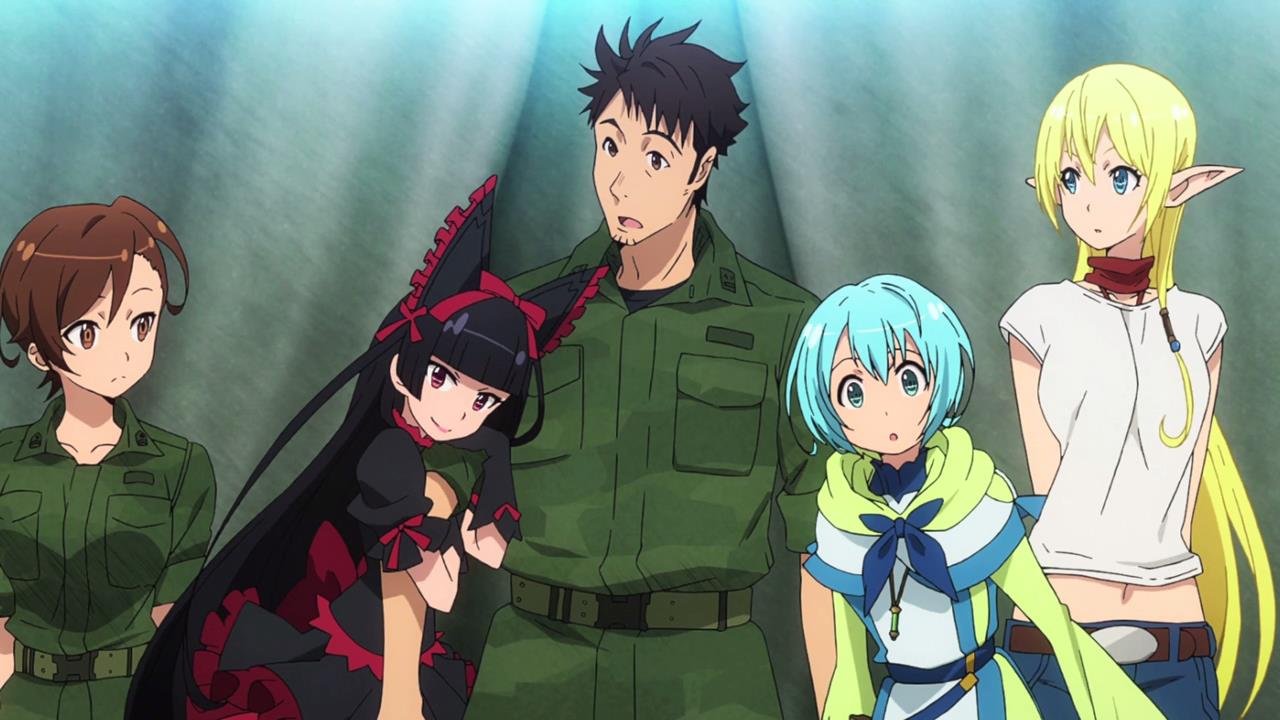
gateThis is very much a “wouldn’t it be cool if…” sort of anime.  You just need look no further than the protagonist, Yoji Itami.  Our first encounter with him makes us believe that he’s your average, everyday otaku, in Ginza for a doujinshi event when the portal opens and the army from another world appears.  But he’s obviously more than your average otaku, because while everyone else is panicking, he more or less takes control and directs the civilians on where to go and tells the police pretty much how to do their jobs, even going so far as to kill one of the enemy soldiers in hand to hand combat.  We soon find out that he is an JSDF officer (Japan Self Defense Force, think National Guard because Japan hasn’t technically been allowed to have a military since WWII) and through the course of the show we find out that not only is this slacker a soldier, but he’s also gone through Ranger and Special Forces training.

Japan sends approximately a brigade sized force through the gate to the other side, where they set up their base.  Naturally, the native forces do not fully comprehend just how much a disadvantage they’re at until the Battle of Arnus Hill.

http://www.youtube.com/watch?v=RjLuYDf-VAY

Following this slaughter, Japan proceeds to set up shop, and because they’re Japan and not the US, Russia, or China (these three nations are also shown here, as less than noble as one would expect from a show made in Japan) instead of moving to conquer the region, they strive to win the hearts and minds of the populace and seek a peaceful solution to the situation that the Empire has brought upon itself.  Needless to say, the Empire doesn’t exactly want to admit they’re beat and it takes many more displays of overwhelming might before they realize that they’ve made an enemy of a force that they just can’t win against.

Now, this would hardly be a “Wouldn’t it be cool if…” scenario unless the main guy was fawned over by half the females in the land, and sure enough he gets his harem in short order.  First him and his squad rescue an elf girl, Tuka Luna Marceau, whose village was wiped out by a Fire Dragon.  Immediately after he meets up with a young female mage, Lelei La Lelena, and then an immortal female demigod of war, Rory Mercury, who happens to have essentially stopped aging at the age of 16 or so.  She also seems to be the favorite girl for people to cosplay as, possibly because of her affinity to dress in gothic lolita clothes, and also because she’s just plain badass.  Later on his harem adds a dark elf and even a princess from the Empire, in addition to many lesser characters who are more than happy to fawn over him.  For the most part, while he’s not unaware of their interest in him, he is fairly ambivalent towards  their affections.

What really makes this show tick though is that while yes, it kind of is a love letter to the JSDF, and its primary purpose is to show off all manner of military hardware, there’s also a lot of political machinations going on behind the scenes.  A lot of it is showing how the Japanese bureaucracy can make even simple decisions take far longer than it should, although that is a problem with any sort of government really.  But it also shows how the rest of the major powers in the world, in this case the US, Russia, and China, would react if a country like Japan were to come across a vast, untapped resource like this world that can easily be dominated with our modern military might.  They were all too happy to let Japan test the waters and cross the gate first, but once it was found out that they were fighting bows and arrows with Abrams and Cobras, they too wanted to try and get a piece of the action.  The show is 75% military and 25% political, which gives it plenty of action, with some intellectual maneuvering thrown in to keep it all interesting.

Even though I enjoyed quite a bit of it, it does still have its faults.  Like 90% of all anime produced these days, it does suffer from the lack of a real ending.  It’s based on an ongoing series of light novels written by Takumi Yanai, so the ending is basically “Do you want to see more?  Maybe we’ll have another season, but otherwise go read the light novels!”  I’ve long come to accept that this is the way of the industry, but it still leaves you feeling unsatisfied.  Many of the plot threads that were left unresolved probably are being wrapped up as the light novels are written, but that doesn’t really help with the anime, which just kinda swept them under the rug and hoped you forgot about them.  There are also a few scenes that could very well creep some people out, most notably where a 12 year old noble girl becomes infatuated with one of the Japanese diplomats, and during the civil war in order to save her, he announces that she is his fiance, then continues to announce that he fully plans to marry her when she turns 16 (the age at which girls can marry without restriction in Japan).  It’s not being forced on her since she had long been saying she wanted to marry him, but it still reeks too much of otaku wish fulfillment and trying to appease the lolicon crowd.  I don’t have a huge problem with it since it’s all fictional, but it just seemed a bit unnecessary to me, and the story could have advanced just as easily if she were already of age.  It also tends to over glamorize the Japanese SDF, making them out to be nothing but the most humane people in the world.  Well, except when they’re slaughtering their enemies.  It’s kind of understandable, since Yanai is a former JSDF member, but it still kind of comes off as ignoring the faults of any military organization and making them out to be infallible knights of justice.

Still, at the end of the day, it left me wanting to watch more.  The likelihood of more anime being produced is probably low, while it did get a 24 episode run, the disc sales were decent but not stellar.  Unless it’s determined that the light novel sales could be boosted by another season, I don’t expect to get to see more of this in animated form.  Which is a shame, because it deserves a proper ending to one of the more interesting shows to come out in recent years.

Best anime of 2014


Arleigh has pointed something very important out to me.  I have been drinking a lot, and the end of the year is nearing.  (EDIT- I started this post on December 28th, and proceeded to get too drunk to continue.  Then I forgot I had started it, got drunk several more times, and now on January 5th, I remembered it and am proceeding to get drunk again, so perfect time to actually finish this)  Pretty much the best time I can think of to make one of my few posts this year.  Again, one thing I should point out is that this year there were 149 series released, and I only watched 44 series.  Basically, no one other than the biggest loser on earth could have possibly watched every single series released each year.  If you know of anyone going by the name of Ryan Saotome, he’s one of those losers.  Punch him one for me.  But, I like to think that I have pretty good taste, and those 44 I watched were the cream of the crop.  So of those best of the best, the best that I’ve watched was easily a series that came out this spring, a title by the name of No Game, No Life.

No game no lifeThis show is pretty much an otaku dream.  The basic premise is that “siblings” (I’m not 100% sure that they actually are related) Shiro and Sora are a couple of hikikomori, which are basically shut ins who don’t associate with other people, and they are the best gamers out there going by the nickname Blank.  Blank is infamous in the online community because no matter what, they never lose.  One day they get an invitation to play a game of chess.  Naturally they win, although they have to struggle to actually do so.  Upon winning, they are warped to the land of Disboard, where the God of that world, Tet, has decreed that all war is abolished and all conflicts between the races will be resolved via games.  They quickly become rulers of the weakest faction in the world, humans, and set about to challenge all the races and eventually challenge God himself.

This is based on an ongoing light novel series, incidentally written by a native born Brazilian/Japanese, Yuu Kamiya real name Thiago Furukawa Lucas.  Generally speaking, non-native Japanese do not find a lot of success in the Japanese light novel/manga/anime scene, so the fact that this has been highly popular speaks volumes about how well written it is.  The anime sticks quite closely to the light novel, which works great for this first season, since there’s enough source material to cover it.  Perhaps this means that any future anime adaptations will have to wait, or won’t be as good, but since most anime these days are basically just advertisements for the light novels/manga, I suspect that they won’t be in a rush to adapt more until either there’s more source material, or the light novel’s sales start to slip.  Still, with it moving on average over 6,000 BDs per volume (and unlike in the US and other countries, Japan tends to only have 2 episodes per volume even with BDs so an average 13 episode series will still have 6 volumes) that’s showing there’s enough money out there to support a second season easily.  I don’t follow light novel releases in Japan, because I can’t read Japanese, so I’m not sure what the sales were like prior to the anime showing, but I do know that for the year the releases averaged over 140,000 per volume, for 6 volumes, which is a pretty decent amount of sales.  Combine that with the BD sales, and it’s pretty likely that the light novels got a decent boost, and so a second season is highly likely.

But what about this series makes it work?  Well, first off, it’s insanely cute.  We all know that Japan does cute better than anyone, but this just strikes a chord with even me, who has seen more cute than you can shake a stick full of kittens at.  How cute is cute?  Well, in a scene near the end, when the duo is panicking over thinking they’ve been transported to the real world (something hikikomori dread more than anything) Shiro is at her most adorable. SoraNo one can tell me that isn’t super adorable.  You can try, you are wrong.

It also has one of the catchiest ending themes of the year.

http://www.youtube.com/watch?v=cMUp67-XI34

Some of my favorite moments in the series come at the expense of Stephanie Dola.  Prior to Shiro and Sora’s arrival in Disboard, she is attempting to be the representative of humanity, but she is inexperienced in the way of games and can’t see when an opponent is cheating, nor can she overcome that.  Her naivety leads Shiro to basically begin using her name as an insult, calling her “Such a Steph”.  She is constantly being somewhat humiliated by Shiro and Sora, but it never really and truly comes across as malicious.  They do embarrass her often, but it seems more like they’re doing it to try and cure her of her naivety and teach her how to become a better ruler of humanity for when they either inevitably become the gods of the world, or return to their world.

Even though you know that Shiro and Sora are going to win (the heroes almost always win, especially in shows like this) the suspense and intrigue isn’t with the if, but the how.  Their fight against the Werebeasts showed that even if they’re going to win, it was going to be tough, and most importantly, it wasn’t a bullshit type of win.  It was certainly a come from behind, wow I didn’t see that coming, kind of win, but once it was explained, it makes good sense.  The fact that the series ends on a major cliffhanger, to me all but assures there being a second season, but since I’m not currently in charge of Japan, and me and Japan don’t always agree upon what makes perfect sense, we shall see.

In all actuality, this was another good year for anime.  Anyone saying that anime was better in the 90’s is a crazy person.  It only seemed that way because anime was fairly new here, and so licensors were cherry picking titles.  These days we get damn near everything, either through streaming, or through physical releases, so naturally there’s gonna be a lot more average titles, and a lot more stinkers.  There has never been a better time to be an anime fan than now, and for 2o14, I say the best thing you could do is sit down and watch No Game No Life.  Here’s to looking forward to what 2015 brings us, and I hope that I have a ton of must watch anime to think about writing about (but ultimately never do) in the coming year!

Anime of the Day: Toradora!


The latest entry for Anime of the Day is the romantic comedy from Japanese animation studio J.C. Staff. I am talking about the quite popular anime series which had a 25-episode run in Japan’s TV Tokyo from October 2008 and March 2009. The series is Toradora! and is based on the light novel and manga by Takemiya Yuyuko.

This series is a romantic comedy and also one that is full of well-done drama. It’s an anime about relationships and stars two very atypical leads in Takasu Ryuji and Aisaka Taiga. Ryuji is the misunderstood highschool boy whose squinty eyes has labeled him a thuggish, criminal-type which causes some hilarious reactions from classmates and teachers both. Taiga is the doll-like tsudere-type who manages to scare everyone in her school due to her quick temper and improbable strong attacks. The two end up accidentally bumping into each other in the first day of classes and hilarity ensues from there.

Other characters such as Taiga’s friend Minorin (the weird, ditzy girl) and Ryuji’s best friend Kitamura Yusaku also lend their own personalities and relationship issues to the mix which ends up complication everyone else’s hook-ups. There’s also the kyuugere character in Kawashima Ami who is Yusaku’s very beautiful childhood friend whose attempt to hook-up with Ryuji causes other relationship complications which doesn’t untangle itself until very close to the end of the series.

Toradora! looks like the typical romantic comedy at first glance, but as one gets deeper into the series deeper layers in how the characters behave and their motivations for their earlier behaviors shine through. The comedy in the series actually begins to take a backseat to the complex romances in the show. We know from the beginning who should end up with who, but the journey the characters take to finally get to where they need to be in the end is the high point in the show.

For people new to anime this series is actually a very good starting point in the romantic-comedy genre as it takes the subject matter seriously and doesn’t pander to the usual easy hook of ecchi scenes and over-the-top comedy.