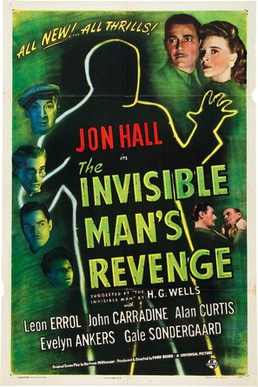
Horror Film Review: The Invisible Man’s Revenge (dir by Ford Beebe)


1944’s The Invisible Man’s Revenge opens with Robert Griffin (Jon Hall) arriving in England.

Despite his last name and the fact that he’s played by the star of Invisible Agent, this Robert Griffin would not appear to be in any way related to the previous invisible men.  Instead, he is someone who has just escaped from a mental institution in South Africa.  He has already murdered two orderlies and now, he’s come to England to take vengeance on Sir Jasper Herrick (Lester Matthews) and his wife, Lady Irene (Gale Sondergaard), two old friends who the paranoid Robert thinks tried to kill him in Africa so that they could steal his money.  When Robert sees Sir Jasper and Lady Irene, he informs them that they can either give him half of their fortune or they can allow him to marry their daughter, Julie (Evelyn Ankers).  Lady Irene responds by drugging Robert and having him kicked out of the house.

Dejected, Robert eventually comes across the cottage of Dr. Peter Drury (John Carradine, giving a surprisingly low-key performance in the mad scientist role).  Dr. Drury reveals to Robert that he has developed a serum that can turn living things invisible.  Drury goes on to “show” Robert all of the invisible pets that he has hanging out around the cottage, from an invisible dog to an invisible parrot.  When Robert asks how long the invisibility lasts, Drury says that it will last until the invisible person dies.  That sounds pretty good to Robert so he volunteers to be Drury’s latest test subject.

Soon, Robert is invisible and going out of his way to haunt that Herrick family.  Some of Robert’s antics are merely playful.  He helps a cobbler (Leon Errol) win a game of darts and later turns the man into his personal servant.  Robert’s other actions are a bit more destructive.  Robert, after all, was a murderer to begin with and using a serum that cause additional insanity is definitely not helping him with his temper.  When Robert decides that he wants to be visible again, he discovers that there’s only one temporary way to do it and it involves a lot of blood.

After being portrayed as being a hero in Invisible Agent, The Invisible Man is once again a villain in The Invisible Man’s Revenge and it just feels right.  There’s just something inherently sinister about the idea of someone being invisible.  Jon Hall, who was so boring in Invisible Agent, is far more compelling here, playing Robert as a paranoid megalomaniac who has so convinced himself of his own cleverness that he can’t even understand that he’s writing the script for his own downfall.  This is a good, solid Universal horror movie.  The true hero of the movie is Drury’s dog, played by a talented canine actor named Grey Shadow.  It takes more than invisibility to fool that dog!
Previous Universal Horror Reviews:

  1. Dracula (1931)
  2. Dracula (Spanish Language Version) (1931)
  3. Frankenstein (1931)
  4. Island of Lost Souls (1932)
  5. The Mummy (1932)
  6. The Invisible Man (1933)
  7. The Bride of Frankenstein (1935)
  8. Dracula’s Daughter (1936)
  9. Son of Frankenstein (1939)
  10. The Invisible Man Returns (1940)
  11. The Wolf Man (1941)
  12. Ghost of Frankenstein (1942)
  13. Invisible Agent (1942)
  14. Frankenstein Meets The Wolf Man (1943)
  15. Son of Dracula (1943)
  16. House of Frankenstein (1944)
  17. House of Dracula (1945) 
  18. Creature From The Black Lagoon (1954)

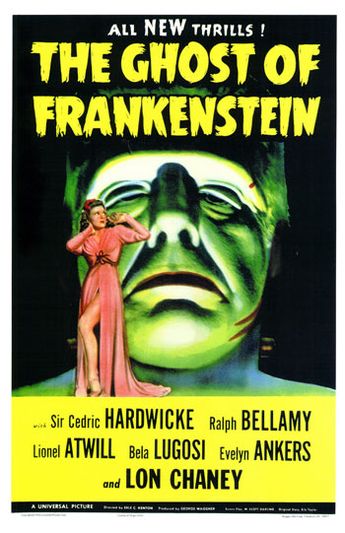
Horror Film Review: The Ghost of Frankenstein (dir by Erle C. Kenton)


the_ghost_of_frankenstein_movie_poster

In 1942, three years after Son of Frankenstein, Universal Pictures continued the story of the Frankenstein family with The Ghost of Frankenstein!

However, The Ghost of Frankenstein was a far different film from the three that came before it.  The budget was lower.  The story was less complicated.  The running time was much shorter.  Whereas the previous films in the franchise clearly took place in Germany, the setting for The Ghost of Frankenstein is less easily defined.  (Considering that the film was made during World War II, this isn’t surprising.)  The biggest change is that, in The Ghost of Frankenstein, the monster is not played by Boris Karloff.  Instead, the role is taken by Lon Chaney, Jr.  Chaney’s hulking frame was perfect for the monster but his face is never as expressive as Karloff’s.  Whereas Karloff turned the monster into as much of a victim as a victimizer, Chaney plays the monster like a … well, a monster.

Returning from Son of Frankenstein, Bela Lugosi is back as Ygor.  At the start of the film, we learn that Ygor actually wasn’t killed at the end of Son of Frankenstein.  Instead, he was just wounded.  He’s spent the last few years hiding out in the old castle, trying to once again revive the monster.  When the villagers attempts to blow up the castle, he and the monster flee.

It turns out that there’s one other Frankenstein son.  His name is Ludwig and he’s played by a very dignified Sir Cedric Hardwicke.  Ludwig, who has been hiding his identity and denying the family legacy, has a successful medical practice in another village.  Working with his assistants, Dr. Kettering (Barton Yarbrough) and the bitterly jealous Dr. Bohmer (Lionel Atwill, who played a far different role in Son of Frankenstein), Ludwig has developed a procedure in which a damaged brain can be removed from the skull, repaired, and then stuck back inside the skull…

Uhmmm … wow, I have no idea what to say about that.  That’s quite a medical breakthrough, though…

When Ygor and the monster show up in the village, searching for Ludwig, the monster ends up getting arrested.  The local prosecutor (played by Ralph Bellamy, Cary Grant’s romantic rival in both The Awful Truth and His Girl Friday) asks Ludwig to examine the prisoner.  Ludwig is shocked to discover that the prisoner is his father’s creation!

Ygor wants Ludwig to perform a brain transplant on the Monster.  At first, Ludwig is hesitant but then he’s visited by Henry Frankenstein’s ghost.  (Since Colin Clive died 5 years before Ghost of Frankenstein went into production, Hardwicke plays both Ludwig and Henry.)  The ghost asks Ludwig to perfect the monster.

Ludwig finally relents and agrees to give the monster a new brain.  Ludwig wants to use the brain of kindly colleague but Ygor has different plans…

The Ghost of Frankenstein is only 67 minutes long but, oddly, it still feels just a little bit draggy.  Director Erle C. Kenton does a workmanlike job but, at no point, does Ghost feature the wit that distinguished James Whale’s films or Rowland V. Lee’s work on Son of Frankenstein.  Chaney is not a particularly interesting monster but Bela Lugosi is a lot of fun as Ygor.  With Chaney showing even less emotion than he usually did and Hardwicke appearing to be occasionally embarrassed by the whole film, it falls to Lugosi to keep the audience awake and he manages to do just that.  Lugosi’s performance may be overly theatrical but that’s exactly what The Ghost of Frankenstein needed.

The Ghost of Frankenstein is occasionally entertaining but ultimately forgettable.  It’ll best be enjoyed by Universal horror completists.