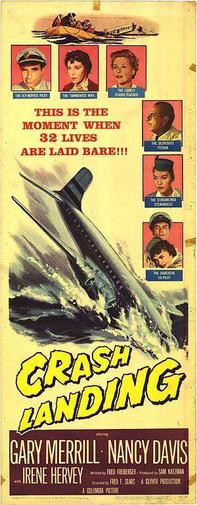
Crash Landing (1958, directed by Fred F. Sears)


Flying from Lisbon to New York City, a commercial airline is flying over the ocean when two of its engines fail.  When the propellers fail to restart, Captain Steve Williams (Gary Merrill) realizes that he will have to land the plane in the ocean.  The Navy is standing by to rescue the passengers.  It’s just a question of whether or not Steve and his crew can land the plane without injuring the passengers or causing the plan to break in half.

This is a disaster film that doesn’t really have a disaster.  The members of the crew all work professionally and efficiently to make sure that the landing is a success, even though none of them have ever had to ditch a plane before.  The Navy shows up on time and ready to help.  With one exception, the passengers react calmly and do what they’re told.  An Orthodox priest prays for the plane.  The flight attendants neatly pack all of the kitchen utensils.  The only drama comes from a boy who is traveling with his dog Wilbur and is upset to hear that Wilbur will have to stay in the back of the plane, where he will probably drown.  The boy’s father says, “I’ll buy you a new dog,” and the boy asks that his baseball cap be placed by Wilbur’s cage so that Wilbur knows his owner was thinking of him.  Don’t worry kid!  Steve Williams isn’t going to let your dog die.

It’s strange to see a disaster film without any real drama.  The crew thinks that Williams can be overbearing but it turns out he knows what he’s doing.  At home, his wife (Nancy Davis, in her final film role) thinks that Steve is too hard on their son.  Their son is going to grow up knowing how to land airplanes in water.  This is almost the Sully origin story.  Otherwise, the film emphasizes the way that everyone works together and doesn’t panic.  The scene where the plane lands in the water features some good special effects but otherwise, the movie is pretty dull.  It could have used Leslie Nielsen and Peter Graves.

Actress Nancy Davis retired from movies after this one but she remained in the public eye as the wife of future President Ronald Reagan.

Star in the Dust (1956, directed by Charles F. Haas)


The time is the late 1800s and the place is the town of Gunlock.  Gunlock is split between the ranchers and the farmers, with the ranchers eager to buy all of the land around the town and the farmers refusing to sell.  Trying to keep the peace is Sheriff Bill Jorden (John Agar), who not only wants to keep war from breaking out in Gunlock but who also wants to live up to the example of his legendary father.

There’s a prisoner in the Gunlock city jail.  Sam Hall (Richard Boone) is a notorious gunman who has been convicted of killing three farmers.  He’s due to hang at sunset but everyone in town believes that Sam will somehow escape the executioner.  (They’re even taking bets down at the local saloon and casino.)  Everyone knows that Sam was hired by the ranchers but Sam has yet to name which rancher specifically invited him to come to town.  The farmers want to lynch Sam.  The ranchers want to break him out of jail and arrange for him to be killed in the resulting firefight.  Meanwhile, Sheriff Jorden insists that he’s going to carry out Sam’s sentence by the letter of the law.  Complicating matters for Jorden is that he’s engaged to Ellen Ballard (Mamie Van Doren), the sister of the main rancher, George Ballard (Leif Erickson).

I was really surprised by Star in the Dust, which turned out to be far better than I would normally expect a John Agar/Mamie Van Doren western to be.  Though Agar, Boone, and Van Doren get top-billing, Star in the Dust is really an ensemble piece, with several different people responding to the possible hanging of Sam Hall in their own way.  Sam’s girlfriend, Nellie Mason (Colleen Gray), tries to figure out a way to keep Sam alive.  One of the ranchers, Lew Hogan (Harry Morgan), is morally conflicted about whether or not to honor his word to help Sam escape, especially after he finds out that Sam tried to rape his wife (Randy Stuart).  Even the old deputies (played by James Gleason and Paul Fix) get a few minutes in the spotlight before the shooting begins.  The town of Gunlock comes to life and everyone, from the villains to the heroes, has a realistic motivation for reacting in the way that they do to Sam’s pending execution.

Mamie van Doren’s role is actually pretty small.  She doesn’t have enough screen time to either hurt or help the film overall.  John Agar is as stiff as always but, for once, it works for his character.  Sheriff Jorden isn’t written to be a bigger-than-life John Wayne type.  Instead, he’s just a small town lawman trying to do his job and keep the peace.  Not surprisingly, the film is stolen by Richard Boone, who brings a lot of unexpected shading and nuance to the role of Sam Hall.  Hall may be a killer but he has his own brand of integrity and, if he’s going to die, he’s determined to do it his way.

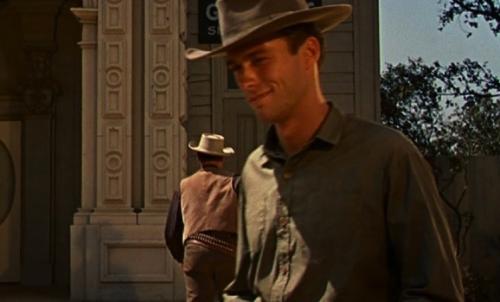
Produced by the legendary Albert Zugsmith, Star in the Dust is a surprisingly intelligent and well-acted B-western.  If you watch carefully, you might even spot Clint Eastwood playing a ranch hand named Tom who wants to know if he should put money down on Sam Hall being hanged.  Though he was uncredited in this tiny role, Star in the Dust was Eastwood’s first western.

Horror on the Lens: Diary of a Madman (dir by Reginald Le Borg)


For today’s horror on the lens, check out the 1963 film, Diary of a Madman!

It’s simply not October without at least one film featuring the great Vincent Price.  In Diary of a Madman, Price plays Simon Cordier, a French magistrate.  What is it that’s causing Simon’s personality to change?  What is making him suffer from greater and greater delusions?  Is he just going insane?  Or is he being haunted by a malevolent spirit known as a horla!?

Any film that features Vincent Price being sinister is worth watching and Diary of a Madman actually features one of his better performances.  Overall, Diary of a Madman is an enjoyable attempt at psychological horror.

Enjoy it below!