Horror Film Review: The Invisible Man’s Revenge (dir by Ford Beebe)


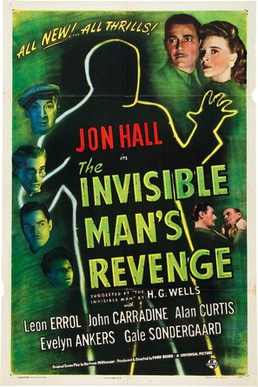
1944’s The Invisible Man’s Revenge opens with Robert Griffin (Jon Hall) arriving in England.

Despite his last name and the fact that he’s played by the star of Invisible Agent, this Robert Griffin would not appear to be in any way related to the previous invisible men.  Instead, he is someone who has just escaped from a mental institution in South Africa.  He has already murdered two orderlies and now, he’s come to England to take vengeance on Sir Jasper Herrick (Lester Matthews) and his wife, Lady Irene (Gale Sondergaard), two old friends who the paranoid Robert thinks tried to kill him in Africa so that they could steal his money.  When Robert sees Sir Jasper and Lady Irene, he informs them that they can either give him half of their fortune or they can allow him to marry their daughter, Julie (Evelyn Ankers).  Lady Irene responds by drugging Robert and having him kicked out of the house.

Dejected, Robert eventually comes across the cottage of Dr. Peter Drury (John Carradine, giving a surprisingly low-key performance in the mad scientist role).  Dr. Drury reveals to Robert that he has developed a serum that can turn living things invisible.  Drury goes on to “show” Robert all of the invisible pets that he has hanging out around the cottage, from an invisible dog to an invisible parrot.  When Robert asks how long the invisibility lasts, Drury says that it will last until the invisible person dies.  That sounds pretty good to Robert so he volunteers to be Drury’s latest test subject.

Soon, Robert is invisible and going out of his way to haunt that Herrick family.  Some of Robert’s antics are merely playful.  He helps a cobbler (Leon Errol) win a game of darts and later turns the man into his personal servant.  Robert’s other actions are a bit more destructive.  Robert, after all, was a murderer to begin with and using a serum that cause additional insanity is definitely not helping him with his temper.  When Robert decides that he wants to be visible again, he discovers that there’s only one temporary way to do it and it involves a lot of blood.

After being portrayed as being a hero in Invisible Agent, The Invisible Man is once again a villain in The Invisible Man’s Revenge and it just feels right.  There’s just something inherently sinister about the idea of someone being invisible.  Jon Hall, who was so boring in Invisible Agent, is far more compelling here, playing Robert as a paranoid megalomaniac who has so convinced himself of his own cleverness that he can’t even understand that he’s writing the script for his own downfall.  This is a good, solid Universal horror movie.  The true hero of the movie is Drury’s dog, played by a talented canine actor named Grey Shadow.  It takes more than invisibility to fool that dog!
Previous Universal Horror Reviews:

  1. Dracula (1931)
  2. Dracula (Spanish Language Version) (1931)
  3. Frankenstein (1931)
  4. Island of Lost Souls (1932)
  5. The Mummy (1932)
  6. The Invisible Man (1933)
  7. The Bride of Frankenstein (1935)
  8. Dracula’s Daughter (1936)
  9. Son of Frankenstein (1939)
  10. The Invisible Man Returns (1940)
  11. The Wolf Man (1941)
  12. Ghost of Frankenstein (1942)
  13. Invisible Agent (1942)
  14. Frankenstein Meets The Wolf Man (1943)
  15. Son of Dracula (1943)
  16. House of Frankenstein (1944)
  17. House of Dracula (1945) 
  18. Creature From The Black Lagoon (1954)
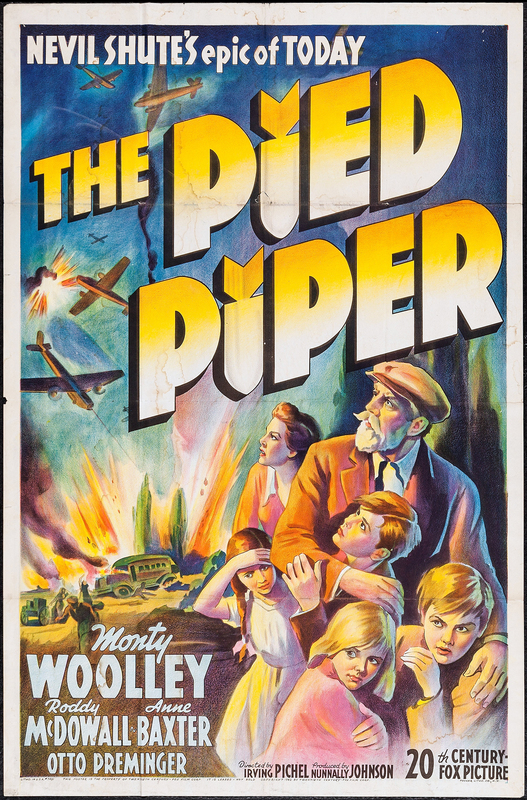
Lisa Reviews An Oscar Nominee: The Pied Piper (dir by Irving Pichel)


The 1942 Best Picture nominee, The Pied Piper, opens in Eastern France, shortly after the outbreak of World War II.

John Sidney Howard (played by Monty Woolley) is an Englishman on holiday.  He says that he just wants to enjoy some fishing before the entire continent of Europe descends into chaos.  He knows that France is going to be invaded at some point and he even suspects that the country will probably fall to the Nazis.  In his 70s and still mourning the death of his son (who was killed during an air battle over occupied Poland), Mr. Howard just wants to enjoy France one last time.  Despite the fact that the bearded Howard bears a resemblance to a thin Santa Claus, he’s quick to declare his dislike of both children and humanity in general.  He’s a misanthrope, albeit a rather friendly one.

Howard’s plans change when the Nazis invade France sooner than he expected.  With his vacation canceled, Howard just wants to get back to England.  Complicating matters is that a diplomat named Cavanaugh (Lester Matthews) has asks Howard to take his children, Ronnie (Roddy McDowall) and Sheila (Peggy Ann Garner), back to England with him.  Despite his self-declared dislike of children, Howard agrees.  However, it turns out that getting out of France won’t be as easy as Howard assumed.  After their train gets diverted by the Nazis, Howard, Ronnie ,and Sheila are forced to take a bus.  After almost everyone else on the bus is killed in a surprise Nazi attack, Howard and the children are forced to continue on foot and rely on the kindness of a young French woman, Nicole Rougeron (Anne Baxer).

Throughout the journey, Howard keeps collecting more and more children.  Everyone wants to get their children to a safe place and Howard soon has a small entourage following him.  Unfortunately, he also has Gestapo Major Diessen (an excellent Otto Preminger) watching him.  How far is Howard willing to go to ensure the safety of the children?

The Pied Piper is an interesting film, in that it starts out as something of a comedy but it then gets progressively darker as events unfold.  At the beginning of the film, it appears that the whole thing is just going to be Howard getting annoyed with the precocious Ronnie and Sheila.  But then that bus is attacked and Howard find himself accompanied by a young boy who has been left in a state of shock by the attack.  When the group is joined by a young Jewish child named Pierre, it’s a reminder that, though the film itself may have been shot on an American soundstage, the stakes and the dangers in occupied Europe were all too real.

The Pied Piper was nominated for Best Picture of the year.  Viewed today, it may seem like an unlikely nominee.  It’s a well-made movie and Monty Woolley gives a good performance as John Sidney Howard.  It’s the type of film that, due to the sincerity of its anti-Nazi message, should bring tears to the eyes of the most hardened cynic but, at the same time, there’s nothing particularly ground-breaking or aesthetically unique about it.  Still, from a historical point of view, it’s not a surprise that this competent but conventional film was nominated.  With America having just entered the war, The Pied Piper was a film that captured the national spirit.  Other World War II films nominated in 1942 included 49th Parallel, Wake Island, and the eventual winner, Mrs. Miniver.

In fact, one could argue that The Pied Piper is almost a cousin to Mrs. Miniver.  Both films are not only anti-German but also unapologetically pro-British.  Just as Greer Garson did in Mrs. Miniver, Monty Woolley is meant to be less of an individual and more of a stand-in for Britain itself.  When both Mrs. Miniver and Mr. Howard refused to surrender in the face of German aggression, these movies were proudly proclaiming that the British would never lose hope or surrender either.

Thankfully, the movies were correct.

Halloween Havoc!: THE INVISIBLE MAN’S REVENGE (Universal 1944)


gary loggins's avatarcracked rear viewer

Jon Hall is back as The Invisible Man, but not the same one he played in INVISIBLE AGENT . Like all the Invisible Man movies, THE INVISIBLE MAN’S REVENGE features a new protagonist, as Hall plays Robert Griffin, an escaped mental hospital patient who comes to London seeking his share of a diamond mine after being left for dead in the African jungle by partners Sir Jasper and Irene Herrick. Griffin has returned to get what’s coming to him, and he does… Irene dopes him, and the couple throw the rascal out. Disoriented, Griffin stumbles into a nearby river, where he’s saved from drowning by shady Cockney Herbert Higgins.

Higgins and his disreputable attorney pal try to shake down Jasper, but are confronted by the local chief constable. Griffin’s left to fend for himself, when he stumbles upon the home of Dr. Drury, a scientist experimenting with invisibility on animals…

View original post 403 more words

Halloween Havoc!: WEREWOLF OF LONDON (Universal 1935)


gary loggins's avatarcracked rear viewer

Lon Chaney Jr.’s Lawrence Talbot wasn’t Universal’s first Wolf Man . That honor goes to Henry Hull in WEREWOLF OF LONDON, a chilling but lesser film in the Universal canon. This one reminds me more of DR. JEKYLL & MR. HYDE than any of Chaney’s lycanthropic outings, and Jack Pierce’s makeup job is a little light in the hirsute department (more on that later).

British botanist Wilfred Glendon travels to Tibet to search for the rare mariphasia lumina lupina, a flower that only blooms in moonlight. Trekking into a forbideden valley, he is attacked and bitten by a werewolf. Returning to London with his find, Glendon is confronted by the mysterious Dr. Yogami, who says they’ve met before. Unbeknownst to Glendon, Yogami is the werewolf in question, who wants the phosphorescent moonflower as an antidote for his own lycanthropy. Yogami manages to steal the two blooms, leaving Glendon to transform…

View original post 374 more words

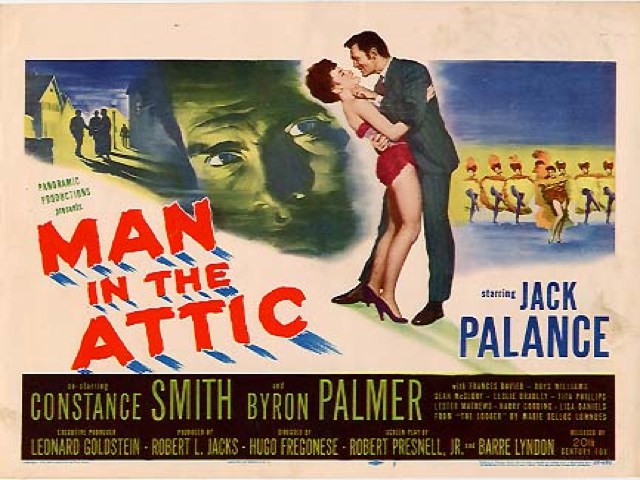
Halloween Havoc!: MAN IN THE ATTIC (20th Century Fox 1953)


gary loggins's avatarcracked rear viewer

attic1

The story of notorious 19th Century serial killer Jack the Ripper has been told countless times on the screen. The case has never been officially solved, and there are probably more theories about Jack’s identity than there were victims. Author Marie Belloc Lowndes wrote “The Lodger”, a speculative fiction novel based on the Ripper murders, that was in turn made into a silent film by the Master of Suspense, Alfred Hitchcock  in 1927. The film was remade in 1932 with the same star, Ivor Novello, then again in what’s probably the most famous version, 1944’s THE LODGER , starring Laird Cregar, Merle Oberon, and George Sanders. Almost a decade later, the tale was again remade, this time with Jack Palance as the mysterious MAN IN THE ATTIC.

attic2

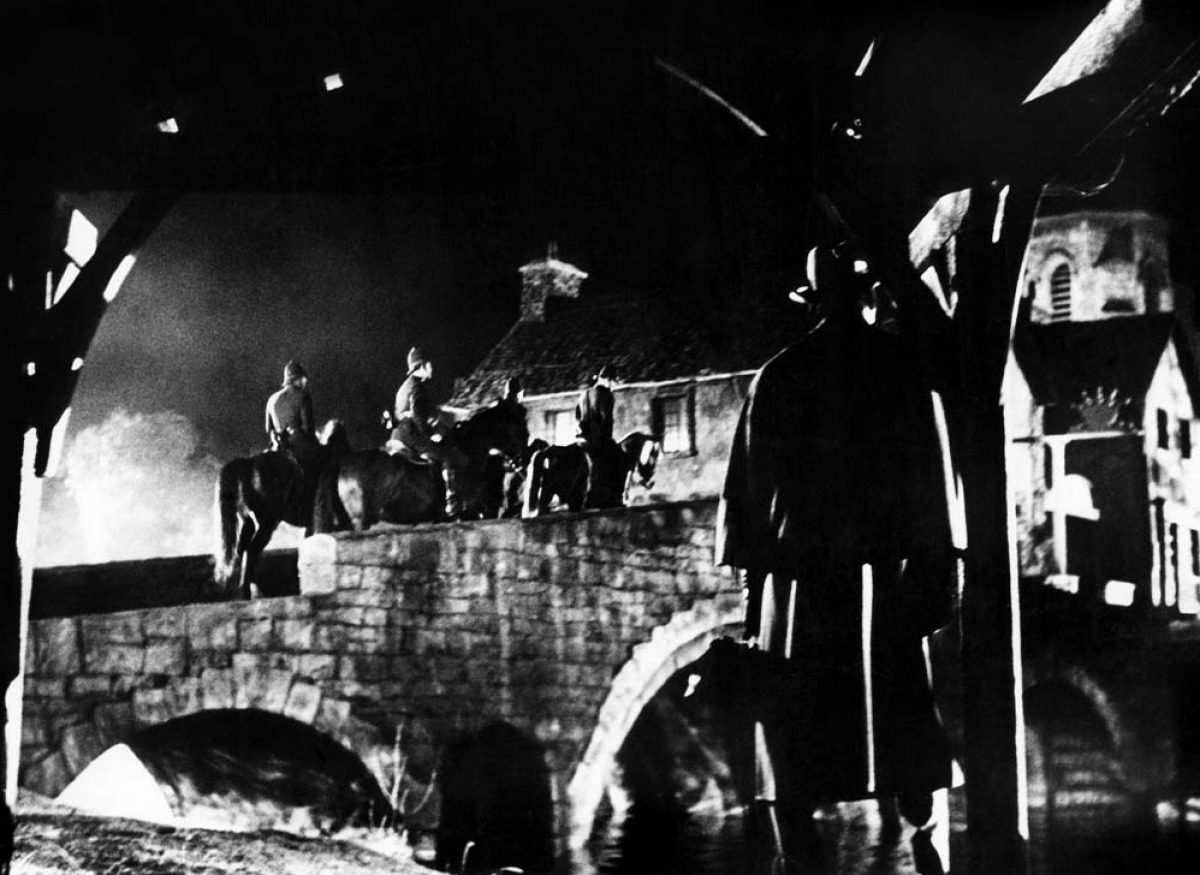
Fog shrouded London’s Whitechapel District is being terrorized by a fiend known in the press as Jack the Ripper. Scotland Yard is baffled, police patrols have been…

View original post 623 more words

Cleaning Out The DVR #23: The Adventures of Robin Hood (dir by Michael Curtiz)


(For those following at home, Lisa is attempting to clean out her DVR by watching and reviewing 38 films by this Friday.  Will she make it?  Keep following the site to find out!)

Robin_hood_movieposter

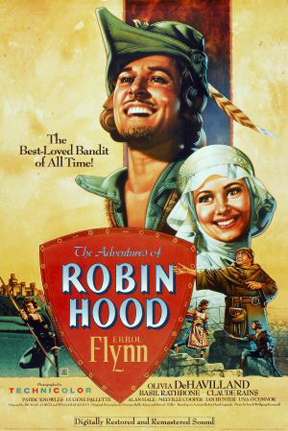
Flamboyant.  Athletic.  Joyous.  Determined.  Handsome.  Outspoken.  Bigger than life.  Revolutionary.  Anarchist.  Sexy.  Libertarian.  Is there any doubt why Errol Flynn remains the definitive Robin Hood?

And. for that matter, is there any doubt why the 1938 film The Adventures of Robin Hood remains not only the definitive Robin Hood film but also one of the most influential action films in history?

The Adventures of Robin Hood tells the story that we’re all familiar with.  The King of England, Richard The Lionhearted (Ian Hunter), is captured while returning from the Crusades.  His brother, King John (Claude Rains, in full autocratic villain mode), usurps the throne while Richard is gone and immediately raises taxes.  He claims that he’s only doing this to raise the money to set Richard free.  Of course, the real reason is that John is a greedy tyrant.

The only nobleman with the courage to openly oppose John is Sir Robin of Locksely (Errol Flynn).  Sir Robin protects his fellow citizens from John’s main henchman, Sir Guy of Gisbourne (Basil Rathbone, also in full autocratic villain mode).  In fact, Robin is so brave that, on multiple occasions, he even enters Sir Guy’s castle so that he can specifically tell King John and Sir Guy that he has no use for their laws.  This, of course, always leads to Robin having to make a dramatic escape while arrows flies and swords are unsheathed all around.

And through it all, Robin Hood keeps smiling and laughing.  He’s a wonderfully cheerful revolutionary.  He may be fighting a war against a ruthless and unstoppable enemy and he may be the most wanted man in England but Robin is determined to have fun.  One need only compare Robin to his humorless foes to see the difference between freedom and bureaucracy.

(We could use Errol Flynn’s Robin Hood today, though I suspect our government would just blow him up with a drone and then issue a statement about how, by stealing money from the rich and giving it to the poor, Robin was keeping the government from being able to rebuild bridges and repair roads.)

When Robin isn’t exposing the foolishness of organized government, he’s hanging out in Sherwood Forest.  He’s recruiting valuable allies like Friar Tuck (Eugene Pallette) and Little John (Alan Hale, Sr.)  He’s playing constant pranks and promoting revolution and, to his credit, he’s a lot more fun to listen to than that guy from V For Vendetta.  He’s also romancing Maid Marian (Olivia de Havilland) and good for him.  Two beautiful people deserve to be together.

Even better, he’s doing it in glorious Technicolor!  There’s a lot of great things about The Adventures of Robin Hood.  The action scenes are exciting.  The music is thrilling.  The film is perfectly cast.  Errol Flynn may not have been a great actor but he was a great Robin Hood.  But what I really love about the film is just the look of it.  We tend to take color for granted so it’s interesting to watch a film like The Adventures of Robin Hood, one that was made at a time when color film was something of a novelty.  For those of us who spend a lot of time talking about how much we love old school black-and-white, The Adventures of Robin Hood is a film that says, “Hey, color can be great too!”

But what I mostly love about The Adventures of Robin Hood is just the pure joy of the film.  Just compare this Robin Hood to the grimly tedious version played by Russell Crowe.

(True, nobody in The Adventures of Robin Hood shouts, “I declare him to be …. AN OUTLAAAAAAAAAAAAWWWWWWWW!”  Actually, now that I think about it, Ridley Scott’s Robin Hood would have worked much better if Oscar Isaac and Russell Crowe had switched roles.)

The Adventures of Robin Hood was nominated for best picture and it probably should have won.  However, the Oscar went to Frank Capra’s You Can’t Take It With You.