Today is the 117th birthday of the great director, Vincente Minnelli!
While Minnelli actually made films in several different genres, he’s best remembered for his many musicals. It’s been said that Minnelli was one of the directors for whom technicolor was invented and his musicals certainly prove the truth of that statement. Minnelli made films that not only celebrated music and dancing but which left audiences wanting to sing and dance themselves.
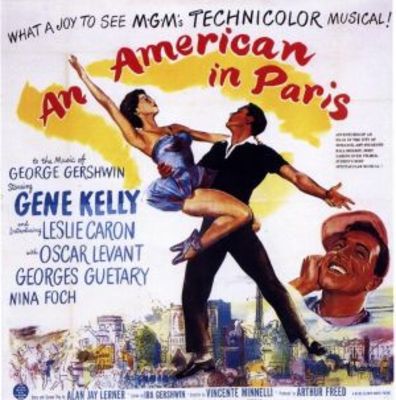
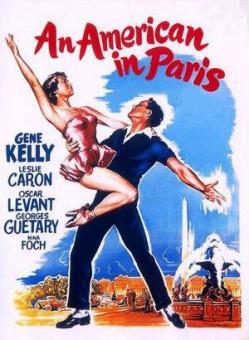
Several of Minnelli’s films were honored by the Academy. Two of his films won the Oscar for Best Picture and today’s scene that we love comes from the first one to do so, 1951’s An American In Paris. In this scene …. well, the why is not important. What’s important is the way the Gene Kelly and Leslie Caron move and the way that Minnelli captures and celebrates every movement.
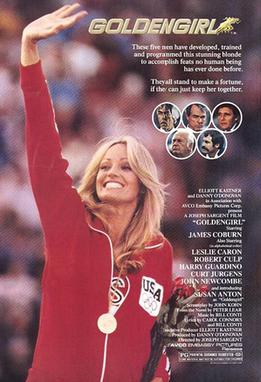
The 1979 film Goldengirl is a film that I had wanted to see ever since I first came across this trailer on one of the 42nd Street Forever compilation DVDs:
Wow, I wondered. What was Goldengirl’s secret and why was she ordering James Coburn to kiss her feet? For that matter, why did James Coburn have a haircut that made him look exactly like this old lady who used to live next door to my grandma in Fort Smith? What did it all have to do with the villain from The Spy Who Loved Me and just how drunk was Robert Culp when he shot his scenes? Even more importantly, why did Goldengirl keep running into that wall? That looked painful!
I did some research. (That’s a fancy way of saying that I looked the movie up on Wikipedia.) I discovered that Goldengirl was made in 1979. It was originally meant to be a television miniseries that would not only air during the 1980 Summer Olympics but which would feature Goldengirl competing at those Olympics! However, during production, it was decided to just use the material for a feature film instead. (Hmmmm, I thought, behind-the-scenes drama! Intriguing!) The film was released in June of ’79 and, despite one rave review from Vincent Canby in the New York Times, the film failed at the box office. Add to that, the U.S. ultimately boycotted the 1980 summer games, which made Goldengirl‘s Olympic-set climax a bit awkward.
I also discovered that Goldengirl is nearly impossible to see. It’s never been released on DVD or Blu-ray or any digital or streaming service. So, I resigned myself to the fact that I’d probably never see Goldengirl and, the more I thought about it, the more I realized that I really didn’t care that much.
However, for the past few days, I have been absolutely obsessed with the Winter Olympics. Even though it was a Summer Olympic movie, I decided to go on YouTube and see if anyone had uploaded Goldengirl since I last checked.
And guess what?
They had!
Now, here’s the problem. The two guys who uploaded Goldengirl also talked over the entire movie. Don’t get me wrong. The movie looked about as good as a VHS copy of a movie from 1979 is ever going to look. And I could still follow Goldengirl‘s story, even if I sometimes had to really strain to hear the dialogue over the two guys “commenting” on it. Still, it meant that I had to put a bit more effort into watching this movie than it perhaps deserved. It was kinda hard not to resent that.
Anyway, I have finally seen Goldengirl and I can now tell you that it’s a pretty lousy movie. Goldengirl is Goldine (Susan Anton). Her father is a German scientist who used to work for the Nazis. When he came to the United States, he decided to prove that his theories of eugenics were correct by adopting a daughter and breeding her to be the world’s greatest athlete. Working with a psychiatrist named Dr. Lee (Leslie Caron, for some reason), they have not only turned Goldine into the world’s greatest athlete but they’ve also turned her into a bright, smiling media personality. (Dr. Lee has trained Goldine, through the use of a vibrator, to always give the right answer when she’s asked a question.) Now, they just need Goldine to win three gold medals at the Summer Olympics and for PR agent Jack Dryden (James Coburn) to make Goldine into a star. Dryden is the only person who really cares about Goldine as something other than an experiment or a way to make money.
Goldine spends almost the entire movie running. There’s one running montage that seems to go on forever. Susan Anton was a model when she was cast as Goldine. She’s got the right look to be a celebrity but she’s never convincing as an Olympic-class athlete. Whenever Goldine competes, we either get a close-up of Anton running in slow-motion with no other runners around her or else a long-shot that’s designed to keep us from noticing that Anton isn’t really on the track.
Really, that’s entire film. On the basis of the trailer, I was expecting that Goldengirl would turn out to be a robot or something like that. Instead, it just turns out that her stepfather has spent years injecting her with vitamins and hormones and now, as a result, she has diabetes. Seriously, that’s it. She gets pretty mad when she finds out that her handlers have put her health at risk just so she could win a race. But then she goes ahead and runs the race anyway so I guess it was all for the best. Seriously, that’s the entire freaking movie. It doesn’t help that Anton’s acting is amateurish and the rest of the cast seems bored. Only Curt Jurgens really makes much of an impression, mostly because he’s too sinister not to be memorable.
The trailer is better than the movie. That’s the secret of Goldengirl.
“Some (producers) are able and humane men and some are low-grade individuals with the morals of a goat, the artistic integrity of a slot machine, and the manners of a floorwalker with delusions of grandeur”- Raymond Chandler, “Writers in Hollywood”, first published in Esquire Magazine, Nov. 1945
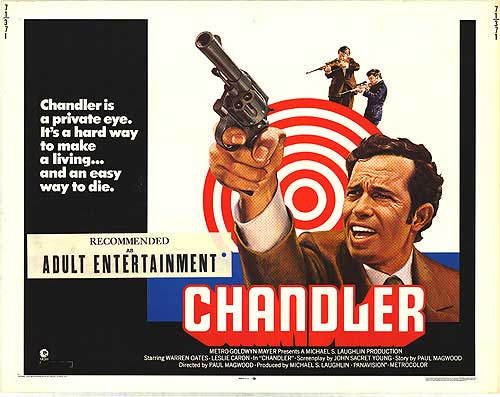
I had high hopes for CHANDLER, I really did. An homage to the hard-boiled fiction of Raymond Chandler (born July 23, 1888) with Warren Oates as the titular detective sounded like it’d be right up my dark alley. But as much as I wanted to like this movie, I was let down by its slow pace, convoluted script, and butchering by studio execs. Much of the film was cut, scenes were replaced, and the result is an evocative mood piece that ultimately doesn’t satisfy the noir lover in me.
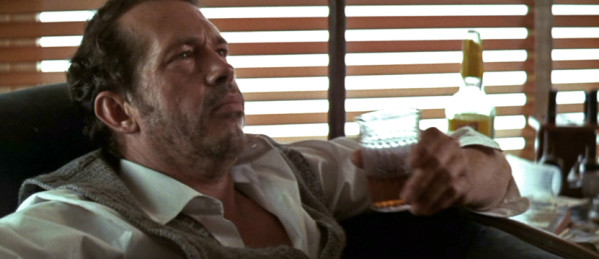
I don’t have a problem with Warren Oates as Chandler, with his Bogie-esque look and low-key performance…
(For those following at home, Lisa is attempting to clean out her DVR by watching and reviewing 38 films by this Friday. Will she make it? Keep following the site to find out!)
I can’t believe it took me this long to see the Oscar-winning 1951 film, An American In Paris. Seriously, I love dancing. I love Paris. I love Gene Kelly. Though this film was made decades before I was born, it still feels like it was literally made for me. And yet, until last night, I had never seen it. Thank God for TCM (and thank God for the DVR that I used to record the movie when it aired on TCM).
Gene Kelly plays Jerry Mulligan, an American veteran of World War II who, now that he is out of the army, is making his living as a painter and living in Paris. (The real Paris is only seen in a few establishing shots. Most of the film takes place on sets that were clearly designed to look more theatrical than realistic. This is the Paris of our most romantic fantasies.) Jerry’s roommate is Adam (Oscar Levant), a pianist who fantasizes about playing before a huge audience.
When the movie begins, Jerry gets his first patron, the wealthy and lonely Milo Roberts (Nina Foch). Though Milo is in love with Jerry, Jerry falls in love with an innocent French girl, Lise Bouvier (Leslie Caron). Although Lise falls in love with Jerry, she feels obligated to marry French singer Henri (Georges Guetary) because Henri helped to keep her safe during the Nazi occupation. And, of course, Henri is friends with Adam who is the roommate of Jerry who is in love with Lise who is engaged…
It sounds a lot more complicated than it actually is. If anything the plot of An American In Paris is too simple. (Just compare An American In Paris to Singin’ In The Rain.) But ultimately, An American In Paris is not about the story. It’s about George Gershwin’s music and Gene Kelly’s dancing. It’s a triumph of pure style. It was said that Fred Astaire made love through dancing and that’s even more true of Gene Kelly, who is literally a force of masculine nature in this film. So impressive was his choreography that it received a special, noncompetitive Oscar.
Check some of this out:
It all eventually ends with the incredible 17-minute The American In Paris Ballet, which sees Gene Kelly and Leslie Carson dancing through a series of sets that were modeled on Impressionist paintings. It’s one of those great movie moments that simply has to be seen.
How impressed were the members of the Academy with An American In Paris? They were impressed enough to name it the best film of 1951. I don’t know if I would go that far because I’ve seen both A Streetcar Named Desire and A Place In The Sun. (And An American In Paris‘s victory is considered to be one of the biggest upsets in Oscar history.) But, with all that said, An American In Paris is still an incredibly enjoyable film to watch.
Chandler (Warren Oates) is a former private investigator who quits his job as a security guard and gets back into the detective game. An old friend of his, Bernie Oakman (Charles McGraw), hires Chandler to follow and protect a woman named Katherine Creighton (Leslie Caron). Katherine is scheduled to testify against gangster John Melchior (Gordon Pinset) and Oakman tells Chandler that he believes Melchior may be planning on murdering her. What Chandler does not know is that Oakman is being manipulated by a corrupt federal agent, Ross Carmady (Alex Dreier), who is planning on duping Chandler into killing Melchior so that Carmady can take over Melchior’s racket. Though Chandler tries not to get emotionally involved in his cases, he ends up falling for Katherine.
In case you are keeping count, Chandler is the sixth Warren Oates film that I’ve reviewed this week. Some of that is because TCM devoted all of Monday to showing his films but it’s also because Warren Oates was a really cool actor who died too soon and never got as much credit as he deserved. Warren Oates combined the talent of a leading man with the face of a character actor and, as a result, he played some of the most memorable supporting roles of the 60s and 70s. He was the tough guy who could talk a mile a minute and his upturned grin always showed up at the most unexpected of times. Warren Oates brought humanity to outcasts and sympathy to villains.
Chandler is one of Warren Oates’s few leading roles. Unfortunately, it’s not much of a showcase. Director Paul Magwood and producer Michael Laughlin felt that the then-head of MGM, James Thomas Aubrey, interfered with the production of the film. After the film’s release, Magwood and Laughlin took out a full-page, black-bordered ad in Variety that read:
Regarding what was our film Chandler, let’s give credit where credit is due. We sadly acknowledge that all editing, post-production as well as additional scenes were executed by James T. Aubrey Jr. We are sorry.
Chandler is a strange film to watch. The plot is complicated but nothing really happens until the downbeat ending. Much like Robert Altman’s far more successful The Long Goodbye, Chandler tries to contrast the title character’s old-fashioned 1940s style and moral code with the 70s. Chandler, who always wears a suit and drives an old car, is meant to be a man out of time. Warren Oates does a good job, giving a Humphrey Bogart-style performance. But since Chandler doesn’t seem to be sure what it is trying to say about either the 40s or the 70s, it’s all for naught.
Chandler is a forgettable film, one that is only worth watching for the rare chance to see Warren Oates as a leading man.



 Through the Shattered Lens