Awwww, that poor pumpkin! Well, hopefully, he’s smiling now!
This animated special originally aired on Halloween night in 1979. I would imagine that the crying pumpkin probably traumatized children across America. Hopefully, all the kids were out trick or treating when this aired. Myself, I remember that when I was a kid, I would help my mom carve a pumpkin every year. And then I would get so depressed when we later had to throw it out. Seriously, I would get really attached to those jack o’lanterns.
Anyway, this cartoon is before my time but I have a feeling that, if I had been around to watch it, I would have been depressed for a whole year afterwards.
This small town is a sleepy coastal village, one that is dominated by a lighthouse sitting near the coast. The town has a lovely beach and friendly citizens. The storekeeper, Mr. Kocheck (Frank Arvidson), is a bit of a know-it-all. The town constable (Forrest Lewis) has the very easy job of keeping peace in the town. Little Jimmy (Wayne Berwick) is the annoying little kid who everyone in town looks after. Little Jimmy is the type who will walk right into the local store and go behind the counter. What a perfect town!
The only problem, when it comes to Piedras Blancas, is that some of the townspeople are a bit superstitious, especially when it comes to a belief in monsters that stalk the sea and the beach. The lighthouse keeper, Sturges (John Harmon), worries that there is a monster hiding in a nearby cave so he often goes down there and leaves food to keep the monster from attacking the town. Still, Sturges worries about his teenager daughter, Lucille (Jeanne Carmen), who has a habit of going down to the beach at night, stripping down to her underwear, and swimming in the ocean. Seriously, if anything is going to attract a horror movie monster, it’s that!
And there is a monster in the cave and yes, the Monster does eventually go on a rampage. As the bodies start to pile up and some of the town’s most beloved citizens are taken out, local scientist Sam Jorgensen (Les Tremayne) speculates that the creature could be a prehistoric amphibian who has somehow survived into the modern era.
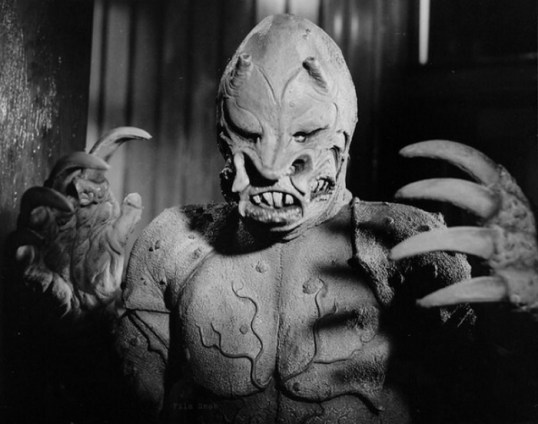
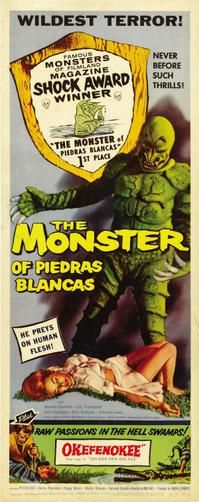
Independently produced and first released in 1959, The Monster of Piedras Blancas was clearly inspired by the success of The Creature From The Black Lagoon, with the boat crew replaced by the citizens of the town and Jeanne Carmen stepping into the role that was played by Julia Adams. The film was produced by Jack Kelvan, who also supervised the creation of the suit that Ricou Browning wore when he played the Gil-Man in The Creature From The Black Lagoon. And just, as with The Creature of Black Lagoon, the monster is the most effective part of The Monster of Piedras Blancas. Here he is!
Now, in close-up and still frame, you can tell that it’s obviously a rubber suit but, when seen in the shadows and stalking people on the beach, the monster is truly menacing. Whether the monster is ripping off someone’s head or carrying around the lighthouse keeper’s daughter, the monster is frightening to watch. I wouldn’t want to live anywhere near him. If the Creature From The Black Lagoon was often more misunderstood than malicious, The Monster of Piedras Blancas is just downright mean.
The Monster of Peidras Blancas does a good job of creating an ominous atmosphere, especially in the shots of Sturges heading down to the cave and the panicked townspeople walking through the town while carrying the body of the Monster’s latest victim with them. The film’s pace is a bit slow and the performances are inconsistent but the Monster definitely makes an impression.
Awwww, that poor pumpkin! Well, hopefully, he’s smiling now!
This animated special originally aired on Halloween night in 1979. I would imagine that the crying pumpkin probably traumatized children across America. Hopefully, all the kids were out trick or treating when this aired. Myself, I remember that when I was a kid, I would help my mom carve a pumpkin every year. And then I would get so depressed when we later had to throw it out. Seriously, I would get really attached to those jack o’lanterns.
Anyway, this cartoon is before my time but I have a feeling that, if I had been around to watch it, I would have been depressed for a whole year afterwards.
Occasionally, I’ll see a film like Crime of Passion or Bigger Than Life and I’ll say, “Wow, that’s really subversive for a movie that came out in the 1950s!”
And it’s true. We tend to think of the 1950s as being a time when conformity ruled all. It was a time of innocence and chastity, when cinema heroes all wanted to have a house in the suburbs and loving couples slept in separate beds and nobody ever questioned anything. Of course, the truth of the matter is that there were a lot of films released in the 50s that challenge that perception.
And then again, there were also films like 1955’s A Man Called Peter.
A Man Called Peter is a biopic about Peter Marshall (played by Richard Todd), a Scottish immigrant who came to the United States, became a Presbyterian minister, and then eventually became the Chaplain of the United States Senate. (That means that he would open each session of the Senate with a prayer and occasionally provide spiritual counsel to the senators.) I recently watched it on Netflix, specifically because I thought it might be appropriate for this series of political reviews.
And it is, but just barely.
It actually takes the film a while to get to the part where Peter Marshall becomes the Senate Chaplain. First, we watch him as a boy in Scotland, trying to stow away on a boat heading for America. Then, several years later, he’s out walking on a foggy night. He trips over a tree root and, as he lies on the ground, he announces that God has told him to 1) pursue a career as a minister and 2) to do so in America. (I have to admit that I was raised Catholic so I have no idea whether he was having a typical Presbyterian spiritual experience or not. But the film certainly takes it seriously.)
Peter ends up in America where he ministers to a church in Atlanta, marries Catherine (Jean Peters), and then eventually ends up at a church in Washington, D.C. When he eventually is asked to serve as Chaplain of the Senate, both he and the film go out of their way to avoid taking any definite position on any issue. Instead, Peter gives prayers that encourage the senators to put partisan bickering aside and work together to make the United States the best country in the world.
Having now watched all 120 minutes of A Man Called Peter, I can safely that this is a film that epitomizes everything that we always assume to be true about the 1950s. From the film’s view of marriage to religion to politics, A Man Called Peter is perhaps one of the most stereotypically 1950s movies ever made. This is such a 1950s movie that it’s even filmed in CinemaScope!
(And speaking of CinemaScope, A Man Called Peter looks great but it’s perhaps one of the least intimate biopics that I’ve ever seen. You can see every inch of the surrounding landscape but the human beings get lost.)
For me, the film’s most 1955 moment comes when Catherine first discovers that her husband has been reassigned to Washington, D.C. She and Peter are on their honeymoon when they get a telegram telling them that their new home in Washington is ready. Catherine is shocked. Peter says that he didn’t want to interrupt their honeymoon by telling her that they’re not going home to Atlanta. Instead, they’re going to an entirely new city and an entirely new life. (In other words, Peter has decided to say goodbye to Catherine’s family and friends.)
“Aren’t you pleased?” Peter asks her.
Cheerfully, Catherine replies, “Well, who wouldn’t be?”


 Through the Shattered Lens