It’s not Christmas without the story of Ebenezer Scrooge and his visit with three ghosts. There have been numerous film versions of this story. The one below comes to us from 1938 and stars Reginald Owen in the role of Scrooge.
This version is surprisingly good, considering that it was apparently shot in a hurry. (The movie hit theaters just a few weeks after filming stopped.) Originally, Lionel Barrymore was going to play Scrooge but he had to drop out due to ill-health. Reginald Owen stepped in and gave a good performance as the famous miser.
(Barrymore himself would more or less play Scrooge a little less than ten years later in Frank Capra’s It’s A Wonderful Life.)
The 1945 Best Picture nominee, Spellbound, tells the story of Dr. Constance Petersen (Ingrid Bergman), a psychoanalyst at a mental hospital in my least favorite state, Vermont.
Constance has fallen in love with a man (Gregory Peck) who she believes to be Dr. Anthony Edwardes, the newly appointed director of the hospital. Dr. Edwardes is youngish and handsome and idealistic and authoritative …. well, he’s Gregory Peck. However, he also has an intense phobia about seeing any set of parallel lines. Curious to discover the reason for Edwardes’s phobia, Constance does a little digging on her own and discovers that Dr. Anthony Edwardes is not a doctor at all! Instead, he’s a guilt-stricken amnesiac who is convinced that he murdered Dr. Edwardes and took his place!
Constance, however, doesn’t believe that the Amnesiac is a murderer. She thinks that he is suffering from some sort of deep-rooted guilt that had led him to believe that killed the doctor. She wants a chance to psychoanalyze him and discover the truth about his background. Unfortunately, the police do think that the Amnesiac is a murderer and their determined to arrest him.
Constance and the Amnesiac go on the run, heading to the home of Constance’s mentor, Dr. Alexander Brulov (Michael Chekhov, the nephew of Anton Chekhov). With Brulov’s help, Constance analyzes a dream that the Amensiac had, one involving curtains decorated with eyes, the faceless proprietor of a casino, and a man falling off a mountain. Can Constance and Brulov solve the mystery of the Amnesiac’s identity before the police take him away to prison?
Spellbound was the last of the four Hitchcock best picture nominees and it was also the last film that Hitchcock made for producer David O. Selznick. Selznick was quite a fan of psychoanalysis and he insisted that Hitchcock not only make a movie about it but that he also use Selznick’s own therapist as a technical advisor on the project. Hitchcock, for his part, was able to bring in the surrealist Salvador Dali to help design the Amnesiac’s dream sequence but Selznick felt that the 20-minute sequence was too long and too weird and, as a result, it was cut down to two minutes for the final film. All this considered, it’s not a surprise that, despite the fact that Spellbound was a hit with critics and audiences, Hitchcock himself didn’t care much for it and considered it to be more of a Selznick film than a Hitchcock film. And it is true that the film’s total faith is psychoanalysis feels more like something one would expect to hear from a trendy producer than from a director like Hitchcock, who was known for both his dark wit and his rather cynical attitude towards anyone in authority.
For a film like Spellbound to truly work, there has to be some doubt about who the Amnesiac is. For the suspense to work, the audience has to feel that there’s at least a chance, even if it’s only a slight one, that the Amnesiac actually could be a murderer, despite the attempts of Constance and Brulov to prove that he’s not. And Spellbound is full of scenes that are meant to leave the audience wondering about whether or not the Amnesiac should be trusted. However, because the Amnesiac is played by Gregory Peck, there’s really no doubt that he’s innocent. Hitchcock was not particularly happy with Gregory Peck as his leading man. Peck projected a solid, middle-American integrity. It made him ideal for heroic and crusading roles but made him totally wrong for any role that required ambiguity. It’s difficult to believe that the Amnesiac is suffering from a guilt complex because it’s difficult to believe that Gregory Peck has ever done anything for which he should feel guilty. Cary Grant could have played the Amnesiac. Post-war Jimmy Stewart could have done an excellent job with the role. But Peck is just too upstanding and stolid for the role. In a role that calls from neurosis, Peck is kind of boring.
That said, the rest of the cast is fine, with Ingrid Bergman giving one of her best performance as Constance and Michael Chekhov bringing some needed nuance to a role that could have turned into a cliché. Leo G. Carroll has a small but pivotal role and he does a good job keeping the audience guessing as to his motivation. Even at a truncated two minutes, the Dali dream sequence is memorably bizarre and the famous shot of a gun pointed straight at the camera still carries a kick. This is a lesser Hitchcock film but, that said, it’s still a Hitchcock film and therefore worth viewing.
As I mentioned previously, this was the last of Hitchcock’s films to be nominated for Best Picture. Ironically, his best films — Rear Window, Vertigo, and Psycho among them — were yet to come. Spellbound was nominated for six Oscars but only won for Miklos Rozsa’s score. (Ingrid Bergman was nominated for Best Actress that year, not for her role in Spellbound but instead for The Bells of St. Mary’s.) The big Oscar winner that year was Billy Wilder’s The Lost Weekend.
The 1934 best picture nominee, The Barretts of Wimpole Street, takes place largely in one room.
That room is a bedroom located in a mansion that sits on Wimpole Street in London. The room is occupied by Elizabeth (Norma Shearer), a sickly woman who has spent years in bed and who is barely able to walk. She is the eldest of 11 siblings and all of them live in the house together, under the watchful eye of their tyrannical father, Edward (Charles Laughton). Edward has forbidden any of his children from ever leaving home. None of them are to get married. In fact, none of them are to have even a relationship. Even when he hears that a trip to Italy could actually improve Elizabeth’s health, he sternly forbids her from leaving. Edward is obsessed with sin. As he explains it, he was once a sinner himself. In fact, he was such a sinner that he sometimes lost control of himself. Now that he’s a father and a widower, Edward deals with his less savory impulses through constant prayer and he’s determined to never allow his children to fall into sin as well.
Despite her father’s attempts to keep her isolated from the outisde world, Elizabeth has managed to find an escape. She’s a poet and her words have won her admirers from around world. One of those admirers is another poet, a young man named Robert (Fredric March), who frequently writes her letters about his love of her work. One day, in the middle of a snowfall, Robert shows up at the house on Wimpole Street and requests to see Elizabeth. Robert tells her that her poetry has not only inspired him but it has also caused him to fall in love with her. When Elizabeth explains that she is dying and cannot leave the bedroom, Robert says that she’s going to live forever. After Robert leaves, Elizabeth manages to stand and, for the first time in years, walks over to the window to watch as he departs.
Sounds like a perfect love story, right? Well, there’s a problem. Edward has absolutely no intention of allowing Elizabeth to leave the house, regardless of how much her health improves after her initial meeting with Robert. He is determined to keep her in that bedroom and, this being a pre-code film, it becomes obvious that there’s more to Edward’s behavior than just being an overprotective father. Though the dialogue may be euphemistic, Edward’s incestuous desires are plain to see. It’s there every time that he leers as his daughters while also saying that he’ll be sure to pray for their souls. It’s there in the film’s final moments, when Edward makes a request that’s so dark and cruel that it will take even a modern audience by surprise. Charles Laughton played a lot of villains over the course of his long career but Edward is perhaps the most monstrous.
As a film, The Barretts of Wimpole Street is undeniably stagy and it’s a bit overlong as well. Charles Laughton so dominates the film with menace that he threatens to overshadow not just March and Shearer but also Maureen O’Sullivan, who plays one of Elizabeth’s sisters. But no matter! I absolutely love The Barretts of Wimpole Street. The house is gorgeous, the plot is wonderfully melodramatic, and Shearer and March both have a wonderful chemistry. You can debate whether or not March and Shearer are credible as poets but, ultimately, what matters more is that they are totally believable as soul mates. From the minute they first meet, you simply buy them as a couple that is meant to be. Robert’s earnestness is perfectly matched with Elizabeth’s growing strength and it’s impossible not to cheer at least a little when Elizabeth first manages to walk down a staircase without collapsing.
Of course, as any student of literature should be aware, Robert is Robert Browning and Elizabeth is Elizabeth Barrett. In real life, Robert Browning did arrange a meeting with Elizabeth after having read her poetry and, as well, it’s been said that Elizabeth’s father did not approve of her relationship with Robert. It’s also apparently true that Edward actually did disinherit any of his children who married. As for the other details of Edward’s depiction in The Barretts of Wimpole Street, it’s unknown how close to the truth Laughton’s performance may have been.
The Barretts of Wimpole Street is a wonderful historical romance. It was Oscar-nominated for best picture, though it lost to a far different romance, It Happened One Night.
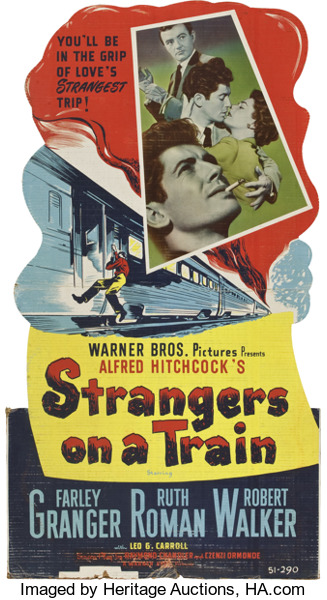
Alfred Hitchcock , like many great artists before and since, was in a bit of a career slump. The Master of Suspense’s previous four films (THE PARADINE CASE, ROPE, UNDER CAPRICORN, STAGE FRIGHT) were not hits with either critics or audiences, and did poorly at the box office. Then came 1951’s STRANGERS ON A TRAIN and Hitch was back on top with this devilish mélange of murder, suspense, romance, and humor, featuring a stunning star turn by Robert Walker, cast against type as a charming sociopath.
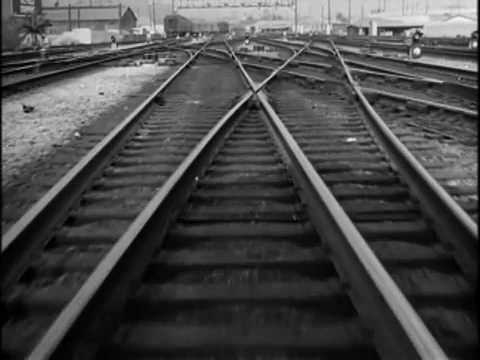
Our story opens with two pairs of shoes (one two-toned, one staid brown loafers) emerging from two separate cabs, walking separately to catch a train and their date with destiny, as we cut to two separate train tracks merging together. Hitchcock’s playing with one of his classic themes: “the double”, or more importantly, duality. Even Dimitri Tiomkin’s score highlights the differences, as a jaunty…
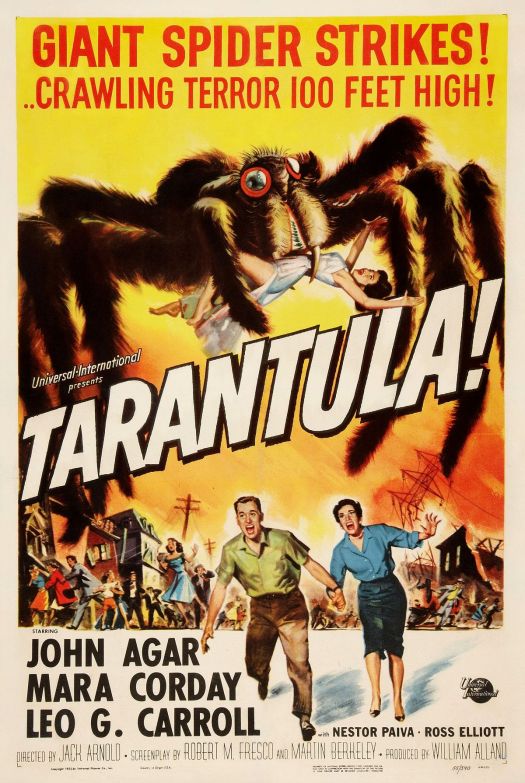
TARANTULA is a movie that used to scare the bejeezus out of me as a kid, and helped warp my fragile little mind. Watching it again through my so-called “grown-up” eyes, I could sit here and pick at some gaps in logic and bad dialog. But I’m not gonna do that; instead I’ll look at the positives in this still entertaining and fun “Big Bug” movie (okay, maybe I’ll pick at it a little!).
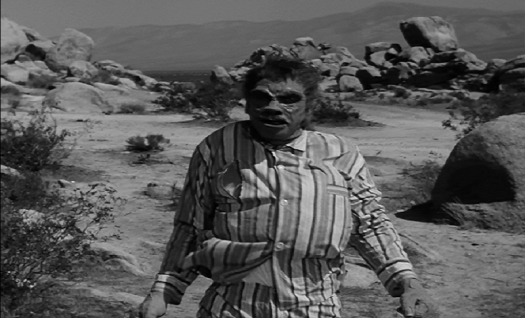
A pre-credits scene shows a deformed looking man in pajamas stumbling across the desert, buzzards circling over his head. He drops in his tracks, then the title appears in big, bold letters: TARANTULA! The credits roll, and we meet Dr. Mark Hastings, who’s “just a country doctor” in the aptly named desert town of Desert Rock. Mark gets a call from Sheriff Jack Andrews to inspect the body, assumed to be scientist Dr. Eric Jacobs. Mark…
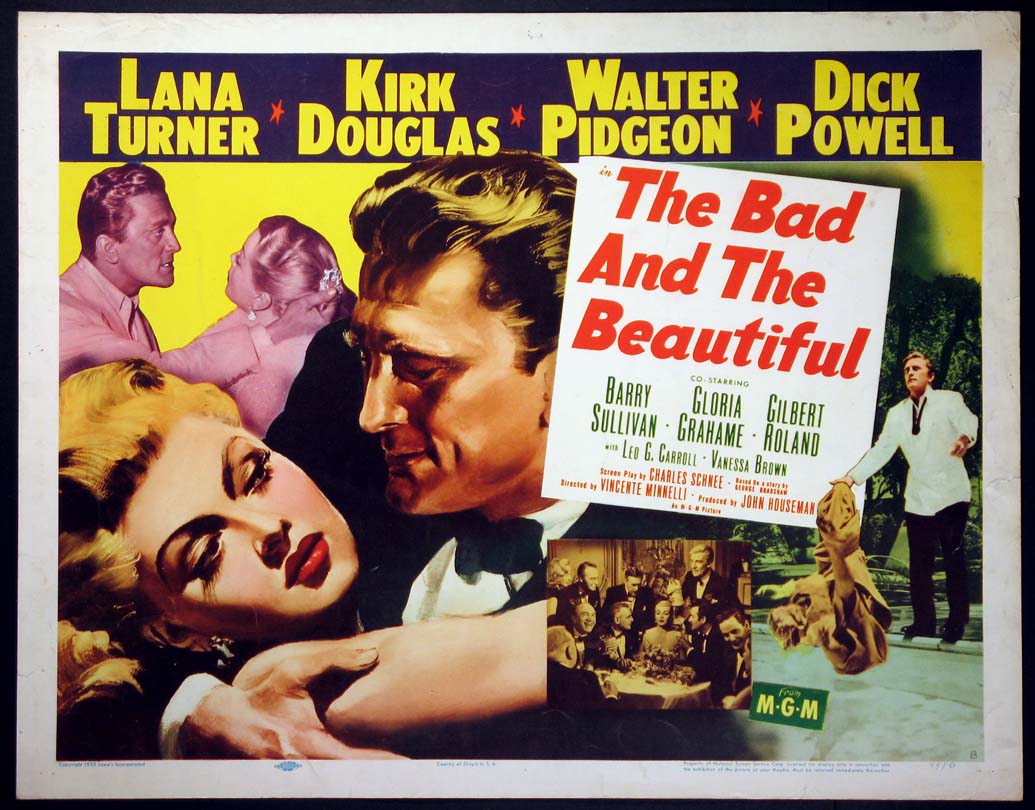
Today is the 100th birthday of movie legend Kirk Douglas! Like Olivia de Havilland earlier this year, Kirk is one of the last living Golden Age greats. Bursting onto the screen in film noir classics like THE STRANGE LOVES OF MARTHA IVERS and OUT OF THE PAST , he first received top billing in the 1949 boxing noir CHAMPION, earning an Oscar nomination for his performance. Later, Kirk starred in some of the best films Hollywood has to offer: ACE IN THE HOLE, 20,000 LEAGUES UNDER THE SEA , LUST FOR LIFE (his second Oscar nom, though he never won the statue), PATHS OF GLORY, SPARTACUS, LONELY ARE THE BRAVE. One of my personal favorites is 1952’s THE BAD AND THE BEAUTIFUL.
One of those Hollywood movies about making Hollywood movies, THE BAD AND THE BEAUTIFUL is expertly directed by insider Vincent Minnelli, who knew this material like the back of his hand. Aided…
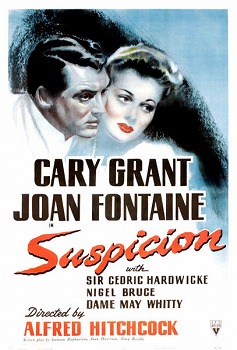
First off, a warning. The following review of the 1941 best picture nominee Suspicion will include spoilers. So, if you haven’t seen the film and you’re obsessive about avoiding major spoilers, then don’t read the review. Simple, no?
Two years ago, I was having lunch with some of my fellow administrative assistants. One of them was talking about how she had watched an “old movie” the previous night. From listening to the vague details that she offered up, I was able to figure out that she had apparently stumbled across TCM for the first time in her life. From listening to her talk, I would not be surprised if she was literally describing the first time she had ever actually seen a black-and-white movie. Needless to say, my first instinct was to correct everything she was saying but I resisted. (For some reason, at that time, I was feeling self-conscious about being perceived as being a know-it-all.) But, as she kept talking, I found it harder and harder to keep quiet. Listening to her talk about old movies was like attending an art history lecture given by someone who had flunked out of a finger painting class. Finally, when the conversation had moved on to someone who we all knew was sleeping with her much older boss, our self-proclaimed old film expert announced that age didn’t matter. “I’d go out with Cary Grant,” she said, “and he’s old.”
Before I could stop myself, I added, “He’s also dead.”
Oh my God, the look of shock on her face! I actually felt really guilty because I could tell that she had apparently taken a lot of happiness from the idea that suave, witty, and handsome Cary Grant was still out there. And can you blame her? In a career that spanned three decades and included several classic dramas and comedies, Cary Grant epitomized charm. Some of his movies may seem dated now but Grant was such a charismatic and natural actor that it’s impossible not to get swept up in his performances.
(Who would be the contemporary Cary Grant? I’ve heard some people compare George Clooney to Grant. And it’s true that Clooney has Grant’s charm but, whereas Grant always came across as very natural, you’re always very aware that George Clooney is giving a performance.)
It was Grant’s charm that made him the perfect choice for the male lead in Suspicion but it was that same charm that made the film so controversial. In Suspicion, Grant plays Johnnie. Johnnie meets, charms, and — after the proverbial whirlwind courtship — marries Lina (Joan Fontaine), a sheltered heiress. It’s only after Lina marries Johnnie that she discovers that he’s broke, unemployed, and addicted to gambling. With everyone from her family to her friends telling her that Johnnie is only interested in her money, Lina starts to worry that Johnnie is plotting to kill her. Lina starts to view all of Johnnie’s actions with suspicion, wondering if there’s an innocent explanation for his occasionally odd behavior or if it’s all more evidence that he’s planning to kill her. When he brings her a glass of milk, Lina has to decide whether or not to risk drinking it…
Suspicion was based on a novel in which Johnnie was a murderer and which ended with Lina voluntarily drinking that poisoned milk. In the film, however, Johnnie is not a murderer. Apparently, it was felt that Grant was so charming and so likable that audiences would never accept him as a murderer. Instead, he’s an embezzler and all of his strange behavior is due to him being ashamed of his past and feeling that he’s not worthy of Lina. Once Lina realizes that Johnnie isn’t trying to kill her, she promises him that she’ll stay with him.
And a lot of people (including director Alfred Hitchcock, who claimed it was forced on him by the film’s producers) have criticized that ending but you know what?
It works. If I had to choose between Joan Fontaine essentially committing suicide or Joan Fontaine promising to love Cary Grant even if Grant goes to prison, I’m going to go with the second choice. Ultimately, Suspicion works because you can imagine being swept off your feet by Grant’s character. But what makes Suspicion enjoyable, to me, is that Johnnie ultimately turns out to be exactly who we were hoping he would be.
Needless to say, Suspicion works as a great double feature with Rebecca. Watch one after the other and have a great night of menace and romance.
Well, here we are, less than a week into Embracing the Melodrama, Part II, and I’m already running behind! The plan, as I mentioned back on Monday, is to review 128 melodramatic films over the next three weeks. And, even though I know that sounds a like a lot, I had it all planned out so that I’d be able to get all that done in just 21 days. All I had to do was make sure that I reviewed 6 films a day.
And …
Well, life happened.
But no matter! It may now take me 3 and a half weeks to review 128 films but that’s no great tragedy. And besides, regardless of how long it takes, I’ve got some pretty good films scheduled.
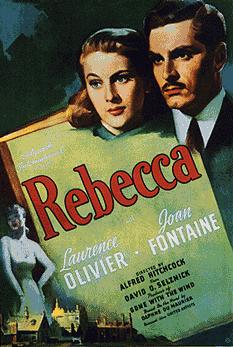
Take, for instance, the 1940 best picture winner Rebecca.
Rebecca is a film that all women can relate to. The heroine is played by Joan Fontaine. I say “heroine” because we never actually learn the character’s name, nor do we learn much about her background. When we first see her, she’s defined by her job, which is to basically be a paid companion to a wealthy woman. Later, she’s defined by her whirlwind romance with the brooding and aristocratic widower Maxim de Winter (Laurence Olivier). When, after two weeks, they get married, she becomes known as the second Mrs. de Winter. She becomes defined by both who she married and who she is not.
She’s not Rebecca, the first Mrs. de Winter.
As soon as Maxim takes his new wife to his estate, the second Mrs. de Winter discovers that she’ll always live in the shadow of the deceased Rebecca. Everyone she meets describes Rebecca as being a vibrant, lively figure — in other words, the complete opposite of the meek second Mrs. de Winter. The coldly imperious housekeeper, Mrs. Danvers (Judith Anderson), has perfectly preserved Rebecca’s room and makes little attempt to hide the scorn that she feels for the second Mrs. de Winter. Even worse, once they return to the estate, Maxim reveals himself to be moody and tempermental. With the help of the manipulative Mrs. Danvers, the second Mrs. de Winter becomes convinced that Maxim will never love her as much as he loved Rebecca.
Making things even more complicated, a man claiming to be Rebecca’s cousin comes by the house when Maxim is away. Jack Flavell (played by George Sanders, at his most serpent-like) suggests that there may have been more to Rebecca’s death than the second Mrs. de Winter was originally told…
Rebecca is a classic film, for many reasons. It’s well-acted, with Fontaine, Olivier, Anderson, and Sanders all bringing their characters to vibrant life. It’s a gothic romance. It’s a thriller. It’s a mystery. It is the epitome of old Hollywood style. But, for me, the main reason that Rebecca is a classic is because it tells a story to which almost everyone can relate. Every relationship that I’ve ever had, I’ve always been curious and occasionally even jealous of who came before me. There’s nothing more intimidating than living in the shadow of someone who you will never get a chance to meet personally. The second Mrs. de Winter’s insecurities are everyone’s insecurities and, in some fashion or another, we’ve all had a Mrs. Danvers in our life. The second Mrs. de Winter’s struggles are our struggles and, as she grows stronger, the viewer grows stronger with her.
Alfred Hitchcock is one of the most influential and acclaimed filmmakers of all time but he never won a directing Oscar. Rebecca was the only one of his films to win Best Picture. Producer David O. Selznick brought Hitchcock over from England to direct Rebecca and it’s been reported that Hitchcock resented Selznick’s interference. (And, while Rebecca is undoubtedly a good film that was directed by Alfred Hitchcock, it’s not exactly a Hitchcock film in the way that Shadow of a Doubt, Rear Window, or Vertigo are Hitchcock films.) As a result, Hitchcock subsequently made it a point to edit future pictures in camera so that the studios would not be able to re-edit his films.
But, whether you consider it to be a Hitchcock picture or a Selznick production, Rebecca remains a wonderfully watchable melodrama.


 Through the Shattered Lens