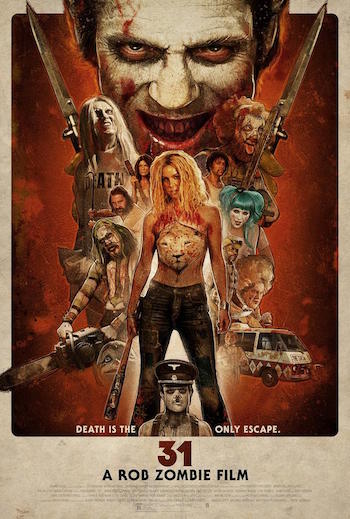
The TSL’s Daily Horror Grindhouse: 31 (dir by Rob Zombie)


31_film_poster

Are you scared of clowns?  Sure, you are.  All good people fear clowns.  However, if you somehow do not find clowns to be frightening, you may change your mind after seeing Rob Zombie’s latest film, 31.

Of course, that’s assuming that you actually see 31.  31 is not a film for everyone.  In fact, if you’re not a fan of Rob Zombie or his style of horror, you should probably stay miles away from 31.  Bloody, intense, violent, and occasionally rather nihilistic, 31 is perhaps the Rob Zombiest of all the films that Rob Zombie has ever made.

However, if you’re a fan of extreme horror, you’ll appreciate 31.  It may not always be easy to take but then again, that’s kind of the point.

The film takes place in the 70s, which means that it has a really kickass soundtrack.  A group of carnival workers are driving across the desert in a van when they are attacked and kidnapped.  They find themselves in a dark building, being lectured by three people who are dressed like 18th century French aristocrats.  The leader of the aristocrats (played by Malcolm McDowell) informs them that they are going to playing a game called 31.  For the next twelve hours, they will be locked away in a maze.  They will be hunted by five murderous clowns.

Yes, you read that right.  Not just one murderous clowns — FIVE!  (Even worse, a sixth bonus clown eventually joins the game.)

If they can survive for 12 hours, they win.  What do they win?  Other than freedom, the film is never particular clear on this point.  The motives of the aristocrats remain a mystery for the majority of the film.  Are they just sadists, are they perhaps devote fans of The Purge who were so disappointed with Election Year that they decided to recreate the second film on their own, or is there some bigger reason behind this game of 31?  The film leaves the question for us to answer.

The rest of the film is a collection of progressively more violent fights between the carnival workers and the clowns.  For the most part, the carnival workers are all likable and you don’t want to see any of them harmed.  The clowns, meanwhile, are just about the freakiest collection of killers that you’ve ever seen.  When one of them is cornered, he pathetically begs, “We’re all pawns!  We don’t want to do this!” but you never quite believe him.  The deadliest of the clowns is Doom-Head (Richard Brake) and his evil smirk will give you nightmares.

31 is an incredibly intense film and it’s definitely not for the faint of heart.  Everything from the acting to the set design to the costumes to David Daniel’s stark cinematography comes together to make 31 into a harrowing horror film.  If you can’t stand Zombie’s trademark mayhem, I would suggest avoiding 31.  However, if you’re a fan of Zombie’s films, you’ll find 31 to be perhaps the purest distillation of his artistic vision.

Cleaning Out The DVR: The Christmas Gift (dir by Fred Olen Ray)


The Christmas Gift

After I watched The Flight Before Christmas, it was time to continue cleaning out the DVR by watching The Christmas Gift!  The Christmas Gift was one of the first Christmas films to show up on Lifetime this year, premiering on November 30th.

Megan (Michelle Trachtenberg) is an ambitious writer who works for a tabloid magazine and who is frustrated by the fact that she’s only assigned to write articles about the best lip gloss for fair skin.  As well, her boorish boyfriend, and fellow journalist, Alex (Daniel Booko) not only dumps her but gets assigned the big story that she wanted!  Michelle’s editor, Cooper (Rick Fox), tells her that, if she really thinks that she deserves better assignments, then she needs to go out and find a story that proves it.

Megan returns home to discover that her aunt has sent her a package of her old belongings.  Going through it, Megan comes across a notebook that was anonymously given to her one Christmas many years ago.  The notebook — and the poem that was inscribed within — inspired Megan to become a writer.  She decides, for her story, to track down the person who gave her the notebook.

Her investigation leads her to Wesley Hardin Johnson, Jr. (Sterling Sulieman), who runs a foster care program.  Megan says that she wants to do a story about the program and the kids that Wesley is helping.  Wesley agrees, on the condition that the story be about the kids and not about him.  For reasons that only make sense when you consider that this is a Lifetime holiday film, Megan decides that this means that she shouldn’t tell him about the notebook.

Not only does Megan have a hit story but she and Wesley are also falling in love!  However, Megan then discovers why her aunt sent her all of her old stuff.  It turns out that her aunt’s retirement community is about to be leveled and repalced with condos.  And who is evicting Megan’s aunt?  None other than Wesley’s father, Wesley Hardin Johnson, Sr. (Lawrence Hilton-Jacobs)…

Needless to say, it all leads to misunderstandings and conflicts but it’s nothing that can’t be solved within 90 minutes of narrative.  This is a Lifetime Christmas film, after all.  You watch it with the full knowledge that everything’s going to turn out okay.  The Christmas Gift is a good-natured and likable holiday movie and Michelle Trachtenberg does a pretty good job in the lead role.

Perhaps what is most interesting about The Christmas Gift is that it was directed by the incredibly prolific Fred Olen Ray, who is better known for directing horror films and thrillers than for directing sweet-natured family films.  (That said, if you look at his filmography, you’ll actually come across several movies that you wouldn’t normally associate with him.)  Someday, someone is going to write the definitive overview of Ray’s long and varied career and, hopefully, I will be one of the first to read it.

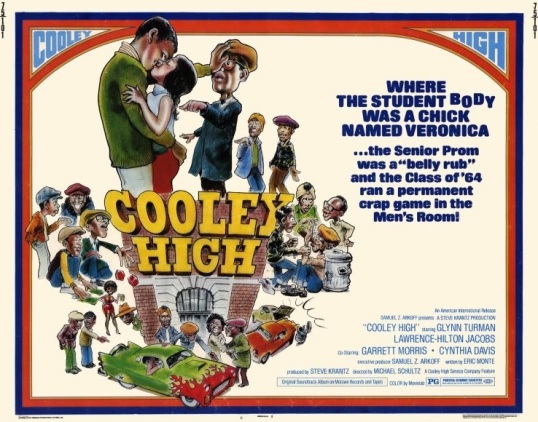
Back to School #17: Cooley High (dir by Michael Schultz)


http://www.youtube.com/watch?v=tmw1Llp92PU

For our next entry in Back to School, we take a look at a film that is often referred to as being a “black American Graffiti,” 1975’s Cooley High.

Cooley High follows the adventures of two lifelong friends who are both seniors at Edwin G. Cooley Vocational High School in Chicago, Illinois.  The charismatic Cochise (Lawrence Hilton-Jacobs) is a popular and friendly basketball star.  Meanwhile, Preach (Glynn Turman) is an aspiring writer who, despite his obvious intelligence, is also one of the worst students at the school.  Preach divides his time between skipping school, gambling, and writing poetry.  Alone among their friends, Cochise and Preach both seem to have a chance to escape from life in the projects.  At the start of the film, Cochise has just received a scholarship to play basketball in college.  As for Preach, he’s the eternal optimist.  He knows he’s going to make it, even if he doesn’t seem to be quite sure how he’s going to do it.

For the first half of the film, Cooley High is largely a plotless collection of vignettes featuring Cochise, Preach, and their friends skipping school, chasing girls, getting into minor trouble, and trying to avoid major trouble.  The emphasis is on comedy but, unlike a lot of high school comedies from the 70s and 80s, the humor grows organically from the characters.  Facing a future that’s likely to be dominated by prejudice, poverty, and limited opportunity, what can the students of Cooley High do other than laugh?  The second half of the film takes a far more dramatic turn, with Preach and Cochise accused of both stealing a car and snitching on the actual thieves in order to get out of jail.  The film’s downbeat conclusion may be predictable but it’s effective all the same.

One reason why I wanted to review Cooley High is because a few months ago, while I was trying to find something to watch on TV, I came across an episode of a show called Unsung Hollywood.  The title of the episode was “The Story of Cooley High” and it told the story of how and why this film was made.  It was actually pretty interesting to watch, as it featured interviews with screenwriter Eric Monte (who based the character of Preach on himself), director Michael Schultz (who directed a lot of memorable films in the 70s — including Sgt. Pepper’s Lonely Hearts Club Band — but has never quite gotten the recognition that he deserves), and the film’s two stars.  Even more interesting, however, were the interviews with the local Chicago residents who essentially played themselves during the filming of Cooley High.  Some of them had fond memories of appearing in the film while others were upset that the film’s box office success didn’t open up any new opportunities for them.  Most haunting of all was the fate of an amateur local named Norman Gibson.  After giving a genuinely good performance as a petty criminal who comes to a violent end in Cooley High, Gibson was murdered a year after the film was released.

As I mentioned before, Cooley High is often compared to American Graffiti and the two films do have some things in common, like the period setting and a great soundtrack.  Ultimately, though, Cooley High can stand on its own.

cooley