October Hacks: The Unnamable (dir by Jean-Paul Ouellette)


1988’s The Unnamable takes place in the type of small, superstitious town that H.P. Lovecraft made famous in his stories.  (The Unnamable is loosely based on Lovecraft’s work.)

The students at Miskatonic University are fascinated by the stories that surround the old Winthrop place, a mansion where, 100 years ago, Joshua Winthrop’s wife supposedly gave birth to a hideous monster that proceeded to kill Joshua and all of his servants.  It is said that the mansion is still haunted, perhaps by the ghost of Joshua or maybe by the monster itself!  The students regularly dare each other to stay at the old Winthrop Place.  Joel (Mark Parra) accepts the dare and vanishes, worrying his friends Howard Damon (Charles Klausmeyer) and Randolph Carter (Mark Kinsey Stephenson).  While Howard is a skeptic about the supernatural, Carter is a dedicated student and he’s obsessed with what might be found within the Winthrop house.

Meanwhile, two frat boys (Eben Ham and Blane Wheatley) convince Wendy (Laura Albert) and Tanya (Alexandra Durrell) to come hang out with them for the night in the Winthrop House.  The frat boys claim that it’s an annual initiation that all new students go through.  For the most part, the frat boys just want to get laid.  One of them even drapes a sweater over his shoulders.  Since when has anyone wearing a sweater that way turned out to be a good guy?

Of course, it turns out that Winthrop House is haunted and soon, heads are rolling (literally) and blood is being spilled.  While the frat boys and the girls fight for their lives, Howard and Carter break into the mansion to see if they can find their missing friend Joel.  Of course, Carter is immediately distracted by the mansion’s collection of ancient texts and hidden tunnels.  Howard, on the other hand, just wants to save Wendy’s life and prove that he’s as good as any sweater-draping frat boy.

The Unnamable is fairly low-budget affair, one that mixes the slasher genre with Lovecraft’s chilly horror.  It works surprisingly well.  The house is a wonderfully atmospheric location.  The monster, when it finally makes its appearance, is frightening and very Lovecraftian.  In fact, the monster feels as if could have wandered over from Stuart Gordon’s Castle Freak.  (The Unnamable probably would never have been made if not for the success of Gordon’s Re-Animator.)  The gore is plentiful and, at times, disturbingly convincing.  The main thing that makes The Unnamable work as well as it does is that the cast is surprisingly game and they attack their stereotypical roles with a likable enthusiasm.  Nobody coasts on the fact that the film is just a “horror movie” or just as “slasher flick.”  The characters may not have much depth but the cast still does a good job of bringing them to life (and death).  I especially liked the performance of Mark Kinsey Stephenson as Randolph Carter.  Randolph Carter, of course, is a name that should be familiar to most Lovecraft readers and Stephenson is a delight as he ignore the chaos around him so that he can check out the mansion’s library.  While the film definitely takes some liberties with Lovecraft, Stephenson is still the ideal Carter.

The Unnamable was an enjoyably macabre surprise.
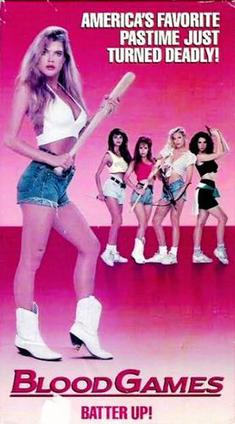
The TSL’s Grindhouse: Blood Games (dir by Tanya Rosenberg)


First released in 1990, Blood Games opens with a birthday celebration gone terribly wrong.

Somewhere in the rural South (at least, I assume it’s meant to be the South if just because of the big Confederate flag that appears in one scene), Roy Collins (Gregory Cummings) is celebrating his birthday.  Roy’s father, Mino (Ken Carpenter), has invited Babe and the Ball Girls, a women’s softball team, to come to town to play an exhibition game against Roy and the local boys.  When Babe (Laura Albert) and her team not only beat but also thoroughly humiliate the hometown team, Mino doesn’t take it well.  He yells at Roy and Roy and his idiot friend, Holt (Don Dowe), decide to get revenge.  After Roy is killed while trying to assault one of the girls, Mino gathers all of the rednecks together and declares, “I WANT JUSTICE!”  Everyone in town grabs a shotgun, jumps in a pickup truck, and heads off in pursuit of the Babe and the Ball Girls tour bus.

It shouldn’t come as a surprise to anyone that the bus itself breaks down in the middle of the woods and the team is forced to hike to safety while being pursued by Mino, Holt, and all of the rest of the shotgun toting locals.  It turns out that Mino is a deadly shot with a crossbow and Holt, at times, seems to be close to indestructible.  However, it also turns out that Babe and the Ball Girls are far tougher than any of the men expected.  The film reaches its bloody conclusion at a deserted farm, complete with a dramatically-scored flashback montage that reminds us of everyone whose life was lost during Roy’s birthday weekend.

Just to state the obvious, Blood Games is just as exploitive as it sounds.  This is the type of film where, early on, the action stops so the camera can linger on Babe and the Ball Girls in the locker room after they win their game.  (George “Buck” Flower shows up as the redneck who inevitably ends up peeking in at them.)  The team’s uniforms were probably popular with the film’s target audience but short shorts and crop tops don’t really seem practical for a game that would involve sliding through the dirt and the weeds on the way to home plate and, as a Southern girl who spent many a summer in the country while growing up, I cringed a bit when I thought about all the bugs that were probably in the grass and the dirt, waiting for a chance to hop onto a bare leg.  (It didn’t help that the game was apparently just being played in some random field.)

And yet, as exploitive as many viewers will undoubtedly find Blood Games to be, the film definitely works.  The rednecks are so loathsome and they overreact so severely to losing one game to a team of girls that it’s impossible not to cheer when Babe and the Ball Girls turn the tables on their pursuers.  “Batter up!” the film’s trailer announces and it is true that the Ball Girls use the same teamwork that won them the game to survive in the wilderness.  At the same time, they also use baseball bats, ropes, guns, and anything else they can get their hands on.

The acting is a bit inconsistent, though Don Dowe and Ken Carpenter are both well-cast as the main villains.  Dowe plays Holt as being someone who knows that he’s in over his head but who is too weak-willed to go against the mob.  The fact that he’s weak makes him all the more dangerous because a weak man will do anything to try to convince others that he’s strong.  Carpenter, meanwhile, is chillingly evil as Mino, who quickly goes from mourning his son to taking a sadistic pleasure out of hunting down human beings.  The film’s real strength is to be found in Tanya Rosenberg’s direction.  Along with keeping hte movie moving at a fairly steady pace, Rosenberg also captures the atmosphere of being lost in the country in the summer.  Watching the film, you can literally feel the heat rising from the ground and hear the cicadas in the distance.

Incidentally, I convinced my sister to watch this film with me because I assumed it was a baseball movie.  However, as Erin quickly pointed out to me, it instead turned out to be a softball movie.  I have no idea what exactly the difference is between baseball and softball but Erin assures me that there is one.  Well, no matter!  Whether it was softball or baseball, Babe and the Ball Girls did a good job striking out the hometown boys.

Batter up!

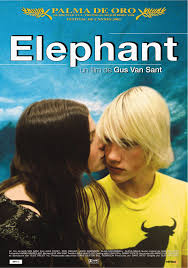
Back to School #62: Elephant (dir by Gus Van Sant)


http://www.youtube.com/watch?v=SC8ogZ4Jsuw

Gus Van Sant’s dream-like 2003 film Elephant is not an easy film to review.  Working with a non-professional cast and avoiding any easy answers or traditional narrative tricks (and indeed, the film ends with the fates of most of the characters still unknown), Elephant is ultimately a disturbing and nightmarish film.  It’s also an important film, one that examines the violence that runs through our current culture.

I’m one of the lucky ones.  I managed to get through all 12 years of my public education without ever getting shot at.  There’s quite a few people my age who can’t make the same claim.  I’d be lying if I said that I spent a lot of time in school obsessing over whether or not someone was going to start shooting but now, when I look back, I sometimes wonder how close I may have come.  One of the scarier things about the typical profile of school shooter is that we’ve all known somebody who fits it.  Sometimes, I can’t help but wonder if I just got lucky.  Maybe the guy who was planning on shooting up my school couldn’t get his hands on a gun.  Maybe, at the last moment, he changed his mind and decided to leave his gun in his locker instead of taking it out before the start of second period.  We come into contact with thousands of people over the course of our lives and we can never for sure what any of them are truly thinking or planning.

According to Wikipedia, there were a dozen school shootings in the U.S. during the time I was in high school.  Thankfully, none of them happened at my high school but, as I looked over the list, I couldn’t help but wonder why my classmates and I were spared the trauma of random violence while the students at Rocori High School in Cold Springs, Missouri were not.  Were we somehow better or more deserving than the students at Rocori?  Had they done something wrong or had we done something right?  Why were they forced to deal with violence while I was spared?  It all just seems so random.

And that’s the terrifying thing about random violence — it is, in the end, all so random.  We always tend to look for explanations afterward.  We try to assign blame and we try to come up with a reason because we know that, if we can explain random violence, then we can do something about it.  But, far too often, there are no reasons.

Elephant perfectly captures this randomness.  The film’s ensemble of characters spend what for many of them will be their final hours randomly wandering through their high school and their lives. Three mean girls eat lunch and then duck into toilet stalls where all three of them proceed to throw up.  John (John Robinson) searches for his drunk father (Timothy Bottoms) who may be wandering around the campus.  Awkward Michelle (Kristen Hicks) goes from her gym class to the library, little aware that she will soon be the first to be confronted by the gunmen.  Once the shooting starts, silent jock Bennie (Bennie Dixon) walks through the body-strewn halls, a potential hero until he is randomly shot.  The film is full of flash forwards and flashbacks, in which we see Alex (Alex Frost) and Eric (Eric Duelen) planning their rampage and we’re given clues as to their motives but we’re not given any answers.

Perhaps most memorable of all, at least to me, is the character of Eli (Elias McConnell), an aspiring photographer who gets one picture of Alex and Eric as they enter the library.  Up until that moment, the entire film has pretty much centered on Eli.  We’ve gotten to know him.  We’ve come to like him.  And yet, when Eli is shot, it happens almost as an afterthought.  One minute, he’s standing in the background and the next moment, he’s gone.  And we’re left to wonder if he survived or if it was even him who got shot.  Ultimately, what we realize is that, in that one split second, Eli ceased to be.  Even if he does survive being shot, he’ll never be the same person we saw earlier.  Even if he wasn’t shot, he’ll always be one of the students who went to that school.  In the end, we may have cared about Eli but none of that could stop the random violence.

Elephant is not an easy film to watch but then again, it shouldn’t be.  (If you want to read a bunch of comments from some people who just don’t get it, you can go read the simple-minded comments that some of them have posted over on the movie’s page at the imdb.) Elephant is a dark and troubling film, one that gave me nightmares after I saw it.  It’s a film so effective and powerful that one viewing is more than enough.

(Incidentally, one of Elephant‘s credited producers was JT Leroy, the pen name of Laura Albert whose books inspired a similarly difficult but powerful film, Asia Argento’s The Heart is Deceitful Above All Else.)

images

Embracing the Melodrama #52: The Heart is Deceitful Above All Things (dir by Asia Argento)


600full-the-heart-is-deceitful-above-all-things-poster

Based on a controversial collection of short stories by JT LeRoy (which was a pen name used by the writer Laura Albert), The Heart is Deceitful About All Things covers three years in the life of Jeremiah and his dug addict mother Sarah.  Over the course of the film, Jeremiah is played by thee different actors — Jimmy Bennett at age 7 and, at age 10, Cole and Dylan Sprouse.  Sarah is fearlessly played by the film’s director, Asia Argento.

Partially in response to her extremely religious upbringing, Sarah spends most of her time drinking, smoking meth, and moving from man to man, the majority of whom treat both her and her son badly.  It looks like things are going to get better when Sarah marries the seemingly stable Emerson (Jeremy Renner) but, when Sarah suddenly abandons both her husband and her son so that she can go to Atlantic City, Emerson rapes Jeremiah.

Jeremiah is sent to live with his grandfather (Peter Fonda) and grandmother (Ornella Muti) who, it turns out, are members of an ultra-religious cult.  Thought Jeremiah initially manages to bond with his cousin Buddy (Michael Pitt), life in the cult proves to be no safer than life with his mother.  After three years with the cult, Jeremiah is standing on a street corner and yelling that everyone is going to go to Hell unless they repent when he is suddenly approached by Sarah.  Sarah grabs him and carries him over to a nearby truck that is being driven by her current boyfriend.

Sarah now supports herself as a dancer and as a prostitute.  When she realizes that the presence of her son is making men reluctant to pay for her, Sarah grows out Jeremiah’s hair and starts to dress him in her old clothes so that she can pass him off as being her younger sister.

Eventually, Sarah and Jeremiah find themselves living with amiable but slow-witted meth addict Jackson (Marilyn Manson) and that’s when things really start to head down hill…

In some ways, The Heart Is Deceitful About All Things is a difficult film to recommend because it is so extremely dark and depressing.  Much as in her debut film, Scarlet Diva, Asia Argento refuses to compromise on the bleakness of her vision.  She set out to make a realistic portrait of what it’s like to live on the fringes of American society and that’s exactly what she did.  If the end result is depressing…well, the fringes aren’t exactly a happy place.  In the end, you’re actually happy that the film is full of familiar actors like Argento, Michael Pitt, Peter Fonda, and Winona Ryder because you need that reminder that, ultimately, you’re watching a movie and that everyone was able to go home after they finished filming.

The Heart Is Deceitful Above All Things may not be easy to enjoy but it is a film that, as a result of its uncompromising vision,  ultimately wins your respect.

heart-is-deceitful-above-all-things-0