Book Review: Laid Cregar: A Hollywood Tragedy by Gregory William Mank


Ah, poor Laird Cregar.

Cregar was born in Philadelphia in 1913 and spent a good deal of his youth in England.  That was where he first appeared, as a child actor, with the Stratford-Upon-Avon theatrical troupe and it was also where he developed the English accent that would serve him well later in life.  Cregar once said that, from the age of eight, all he wanted to do was be on stage.

For most of the years that followed, Cregar never stopped performing.  Cregar went from acting on stage to eventually making his way to Hollywood.  He first appeared on the big screen in 1940 and he went on to appear in 16 films. He appeared in nearly every genre of film, from comedy to film noir to even a western.  As frequent viewers of TCM can tell you, he played a surprisingly charming devil in 1943’s Heaven Can Wait.  But he was probably best-known for playing a mysterious man who might be Jack the Ripper in 1944’s The Lodger and for his role as the possibly mad pianist, George Henry Bone, in Hangover Square, obsessively playing the piano while his room burned down around him.  Sadly, that will be his final role.

Cregar was an actor who had the talent to be a leading man but, because he weighed over 300 pounds, he found himself used as a supporting player in Hollywood.  He was a character actor who yearned to be a romantic star and who feared he would be forever typecast as a villain.  Perhaps because Cregar disliked playing villains, his villains often seemed to be conflicted about their actions.  (Indeed, there was a vulnerability to Cregar that made it difficult not to feel some sympathy for his characters.)  Determined to change his image, Cregar embarked on a crash diet that was aided by amphetamines.  He lost over a 100 pounds but he also put his health in jeopardy.  On December 9th, 1944, Cregar died after suffering a heart attack.  He was 31 years old.  His friend Vincent Price delivered the eulogy at Cregar’s story.  Cregar’s final film, Hangover Square, was released four months after he died.

Gregory William Mank’s biography, Laird Cregar: A Hollywood Tragedy, not only tells the story of Cregar’s short life but it also examines how Cregar took his frustrations and his insecurities and used them in his performances.  In Mank’s biography, Cregar comes across as being a kind and generous man who wanted so desperately to be a star that it destroyed him.  The book serves as not only an examination Cregar and his talent but an indictment of a studio system that set very rigid rules for who could and who couldn’t be a star.  The book also features details about Cregar’s extensive and successful stage career.  If you’re a history nerd like me, you’ll appreciate all of the detail that Mank goes into while discussing who co-starred with Cregar and their subsequent careers.  Mank explores Cregar’s childhood and his career.  The resulting biography pays tribute to a star who deserved better.
Horror on the Lens: The Lodger (dir by John Brahm)


Today’s horror on the lens is 1944’s The Lodger, a remake of Hitchcock’s silent classic.

This creepy little story of paranoia and murder in the London fog features an excellent performance from Laird Cregar and is definitely one of the best films ever made about Jack the Ripper!

Enjoy!

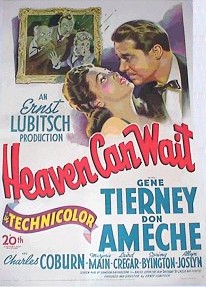
Cleaning Out The DVR #33: Heaven Can Wait (dir by Ernst Lubitsch)


(For those following at home, Lisa is attempting to clean out her DVR by watching and reviewing 38 films by the end of today!!!!!  Will she make it?  Keep following the site to find out!)

Heavencwaitposter

The 1943 film Heaven Can Wait opens with a 70 year-old man named Henry Van Cleve (Don Ameche) stepping into an opulent drawing room and having a conversation with a refined but menacing man known as His Excellency (Laird Cregar).  From their conversation, it quickly becomes obvious that Henry has recently died and His Excellency is in charge of Hell.  Most people who come to see His Excellency do so because they want to argue that they do not belong in Hell and they usually end up falling through a convenient trap door.  However, Henry is there to argue that, after living an enjoyable but dissolute life, he belongs in Hell.

Henry tells the story of his life.  He tells how he was born into great wealth and influenced by his down-to-Earth grandfather (Charles Coburn).  As a young man, he spent most of his time chasing after showgirls bur eventually, he met the beautiful and kind-hearted Martha (Gene Tierney).  He immediately fell in love with Martha but, unfortunately for him, she was engaged to his cousin (Allyn Joslyn).  Henry, however, used his considerable charm to convince her to elope with him.

(It helps, of course, that Henry’s cousin was totally and completely obnoxious, in the way that rival suitors often are in films like this.)

And, for 25 years, Henry was happy with Martha.  It took him a while to settle down and, at one point, Martha even left him as a result of his affairs.  However, they always got back together and Henry eventually did settle down, even going so far as to prevent his son from running off with a showgirl of his own.  It was only after Martha herself died that Henry, who always felt he didn’t deserve her love, returned to his old ways.

And, Henry argues, it’s because he was unworthy of his wife that he deserves to spend an eternity in Hell.  Does His Excellency agree?

Well, it would certainly be a depressing movie if he did.

One of the great things about TCM’s 31 Days of Oscar is that it gave me a chance to discover several films from director Ernst Lubitsch, films like The Smiling Lieutenant, The Love Parade, Ninotchka, and Heaven Can Wait.  Of those four Lubitsch films, Heaven Can Wait is probably the least substantial but it’s still an undeniably entertaining and nicely romantic film.  This is one of those films that you watch because the sets look wonderful, the costumes are to die for, and the performers are all pleasant to watch.  It’s pure entertainment, a crowd-pleaser in the best sense of the word.

In fact, tt was such a crowd-pleaser that it was nominated for best picture of the year.  However, it lost to the ultimate crowd-pleaser, Casablanca.