(This review is based on my experience replaying L.A. Noire. Be sure to reread Leonard Wilson’s review, from when the game was originally released.)

I recently replayed L.A. Noire, a game that I enjoyed when it was first released in 2011. I was curious to see if, after eight years, it still held up. The first time I played L.A. Noire, it was on the Xbox 360. For the replay, I used the version that was released for the PS4. This version included extra rewards and cases that were not originally included in the game.
L.A. Noire takes place in Los Angeles in the years immediately following World War II. For the majority of the game, you control the actions of Cole Phelps, a decorated USMC veteran who works his way up through the LAPD. He starts as a uniformed policeman before being promoted to detective. The game follows him through three different department until, as a result of a personal scandal, he ends up being demoted down to arson. Along the way, Phelps learns the truth about the Black Dahlia murderer and gets involved in the deadly aftereffects of a morphine heist. Through a series of flashbacks, we also discover that Phelps may not be the war hero that everyone thinks that he is. Cole’s an interesting hero because he’s so openly ambitious and judgmental that he is sometimes easy to dislike. Nearly everyone who works with Cole in the game either beings their partnership disliking him or grows to dislike him over time. Cole can be abrasive but he also has a strong moral sense and, when he says that he’s a better detective than his partners, he has a point. From the start, the games teases us about Cole’s inevitable downfall but, when it actually does happen, it catches both Cole and the player by surprise.
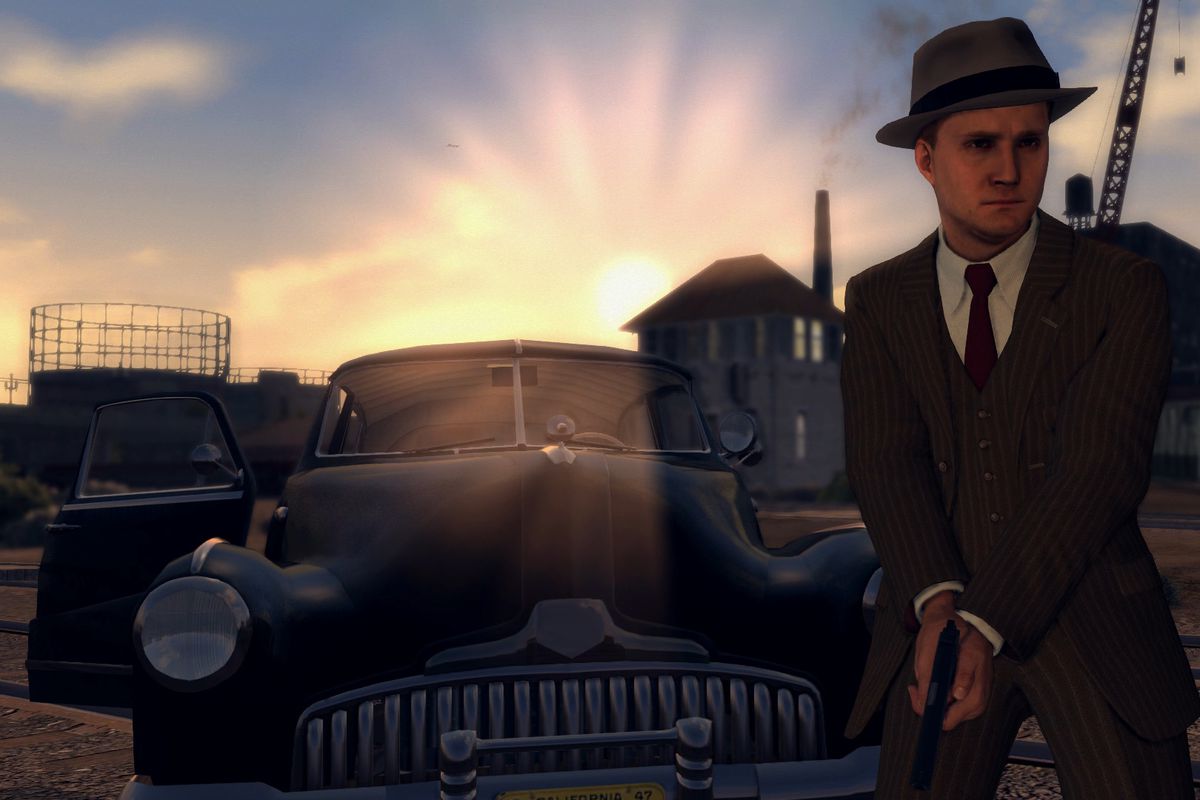
L.A. Noire is an open world game, meaning that Phelps can temporarily abandon a case and spend some time walking and driving around Los Angeles. The game’s recreation of 1947 Hollywood is impressive but, when compared to other open world games, there’s not much to do when you’re not actually on a mission. This isn’t like Grand Theft Auto, where you can spends weeks mugging people and stealing cars until deciding to return a phone call so that you can get your next task. L.A. Noire is a story-centered game so be prepared to spend most of your time searching crime scenes for clues, going back to the police station to pick up lab reports, and interrogating suspects.
When L.A. Noire first came out, it was the interrogation scenes that received the most attention. The game used MotionScan technology and 32 cameras to capture every possible facial expression of the actors appearing in the game. When you ask someone a question, you can watch their expressions while they answer and make the determination whether they’re lying or telling the truth, as well as whether to be a good cop or a bad cop. You can watch an liar refuses to make eye contact with you or as an innocent man sweats out an aggressive questioning. It puts you right in the world of the game, though I was disappointed to discover that wrongly accusing someone of lying doesn’t actually have much of an effect on how each case ends.

The main flaw with L.A. Noire‘s stoy is that, during the final fourth of the game, a new character is introduced. Jack Kelso served with Cole in the Marines and knows the truth about Cole’s wartime “heroism.” For the final few cases, Jack replaces Cole as the playable character and Cole is reduced to supporting him. Because Jack is written to be perfect and basically has none of Cole’s flaws, he’s also not a very interesting protagonist. Switching from playing Cole to Kelso bothered me the first time that I played L.A. Noire and it bothered me even more when I replayed it. A final cut scene, which revealed that Kelso knew more than he originally let on, did not help.
Fortunately, the rest of the game still held up very well. The cases are all challenging without being impossible to solve and the game does a great job of recreating the atmosphere of classic California noirs like Chinatown and L.A. Confidential. Cole, his partners, and all of the suspects are vividly written and voiced characters and the cases that Cole works for Homicide are just creepy enough to make this game appropriate for October playing. Be careful chasing the Black Dahlia killer into the catacombs. I didn’t bother to pay attention to where I was going and I spent an hour running around in circles before I finally found him and promptly got gunned down.

There are puzzles to be solved and suspects to be pursued. This game may mostly be about interrogating people and analyzing clues but it does have its share of car chases. Fortunately, if you fail to complete an action scene too many times in a row, the game will give you the option of just skipping it. When you’re working with a partner and heading to a crime scene, that game also give you the option of telling your partner to drive to the location. That’s something I, being among the directionally challenged, appreciated.
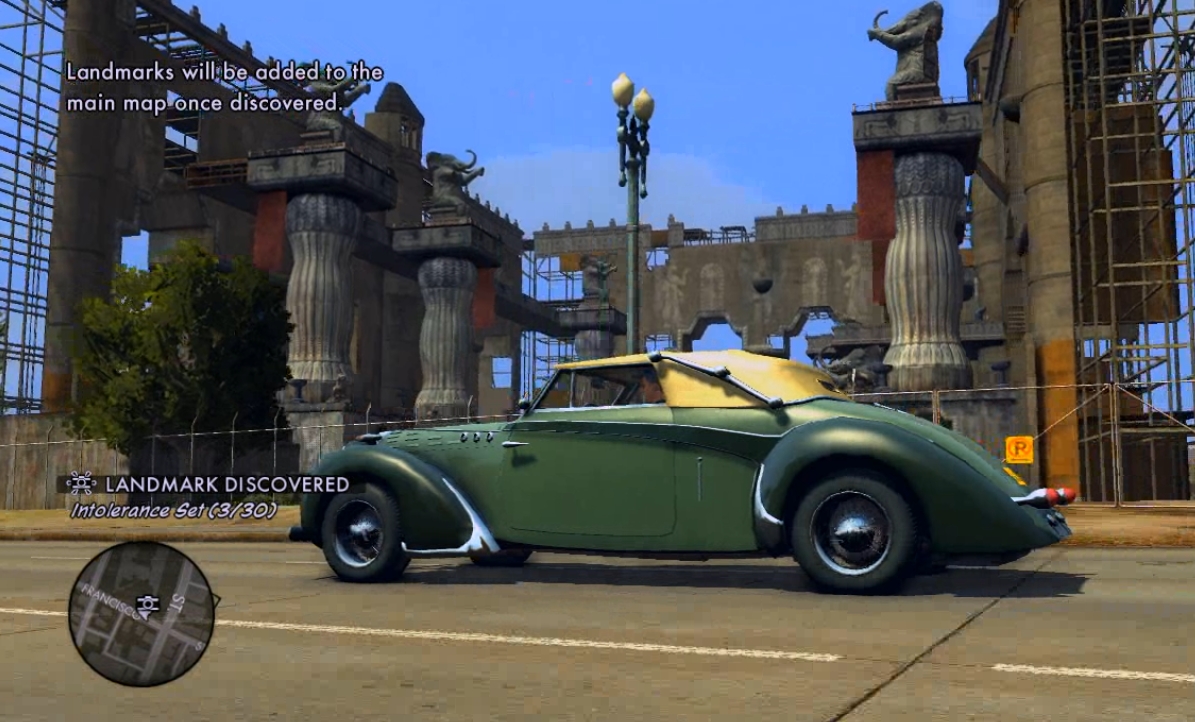
However, if you do enjoy driving through a video game, L.A. Noire‘s recreation of Los Angeles in the 40s has much to recommend it. Driving through the game’s version of Los Angeles, you’ll find plenty of evidence of America’s post-World War II optimism. New houses are being constructed. Innocent young women are hanging out on every street corner, looking to become a star. The theater marquees advertise movies like Odd Man Out. All of the famous Hollywood landmarks are lovingly recreated. An early case leads to you searching for clues behind the Hollywood sign. Another case actually leads to a firefight at the old Intolerance set while yet another case tests how much attention you’ve been paying by requiring you to solve a series of riddles that will lead you from one landmark to another. In the tradition of Raymond Chandler and James Ellroy, L.A. Noire challenges you to take a look at what’s happening underneath Los Angeles’s pleasing surface.
As a game, L.A. Noire holds up well. I won’t hold my breath for that sequel that was promised seven years ago but I did enjoy replaying it.
 Through the Shattered Lens