Late Night Retro Television Review: 1st & 10 3.2 “A Second Chance Once Removed”)


Welcome to Late Night Retro Television Reviews, a feature where we review some of our favorite and least favorite shows of the past! On Wednesdays, I will be reviewing 1st and Ten, which aired in syndication from 1984 to 1991. The entire series is streaming on Tubi.

This week, OJ Simpson makes things awkward.

Episode 3.2 “A Second Chance Once Removed”

(Dir by Stan Lathan, originally aired on August 12th, 1987)

With Coach Denardo no longer around, Diana has kept her promise and promoted Fred Grier to head coach.  However, Diana’s boyfriend and the new co-owner of the Bulls, Teddy, wants to hire T.D.’s old college coach, Red Macklin (John Robinson).  Though T.D. isn’t comfortable with the idea of betraying Fred or doing anything behind Diana’s back, he does agree that Macklin would be a better coach.  After an argument with his wife, T.D. flies out to his old college.

T.D. doesn’t do a very good job of selling the team to Macklin.  Macklin finally says, “You don’t want to be the head coach of the Bulls, do you?”  T.D. says that he does but the position has already been given to Fred and T.D. doesn’t believe in doing things without being upfront with everyone because …. well, I’ll let T.D. explain it….
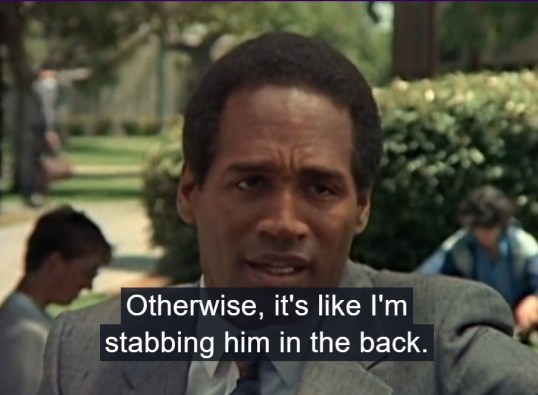
This episode is a good example of what happens when one of a show’s main characters is played by someone who is now best-known for somehow getting acquitted of stabbing his ex-wife and a waiter to death.  Even the most innocuous of lines seem to take on an entirely different meaning.  I have to admit that I cringed every time T.D.’s wife called and said that he was working too hard and spending too much time with the team.  No, I wanted to yell, don’t make him mad….

As for the rest of the episode, it largely dealt with training camp.  Veteran defensive player John Manzak (John Matuszak) fears that he won’t make the team.  There’s a young rookie who seems to have more energy and strength than him.  However, Manzak has a secret weapon …. steroids!  I cannot imagine that this is going to end well.

Meanwhile, the government wants to deport the Bulgarian kicker, Zagreb (John Kassir).  Zagreb applies for political asylum but it turns out that his father is some sort of official in the Bulgarian government and, as such, Zagreb would not be in any danger if he was sent back home.  (I don’t really follow that logic, to be honest.  Communist dictators, like Zagreb’s father, are notoriously unsentimental when it comes to their children.  Fidel Castro had children all over the world and he didn’t leave Cuba to a single one of them.  Instead, Justin had to settle for Canada.)  Diana has a solution, though.  They have to find Zagreb a wife.  Again, I cannot imagine that this is going to end well.

Meanwhile, Yinessa is still holding out for money, Bubba is still arguing with his wife, and I’m still not sure what Jethro does on the team.

This episode of 1st & Ten …. actually, it wasn’t that bad.  I could actually follow the story for once and it didn’t feel like it had been cut to ribbons for syndication.  John Matuszak actually gave a very touching performance as a player who might be past his prime.  Hopefully, things will work out for him.  We’ll find out next week!
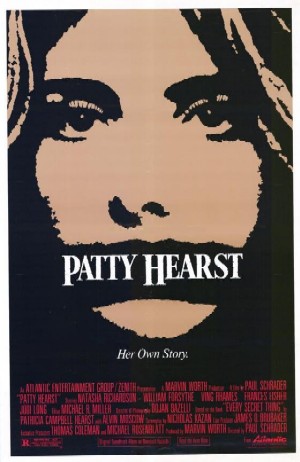
Film Review: Patty Hearst (dir by Paul Schrader)


The 1988 film, Patty Hearst, is based on a fascinating true story.

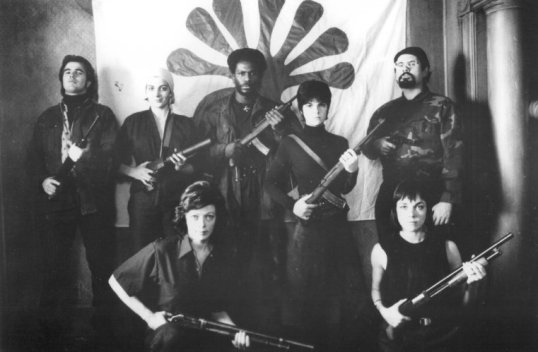
In 1974, newspaper heiress Patty Hearst was a 19 year-old student at Berkeley who was kidnapped from her apartment by a group of self-styled leftist revolutionaries known as the Symbionese Liberation Army (SLA).  The SLA was led by a charismatic escaped prisoner who called himself Field Marshal Cinque and who announced — via messages that Hearst read into a tape recorder — that Hearst was being held hostage in the name of social justice.  The police and FBI spent several months unsuccessfully searching for Hearst until one day, the SLA released an audio tape in which Hearst announced that she had now joined the SLA and would now be known as Tania.  Hearst was soon robbing banks and went from being a hostage to a wanted criminal.  When she was arrested in 1975, Hearst claimed to have been brainwashed by the SLA and people still debate whether she was a sincere revolutionary, a calculating criminal, or a victim.

(From what I’ve read about the Hearst kidnapping, I guess the modern day equivalent would be if Kendall Jenner disappeared and then resurfaced in Portland, setting cars on fire with Antifa.)

What can said for sure is that, after being arrested and convicted of bank robbery, Patty Hearst was sentenced to 7 years in prison.  Hearst served less than three years before her sentence was commuted by President Jimmy Carter.  Twenty years later, another President — Bill Clinton — gave her a full pardon.  Needless to say, the rest of the SLA did not receive a pardon or, for that matter, even a commutation.  The majority of them, including Field Marshal Cinque, died in a fiery explosion that came at the climax of a gun battle with police.  The rest were arrested, convicted, and ended up serving their full sentences.  Of course, while the majority of the SLA came from middle and upper middle class backgrounds, only one of them was the heir to a fortune.  When she was arrested, Patty may have given her career as being an “urban guerilla,” but ultimately, she was the granddaughter of William Randolph Hearst.

(Regardless of whether you believe Patty Hearst was brainwashed or not, it’s an undeniable fact that it’s easier to be a revolutionary when you know you won’t face any serious consequences if the revolution eventually fails.  If the members of the SLA were around today, they could just spend their time on twitter, retweeting John Fugelsang’s thoughts on Jesus.  But, in 1974, there was no twitter…)

Based on Every Secret Thing, Hearst’s own account of her kidnapping and subsequent life as a fugitive, Patty Hearst opens with the heiress (played by Natasha Richardson) being kidnapped and held prisoner by the SLA.  For the first fourth of the film, we see everything exclusively through Patty’s eyes.  She spends her days locked in a dark closet that’s so tiny that she can barely stand.  Whenever the door is opened, shafts a bright light flood both the closet and the screen, blinding not only Patty but the audience as well.  At first, Patty cannot even see the faces of the people who have kidnapped her.  All she knows are their voices.  Whenever that door opens, neither Patty nor the viewer knows whether she’s going to fed, berated, comforted, or raped.  All four of them happen to her, several times over the course of her time in that closet.  It’s harrowing to watch, all the more so because Natasha Richardson gives such an empathetic and bravely vulnerable performance as Patty.  When Patty is finally allowed to leave that closet, the audience is almost thankful as she is.  And, when Patty gets out of the closet, the look of the film changes as well.  It goes from being darkly lit to almost garishly colorful.  Patty’s entire world has changed.

The first part of the film is so powerful that it’s not surprising that the rest of Patty Hearst suffers by comparison.  Once Patty gets out of the closet and declares her allegiance to the revolution, she becomes a bit of a dead-eyed zombie and the focus naturally shifts to the rest of the SLA.  Ving Rhames gives a powerful performance as Cinque, the head of the SLA.  Cinque may be a passionate revolutionary but he also has a dangerous messianic streak.  Even worse, the film suggests, is Cinque’s lieutenant, Teko (William Forsythe).  Teko claims to be a revolutionary but ultimately reveals himself to be as much of a misogynist as those who he claims to oppose.  (Today, Teko would probably be one of those guys arguing that it’s okay for him to use the C word because he’s an “ally.”)  Whereas Cinque has no doubt about his revolutionary commitment, Teko always seem to be trying to prove something to everyone, especially himself.

Ultimately, Patty becomes almost a bystander to her own story.  For a time, she is the most famous bystander in the country.  Though the film is sympathetic to Patty, Natasha Richardson plays her with just a hint of ambiguity.  Ultimately, Patty comes across as someone desperately searching for an identity.  Since she is not sure who she ultimately is, it’s easy for Patty to become an “urban guerilla” and it’s just as easy for to her go back to being an heiress.  By the end of the film, it’s obvious that Patty is just as confused by her life as everyone else.

Patty Hearst was directed by Paul Schrader, who is best known for writing the scripts for such films as Taxi Driver and Rolling Thunder.  (Among Schrader’s other directorial credits: Blue Collar, Hardcore, American Gigolo, Cat People, and The Canyons.  Needless to say, he’s had an interesting career.)  In many ways, Patty Hearst is probably more relevant today than it was first released.  Considering that our culture is currently dominated by people pretending to be revolutionaries and celebrities famous solely for being famous, Patty Hearst feels rather prophetic.

Watching this film and experiencing Patty’s transformation from vapid heiress to brainwashed political activist to briefly notorious celebrity, I realized that we now live in a world of Patty Hearsts.