Retro Television Review: Indict & Convict (dir by Boris Sagal)


Welcome to Retro Television Reviews, a feature where we review some of our favorite and least favorite shows of the past!  On Sundays, I will be reviewing the made-for-television movies that used to be a primetime mainstay.  Today’s film is 1974’s Indict & Convict!  It  can be viewed on YouTube.

There’s been a murder!

The wife of Assistant District Attorney Sam Belden (William Shatner) has been found, shot to death.  Making things especially awkward is that the body of her lover is found next to her.  Though Belden is the obvious suspect, he has an alibi for the time of the murders.  He claims that he was in Las Vegas, attending a convention.  Two gas station attendants remember seeing him filling up his car with gas at around the same time that his wife and her lover was being shot.

Attorney General Timothy Fitzgerald (Ed Flanders) is not so sure that Belden is innocent.  He instructs two of his top prosecutors to check out Belden’s story and to see if there’s enough evidence to not only indict but also to convict.  Bob Matthews (George Grizzard) is a veteran prosecutor and he’s the one who narrates the story for us.  Assisting him is Mike Belano, who is played by the always likable Reni Santoni.  Just three years before this movie aired, Santoni played Harry Callahan’s partner in Dirty Harry.  There was just something about Santoni’s friendly but determined demeanor that made him perfect the role of the supportive partner or assistant.

The film is very much a legal procedural, with the emphasis on not only the investigation but also on the strategies and the techniques that are used in the courtroom by Matthews and defense attorney DeWitt Foster (Eli Wallach).  In many ways, it feels like a forerunner to Law & Order.  Usually, I love court procedurals but Indict & Convict was a bit too slow and high-minded for its own good.  Maybe it’s because I’ve been spoiled by all of the legal shows that I’ve seen but I have to admit that I spent a good deal of Indict & Convict wanting the prosecutors to get on with it.  Flanders, Grizzard, Santoni, and Wallach were all ideally cast but the film itself sometimes got bogged down with all the debate about the best way to win a conviction.  It’s a shame because the story itself is an intriguing one and I actually enjoyed the movie’s use of spinning newspaper headlines to let us know what had happened in between scenes.  Also, as a classic film fan, I enjoyed seeing Myrna Loy as the judge.  She didn’t get to do much other than say, “Sustained” and “Overruled,” but still …. Myrna Loy!

Most people who watch this film will probably do so out of the hope of seeing some trademark Shatner overacting.  William Shatner doesn’t actually get to say much in this film.  He spends most of the running time sitting silently at the defense table.  Towards the end, he does finally get a chance to deliver a brief speech and it’s everything you could hope for.  Shatner takes dramatic pauses.  Shatner emphasizes random words.  Every line is delivered with the subtext of, “Pay attention, Emmy voters!”  Eventually, Shatner would learn the value of laughing at oneself but apparently, that lesson had not yet been learned when he did Indict & Convict.

A Movie A Day #325: Damnation Alley (1977, directed by Jack Smight)


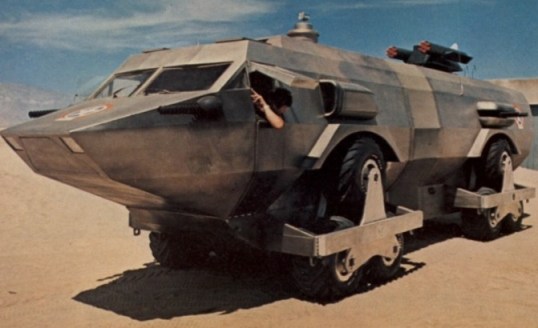
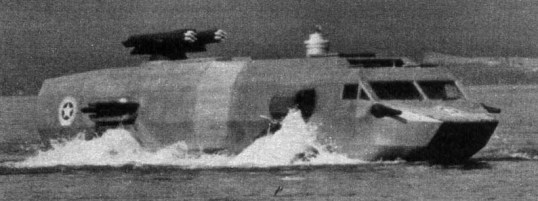
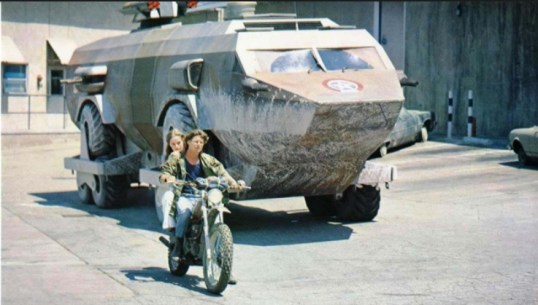
Anyone who has seen Damnation Alley knows that the only thing that matters is the Landmaster.

Damnation Alley has a slight plot.  A nuclear war has knocked the Earth off of its axis.  The skies are green and purple.  The scorpions are huge and the cockroaches eat humans.  Crazed survivors are living like savages, attacking anyone that they come across.  When a radio signal seems to indicate that there might still be civilization in Albany, four military men (George Peppard, Jan-Michael Vincent, Paul Winfield, and Kip Niven) decide to drive across the country to check it out.  To reach Albany, they will have to cross an inhospitable stretch of land called Damnation Alley.  They will be making the journey in two Landmasters, amphibious vehicles that provide RV comfort with the extra advantage of a rocket launcher.  Along the way, they fight scorpions, roaches, and pick up some extra passengers (Dominique Sanda and Jackie Earle Haley).

The radioactive sky looks cool but otherwise, the scorpions and the cockroaches are all obviously fake and no one in the cast makes any effort to do more than recite their lines.  But no one who has watched Damnation Alley cares about any of that.  We just want to drive a Landmaster.

There is nothing that the Landmaster cannot do.  It  can speed across desert sand.  It can tear up city streets.  It can break through walls.  It can turn into a boat.  It can fire missiles.  It also appears to be bigger on the inside than the outside, just like the TARDIS.  Either that or whoever did the set design for Damnation Alley was not detail-oriented.

Despite the awe-inspiring Landmaster, Damnation Alley was neither a critical nor a box office hit.  It was one of two science fiction films released by 20th Century Fox in 1977.  The other one was Star Wars, which was a good movie but didn’t have a Landmaster.

As for the Landmaster itself, it currently resides in California and has appeared in a handful of other movies.  Sadly, it missed out on the opportunity to appear in any of the Smoky and the Bandit movies.  Burt Reynolds driving a Landmaster?  That would have been box office gold.

Right, Burt?

Film Review: Magnum Force (dir by Ted Post)


Today, we continue our look at the Dirty Harry film franchise by taking a look at the second film in the series, 1973’s Magnum Force.

Despite the fact that Dirty Harry famously ended with Harry Callahan throwing away his badge in disgust, Magnum Force reveals that Callahan (played again by Clint Eastwood) is still a member of the San Francisco Police Department.  He’s got a new partner (Felton Perry, a likable actor in a thankless role) but he’s still butting heads with his superiors at the department.  He’s also still got a way with the one-liners.  When Lt. Briggs (Hal Holbrook) brags that he never once had to draw his gun while he was in uniform, Callahan replies, “A man’s got to know his limitations.”

While Callahan is busying himself with doing things like gunning down robbers and preventing an attempt to hijack a plane, a group of motorcycle cops are gunning down the town’s criminals.  They begin by killing a mobster who has just beaten a murder charge on a technicality but soon, they’re gunning down anyone who has ever so much as been suspected of committing a crime.  Alone among the detectives investigating the murders, Callahan believes that the killers are cops and, even worse, he suspects that his old friend Charlie McCoy (played by Mitchell Ryan) might be a member of the group…

Though it suffers when compared to Dirty Harry, Magnum Force is still an exciting and effective action film that is clearly a product of the same period of time that gave us such classics of paranoid cinema as The Parallax View and Three Days of the Condor.  Whereas Dirty Harry took an almost documentary approach to capturing life and death in San Francisco, Magnum Force is a film that is full of dark shadows and expressionistic angles.

In Dirty Harry, the Scorpio Killer was both an obvious outsider and an obvious force of destruction.  The film’s dramatic tension came from the fact that he was so clearly guilty and yet nothing could be done to stop him.  The villains in Magnum Force are the exact opposite of Scorpio.  As chillingly played by David Soul, Robert Urich, Tim Matheson, and Kip Niven, the killer cops are distinguished not by their otherness but by their total lack of individuality.

In the film’s best scene, they confront Harry in a parking garage and basically tell him that he’s either with them or against him.  Sitting on their motorcycles, wearing their leather jackets, and with their grim faces hidden behind their aviator sunglasses, these cops are the ultimate representation of  faceless fascism.  After listening to their excuses, Harry asks if they consider themselves to be heroes.

“All of our heroes are dead,” one of them replies, delivering the film’s best line.

Obviously, Magnum Force was made to be an answer to those critics who claimed that Dirty Harry was a fascist film and it is a bit jarring, at first, to see Harry “defending” the system.  (“I hate the goddamn system but until something better comes along…”)  When Harry tells the killer cops, “I’m afraid you’ve misjudged me,” it’s not hard to see that this is the same message that Eastwood meant to give his critics.

However, what makes the killer cops in Magnum Force such interesting villains is that they are, ultimately, tools of the system that they’re attempting to destroy.  By killing off criminals as opposed to arresting them and putting them on trial, the killer cops are minimizing the risk of the flaws inherent in the system being exposed.  Hence, by defending the system, Harry is helping to expose and destroy it.

When I told Jeff that I was planning on watching and reviewing all of the Dirty Harry films, he suggested that I watch them in reverse-order.  His logic was that, since the films tended to get worse as the series progressed, watching them backwards would allow me to end my project on a happy note as opposed to a note of bitter disappointment.  I took his advice and I’m glad I did.  While I disagree with him about whether or not The Dead Pool is a better film than Sudden Impact, I do have to agree that the first two Dirty Harry films are dramatically better (and quite different in tone) from the ones that subsequently followed.

Tomorrow, we’ll look at the third film in the series, 1976’s The Enforcer.