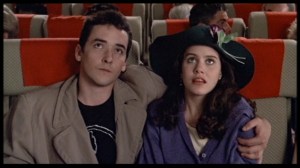
Embracing the Melodrama Part II #91: A Reason to Believe (dir by Douglas Triola)


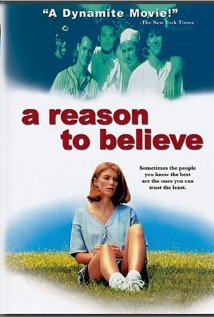
A Reason to BelieveThroughout the late 90s, a rather obscure film from 1995 called A Reason To Believe used to show up on Cinemax fairly frequently. I was 11 when I first saw it.  At the time, I was indulging in my rebellious streak by secretly staying up past my bed time and sneaking into the living room, where I would watch whatever forbidden sordidness what being aired.  Because I didn’t want to wake anyone up, I would watch with the volume turned almost all the way down.  Hence, when I first saw A Reason To Believe, I literally had to sit less than an inch away from the TV just so I could hear the dialogue.

And I remember that, at the age of 11, A Reason To Believe really blew me away.  I thought it was one of the greatest films that I had ever seen.  The fact that the film involved college students made me feel like I was both watching a movie for adults and getting a preview of what life would be like when I was older.  All of the sex and the language made me feel like I was getting away with something while I was watching it.  At one point, there was a shot of Sharon (played by Holly Marie Combs) putting a condom on Wesley’s (Danny Quinn) erect penis and I found myself glancing over my shoulder, convinced that at any minute a responsible adult was going to enter the living room and say, “WHAT ARE YOU WATCHING!?”

So, when I recently rewatched A Reason To Believe, I did so wondering how the film would hold up now that I’m an adult.  Not surprisingly, a good deal of the film now seemed to be heavy-handed.  For every good line in the script, there was a line that was way too obvious.  Characters who were funny when I was 11 — like dorky stoner Potto (Keith Coogan) — now seemed to be annoying.  And, of course, my more experienced eyes immediately realized that Holly Marie Combs was putting that condom on a prosthetic penis.

And yet, A Reason To Believe is still fairly effective and probably deserves to be better known than it actually is.  Usually, I refuse to give extra credit for good intentions but I’m willing to make an exception for A Reason To Believe because the film deals with a subject that, now more than ever, needs to be dealt with.

Charlotte (Allison Smith) is a student at an unnamed generic university.  When her boyfriend, Wesley (Danny Quinn), has to go away for the weekend, he asks Allison not to go to Viking, an annual party thrown by his fraternity.  Charlotte promises that she won’t but then goes anyway.  At Viking, she hangs out with Wesley’s best friend, Jim (Jay Underwood).  Jim is also dating Allison’s friend, Judith (Kim Walker).  Realizing that she’s had too much to drink, Allison attempts to leave the party but instead, Jim leads her into his bedrom.  He kisses her.  She says no but Jim forces himself on her.  Repeating all the old bullshit excuses (i.e., Charlotte was flirting with him, all girls say no when they mean yes, and all the rest) Jim seems to truly believe that the sex was consensual.  Charlotte knows it was rape.

At first, Charlotte doesn’t want to face what happened.  When she finally does go to the university administration and reports what happened, the frat — including her boyfriend — comes together to protect Jim.  Charlotte’s friends — like Judith — abandon her.  Her only supporter is Linda (Georgia Emelin), an anti-fraternity campus activist who is more interested in Charlotte as a means to an end than as a human being.

A Reason To Believe held up fairly well.  Yes, it’s heavy-handed and a lot of the dialogue is too spot-on and literal.  I could have done without the scenes featuring Obba Babatunde as a bombastic professor.  However, Allison Smith and Jay Underwood both gave excellent performances in the two lead roles and the film deserves a lot of credit for not shying away from just how misogynistic the fraternity/sorority culture can truly be.  Ultimately, flaws and all, it’s a valuable, realistic, and angry portrayal of rape culture and it deserves to be seen for that reason.

It can currently be viewed on YouTube.

Back to School #46: Heathers (dir by Michael Lehman)


heathers-movie-poster

Well, it had to happen.  We have finally reached the end of the 80s with this Back to School series of reviews.  The 80s are often considered to be the “Golden Age of Teen Films,” largely due to the efforts of director-writer-producer John Hughes.  In films like The Breakfast Club and Ferris Bueller’s Day Off, Hughes skillfully mixed teen comedy with teen drama and the end results were some of the best-remembered and most influential films ever made.  At the same time, it’s also can’t be denied that, even as he was dealing with real issues of class differences and sexuality, Hughes also tended to idealize his teenage protagonists.  They were often cast as noble savages, struggling to survive in a world that was exclusively run by cynical and judgmental adults.  In The Breakfast Club, Ally Sheedy says that when you grow up, your heart dies.  That, more than anything, defines the way that most of the great teen films of the 80s tended to view the world.

By the end of the 80s, John Hughes had stopped making films about high school and teenagers and so, it is perhaps appropriate that the final Back to School review of the 80s should be for a 1989 film that often time seems to be taking place on a totally different plant from the films of John Hughes.  If Hughes told us that your heart dies when you grow up, Heathers would seem to suggest that most people’s hearts were never alive to begin with.

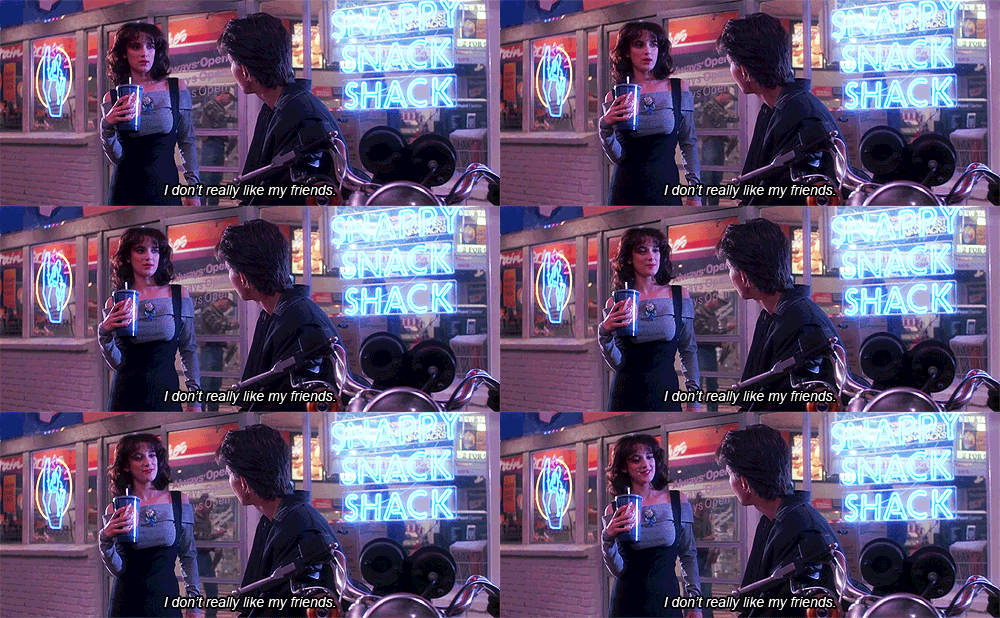
Heathers takes place at Westerburg High, a school full of student so rich that their mascot is a Rottweiler.  Westerburg is run by a clique of three mean girls, all of whom are named Heather.  Heather Chandler (Kim Walker) is their leader.  Cheerleader Heather McNamara (Lisanne Falk) is weak-willed and insecure.  And finally, Heather Duke (Shannen Doherty) is the smartest of the Heathers.  She’s also bulimic.  Now, there is a fourth member of the ruling clique but she’s a bit of an anomaly because she’s neither mean nor named Heather.  Instead, her name is Veronica (Winona Ryder) and she is valued for her ability to forge signatures.

Heathers

Since joining the Heathers, Veronica has drifted away from old friends like Betty Finn (Renee Estevez).  And though Veronica quickly realizes that she doesn’t really belong with the Heathers, she doesn’t know how she can break free without also destroying her reputation of Westerburg.  Then, she meets J.D. (Christian Slater), a prototypical rebel with a cause.  J.D. is not only an outsider at Westerburg but he’s proud of it.  Soon, he and Veronica are a couple and J.D. is pulling Veronica into his plans to destroy the social hierarchy of Westerburg High.

When a practical joke arranged by J.D. and Veronica leads to the accidental death of Heather Chandler, J.D. convinces Veronica to forge a suicide note.  As a result, Heather Chandler is canonized by the same students that she previously terrorized.  However, J.D. is not done killing.  With each new death (and with each forged suicide note), a new social hierarchy starts to form at Westerburg until, eventually, J.D. comes up with a plan that owes a bit to the end of Massacre at Central High

fashion-film-volume-8-heathers--large-msg-132147013822

Heathers is a darker than dark comedy and one that I imagine probably could not be made today.  (To be honest, I’m a little bit surprised that it could be made in 1989.)  Seriously, a comedy where one of the main plot points is that students become more popular after everyone has been fooled into thinking they committed suicide?  (Not to mention a scene where a grieving father shouts, “I love my dead gay son!”)  People would get so offended if this film was made today but you know what?  They would be totally missing the point.  The film isn’t making fun of suicide as much as it’s exposing the hypocrisy of a society that only seems to care about people after they die. To me, the most important scenes aren’t the ones where people react to the fake suicides.  Instead, the heart of Heathers‘s dark vision is to be found in the scene where a true outcast like Martha Dunnstock (Carrie Lynn) fails in her attempt to commit suicide and is ridiculed by the same students and teachers who were previously patting themselves on the back at Heather Chandler’s funeral.

Heathers is dark but it’s also a genuinely funny film, filled with great lines and performances.  (“Fuck me gently with a chainsaw,” is my personal favorite.)  It’s a film that still carries quite a satiric bite and a perfect film with which to end the 80s.

8-Heathers-quotes


Back to School #45: Say Anything… (dir by Cameron Crowe)


220px-Say_Anything

For the past two and a half weeks, we’ve been taking a chronological look at some of the best, worst, most memorable, and most forgettable teens films ever made.  We started with two films from 1946 and now, 43 films later, we’ve reached the end of the 80s.  And what better way to close out the decade that is often considered to be the golden age of teen films than by taking a look at two films from 1989 that both paid homage to the films that came before them and also served to influence the many films that would come after.

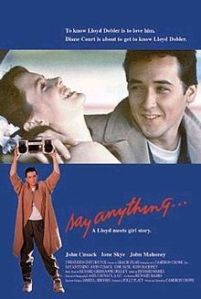
When people talk about Say Anything…, they usually seem to talk about the fact that it was the directorial debut of Cameron Crowe (who, it must be said, launched the golden age of teen films by writing Fast Time At Ridgemont High) and that it features what may be John Cusack’s best performance.  Famously, Cusack apparently felt that — after performances in Class, Sixteen Candles, and Better Off Dead — he was through playing teenagers.  But then he read Crowe’s script and was so impressed by it that he agreed he would play a student one last time.

It may, however, have helped that the character Cusack plays, a likable and easy-going kickboxing enthusiast named Lloyd Dobler — is only briefly seen as a student.  He graduates from high school early on in the movie.  That majority of Say Anything… deals with the summer right after high school.*  Lloyd has an unlikely but heartbreakingly real romance with Diane Court (Ione Skye), the valedictorian.

Cusack is so charming as Lloyd (and, needless to say, he gets all of the best lines) that I think people tend to overlook the fact that Ione Skye is equally as good.  Diane is actually a far more challenging role than Lloyd.  Whereas Lloyd is distinguished by his confidence and his friendly manner, Diane is neurotic, shy, and unsure of herself.  She’s won a scholarship to study in England and is scheduled to leave at the end of the summer but she’s scared of flying.  Even worse, her father, Jim Court (John Mahoney), is being investigated by the IRS.  As the summer progresses, Diane is forced to deal with the fact that not only has her seemingly perfect father broken the law but, when he’s confronted with his crimes, he uses his daughter as his excuse.  Yes, Jim seems to be saying, I stole money but I only did it to give you the best life possible.

Everyone seems to remember Say Anything… as the film that has that scene where Lloyd serenades Diane by holding that radio over his head.  And yes, that’s a wonderfully romantic scene, even if it’s been parodied so many times that it’s probably no longer as effective as it was when the film was first released.  But for me, Say Anything… is truly about Diane growing up and realizing that her father is not the saint that she thought he was.  (Making this realization especially upsetting is the fact that, initially, Mahoney is so likable in the role.)  You’re happy that Lloyd is there for her and you truly do come to love him because he is the perfect boyfriend, but ultimately, Say Anything… is Diane’s story.

(That said, though, I have to admit that some of my favorite scenes are just Lloyd talking to his friends.  Lili Taylor gives a great performance and how can you not laugh at Jeremy Piven hanging out at the convenience store?)

Ultimately, of course, the film works because both Lloyd and Diane come across as real human beings.  They’re not just boyfriend and girlfriend.  Instead, they’re two very likable characters who have been lucky enough to find each other.  In the end, you love Lloyd not because he’s funny or quirky but because he loves Diane for who she is.

Of course, it also helps that Say Anything has the perfect ending.

Ding!

Say-Anything_199

—-

* On a personal note, the summer after I graduated high school was the best summer of my life because I spent most of it in Italy!  Viva Iatalia!