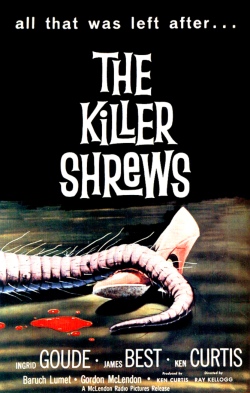
The TSL’s Horror Grindhouse: The Killer Shrews (dir by Ray Kellogg)


Genetic modification.  Sure, it sounds like a good idea.  But are the results ever worth it?

Dr. Marlowe Cragus (Baruch Lumet) thought it was a good idea.  That why he and his daughter, Anne (Ingrid Goude), and Anne’s boyfriend, Jerry (Ken Curtis), all moved to an isolated island.  Dr. Cragis though he could perform some experiments on some shrews and that he would unlock the secret of how to …. well, who knows what Dr. Cragis thought he was actually doing.  (I mean, to be honest, who is really sure what a shrew really is?)  Cragis claims that he was trying to end world hunger but that sounds like a convenient excuse.  To be honest, it seems like Dr. Cragis was just experimenting for the sake of experimenting.

Unfortunately, Cragis’s experiments somehow led to the shrews turning into giant and carnivorous beasts.  At first, the doctor kept them locked up.  But then Anne broke up with Jerry and Jerry got drunk and he let all the shrews go free.  Yep, it’s a mess.  Now, the shrews are running around the island and the doctor and everyone else is trapped in the lab.  Boat captain Thorne Sherman (James Best) has arrived to take everyone back to the mainland but, unfortunately, there’s a hurricane approaching.  The humans will have to survive one more night on the island of …. THE KILLER SHREWS!

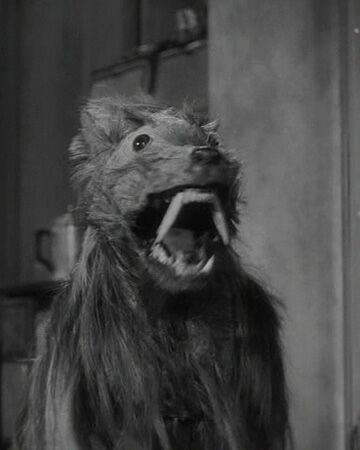
Directed by Ray Kellogg, The Killer Shrews was filmed in 1959.  It was a regional production, filmed just outside of my hometown of Dallas and released to local drive-ins.  It did well enough to get national distribution and it continues to be popular among aficionados of bad cinema.  The main problem with The Killer Shrews is that the shrews themselves are obviously just dogs that are wearing shrew masks.  For the most part, the dogs seem to be happy to be there.  I’m pretty sure that I saw a few of them wagging their tails shortly before launching their attack on the humans.  We’re told that the shrews are killers but they don’t look like they’ve ever killed anything.  Instead, they look like very good boys.  One gets the feeling that they were a lot of fun to play with between filming.

That said, The Killer Shrews is entertaining if you’re looking for a short movie that will inspire a good laugh or two.  James Best and Ken Curtis play romantic rivals and the fact that they both attempt to give serious performances only serves to highlight the absurdity of a group of people being held prisoner by a pack of shrews.  Baruch Lumet, the father of director Sidney Lumet, acts up a storm in the role of Dr. Cragis, yelling all of his dialogue like the stage veteran that he was.  And, of course, the dogs playing the shrews appear to be having the time of their lives. Hopefully, someone tossed around a tennis ball with them after they finished their scenes because they definitely earned the reward.

The Killer Shrews is not exactly a killer movie but at least the dogs are cute!
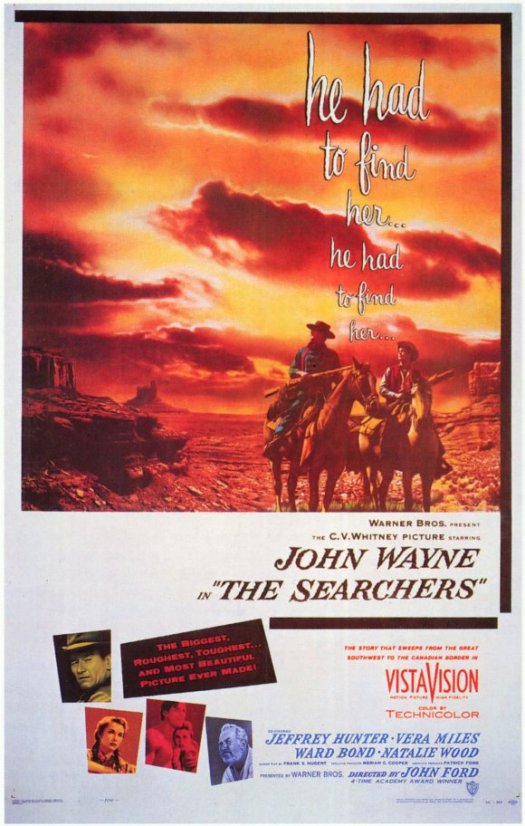
Ride Away: John Wayne in John Ford’s THE SEARCHERS (Warner Brothers 1956)


gary loggins's avatarcracked rear viewer

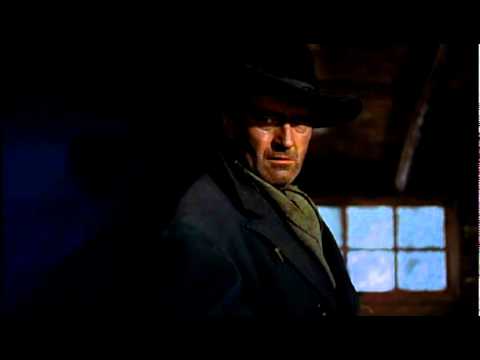
John Ford’s  THE SEARCHERS is without question an American Film Classic. I’d even go as far as saying it’s my second all-time favorite film, directly behind CASABLANCA. Every shot is a Remington Old West masterpiece, every actor perfect in their role, large or small, and not a minute of footage is wasted. The film has also stirred up quite a bit of controversy over time for John Wayne’s portrayal of the main character Ethan Edwards.

The plot is structured like Joseph Campbell’s “Hero’s Journey”, but let’s get it out of the way right now: Ethan Edwards is no hero. He’s a mean, bitter, unreconstructed Confederate who’s been on the shady side of the law since war’s end. When he returns to his brother Aaron’s homestead, he makes no bones about his distaste for “half-breed” Martin Pawley (really an eighth Cherokee). His hatred of Native Americans even extends to their dead, as…

View original post 1,096 more words

Creature Double Feature: THE BLACK SCORPION (1957) and THE KILLER SHREWS (1959)


gary loggins's avatarcracked rear viewer

Creature_Double_Feature_Logo

Back in the glory days of local television, Boston’s WLVI-TV (Channel 56) ran a Saturday afternoon movie series titled “Creature Double Feature”. It was a huge ratings hit during the 1970’s, introducing young viewers to the BEM (bug-eyed monsters) movies of the past. Let’s return now to those halcyon days of yesterday with a look at two sci-fi flicks from the fabulous 50’s.

scorp

First up is THE BLACK SCORPION, a 1957 giant monster movie from Warner Brothers. This low-budget saga starts off with stock footage of volcanos erupting and earthquakes a-quaking, and a hyperbolic narrator expounding on natural disasters threatening Mexico. Two brawny geologists, Hank and Artur, investigate the devastation. While out scouting they run into beautiful rancher Teresa Alvarez, whose vaqueros have fled the hacienda in fear. After getting them back on the ranch, our scientists attend an autopsy of a dead Mexican cop (the doctor performing the autopsy looks like he…

View original post 757 more words

Shattered Politics #14: The Last Hurrah (dir by John Ford)


Last_Hurrah

Down here in Dallas, we have a county commissioner named John Wiley Price.  Even if you don’t live in Texas, you might have heard about him.  A few years ago, Price stormed out of a commissioners meeting while shouting, “All of you are white!  Go the Hell!”  It was a popular YouTube video for a while and attracted all of the usual type of comments that you see online.  It even made the national news.

Nobody down here in Dallas was surprised by Price’s outburst.  To us, that was just John Wiley being John Wiley.  For that matter, nobody was particularly surprised when it was reported that he was being investigated by the FBI.  Everyone always took it for granted that John Wiley Price was taking bribes and receiving kickbacks.  That’s just the way that things are done down here in Dallas, by politicians both white and black.  (Of course, most of the white politicians who do it don’t get publicly investigated by the FBI.)

Now, if you ask the majority of people in Dallas county what they think about John Wiley Price and they’ll probably say something negative.  I’ll admit that I would probably be among them.  But the thing is — John Wiley Price’s constituents love him.  John Wiley Price was first elected to the commissioner’s court before I was even born and, as long as he’s on the ballot, he will be reelected.  Even if Price is convicted on corruption charges, he will still be reelected.

I can still remember the night that it was announced that John Wiley Price was on the verge of being arrested by the FBI.  All across his district, emergency meetings were held in churches and ministers stood behind the pulpit and, while the TV cameras rolled, they called upon everyone to pray for John Wiley Price.  In Price’s district, he’s known as “our man downtown,” the idea being that John Wiley Price is standing up to the rich and white Dallas establishment and, if he makes some money for himself in the process, so be it.  As long as he’s doing right for the people who elected him, who cares how he does it?

And, as much as we may want to judge the John Wiley Prices of the world, the fact that of the matter is that he’s a part of a long American political tradition.  That political tradition is also the driving force behind today’s final entry in Shattered Politics.

First released in 1958 and directed by John Ford, The Last Hurrah tells the story of Frank Skeffington (Spencer Tracy), the mayor of an unnamed city in New England that’s obviously meant to be Boston.  Skeffington is the flamboyant head of a large and powerful (but, as the film makes clear, aging) Irish-American political machine.  He’s preparing to run for his fifth term for mayor, a campaign that he says will be his last.

Whether Frank Skeffington is a good mayor or not depends on who you ask.  The poor and the disenfranchised love him.  Skeffington, after all, is the son of Irish immigrants.  He was born poor.  His mother worked as a maid and was even fired by a member of the wealthy and influential Force family.  They know that Skeffington has had to cut corners and that he’s gone out of his way to reward his cronies but they also know that Skeffington is on their side.  Though the phrase is never used in the film, Skeffington is “their man downtown.”

Meanwhile, the wealthy and the upper class see Frank Skeffington as being a crook, a man who has run a corrupt administration and who uses class warfare to keep the city divided against itself and to make himself and his cronies rich.  Newspaper editor Amos Force (John Carradine) has thrown his considerable influence between Skeffington’s opponent, a wealthy but dull man named Kevin McCluskey.

Reporter Adam Caulfield (Jeffrey Hunter) is in an interesting position.  On the one hand, he is Skeffington’s nephew.  On the other hand, as a journalist, he works for Amos Force.  Skeffington invites Adam to follow and record his final campaign for posterity.

It’s interesting to compare The Last Hurrah to films like The Boss or All The King’s Men.  Whereas those two films came down squarely on the sides of the reformers, The Last Hurrah is firmly on the side of Frank Skeffington.  It presents Skeffington as being a sentimental figure, the type of old-fashioned, populist politician who won office by going out and meeting the people face-to-face and personally giving them a reason to vote for him.  As Skeffington himself points out, he’s the type of politician that will soon be made obsolete by television and modern campaigning.

And it’s impossible not to enjoy The Last Hurrah‘s refusal to pass judgment on its lead character.  It helps, of course, that Spencer Tracy plays Skeffington with a twinkle in his eye while all of his opponents are played by villainous and aristocratic character actors like John Carradine and Basil Rathbone.  Yes, the film says, Skeffington may have been corrupt but at least he wasn’t boring!

Finally, I enjoyed the film because all of the “good” guys were Irish Catholic and all of the bad guys most definitely were not.

So, with that last hurrah, we conclude Shattered Politics for today.  We’ll be back tomorrow, when we’ll start to get into the 1960s.

Sláinte!