For the record, you can count me amongst those who thinks that Ben got everyone killed. We root for Ben because he’s the more likable character but, in the end, Harry was right and Ben ended up becoming a cold-blooded murderer. These are the type of things that make Night of the Living Dead the scariest zombie film ever made. The living are just as terrifying as the dead.
I should also note that, for all the criticism the character gets, Barbara has one of the most totally realistic reactions that I’ve ever seen in a horror movie. She’s in shock and denial. I would probably have the same reaction.
And now, here is the greatest zombie film ever made!
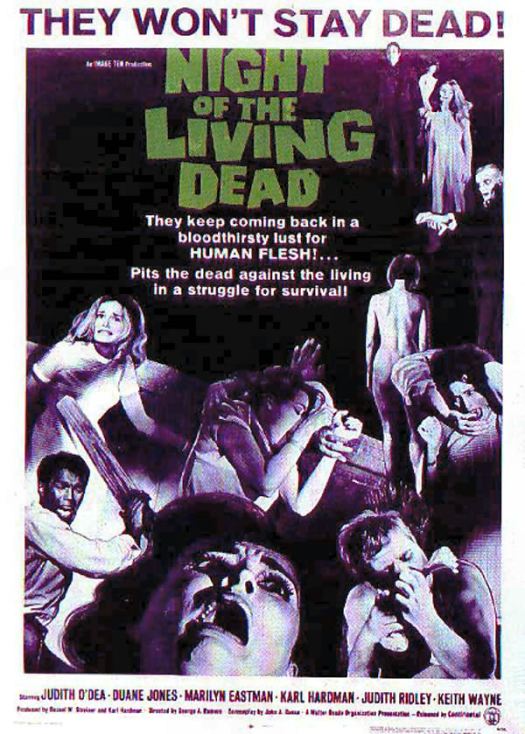
Well, as another horrorthon draws to a close, it’s time for another Shattered Lens tradition! Every Halloween, we share one of the greatest and most iconic horror films ever made. For your Halloween enjoyment, here is George Romero’s Night of the Living Dead!
The late, great George A. Romero’s first feature, NIGHT OF THE LVING DEAD, was shot in the wilds of Pittsburgh, PA on a budget of $114,000. This unheralded, gruesome little indie became a landmark in horror, influencing and inspiring generations of moviemakers to come. Better scribes than your humble correspondent have written countless analyses on the film, so I’m going to give you my perspective from my first viewing of the film… at the impressionable age of 13!
My cousin and I, both horror buffs, first saw it as the bottom half of a double feature in 1970. The main attraction was EQUINOX , which came highly recommended by Forrest J Ackerman , editor of the Monster Kid’s Bible, FAMOUS MONSTERS OF FILMLAND. As we eagerly awaited the main attraction, we sat through the warm-up, NIGHT OF THE LIVING DEAD. At first, we thought it was an older rerelease, because…
Lisa Marie has been posting some very good pubic domain horror films for the past couple weeks and I think it’s about high time I posted one of the best public domain films. This one happens to be a horror film and also happens to be one of the best horror films ever made. I would be of the mind to call this one of the most important films ever made in the last hundred years.
The film I speak of is George A. Romero’s classic and iconic horror film from 1968 simply called Night of the Living Dead. I’ve reviewed and posted this film from over a year ago, but it’s only been recently that Youtube has had a quality HD version of the full film uploaded to its site. Now, people don’t need to go find and buy the countless DVD versions of this film floating around in almost every store imaginable. I think even 7-11 and corner mom-and-pop stores carry a dvd of this film. This is why public domain films can be such a boon to films of the past (though also a curse since some transfers of pubic domain films are beyond awful) that tend rarely get a video release.
Fortunately, Night of the Living Dead is not one of those films. It’s the opposite in that it’s a film that many consider the birth of modern horror cinema and one of the perfect example of guerrilla filmmaking. It’s a film that didn’t just change how we look at horror now (gone are the gothic trappings that most horror had prior), but it also was one of the few horror films to successfully marry not just scares but thought-provoking themes and ideas. Even now most horror films fail to do one of the other let alone both at the same time.
The modern zombie genre of entertainment (films, stories, video games and even protest movements) owe it’s existence to this little low-budget horror film from the late 60’s by a Pittsburgh native and his friends who decided to pool their money together and make a horror flick. It’s a film that still stands the test of time. When all the hoopla over the Paranormal Activity nonsense, remakes of horror (both good and bad) and teen-sanitized horror goes by the wayside this film will continue to impress, remain relevant and still scare (pardon my French) the shit out of young people discovering it for the first time.
I wasn’t born yet when George A. Romero’s Night of the Living Dead was first released in theaters, but I’ve wished many a night that I was old enough to have seen this classic horror film on the big screen. Night of the Living Dead simply changed the film industry forever and showed that horror was taking an uncharted road toward realism, brutality, and true terror. Before Romero’s film, horror often echoed the classic 1940s Universal style or the technicolor Hammer Films. Night of the Living Dead became the torchbearer of what would soon evolve into the splatter and exploitation films of the following decades. The influence this film has had on horror filmmakers is still ongoing.
Zombie films existed long before Night of the Living Dead, but they mostly depicted the traditional Haitian voodoo variety—with zombies as heavily drugged victims forced into slave labor for merciless masters. Romero changed all that in 1968. Made on a shoestring budget even by the standards of the time, Romero and his friends decided to make their own horror movie. The premise was simple: radiation from a returning Venus probe (though later films in the series abandoned that explanation for something more vague) somehow reanimated the recently deceased—though these zombies only had the most basic motor skills. That alone was terrifying enough. But Romero took it further by giving the zombies a new motivation: an unending hunger for the flesh of the living. With this, Night of the Living Dead marked the birth of horror at its most extreme.
The story was heavily influenced by Richard Matheson’s apocalyptic vampire novel I Am Legend, and Herschel Gordon Lewis’ Blood Freaks and Two Thousand Maniacs. Matheson’s novel contributed the idea of an encroaching horror besieging the survivors, while Lewis’ films provided an unflinching portrayal of exploitative violence and gore. Lewis didn’t shy away from gore, but Romero was the first to put a solid story behind the carnage.
The film opens simply enough, with a brother and sister heading to a rural cemetery to visit their dead mother. Right away, it takes on a disturbing tone, as both siblings come under attack from what seems to be a transient. Barbara, played by Judith O’Dea, flees for her life, with her brother Johnny already down. The tension of the opening sequence still makes my pulse pound every time I watch it. Soon, the story introduces the strongest character: Ben, played by Duane Jones in what became his signature performance. But even as strong-willed and level-headed as Ben is, he shares flaws that lead to critical mistakes later. The rest of the cast follows: Harry Cooper (Karl Hardman), his wife Helen (Marilyn Eastman), their injured daughter Karen (Kyra Schon), and the local couple Tom (Keith Wayne) and Judy (Judith Ridley). As the farmhouse becomes surrounded by a growing horde of undead, attracted by their noise, you’d expect the group to band together to survive the night until help arrives. But instead, misunderstandings and bitterness divide them, escalating into open conflict and self-preservation without concern for others.
The infighting and inability to cooperate is Night of the Living Dead’s strongest message—a bleak reflection of human nature in times of upheaval. The characters are fully realized, complex, and rare for horror films of that era. Their realistic portrayal makes their conflicts hit harder. After watching them fall apart, it’s easy to judge them as foolish, but realistically, many others faced with the same pressure might behave just as destructively. Romero’s harsh commentary on humanity’s failure to unite has led to conflict throughout history, and the film points this out in the bluntest, most brutal way possible.
The horror of Romero’s film is intensified by an economic choice. Color film was available in the 1960s but still expensive; only major studios or wealthy independents could afford it. Romero instead used black and white, helped by his background in documentary filmmaking, which made film stock easier to procure. This gave Night of the Living Dead its signature cinéma vérité look—grainy, raw, and immediate, like 8mm home movies of the era. Combined with Romero’s economical editing and minimalist, bass-heavy soundtrack, the film gains a life of its own. Its creeping dread was so tangible, I’m surprised more viewers didn’t walk out when it first played. The horror lingered long after watching.
There really isn’t much to complain about this film. Horror fans were given a movie that went well beyond exploitation. It also opened the door for a new generation of filmmakers who saw that movies could be more than entertainment—they could express social, political, and economic truths of their era. Night of the Living Dead had it all. It told audiences young and old that the era of silly, fantastical horror was over, and a new wave of realistic horror was about to descend. It didn’t shy away from violence. Flesh was ripped from limbs; intestines and organs were shown being handled and devoured. This “Vietnamization” of film violence launched a new era in what filmmakers could depict. But in 1968, this was the kind of violence usually reserved for drive-in exploitation fare—and initial audiences were unprepared. Not just adults, but 11- and 12-year-olds saw this as part of Saturday morning double features. One moment they were watching Flash Gordon or Buck Rogers, the next they faced flesh-eating ghouls and damning social themes bombarding their minds.
1968 is now seen as a turning point in filmmaking history. Night of the Living Dead influenced not just horror directors but filmmakers in all genres. It’s no surprise the film lives in the Smithsonian National Film Registry as a work that reshaped filmmaking art. Decades later, it still shocks first-time viewers and delights devoted fans. Night of the Living Dead didn’t just usher in a new era of horror and cinema; it announced the arrival of a genuine guerrilla auteur, a master of his craft.



 Through the Shattered Lens