Horror Film Review: The Torture Chamber of Dr. Sadism (dir by Harald Reinl)


On Saturday night, I watched the 1967 German horror film, The Torture Chamber of Dr. Sadism.

I have to say that the film itself turned out to be quite a bit more entertaining than I was expecting it to be.  It was an entertaining and atmospheric horror film, the type where travelers rode in stage coaches to gothic castles and Christopher Lee showed up as the villain.  However, I was very disappointed to discover that, while the film did feature a torture chamber, there was not a character named Dr. Sadism anywhere to be found.  In fact, I don’t think that the word “Sadism” was even mentioned in the film.

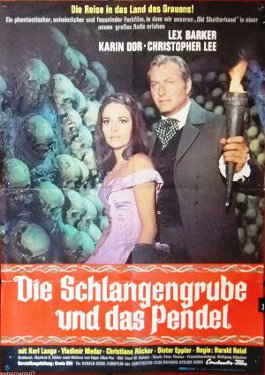
Of course, The Torture Chamber of Dr. Sadism was not the only title by which this film was released.  As was typical of horror films in the 60s (especially international horror films), this film had many different titles.  In Germany, it was known as Die Schlangengrube und das Pendel.  It was also released under titles like The Blood Demon, The Crimson Demon, The Snake Pit and the Pendulum, and The Castle of the Walking Dead.  That’s a collection of good names.  It’s just too bad that they were all given to one film as opposed to being spread out amongst several films.

The Torture Chamber of Dr. Sadism (or whatever you want to call it) opens with a public execution.  Count Regula (Christopher Lee) has been found guilty of the murder of 12 virgins.  Regula is forced to wear a gold mask with a rather awkward smiley face on the front of it.  He is then forced to lie down in the town square and his wrists and his ankles are tied to four horses.  As the red-hooded executioner looks on, the horses run in four different directions and, though we don’t actually see it, Count Regular is ripped apart.  Agck!

35 years later, Baroness Lilian von Brabent (Karin Dior, wearing a purple gown that is simply to die for) and her lawyer, Roger Mont Elise (Lex Barker) are invited to pick up an inheritance that is due to the Baroness.  The only catch is that they’ll have to ride a stagecoach all the way to a forbidding castle that the locals refer to as being Blood Castle.  On the way to the castle, they are joined by a highwayman who is pretending to be a priest (Vladimer Medar) and the Baroness’s maid (Christiane Rucker).  They are ride through a forest where the trees are full of human limbs.  They battle some mysterious robbers.  They discover a burned out church and an apparent madman living inside the ruins.  Eventually, they reach the castle where the resurrected Count Regula waits for them, along with his undead, green-blooded servant, Anatol (Carl Lange).  Count Regula is eager to sacrifice a 13th virgin so that he can become immortal.  Apparently, this will grant Regula immortality, which he does not yet have despite the fact that he’s somehow recovered nicely from being dismembered and beheaded.  Regula announces that the Baroness will be his next virgin victim.

(See, there’s actually very real advantages to not waiting.)

The Torture Chamber of Dr. Sadism is one of those films that is described as being based on the writings of Edgar Allan Poe.  In this case, that means that Roger ends up in a pit with a pendulum swinging over him.  For a film with a title like The Torture Chamber of Dr. Sadism (or even The Blood Demon), there’s not really a lot of gore in this film.  Instead, the film focuses more on creating and maintaining a properly gothic atmosphere.  It’s surprisingly entertaining, largely due to the ominous design of the torture dungeon, Christopher Lee’s villainy, Vladimer Medar’s comedic relief, the beauty of Karin Dor, and the square-jawed heroism of Lex Barker.  Lee, in particular, deserves some credit for embracing the melodrama in his role as Regula.  Lee knows exactly the type of film in which he’s appearing and he appropriately modulates his performance.

Whatever title you see it under, The Torture Chamber of Dr. Sadism will keep you entertained.


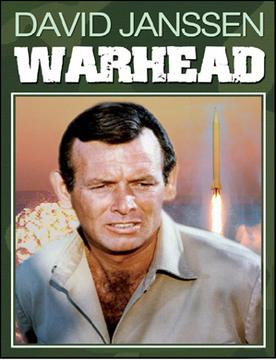
Warhead (1977, directed by John O’Connor)


Somehow, a nuclear bomb falls out of an American airplane that happens to flying over the border between Israel and Jordan.  Luckily, the bomb doesn’t explode but now it’s just sitting out in the desert where anyone can stumble upon it.  CIA operative Tony Stevens (David Janssen) just happens to be on vacation in the Middle East so he’s recruited and sent off to find the bomb before anyone else finds out about it.

At the same time, a group of Israeli soldiers, led by Captain Ben-David (Christopher Stone) and Lt. Liora (Karin Dor), are searching for a group of Palestinian terrorists, led by Malouf (Tuvia Tavi).  As soon as Tony finds the bomb, he is captured by Malouf.  He is then rescued by Ben-David but now Tony has to deal with two interested parties who want the bomb for themselves.

Warhead is a confusing movie that seems like it is trying to say something about the Middle East and America’s role as an international policeman.  Captain Ben-David feels that the Americans are being selfish with their refusal to allow other countries to develop their own nuclear missiles while Tony argues that the world would be plunged into war if everyone had the bomb.  (Remember, this film is from the 70s and was made at a time when the U.S. and the Russians were pretty much the only nuclear super powers.)  The film ends on a nihilistic note, with almost everyone either dead or disillusioned but why?  The acting is so bad and the production is so shoddy that it’s hard to figure out what this movie is trying to say.  Is Ben-David right about American arrogance or is Tony right to argue that deterrence is the only way to keep the world safe?  The movie doesn’t seem to know.  David Janssen was usually the ideal actor to play grizzled tough guys but, in this movie, he was clearly just collecting a paycheck and hopefully enjoying the chance to do some sight-seeing in the Holy Land.  The most intriguing character in the movie is a beautiful Israeli sniper played by Joan Freeman but she is killed off early and forgotten.

Warhead premiered on TV but was obviously originally intended for a theatrical release.  There’s a very gratuitous rape scene that is so awkwardly edited that it’s easy to see that it was cut down once it became apparent the movie was never going to play in theaters.  (The scene could have just as easily been removed from the film without effecting the narrative but I guess the networks wanted to give all of the dads and teenage boys a reason to not change the channel.)  According to the information I’ve found online, Warhead was filmed in 1973 but sat on the shelf for four years.  Watching the movie, it’s easy to see why.

Horror On The Lens: Los Monstruos del Terror (dir by Tulio Demicheli, Hugo Fregonese and Eberhard Meichsner)


For today’s Horror on The Lens, we have a Spanish film that was originally made in 1969 and given an international release in 1970.  In the United States, it was released under several different names: Monsters of Terror, Assignment: Terror, and Dracula vs. Frankenstein.

Despite the title, this film really isn’t about Dracula fighting Frankenstein.  There is, of course, a Frankenstein monster in the film and there is a vampire who, in some versions of the film, is referred to as being Dracula and, in other versions, is referred to by a lot of other names.  (What’s he called in the version below?  You’ll have to watch to find out.)

What this film is about is Waldemar Danisky, a tragic werewolf who was played by Paul Naschy in a series of films.  In this, his third appearance, Waldemar and a host of other monsters are brought back to life by aliens who are looking to take over the Earth.  Fortunately, Waldermar is a werewolf with a conscience and battles not only the aliens but the other monsters as well.

Yes, it’s all a bit silly and really doesn’t make much sense but you really owe it to yourself to watch at least one Paul Naschy film before this October ends..

http://www.youtube.com/watch?v=qbWf8nboSxQ


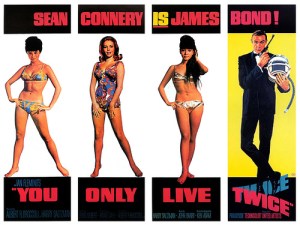
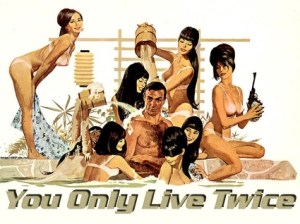
James Bond Film Review: You Only Live Twice (dir. by Lewis Gilbert)


In the days leading up to the American release of Skyfall, the Shattered Lens has been taking a look at the previous films in the James Bond franchise.  Today, we take a look at the 5th official James Bond film, 1967’s You Only Live Twice.

Released two years after the critically derided but financially succesful Thunderball, You Only Live Twice was a step in a new direction for the Bond series.  As Sinclair McKay explains in his brilliant book on the Bond films, The Man With The Golden Touch,  both the world and the movies changed a lot between 1965 and 1967 and You Only Live Twice reflected that change.  Director Lewis Gilbert and screenwriter Roald Dahl were newcomers to the Bond series and the film they created would serve as a prototype for the flamboyant, big budget espionage fantasies that would come to epitomize many of the later entries in the franchise.

You Only Live Twice begins with one the Bond franchise’s more elaborate precredit sequences.  During these first few minutes, the film rather boldly announces that You Only Live Twice is going to be a bit of a departure from the previous Bond films.  The film begins not with Bond but with two anonymous American astronauts orbiting the Earth in a small capsule.  The two astronauts are blandly chatting with mission control on Earth when, suddenly, another spacecraft approaches and literally swallows the American capsule whole.  One of the astronauts is hurled into space as a result and, as his body spins away, it’s obvious that Bond’s not going to be dealing with something bigger than just another guy looking to hold up Fort Knox.

The Americans blame the Russians while the Russians claim that they’re being framed by Americans and the entire world appears to be on the verge of war.  But as always happens in the Bond films, the British are there to keep everyone from overreacting.  A British diplomat is seen calming down the belligerent super powers and assuring them that MI6’s “best man” is already on the case.

(One of the undeniably charming things about the Connery and Roger Moore  Bond films is the way that the United Kingdom is portrayed as being the world’s unofficial third superpower.)

Cut to Hong Kong, where James Bond is lying in bed and asking his latest conquest, “Why do Chinese girls taste different?”  And, at this point, I think it’s fair to say that Bond is really lucky that he looks like a young Sean Connery.  Suddenly, gunmen storm the bedroom and open fire, apparently killing 007.

Oh no!  I guess the world is doomed, right?  We’re left to consider this sad reality as we watch the opening credits and listen to Nancy Sinatra sing the film’s excellent theme song.

Well, of course, James Bond isn’t really dead.  He faked his death so that he can safely go to Tokyo and investigate who was behind the attack on the space craft.  You Only Live Twice was filmed almost entirely on location in Japan and a good deal of the film’s first half is devoted to scenes of Bond simply observing Japanese culture.  It’s a bit like Lost In Translation with an espionage subplot.

After fighting a few random henchmen, Bond meets Tiger Tanaka (Tetsuro Tamba), the head of the Japanese secret service.  Tanaka seems to spend the majority of his time getting massages from the dozen or so young women who wait on him hand-and-foot.  “In Japan,” he tells Bond, “men come first, women come second.”  “I might just retire here,” Bond replies.  Uhmmm…okay.  Thank you, 1967.

In order to continue the ruse that Bond’s dead, Tanaka arranges for Bond to take on an assumed identity.  After being trained on all aspects of Japanese culture and on how to fight like a ninja, Bond is heavily disguised to look like a Japanese fisherman.  Tanaka arranges for Bond to fake marry a local girl named Kissy (Mie Hama).  Kissy is probably one of the least interesting Bond girls in the history of the franchise.  Beyond walking around in a bikini while wearing high heels, Kissy just doesn’t have much of a personality.

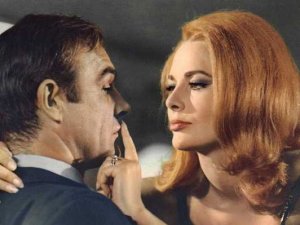
Bond and Tanaka’s investigation lead them to a shady industrialist named Osato and his secretary Helga Brandt (Karin Dor).  Helga is about as close as You Only Live Twice comes to featuring a strong female character.  Not only is she an assassin who has no problem with killing a man who she’s just had sex with but she’s also a redhead, just like me!

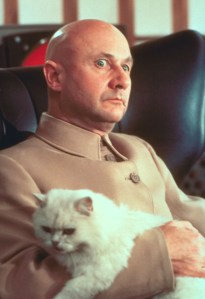
Anyway, it’s not until very late in the film that we finally meet Helga’s boss.  If for no other reason, You Only Live Twice will always be remembered for featuring one of the great Bond villains.  After being seen in the previous Bond films as just a hand stroking a white cat, Ernest Stavros Blofeld makes his first on-screen appearance here and fortunately, he’s played by Donald Pleasence.

Looking at Pleasence’s performance today, the natural tendency is to compare his Blofeld to the iconic character that he inspired, Mike Myers’ Dr. Evil.  However, one reason that Dr. Evil became such a popular character is because Donald Pleasence’s Blofeld is one of the great film bad guys.  As delivered by Pleasence in his casually off-center way, every line of Blofeld’s dialogue drips with the promise of perversion and hints of the neurosis that fuels his every action.  Blofeld spends most of the movie hiding out in a secret base that’s hidden inside a hollow volcano.  He strokes that ever-present white cat and uses a pool of piranhas to punish failure.  It is a credit to Pleasence’s performance that you never, for a second, doubt that Blofeld could very well be living in a hollow volcano.

I have to admit that You Only Live Twice is not my favorite James Bond film, though there are plenty of things that I do like about it.  Bernard Lee, Lois Maxwell, and Desmond Llewelyn all make welcome appearances and there is a genuinely exciting scene where Bond flies around in a toy helicopter.  Working on his first and only Bond film, Oscar-winning cinematographer Freddie Young captured some beautiful images of Japan and Blofeld’s volcano lair is one of the franchise’s best locations.

That said, You Only Live Twice often moves a bit too slowly for its own good and, with the exception of Blofeld and occasionally Helga Brandt, none of the film’s supporting characters are all that interesting.  Charles Gray, who later took over the role of Blofeld in Diamonds Are Forever, has a nice cameo as a decadent retired intelligence agent but he’s killed off before he can make too much of an impression.  Perhaps worst of all, Connery spends most of this film looking like he’d rather be doing anything other than play James Bond for the fifth time.  By his own account, Connery eventually grew bored with the role and that’s certainly obvious in You Only Live Twice.

Connery’s boredom can perhaps explain why, during the shooting of You Only Live Twice, it was announced that he would not be returning to play the role in the 6th Bond film.  The Bond franchise would continue with On Her Majesty’s Secret Service but it appeared that Connery would no longer be a part of it.

We’ll be taking a look at that film tomorrow.