Horror on TV: One Step Beyond 3.3 “The Death Waltz” (dir by John Newland)


Tonight’s episode of One Step Beyond is called The Death Waltz.  It’s about what happens when, in 1860, two calvary officers fall in love with the same young woman, Lillie (Elizabeth Montgomery).  Lillie has a great time playing the two men against each other but, when one of them is killed by Apaches, she rather heartlessly goes to a dance with the surviving suitor.

Unfortunately, for her, the dead man’s ghost decides to go to the dance as well….

The episode originally aired on October 4th, 1960.

Enjoy!

Missile to the Moon (1958, directed by Richard E. Cunha)


At a secret laboratory located just a few miles from the local prison, scientist Dirk Green (Michael Whalen) is working with Steve Dayton (Richard Travis) to build a missile that’s capable of flying to the Moon.  Dirk’s obsession about traveling to the moon is not just scientific.  Dirk is secretly from the Moon himself and is desperate to return.

Dirk gets his opportunity when two convicts escape from the prison and hide out in his rocket.  Dirk agrees not to turn Gary (Tommy Cook) and Lon (Gary Clarke) over to the authorities but only if they agree to help him fly the rocket to the Moon.  It turns out that it doesn’t take any special training to fly a rocket.  According to this film, you don’t even have to worry about oxygen in space.  Anyone can travel to the Moon, even two escaped convicts who have only had about an hour’s worth of instruction in how to pilot a rocket!  Gary and Lon agree because dying in space is preferable to serving out a prison sentence.

Once Dirk, Gary, and Lon are in space, they discover that Steve and his fiancee, June (Cathy Downs), have stowed away on the ship.  Gary takes a liking to June but Steve tells him to back off.  After a journey through a meteor field, the missile finally lands on the Moon, which is ruled over by The Lido (K.T. Stevens), a beautiful woman who enforces order through the help of a giant spider.

This afternoon, Lisa and I watched Missile to the Moon because today is May 4th, which is also known as Star Wars Day.  (May the 4th be with you, get it?)  Since every Star Wars film has already been reviewed on this site, I had to find a different science fiction film to review for today.  And because Lisa claimed Starcrash for herself, I got stuck with Missile to the Moon.

Missile to the Moon is science fiction with an emphasis on the fiction.  In this film, space travel is easy and certain parts of the moon have a breathable atmosphere.  Not to mention, of course, that there are all sorts of creatures living on the Moon.  It’s easy to laugh at Missile to the Moon today but this movie was made before anyone had ever set foot on the Moon so, for all people knew, there could have been aliens and giant spiders living underneath the surface.  In fact, maybe there still are.  It’s been a while since anyone went up there and checked.

The main thing I liked about Missile to the Moon was the implication that anyone, no matter how dumb, can learn how to fly a spaceship in under an hour.  That’s what we all believed when we were kids.  Want to go into space?  Just put me in the pilot’s seat, show me where the booster button is, and let’s go into hyperspace!  The other thing I liked about the movie is that the Moon was populated by attractive belly dancers.  That’s exactly what you want to find on another planet.  The paper mache spiders were pretty cool too.

It’s a dumb movie but I enjoyed it.  I’d rather go to the movie’s Moon than the real Moon.

Horror on TV: One Step Beyond 3.3 “The Death Waltz” (dir by John Newland)


Tonight’s episode of One Step Beyond is called The Death Waltz.  It’s about what happens when, in 1860, two calvary officers fall in love with the same young woman, Lillie (Elizabeth Montgomery).  Lillie has a great time playing the two men against each other but, when one of them is killed by Apaches, she rather heartlessly goes to a dance with the surviving suitor.

Unfortunately, for her, the dead man’s ghost decides to go to the dance as well….

The episode originally aired on October 4th, 1960.

Enjoy!

Lisa Reviews An Oscar Nominee: Kitty Foyle (dir by Sam Wood)


(With the Oscars scheduled to be awarded on March 4th, I have decided to review at least one Oscar-nominated film a day.  These films could be nominees or they could be winners.  They could be from this year’s Oscars or they could be a previous year’s nominee!  We’ll see how things play out.  Today, I take a look at the 1940 best picture nominee, Kitty Foyle!)

Kitty Foyle opens with a title card informing us that, before the film can tell us the story of Kitty Foyle, it is necessary to remind audiences of how Kitty Foyle — and so many other “white-collar” girls — arrived in their present (which is to say, 1940) situation.

We then get a strange little montage of life at the turn of the century.  A woman meets a man.  The man marries the woman.  They’re a happily married couple.  The man goes to work.  The woman takes care of the house.  The man comes home.  Everything’s perfect.  Then suddenly — oh my God, it’s the suffragettes!  They’re holding rallies!  They’re parading around with signs!  They’re demanding the right to vote!  They’re demanding prohibition!  Suddenly, women are expected to be independent and to have careers…

Which leads us to New York in the 1940s, where a bunch of women in an elevator discuss how difficult it is to find a good husband, especially now that they’re all busy working as salespeople and administrative assistants.  Apparently, this is the price that we all had to pay for the right to vote.  On the one hand, the women who cast their first votes in 1920 elected Warren G. Harding and spared the nation from another four years of Wilsonianism.  On the other hand, it’s now difficult to find a husband.

Fortunately, Kitty Foyle (Ginger Rogers) doesn’t have that problem.  She has a wonderful suitor, a man who has just asked her to marry him.  His name is Dr. Mark Eisen (James Craig).  He may not have a lot of money but he’s handsome, he’s considerate, and he spends all of his time providing medical care to the poor and indigent.  When Mark asks her to marry him, he asks her if she’s sure that she’s over that man from Philadelphia.  Kitty says that she is.

Of course, as soon as Kitty returns home, that man from Philadelphia is waiting for her.  Wyn Stafford VI (Dennis Morgan) is handsome, rich, and totally in love with Kitty.  Of course, he’s also married to his second wife.  (The identity of his first wife isn’t revealed until late in the film but you’ll be able to guess who she is.)  Wyn is in love with Kitty and he wants her to run away to South America with him.  Kitty says yes.

However, as Kitty is packing to leave, her reflection in the mirror starts talking to her.  It turns out to be a pretty judgmental mirror.  The rest of the film is an extended flashback, showing us how Kitty was raised by her single father (Ernest Cossart), how she first moved to New York, and how she met and fell in love with both Wyn and Mark.  Will she run off and live in wealthy sin with Wyn?  Or will she stay in New York and marry honest, hard-working Mark?

The main problem with Kitty Foyle is that there really isn’t much suspense as far as the film’s central dilemma is concerned.   Mark is a living saint who heals children.  Wyn is a heel who wants to abandon his wife and son so that he and Kitty can live in South America.  About the only thing that Wyn has going for him is that he’s got a better sense of humor than Mark but, in 1940, that wasn’t necessarily considered to be a good thing.  There’s really no question about who Kitty is going to pick and, in fact, the answer is so obvious that you kind of lose respect for Kitty when it takes her so long to make up her mind.  It’s like being told you could either marry a Nobel Peace Prize winner or someone who embezzles from a charity and replying, “Let me think about it…”

Of course, the main focus of Kitty Foyle is less on the love triangle and more on Ginger Rogers’s performance as Kitty.  This was one of Ginger’s first films after she stopped making films with Fred Astaire and it’s obvious that the film’s main theme was that Ginger Rogers could do more than just dance with Fred.  In Kitty Foyle, she gets to make jokes.  She gets to cry.  She gets to fall in love.  She gets a huge dramatic scene in which she mourns the loss of a child.  She does it all and yes, she does it very well.  Still, Kitty Foyle is never as much fun as the movies that she made with Fred.

Ginger Rogers won the Oscar for Best Actress for her performance in Kitty Foyle, beating out Katharine Hepburn, Joan Fontaine, Bette Davis, and Martha Scott.  Kitty Foyle was nominated for Best Picture but lost to Hitchcock’s Rebecca.

Horror on TV: Thriller 2.26 “Kill My Love” (dir by Herschel Daugherty)


Tonight’s excursion into televised horror is Kill My Love, an episode of Thriller that originally aired on March 26th, 1962!

In this episode, Richard Carlson plays Guy Guthrie.  To the outside world, Guy looks like the perfect husband and father.  However, he’s actually a cruel sociopath.  When his mistress threatens to expose him, he murders her.  When his wife realizes what Guy has done, he murders her as well.

But then Guy’s beloved son (David Kent) starts to figure out what his father has done and Guy is forced to decide just how far he’s willing to go to hide his secrets…

This episode, of course, is introduced by the one and only Boris Karloff!

Enjoy!

The Fabulous Forties #1: Port of New York (dir by Laszlo Benedek)


40s

This last Christmas, along with several other wonderful and sexy gifts, I received The Fabulous Forties DVD box set.  Released by the good people at Mill Creek (who have yet to come across a single public domain film that they couldn’t repackage as being a classic), this box set contained 50 films from that wonderful decade.

Since my proclivity for serial reviewing is well-known, you’re probably not surprised that I’ve decided to watch and review all fifty of the films to be found in the Fabulous Forties box set.  And, once I’ve finished with the Fabulous Forties, I will move on to the Nifty Fifties, the Sensational Sixties, the Swinging Seventies, and the Excellent Eighties!  Since each box set contains 50 films, I will have watched and reviewed 250 films by the time this is all finished.  It might take a while but that’s okay.  Arleigh keeps us well-supplied with energy drinks here at the Shattered Lens bunker and I am determined to keep going until the job is done.

(And, if need be, there’s always Dexedrine…)

Let’s get things started with the first film in the box set, 1949’s Port of New York!
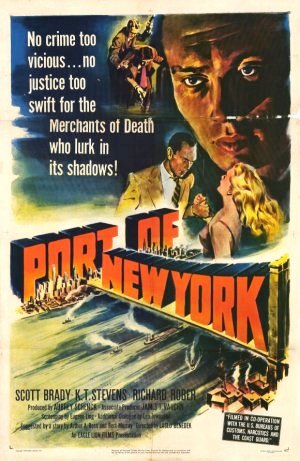
Port_of_New_York_(film)_poster

This low-budget, black-and-white film opens with a series of shots of cargo ships sailing into New York Harbor.  A narrator, speaking in the type of tone that one would usually associate with an old educational film, informs us that, every day, thousands of ships sail into New York Harbor.  Most of those ships are delivering important supplies and conducting important business.  However, occasionally, the harbor is used by drug smugglers.  (GASP!)  Fortunately, both the federal and the state government employ brave and honest men who will stop at nothing to battle the scourge of opium.

(And, fortunately, since this film was made in 1949, they can do whatever they want without having to worry about the Supreme Court getting in the way.)

If it’s not already apparent, Port of New York is a bit of a time capsule.  The drug smugglers are unambiguous in their villainy and the decency and honesty of law enforcement is taken for granted.  Port of New York was filmed on location in New York and I enjoyed getting a chance to see what New York looked like in 1949.

As for the film’s plot — well, it’s nothing surprising.  The port authority discovers that a shipment of morphine, which was meant to be delivered to a pharmaceutical company, has instead been stolen.  A million dollars worth of narcotics is missing and the U.S. Government is going to find it!  Meanwhile, Toni Cardell (K.T. Stevens) approaches a narcotics agent and says that she has information that could take down one of New York’s biggest gangster.  However, before she can tell all the she knows, Toni is murdered.

(The detective who failed to keep Toni from leaving his office and going off to get killed looks down at her body, shrugs, and says, “This one’s on me.”)

Who killed her?  That’s what Mickey Waters (Scott Brady) and Jim Flannery (Richard Rober) spend the movie figuring out.  However, we already know that Toni was murdered by her boyfriend, a suave gangster named Paul Vicola.  Paul is played, in his film debut, by Yul Brynner and he gives a charismatic performance, turning Paul into a memorable monster.  Brynner still had a full head of hair when he did this movie, though his hairline was definitely moving backwards.
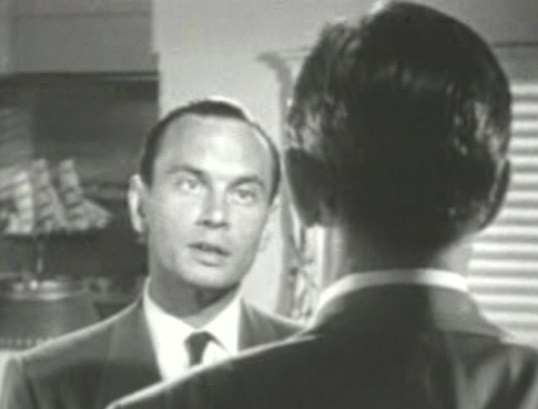
Yul

Over the course of their investigation, Waters and Flannery discover that a second-rate comedian named Dolly Carney (Arthur Blake) is being supplied by Vicrola.  The scenes where they interrogate Dolly, who is going through withdraw, are some of the best in the film and are distinguished by Blake’s empathetic performance.  However, beyond those scenes, there’s really nothing surprising to be found in Port of New York.  It’s a thoroughly predictable police procedural that’s distinguished by the presence of Yul Brynner and not much else.  That said, the action in this 82-minute film moves quickly and I enjoyed it as a historical artifact.

Yul_Brynner_&_K.T._Stevens_Port_of_New_York_01